
Which of the following is a possible rationing device?
a. dollar price
b. first-come-first-served
c. brute force
d. a and b
e. a, b, and c
The quantity demanded of loanable funds is inversely related to the rate of interest.
a. True
b. False
A good is nonrivalrous in consumption if
a. its consumption by one person does not reduce its consumption by others.
b. its consumption by one person reduces its consumption by others.
c. it is possible, or not prohibitively costly, to exclude someone from receiving the
benefits of the good once it has been produced.
d. it is impossible, or prohibitively costly, to exclude someone from receiving the
benefits of the good once it has been produced.

e. a and d
If the return on capital is 12 percent and the price for loanable funds is 14 percent, then
a. currently businesses will not borrow loanable funds to invest in capital goods.
b. eventually the return on capital will decrease to the point where businesses will find
it profitable to borrow loanable funds.
c. the return on capital will fall as the supply of capital decreases over time, and
simultaneously, the price for loanable funds will increase as savers make even more
savings available.
d. a and b
Suppose the demand curve for corn is inelastic between the current price and price that
exists after the supply of corn falls. It follows that
a. fewer farmers are producing corn at the new price than at the old price.
b. the total revenue for corn is lower at the new price than at the old price.
c. the total revenue for corn is higher at the new price than at the old price.
d. more farmers are producing corn at the new price than at the old price.
e. a and c

The law of demand states that price and ______________ are _____________
related,ceteris paribus.
a. demand; inversely
b. quantity demanded; inversely
c. demand; directly
d. quantity demanded; directly
e. quantity supplied; directly
Marginal revenue is defined as
a. the difference between costs and revenues.
b. the change in total revenue caused by selling one additional unit of output.
c. price times quantity.
d. total revenue divided by the level of output.
e. total revenue minus the level of output.

Exhibit 5-3
which shows the demand and supply of a college athlete.Suppose that NCAA rules limit
the amount that the college can pay this athlete, such that their payment can not exceed
the cost of attending the college (currently, $8,000).What is the consumers’ surplus for
the college (with respect to this one athlete)?
a. area 1
b. area 2
c. area 1 + 2+ 3
d. area 1 + 2
A factor price taker is a firm that
a. can sell as many units of its good as it wants without affecting price.
b. sells fewer units of its good at higher prices than lower prices.
c. can buy all of a factor it wants at the equilibrium price.
d. drives up factor price if it buys an additional factor unit.
e. none of the above

A monopoly exhibits resource-allocative efficiency if it
a. is a single-price monopolist.
b. is a perfectly price-discriminating monopolist.
c. engages in second-degree price discrimination.
d. engages in third-degree price discrimination.
e. all of the above
“In two hours the polls will close. I know I should probably vote, but it is raining, and
besides, there is a basketball game on TV tonight, so I’ll just stay in.” This person is
exhibiting
a. median voter preferences.
b. rational ignorance.
c. decision making based on cost-benefit considerations.
d. logrolling.

In a foreign exchange market diagram with dollars per peso on the vertical axis, the
quantity of __________ would be on the horizontal axis, and the U.S. demand for
Mexican goods would help to determine the __________ curve.
a. dollars; demand
b. dollars; supply
c. pesos; demand
d. pesos; supply
Suppose a factor price taker purchases one unit of factor X for $10. At what price would
it purchase the second unit, and what would marginal factor cost (MFC) equal?
a. It would purchase the second unit for $10, and MFC equals $10.
b. There is not enough information to know what it would purchase the second unit for,
and thus we do not know what MFC equals.
c. It would purchase the second unit for $10, but there is not enough information to
know what MFC equals.
d. There is not enough information to know what it would purchase the second unit for,
but MFC equals $10.

If the demand for a good falls by less than the supply of the good rises, then the good€s
equilibrium price will __________ and its equilibrium quantity will __________.
a. rise; fall
b. rise; rise
c. fall; fall
d. fall; rise
Suppose a monopolist practices perfect price discrimination. Its marginal revenue curve
a. will lie below its demand curve.
b. will lie above its demand curve.
c. will coincide with its demand curve.
d. has no definite relationship with its demand curve.
Exhibit 21-6
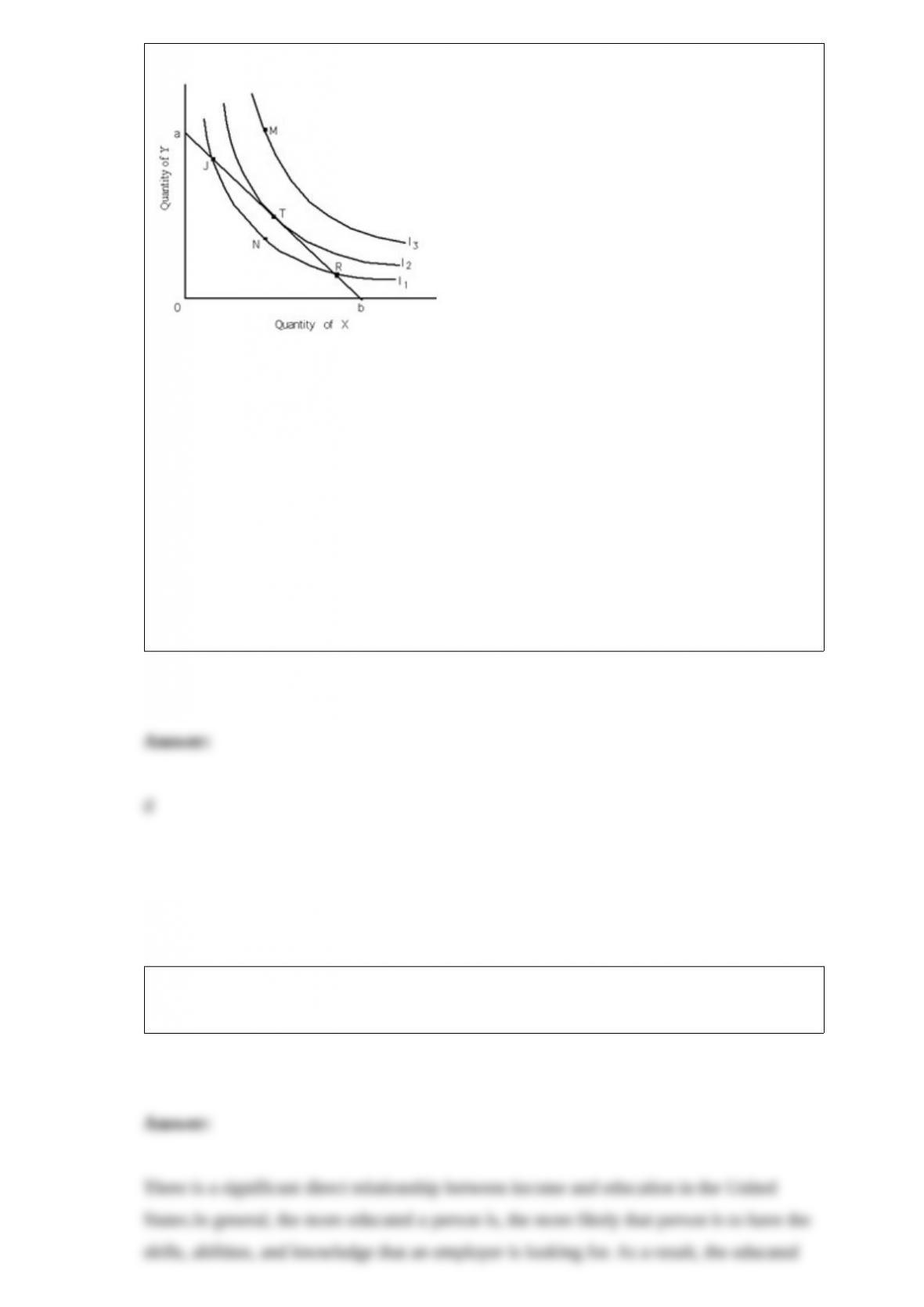
I1, I2 and I3 are indifference curves and line ab is the relevant budget constraint. If the
consumer is initially at point R, he should
a. strive for point N by obtaining a larger money income.
b. purchase more of X and less of Y.
c. remain at that point in order to maximize utility.
d. purchase more of Y and less of X.
e. none of the above
Describe the relationship between income and education in the United States.Cite
evidence that supports and explains this relationship.
Explain why price is greater than marginal revenue for a single-price monopolist and
how this differs from perfect competition.
Assume that two products are being produced: benches and chairs.Create a table that
illustrates constant opportunity costs in the production of these two goods.Draw a
production possibilities frontier (PPF) based on the data in your table and explain the
condition necessary for a PPF to exhibit constant opportunity costs.
What relationship exists between marginal factor cost (MFC) and wage for a
monopsony firm?Explain why this is so.
Describe what cross elasticity of demand measures. Be specific in your response.
List and describe the three defining assumptions of the theory of monopolistic
competition.
With respect to the supply and demand for a given product, describe the connection that
exists between equilibrium/disequilibrium and predictions.Cite your own unique
example in order to help support your answer.
Describe the Alchian and Demsetz theory of why firms exist.How does this differ from
the Coase theory of why firms exist?