Direct finance includes the sale by a corporation of stocks or bonds, but does not
include borrowing money from a bank.
If the CPI falls from 142 to 140 between two consecutive years, this implies that prices
fell by 2% between those two years.
Nominal GDP measures the value of all final goods and services at base-year prices.
Under the Bretton Woods system, the World Trade Organization (WTO) provided
foreign currency loans to central banks and approved adjustments to the agreed upon
fixed exchange rates.
An increase in quantity supplied is represented by a rightward shift of the supply curve.
For all points above the 45-degree line, planned aggregate expenditure will be less than
GDP.
A decrease in the unemployment rate may be represented as a movement from a point
inside the production possibilities frontier to a point on the frontier.
Equilibrium in a competitive market results in the greatest amount of economic surplus
from the production of a good or service.
The Sarbanes-Oxley Act of 2002 requires that CEOs personally certify the accuracy of
financial reports.
Roderick received a $100 savings bond for his graduation. The bond pays $100 at
maturity, which is in five years. If the interest rate is 6%, the bond has a present value
of $90.09.
When a business is set up as partnership, the owner of the business faces unlimited
liability.
The total amount of consumer surplus in a market is equal to the below above the
market demand curve and above the market price.

If the Federal Reserve announces that its target for the federal funds rate is rising from 4
percent to 4.25 percent, how do you expect workers and firms to react?
A) As long as the Fed’s announcement is credible, workers and firms will increase their
consumption and investment spending, which will increase aggregate demand and
inflation.
B) As long as the Fed’s announcement is credible, workers and firms will reduce their
consumption and investment spending, which will reduce aggregate demand and reduce
inflation.
C) If the Fed’s announcement is not credible, workers and firms will not expect inflation
to fall so they will reduce their consumption and investment spending, which will
increase aggregate demand and reduce inflation.
D) Workers and firms will incorporate the increase in interest rates into their
expectations of inflation, and they will expect inflation to rise as a result of Fed’s policy
announcement.
In recent years, a monetary growth rule has fallen out of favor because
A) it is believed that active monetary policy destabilizes the economy and makes the
business cycle worse.
B) the growth rate of GDP has been highly unstable.
C) the close relationship between movements in M1 and movements in real GDP has
become weaker.
D) the growth rate of M1 has become more stable.

Fiscal policy actions that are intended to have long-run effects on real GDP attempt to
increase ________ through changing ________.
A) aggregate demand; government spending
B) aggregate supply; taxes
C) aggregate demand; taxes
D) aggregate supply; government spending
The difference between GDP and disposable income is
A) national income.
B) actual investment spending.
C) net taxes.
D) unplanned investment spending.
Dividing the current market price of a stock by the firm’s earnings per share gives the
firm’s
A) price-earnings ratio.
B) year-to-date percentage change.
C) dividend yield.
D) stock coupon maturity yield.
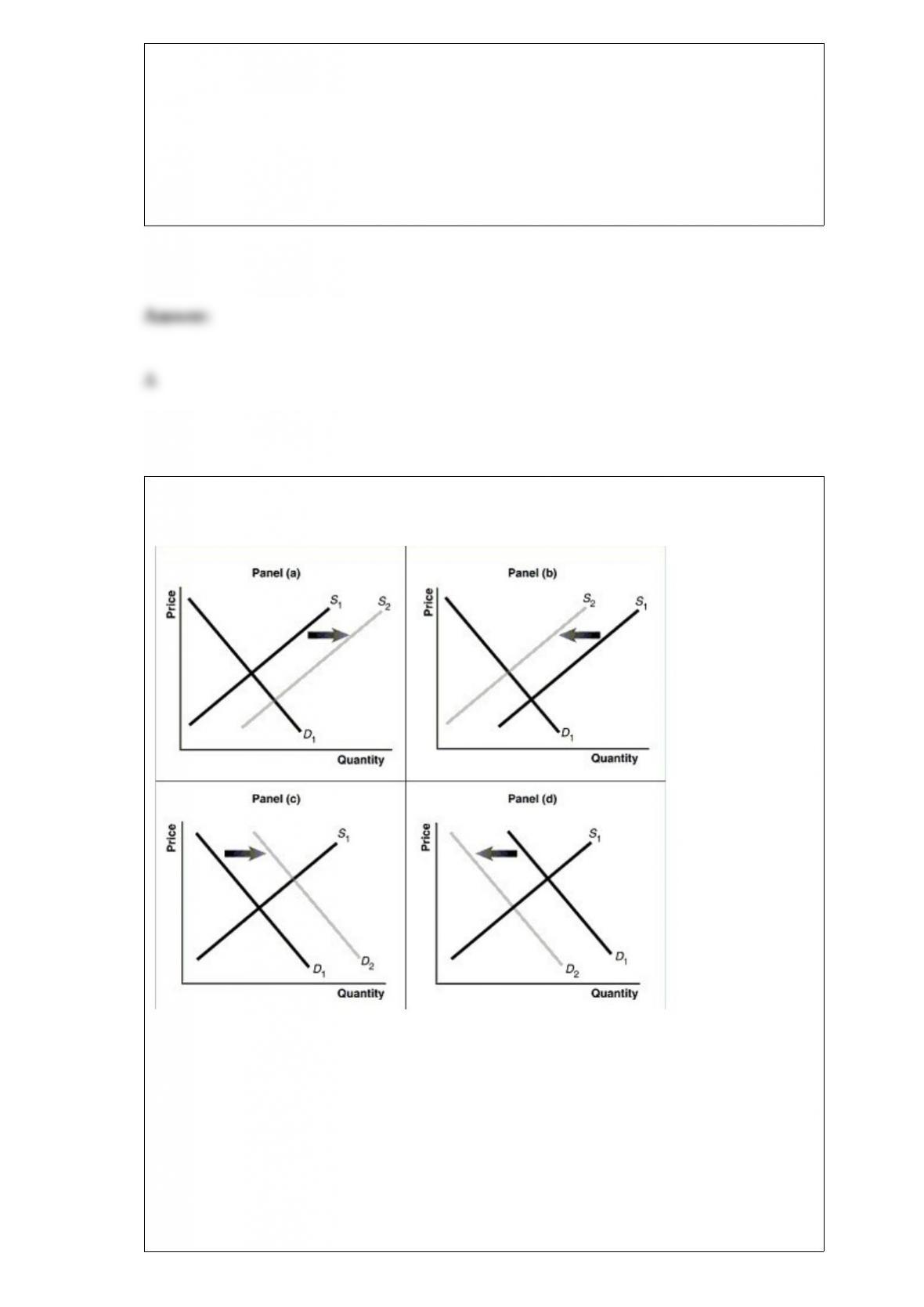
Figure 3-7
Refer to Figure 3-7. Assume that the graphs in this figure represent the demand and
supply curves for frozen yogurt. Which panel describes what happens in the market for
frozen yogurt when the price of ice cream, a substitute product, increases?
A) Panel (a)
B) Panel (b)
C) Panel (c)

D) Panel (d)
Included on the board of directors of Microsoft are Dina Dublon, former chief financial
officer of JP Morgan Chase, the president of Harvey Mudd college Maria M. Klawe,
and the vice chairman of Bank of America Charles H. Noski. These three board
members do not have a direct management role with Microsoft and are therefore
referred to as
A) inside directors.
B) outside directors.
C) competitive directors.
D) honorary directors.
Purchasing power parity is the theory that, in the long run, exchange rates move to
equalize
A) nominal interest rates across countries.
B) real GDP across countries.
C) corporate profits across countries.
D) the relative purchasing power of currencies across countries.
a. Draw a production possibilities frontier for a country that produces two goods, wine
and cheese. Assume that resources are not equally suited to both tasks.
b. Define opportunity costs.
c. Use your production possibilities frontier graph to demonstrate the principle of
opportunity costs.
Borrowers are ________ of loanable funds, and lenders are ________ of loanable
funds.
A) demanders; suppliers
B) suppliers; demanders
C) suppliers; suppliers
D) demanders; demanders
Which of the following is a problem inherent in centrally planned economies?
A) There are no problems and everyone, including consumers, is satisfied.
B) There is too much production of low-cost, high-quality goods and services.
C) Production managers are more concerned with satisfying government’s orders than
with satisfying consumer wants.
D) Unemployment is too high.
Figure 9-1
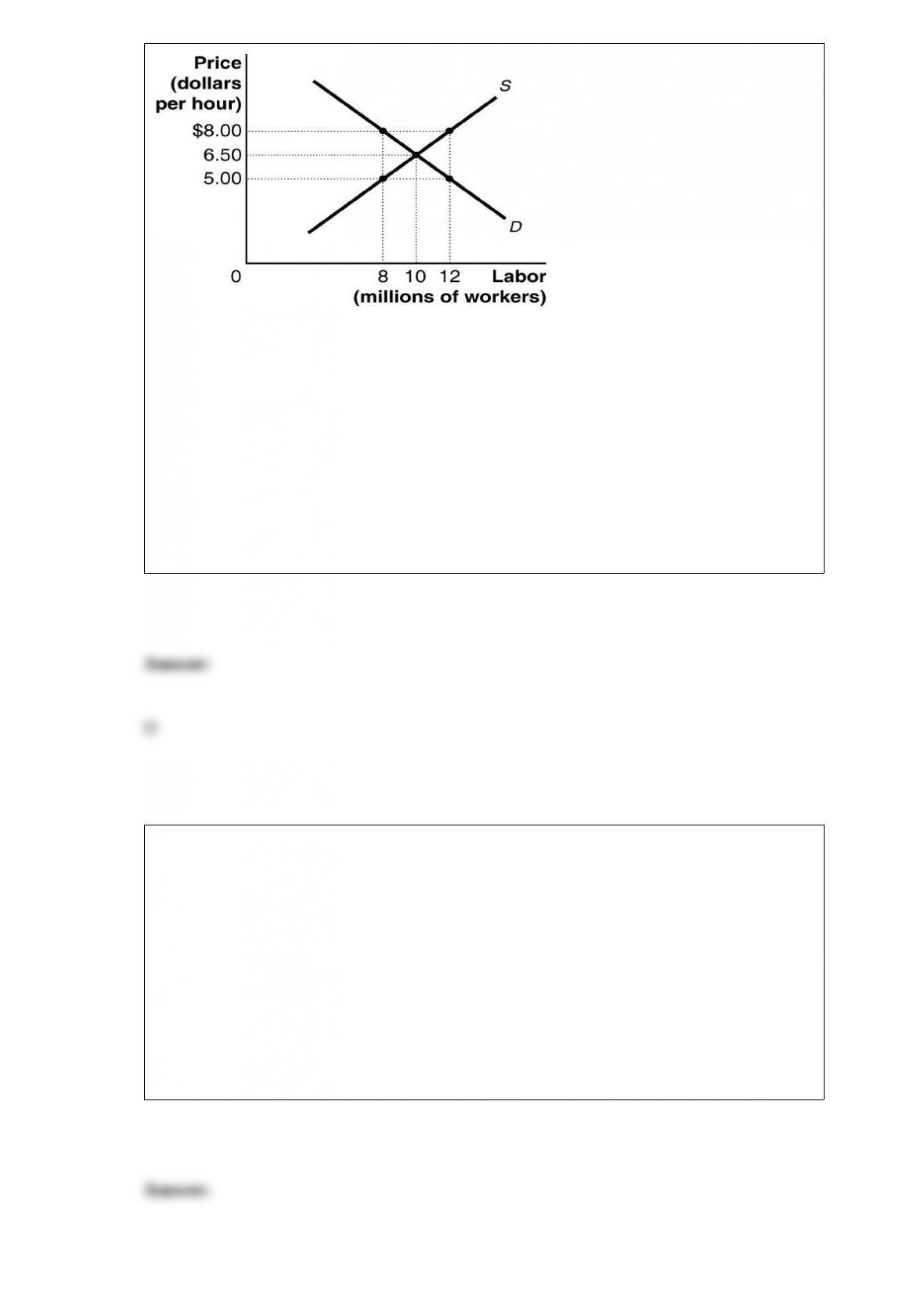
Refer to Figure 9-1. Based on the graph of the labor market above, if a minimum wage
is set at $5 per hour, which of the following will occur?
A) The unemployment rate will rise.
B) The unemployment rate will fall.
C) The level of unemployment will rise, but the percentage of the labor force
unemployed will not change.
D) None of the above will occur.
In October 2013, General Motors (GM) posted a price-earnings ratio of 10.13. If the
price of the stock at that time was $36 per share, which of the following must have been
true?
A) GM’s revenues that month were $364.68 million.
B) GM’s earnings per share was $3.55.
C) GM’s coupon payment was $36 per year.
D) GM’s dividend yield for the year was 36.5%.

Using the Taylor rule, if the current inflation rate equals the target inflation rate and real
GDP is less than potential GDP, then the federal funds target rate ________ the sum of
the current inflation rate plus the real equilibrium federal funds rate.
A) will be greater than
B) will be less than
C) will be the same as
D) may be greater than or less than
If the production possibilities frontier is linear, then
A) opportunity costs are decreasing as more of one good is produced.
B) it is easy to efficiently produce output.
C) opportunity costs are increasing as more of one good is produced.
D) opportunity costs are constant as more of one good is produced.
Economists first began studying the relationship between changes in aggregate
expenditures and changes in GDP

A) in the 1950s.
B) during the Great Depression.
C) at the end of the Civil War.
D) during the Industrial Revolution.
If property rights are not enforced in a country,
A) the market system will still work smoothly.
B) entrepreneurs are unlikely to risk their own funds investing in such an economy.
C) that country’s growth rate will not be affected.
D) that country will grow more rapidly because of the reduction of law suits.
Figure 7-1
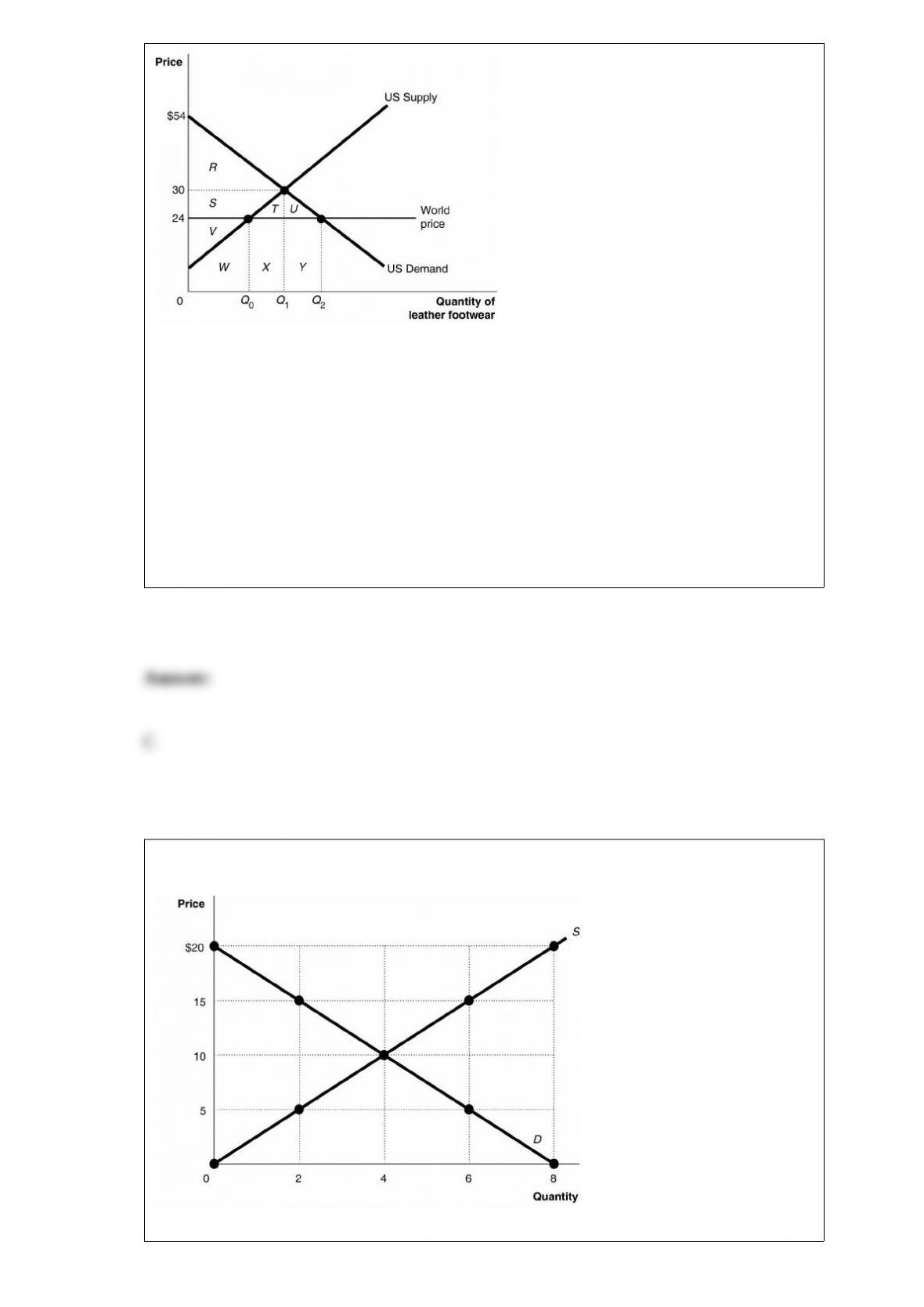
Figure 7-1 shows the U.S. demand and supply for leather footwear.
Refer to Figure 7-1. Under autarky, the equilibrium price is
A) $0.
B) $24.
C) $30.
D) $54.
Figure 3-5
Refer to Figure 3-5. At a price of $0,
A) there would be a surplus of 8 units.
B) there would be a surplus of 0 units.
C) there would be a shortage of 0 units.
D) there would be a shortage of 8 units.
The underground economy € the informal sector € can be a significant drag on the
economies of developing countries. Why are firms in the informal sector often less
efficient than firms in the formal sector?
What is scarcity, and why is it a fundamental concept in economics?
Define the term “property rights.” Explain why the lack of well defined and enforceable
property rights is detrimental to the smooth functioning of a market system.
How is the quantity theory of money different from the quantity equation and why must
the quantity equation always be true?
Figure 19-9
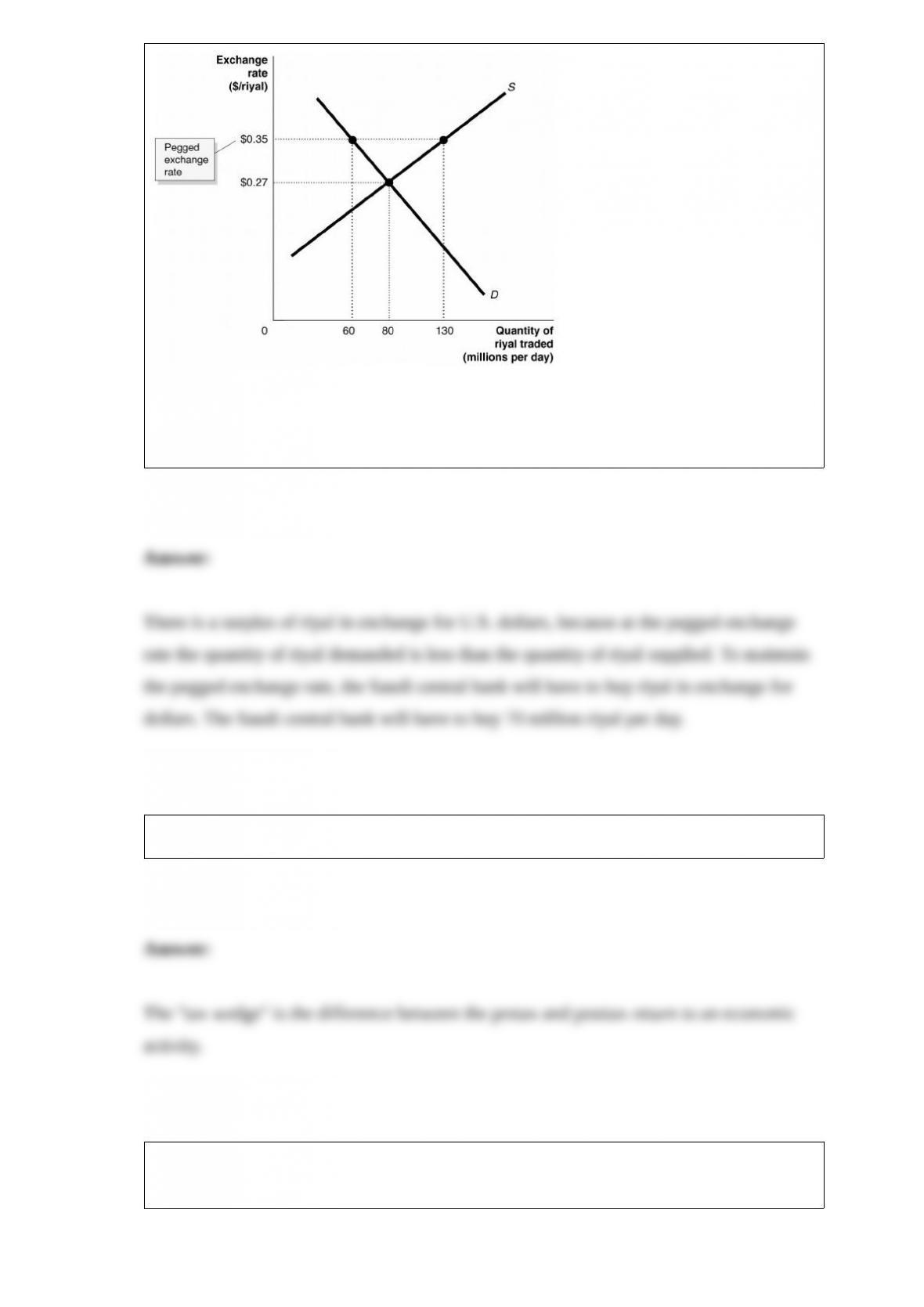
Refer to Figure 19-9. According to the graph, is there a surplus or shortage of Saudi
Arabian riyal in exchange for U.S. dollars? To maintain the pegged exchange rate, will
the Saudi central bank need to buy riyal in exchange for dollars or sell riyal in exchange
for dollars? How many riyal will the Saudi central bank need to buy or sell?
What is the “tax wedge”?
When will a decrease in aggregate demand not result in a lower inflation rate in the
short run?
What type of business has the potential for double taxation of profits and why?