
1) (Last Word) In recent years:
A.significant changes in the price of oil have had much less effect on the U.S. economy
than did similar changes in oil prices in previous decades.
B.large increases in the price of oil have reduced U.S. aggregate supply and caused
cost-push inflation.
C.large decreases in the price of oil have increased U.S. aggregate supply and caused
deflation.
D.the United States has become a net exporter of oil.
2) when an economy’s production capacity is expanding:
a.nominal gdp, but not necessarily real gdp, is rising.
b.net exports is always a positive amount.
c.di exceeds pi.
d.domestic investment exceeds depreciation.
3) if depreciation (consumption of fixed capital) exceeds domestic investment, we can
conclude that:
a.nominal gdp is rising but real gdp is declining.
b.net investment is negative.
c.the economy is importing more than it exports.
d.the economy’s production capacity is expanding.
4) one can say with certainty that equilibrium quantity will increase when supply:
a.and demand both decrease.
b.increases and demand decreases.
c.decreases and demand increases.
d.and demand both increase.
5)
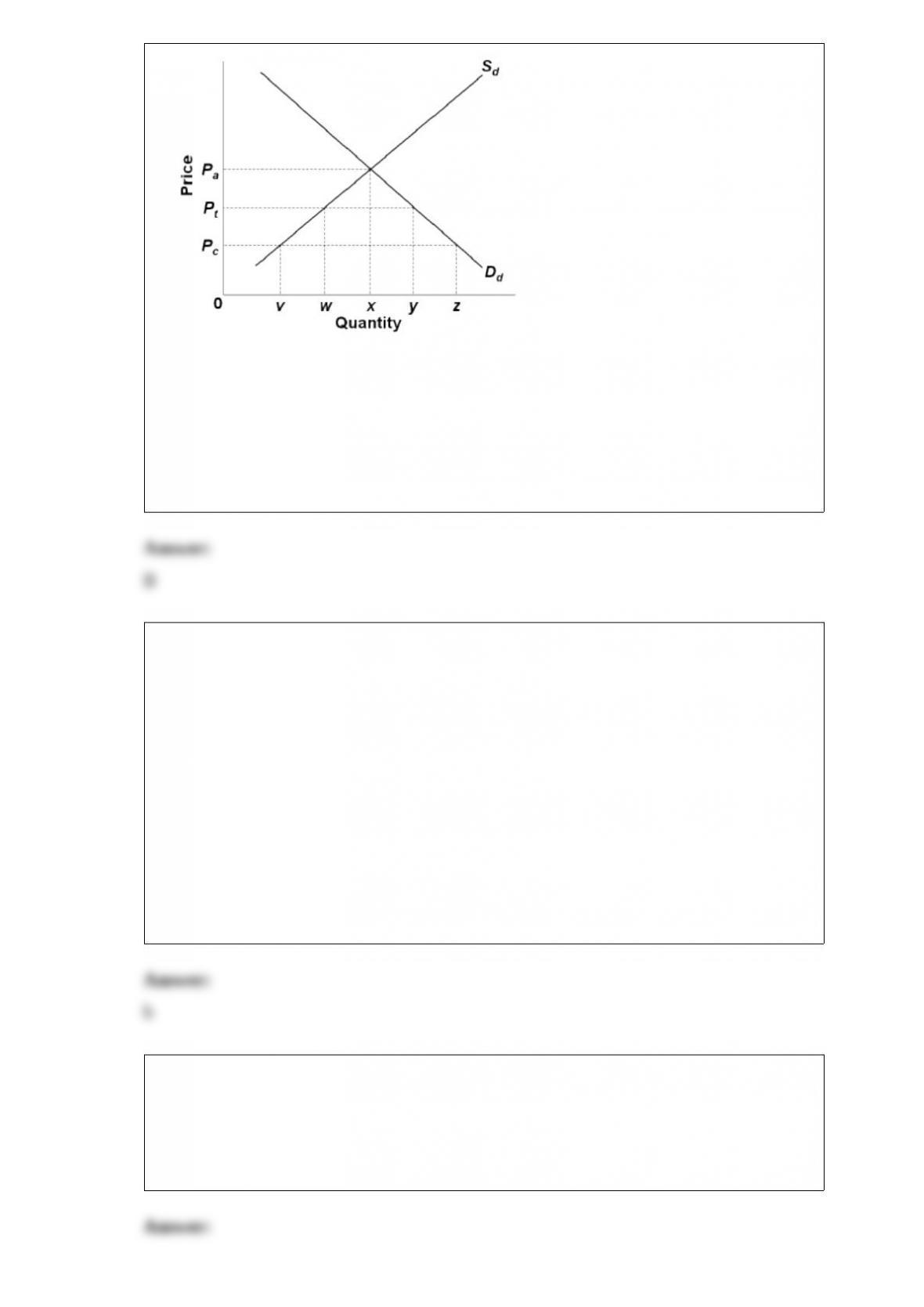
Refer to the above diagram, where Sd and Dd are the domestic supply and demand for a
product and Pc is the world price of that product. If this economy was entirely closed to
international trade, equilibrium price and quantity would be:
A.Pa and z.
B.Pa and x.
C.Pc and z.
D.Pc and v.
6) assume that if the interest rate that businesses must pay to borrow funds were 20
percent, it would be unprofitable for businesses to invest in new machinery and
equipment so that investment would be zero. but if the interest rate were 16 percent,
businesses will find it profitable to invest $10 billion. if the interest rate were 12
percent, $20 billion would be invested. assume that total investment continues to
increase by $10 billion for each successive 4 percentage point decline in the interest
rate.
refer to the above information. which of the following correctly expresses the indicated
relationship as an equation?
a.i = 20 – 4i.
b.i = 20 – .4i.
c.i = 24 – .4i.
d.i = 20 – 10i.
7) A unique characteristic of taxes on economic rents is that such taxes:
A.stimulate aggregate production.
B.do not lead to a reallocation of the resource.
C.are paid by consumers.
D.are always regressive.
8) in the short run, a monopolist’s economic profits:
a.are always positive because the monopolist is a price-maker.
b.are usually negative because of government price regulation.
c.are always zero because consumers prefer to buy from competitive sellers.
d.may be positive or negative depending on market demand and cost conditions.
9)
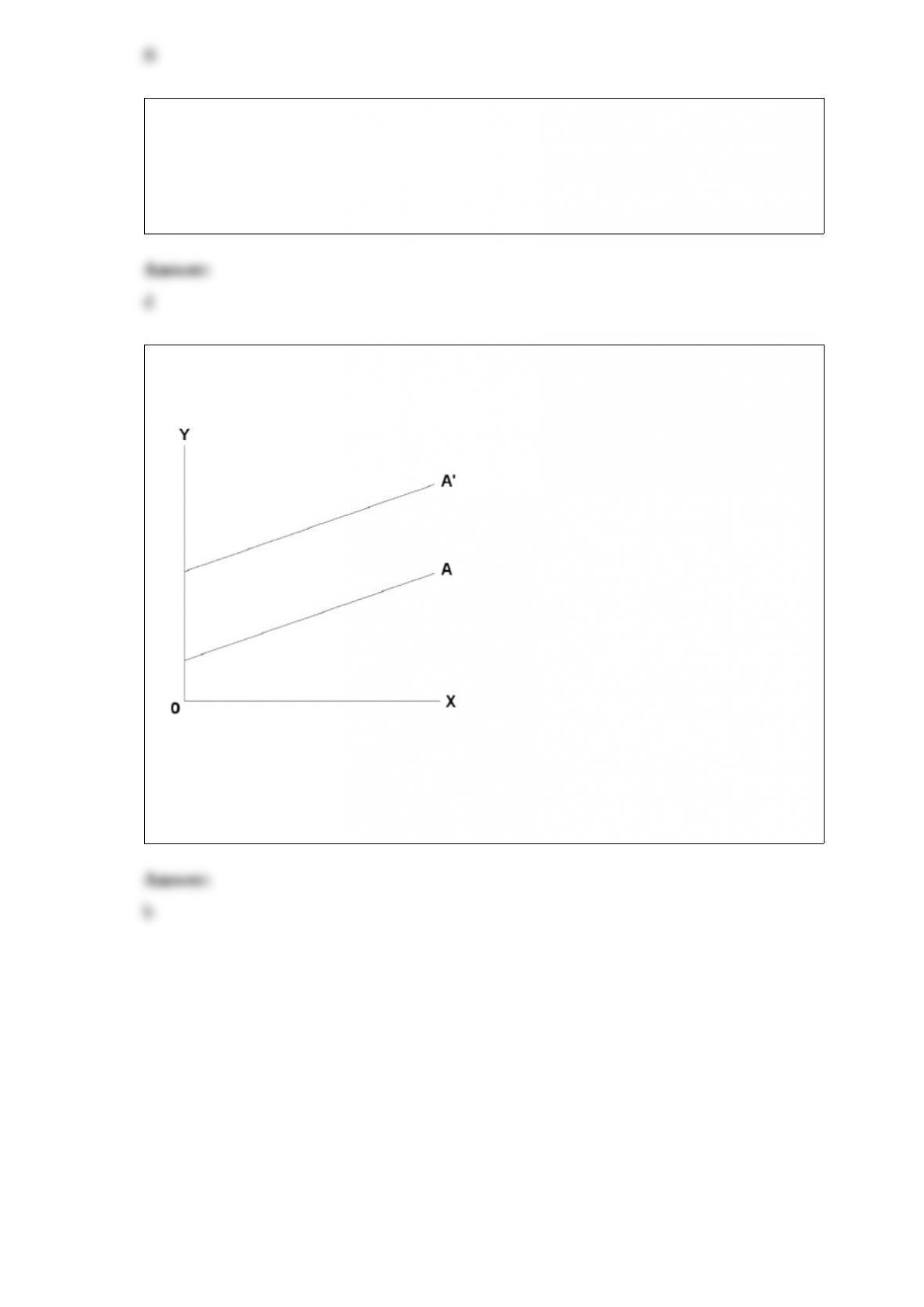
the movement from line a to line a’ represents a change in:
a.the slope only.
b.the intercept only.
c.both the slope and the intercept.
d.neither the slope nor the intercept.
10)
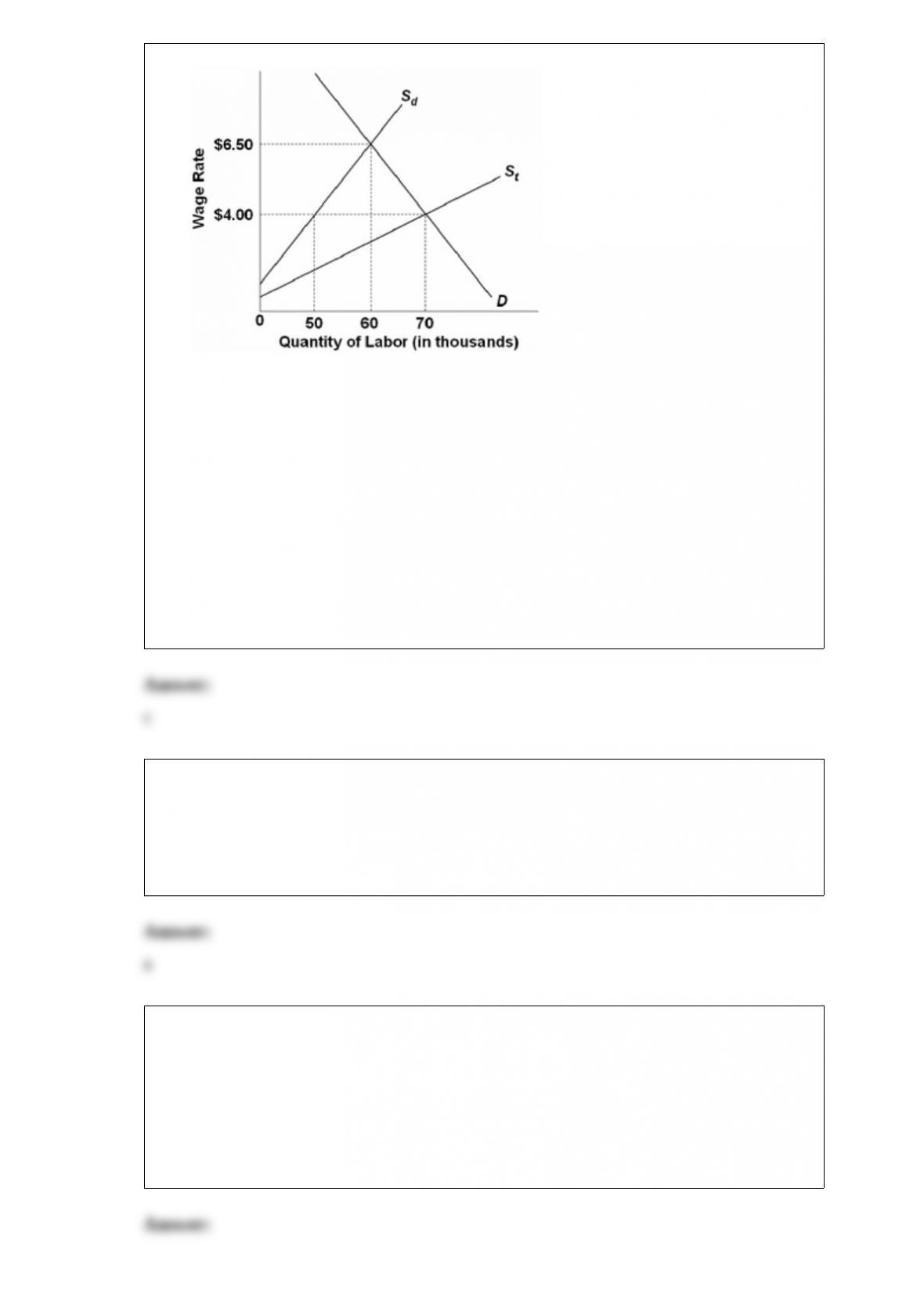
assumptions: 1) employers in this market are willing and able to ignore minimum wage
laws; 2) sd represents the supply of domestically-born (and legal immigrant) workers;
3) st represents the total supply of workers in this labor market (sd plus illegal
immigrants); and 4) unless otherwise stated, illegal immigration is not effectively
blocked by the government.
refer to the above figure. the equilibrium wage and level of employment are,
respectively:
a.$4.00 and 50,000
b.$4.00 and 60,000
c.$4.00 and 70,000
d.$6.50 and 60,000
11) the labor force includes:
a.employed workers and persons who are officially unemployed.
b.employed workers, but excludes persons who are officially unemployed.
c.full-time workers, but excludes part-time workers.
d.permanent employees, but excludes temporary employees.
12) (Last Word) Most economists view economic growth as:
A.good for the environment because richer economies spend more on environmental
protection.
B.bad for the environment because richer economies extract resources at a faster rate.
C.good for the environment because richer economies produce less chemicals.
D.bad for the environment because people in richer economies tend to care less about
the environment.

13) Alex and Ben are both loggers wanting to harvest timber from the same forest. Alex
prefers to harvest and replant at a sustainable rate; Ben wants to harvest as many trees
as possible to maximize short-run profit, and then move on. They face the same
production costs.
Refer to the information above. If property rights are well-defined and enforced:
A.Alex could buy Ben’s part of the land and harvest and replant in a sustainable
manner.
B.Ben could buy Alex’s part of the land and harvest all the timber as quickly as
possible.
C.incentives to harvest and replant in a sustainable manner are greater than with no
property rights.
D.all of these could occur.
14) If the nominal wage increases by less than the price level, the real wage:
A.will increase.
B.will decrease.
C.may either increase or decrease.
D.will diverge from labor productivity growth.
15) According to international comparisons, which nation had the highest hourly wages
in U.S. dollar terms in 2006?
A.United States
B.Germany
C.Denmark
D.Sweden
16) Suppose that the CPI for a particular economy rose from 110 to 120 in year 1, 120
to 130 in year 2, and 130 to 140 in year 3. We could conclude that this economy is
experiencing:
A.accelerating inflation.
B.deflation.
C.disinflation.
D.a constant rate of inflation.
17) gdp differs from ndp in that:
a.gdp is based on gross exports, while ndp is based on net exports.
b.gdp includes, but ndp excludes, taxes on production and imports.
c.net investment is used in calculating gdp and gross investment is used in calculating
ndp.
d.gross investment is used in calculating gdp and net investment is used in calculating
ndp.
18) Suppose that unintended increases in inventories are occurring in a mixed closed
economy. We can surmise that:
A.Ig + T > Sa + G.
B.T + G > Sa + Ig.
C.T + Sa > Ig + G.
D.T + Sa < Ig + G.
19)
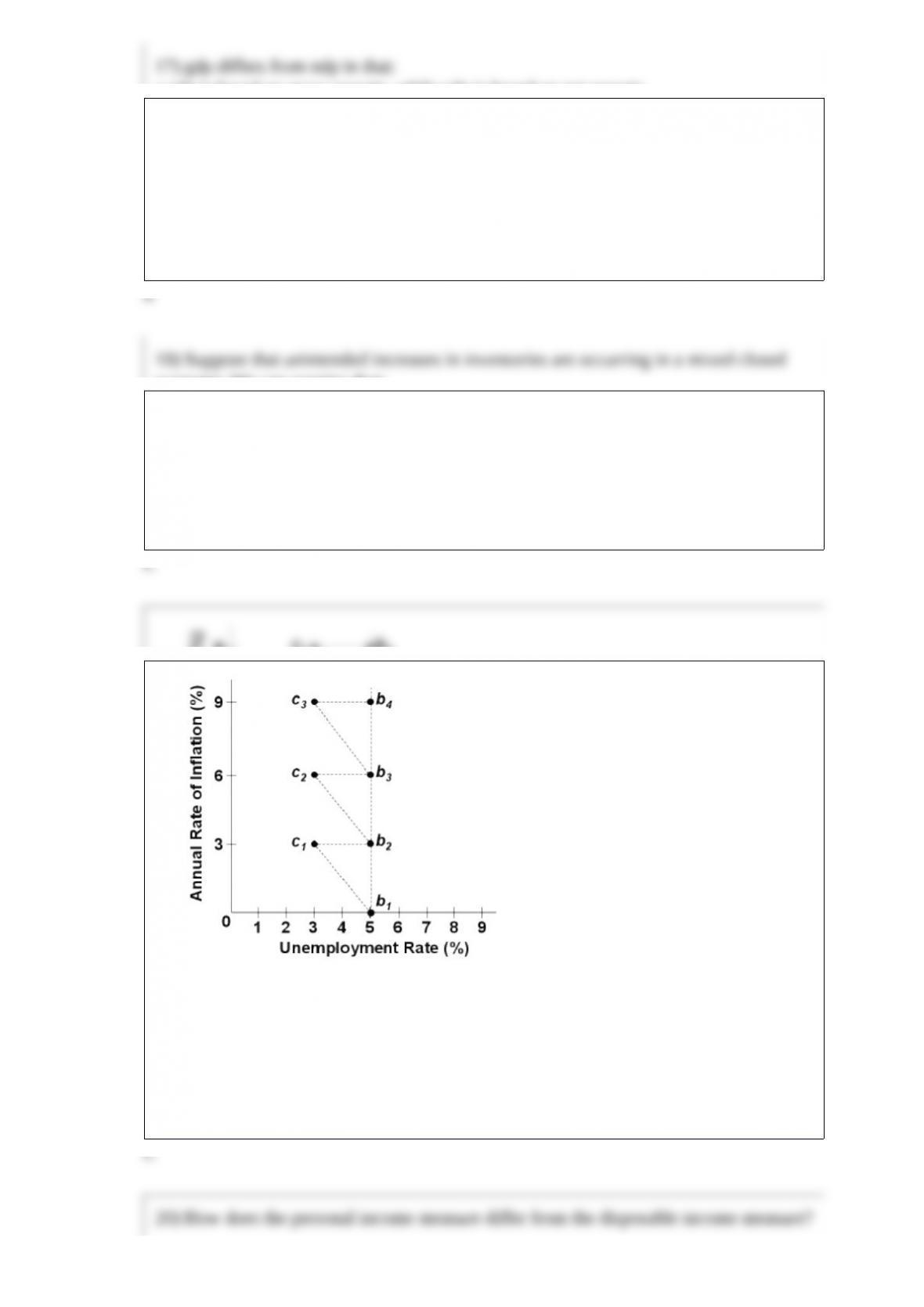
Refer to the above diagram. Assume the economy is initially at point b1. With a time
lag between price and nominal wage adjustments, an increase in aggregate demand will
temporarily move the economy from:
A.b2 to b1.
B.c1 to b2.
C.b1 to c1.
D.b1 to b2.
20) How does the personal income measure differ from the disposable income measure?
21) Describe how the income shares of national income are distributed to labor and to
capitalists. How has this distribution changed since 1900?
22) What were the key features of the Bretton Woods system?
23) Three people on a city council have three different spending proposals for snow
removal. Mitchell wants to spend $2 million to purchase more trucks and equipment.
Williams wants to spend $1 million and purchase half the equipment. Symmes doesnt
want to purchase any new equipment, but prefers to spend $200,000 for additional
stocks of de-icing chemicals. What does the median-voter model suggest will happen in
this case? Explain the likely outcome.
24) What is meant by human capital and how can it be used to promote economic
growth?
25) Explain cost-push inflation using aggregate demandaggregate supply analysis.