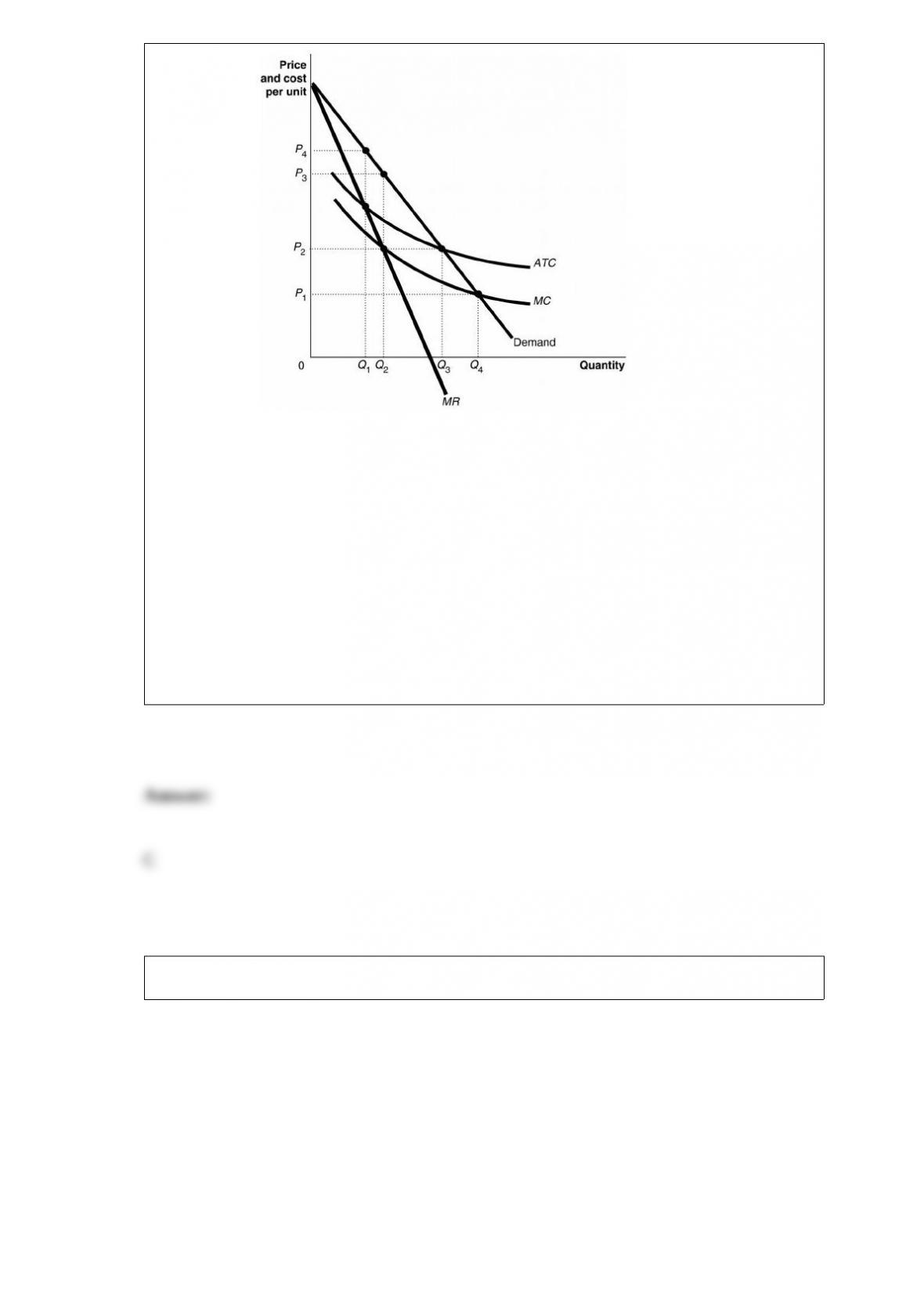
Figure 15-15 Figure 15-15 shows the
cost and demand curves for the Erickson Power Company.
The profit-maximizing price is
A) P1.
B) P2.
C) P3.
D) P4.
Table 14-7
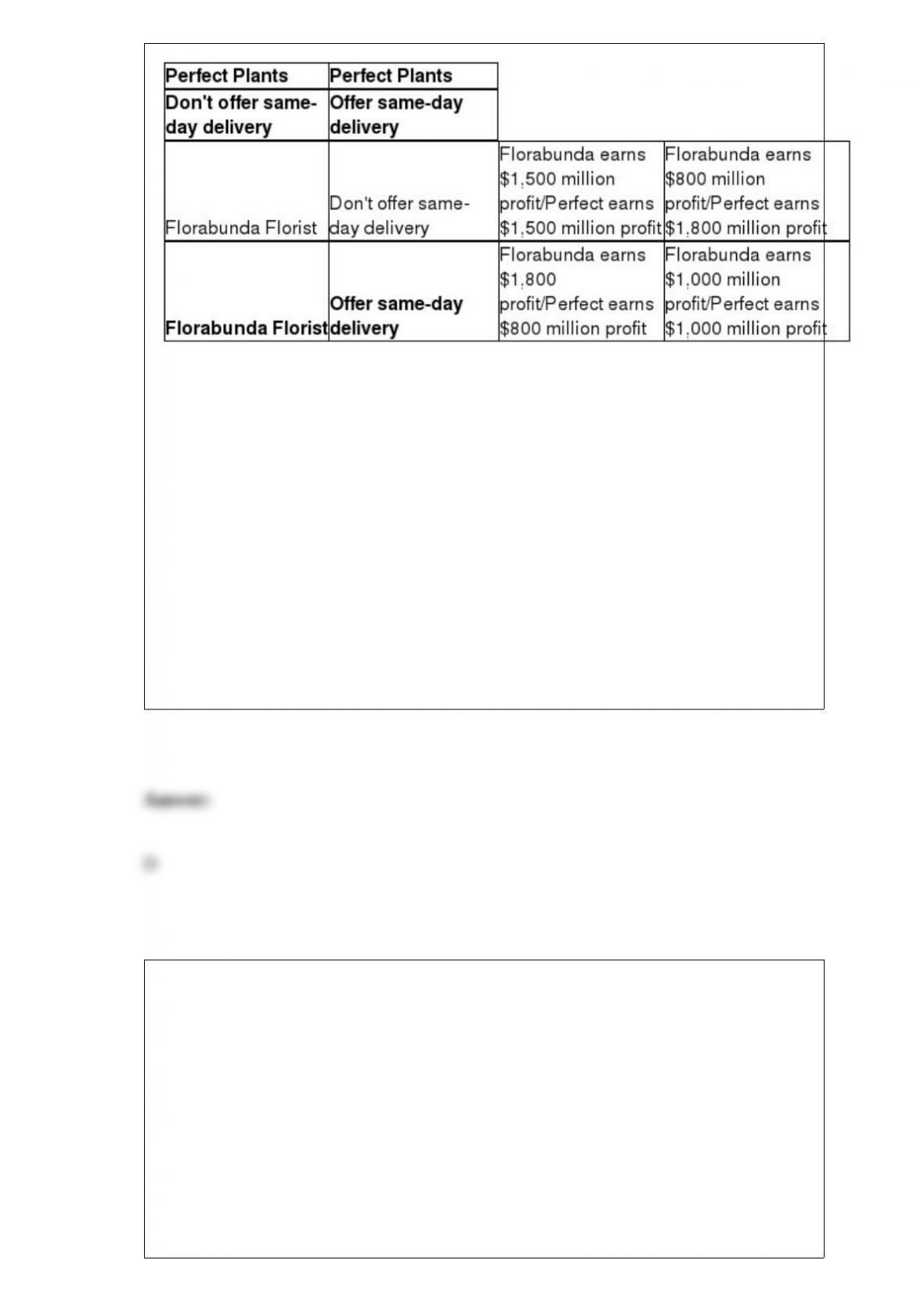
The payoff matrix shown above assumes that Perfect Plants and Florabunda Florist
must decide whether to offer same-day delivery for their products. The matrix shows
how much profit each firm will earn if it does or does not offer same-day delivery. The
amount of profit for one firm depends on whether the other firm offers same-day
delivery. Which of the following statements is true?
A) Neither Perfect nor Florabunda have a dominant strategy.
B) Perfect’s dominant strategy is to offer same-day delivery; Florabunda’s dominant
strategy is to not offer same-day delivery.
C) Florabunda’s dominant strategy is to offer same-day delivery; Perfect’s dominant
strategy is to not offer same-day delivery.
D) The dominant strategy for both firms is to offer same-day delivery.
What is logrolling?
A) a situation where a policymaker votes to approve a bill in exchange for favorable
votes from his colleagues on other bills
B) a situation where policymakers transfer resources from those voters who are unlikely
to have a huge impact on the political outcome to those who contribute to political
campaigns
C) a situation where a policymaker accepts bribes to prevent proposed legislation from
coming to a vote

D) a situation where a policymaker gets the government to fund a non-essential project
benefiting her family members
Technological advancements have led to lower prices and an increase in the sale of
digital cameras. How does this affect the digital photo printing paper market?
A) The demand curve for digital photo printing paper shifts to the right.
B) The demand curve for digital photo printing paper shifts to the left.
C) The supply curve for digital photo printing paper shifts to the right.
D) The supply curve for digital photo printing paper shifts to the left.
The Fed seeks to promote stability of financial markets because
A) they want to lift the self-esteem of workers.
B) Congress directed them to do so by the Employment Act of 1946.
C) resources are lost when there is not an efficient matching of savers and borrowers.
D) unstable markets result in increased efficiency.
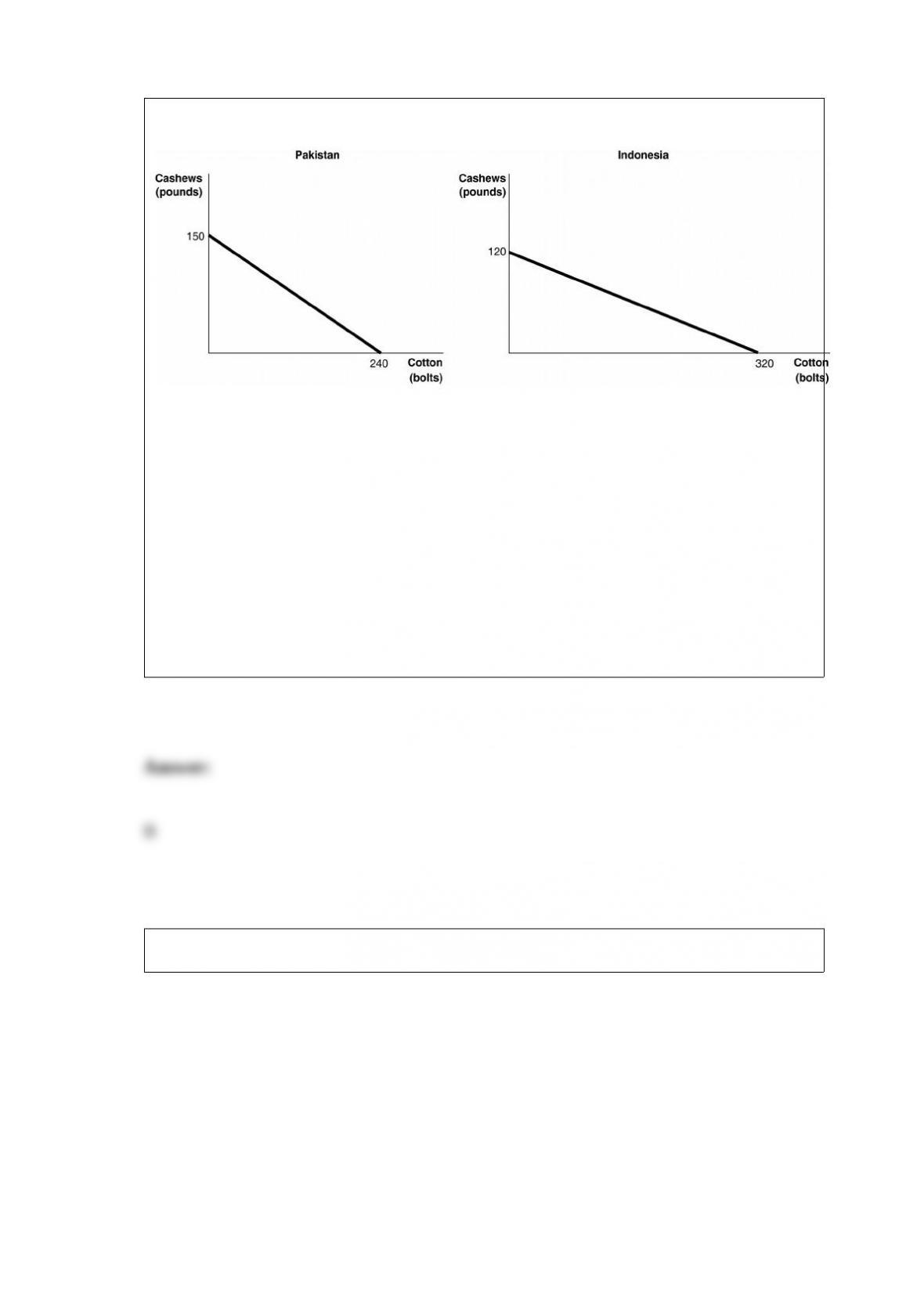
Figure 2-12
Figure 2-12 shows the production possibilities frontiers for Pakistan and Indonesia.
Each country produces two goods, cotton and cashews.
What is the opportunity cost of producing 1 bolt of cotton in Pakistan?
A) 3/8 of a pound of cashews
B) 5/8 of a pound of cashews
C) 1 3/5 pounds of cashews
D) 150 pounds of cashews
Figure 3-8

The graph in this figure illustrates an initial competitive equilibrium in the market for
apples at the intersection of D2 and S2 (point E). Which of the following changes would
cause the equilibrium to change to point A?
A) A positive change in the technology used to produce apples and decrease in the price
of oranges, a substitute for apples.
B) An increase in the wages of apple workers and a decrease in the price of oranges, a
substitute for apples.
C) An increase in the number of apple producers and a decrease in the number of apple
trees as a result of disease.
D) A decrease in the wages of apple workers and an increase in the price of oranges, a
substitute for apples.
In 2013, health care made up ________ of the U.S. economy
A) about 2 percent
B) roughly 8 percent
C) more than one-sixth
D) almost two-thirds

Article Summary. Since 2008, the United States has been involved in trade
negotiations over the Trans-Pacific Partnership (TPP), a free trade agreement with
11 other countries on both sides of the Pacific Ocean. One area of the negotiations
involves patents and intellectual property rights in the pharmaceutical industry. A
number of developing countries have ignored international agreements concerning
patents and intellectual property rights as a way to benefit their domestic
pharmaceutical industries, to the detriment of those companies which have spent
considerable time and money developing new medicines. For every 5,000 to 10,000
experimental drugs contemplated, only one will typically gain FDA approval, and
this occurs only after up to 15 years of research at an average cost of more than $1
billion. Also, 30 percent of the U.S. workforce is either directly or indirectly
employed in the pharmaceutical industry, so protection of these intellectual
property rights is very important for the U.S. economy. Source: Doug Schoen,
“Intellectual Property Rights Matter,” Forbes, September 24, 2013.
If more developing countries began abiding by international agreements which protect
intellectual property rights, all of the following would most likely occur except
A) pharmaceutical companies would increase investment in the development of more
experimental drugs.
B) pharmaceutical companies would consider expanding operations to these developing
countries.
C) more patents would be issued to pharmaceutical companies.
D) fewer dollars would be spent on the development of new medicines.
The Business Cycle Dating Committee, a part of the ________, officially decides when
a recession begins and ends.
A) federal government

B) Bureau of Labor Statistics
C) National Bureau of Economic Research
D) Federal Reserve
The total output produced by a firm divided by the quantity of workers employed by the
firm is the definition of
A) the marginal product of labor.
B) the division of labor.
C) the average product of labor.
D) the average cost of production.
Which component of consumption spending is the greatest in a typical economy?
A) services
B) durable goods
C) nondurable goods
D) new housing

How are the fundamental economic questions answered in a market economy?
A) The government alone decides the answers.
B) Individuals, firms, and the government interact in markets to decide the answers to
these questions.
C) Households and firms interact in markets to decide the answers to these questions.
D) Large corporations alone decide the answers.
Which of the following is a reason why a firm would not engage in price
discrimination?
A) Price discrimination is illegal in some western states and the owners of firms in
these states face civil or criminal prosecution if they engage in price discrimination.
B) Some firms are not able to segment the market for the products they sell.
C) Some firms do not want to violate the law of one price.
D) The transactions costs associated with selling the product exceed the price of the
product.

Which of the following describes the infant industry argument for protectionism?
A) An industry must be protected in its early stages of development so that firms can
compete with government-subsidized foreign competition.
B) Some strategic industries must be protected to ensure adequate supplies of resources
needed for national defense in emergencies.
C) Domestic producers in high-wage countries must be protected from foreign
producers in low-wage countries to produce a level playing field.
D) Domestic producers require time to gain experience and lower their unit costs; this
will allow these producers to compete successfully in international markets.
Economist Jerry Hausman estimated the price elasticity of demand for breakfast cereal.
He found that
A) the price elasticity for a particular brand of raisin bran was the same as the elasticity
of demand for all family cereals.
B) the price elasticity of demand for Post Raisin Bran is less than the price elasticity of
demand for Kellogg’s Raisin Bran.
C) the price elasticity of all family breakfast cereals is greater than the price elasticity of
demand for Post Raisin Bran or Kellogg’s Raisin Bran.
D) the price elasticity of demand for a particular brand of raisin bran was larger in
absolute value than the elasticity for all family cereals.
What is a secondary market?

A) a market where factory seconds and damaged merchandise are sold
B) a market where newly issued bonds are sold to initial buyers by the borrowing firm
C) a market where a newly issued stocks are sold to initial buyers by the borrowing
firm
D) a market where you can sell any stocks you own as a private investor
The perfectly competitive market structure benefits consumers because
A) firms do not produce goods at the lowest possible price in the long run.
B) firms are forced by competitive pressure to be as efficient as possible.
C) firms add a much smaller markup over average cost than firms in any other type of
market structure.
D) firms produce high quality goods at low prices.
Economic models do all of the following except
A) answer economic questions.
B) portray reality in all its minute details.
C) make economic ideas explicit and concrete for use by decision makers.
D) simplify some aspect of economic life.