
Suppose Sarah owns a small company that makes wedding cakes. The table below
shows how Sarah’s total cost varies depending on the number of wedding cakes she
makes each day.
If Sarah’s fixed costs double, then in the short run, her profit-maximizing level of
output:
A. will shrink to zero if she starts earning a loss.
B. will increase.
C. will decrease.
D. will not change.
The labor force equals the number of people:
A. employed.
B. aged 16 years and older.
C. both employed and unemployed.
D. employed, unemployed and discouraged.
There are two employers in Bucolic that hire people who do not have a high school
degree: a grocery store and a hardware store. The grocery store pays $10 per hour and
the hardware store pays $12 per hour. People who work at either store can work as
many hours as they want at those wages. Assume that it takes two hours to interview for
a job. Lee works at the grocery store, but would like to work at the hardware store. If
Lee interviews at the hardware store, there is a 10% probability of being hired. Assume

that Lee is risk-neutral. What is Lee’s expected hourly benefit from interviewing at the
hardware store?
A. $12
B. $0.12
C. $0.20
D. $2
A shortage occurs when:
A. demand is greater than supply.
B. the equilibrium price is too high.
C. quantity demanded exceeds quantity supplied.
D. quantity supplied exceeds quantity demanded.
Susan Suarez would like to work forty hours per week, but can only find twenty hours
per week of work. In the official employment statistics, Susan is classified as:
A. employed.

B. unemployed.
C. out of the labor force.
D. underemployed.
Refer to the figure below. Suppose that the economy is initially in equilibrium with
output Y2 and inflation rate of π3. An increase in military spending will generate:
A. a recessionary gap.
B. an expansionary gap.
C. disinflation.
D. hyperinflation.
When an individual is judged by the characteristics of the groups to which he or she
belongs rather than on his or her own characteristics, it is called:
A. adverse selection.
B. statistical discrimination.
C. the lemons model.
D. moral hazard.

If short-run equilibrium output equals 10,000, the income-expenditure multiplier equals
5, the mpc equals 0.8, and potential output (Y*) equals 9,000, then taxes must be
______ by approximately ______ to eliminate any output gap.
A. decreased; 250
B. decreased; 200
C. increased; 250
D. increased; 200
Menu costs are the costs of:
A. running a restaurant.
B. changing prices.
C. increasing aggregate demand.
D. changing production.

Data on output and planned aggregate expenditure in Macroland are given below.
Based on these data, the short-run equilibrium level of output is:
A. 2,000.
B. 3,200.
C. 4,100.
D. 5,000.
If consumption increases by $9 when disposable income increases by $10, the marginal
propensity to consume (mpc) equals:
A. 0.1.
B. 0.9.
C. 1.0.
D. 9.0.

For a given seller, the figure below shows the relationship between the number of units
produced and the opportunity cost of producing an additional unit of output. What is
this seller’s reservation price for the 250th unit?
A. $2
B. $4
C. $8
D. $14
Aaron’s neighbor Cliff keeps his front yard well-manicured and plants beautiful flowers
which Aaron enjoys. If local law prevents Cliff from fencing his yard, the beauty of
Cliff’s front yard is:
A. nonrival.
B. a private good.
C. nonexcludable.
D. both nonrival and nonexcludable.
Real wages can be cut without cutting nominal wages if:
A. the rate of inflation is positive.

B. the rate of inflation is zero.
C. the rate of inflation is negative.
D. there is deflation.
If the market demand curve does not capture all of the benefits to society of buying an
additional unit of good, then:
A. the market equilibrium will be socially optimal.
B. the market equilibrium will not be efficient.
C. the allocation of resources will be socially optimal.
D. the market will not be in equilibrium.
Real GDP per person in Northland is $30,000, while real GDP in Southland is $10,000,
However, Northland’s real GDP per person is growing at 1 percent per year, and
Southland’s real GDP per person is growing at 3 percent per year. If these growth rates
persist indefinitely, then:

A. Northland’s real GDP per person will decline until it equals Southland’s.
B. Northland’s real GDP per person will always be between 1 and 2 percent greater than
Southland’s.
C. Southland’s real GDP per person will always be exactly 2 percent less than
Northland’s.
D. Southland’s real GDP per person will eventually be greater than Northland’s.
The key indicator of a country’s living standard and economic well-being is:
A. the interest rate.
B. nominal GDP per person.
C. real GDP.
D. real GDP per person.
When buyers and sellers are not equally informed about the characteristics of the goods
and services offered for sale, information is said to be:
A. costly-to-fake.
B. asymmetric.

C. credible.
D. symmetric.
National saving is done by:
A. only households.
B. only businesses.
C. only governments.
D. households, businesses, and governments.
Imagine a world in which landlords always fix problems quickly, tenants never damage
property and always pay their rent in a timely fashion. In such a world, lease
agreements would ______.
A. still exist to solve the commitment problem
B. be unnecessary
C. apply only to people with low monthly income
D. only serve the interests of tenants

Planned aggregate expenditure is total:
A. value added in the economy.
B. planned spending on final goods and services.
C. income of households, businesses, governments, and foreigners.
D. revenue from the sale of goods and services.
The money demand curve will shift to the left if:
A. the nominal interest rate increases.
B. the nominal interest rate decreases.
C. the price level increases.
D. real income decreases.
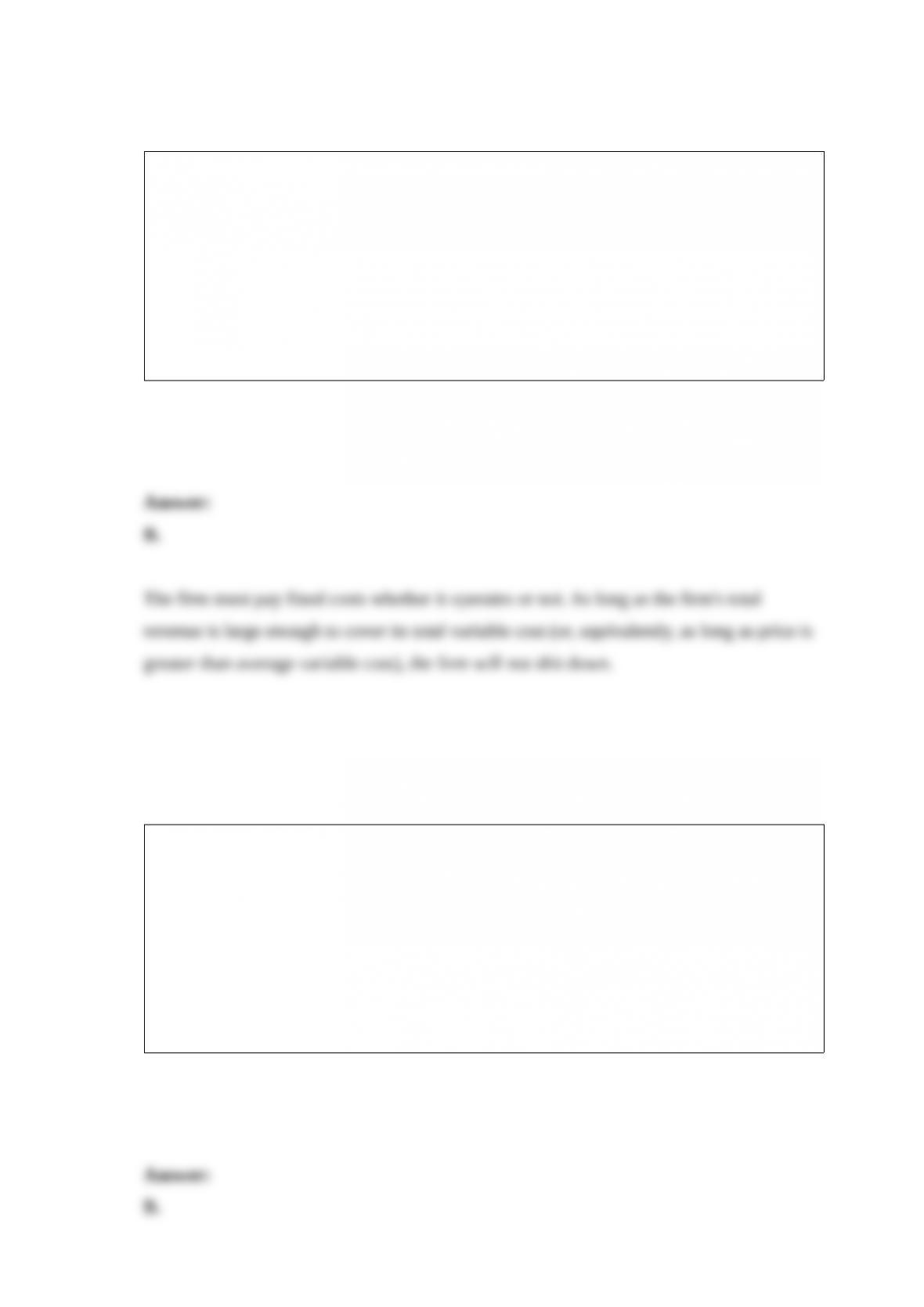
A profit-maximizing firm will shut down if, at the firm’s profit maximizing level of
output, its total revenue is ______
A. less than its total cost.
B. less than its variable cost.
C. less than its average total cost.
D. less than its average variable cost.
The price elasticity of supply for the Hope Diamond is zero because there is only one.
Therefore, the supply curve for the Hope Diamond is
A. elastic.
B. perfectly inelastic.
C. unit elastic.
D. perfectly elastic.

P-TV and QRS-TV are trying to decide whether to air a sit-com or a reality show in a
given time slot. Viewers like both sit-coms and reality shows, but sit-coms are more
expensive to produce than reality shows since real actors need to be hired. QRS-TV
makes its decision first, and then P-TV observes that choice before making its decision.
Both stations know all of the information in the decision tree below.
P-TV and QRS-TV are trying to decide whether to air a sit-com or a reality show in a
given time slot. Viewers like both sit-coms and reality shows, but sit-coms are more
expensive to produce than reality shows since real actors need to be hired. QRS-TV
makes its decision first, and then P-TV observes that choice before making its decision.
Both stations know all of the information in the decision tree below.
Given the information in this decision tree, if QRS-TV announces that it will air a
sit-com, it can expect to:
A. lose $5 million.
B. earn $5 million.
C. earn $10 million.
D. earn $20 million.
The demand for labor increases when the:
A. real wage increases.
B. real wage decreases.
C. value of the marginal product of labor increases.
D. value of the marginal product of labor decreases.
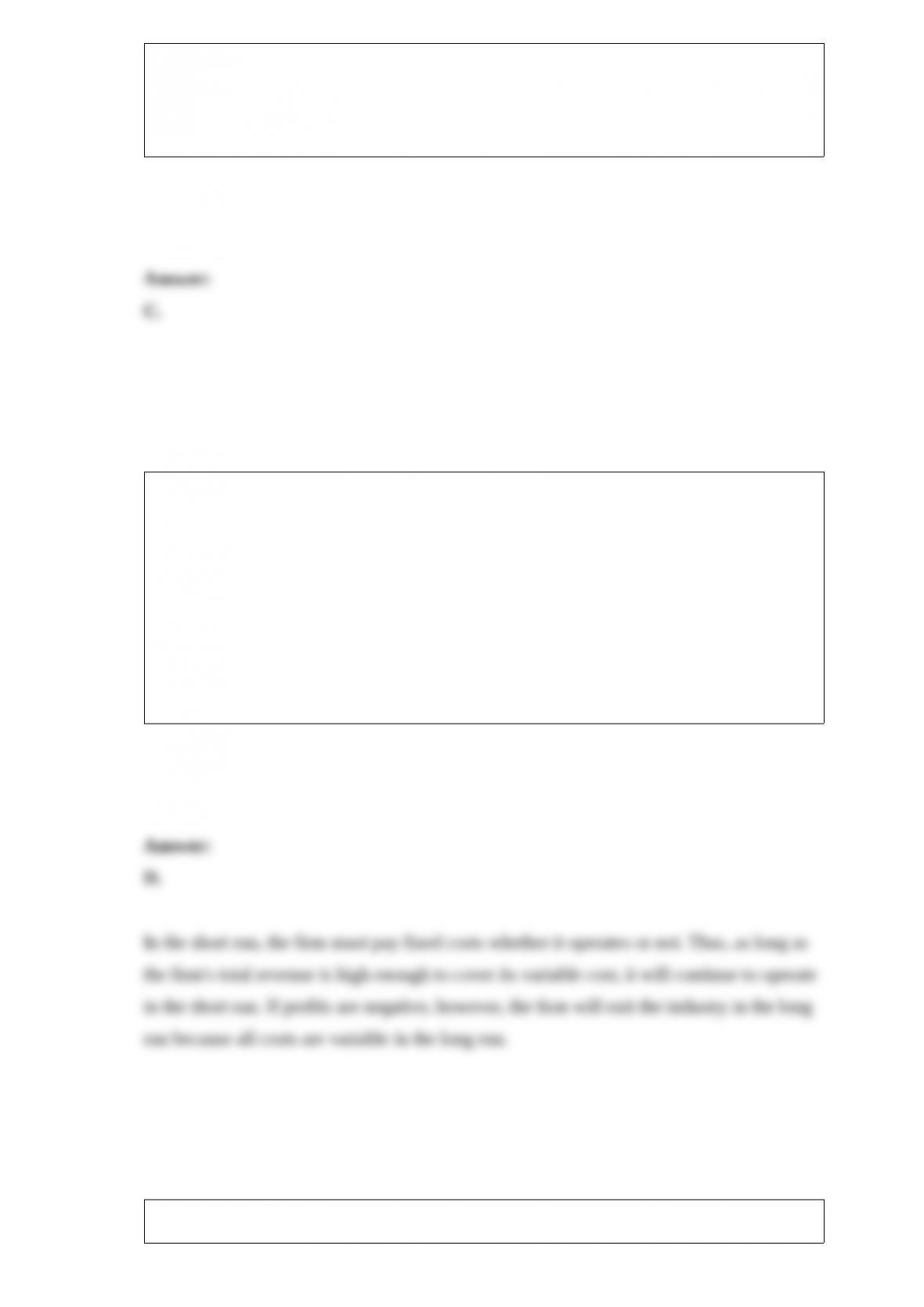
Suppose that at a firm’s profit-maximizing level of output, its total revenue is $1,250,
the total cost of its variable factors of production is $1,000, and its total fixed cost is
$500. This firm will ______ in the short run, and will ______ in the long run.
A. shut down; reopen for business
B. earn a profit; earn a loss
C. earn a loss; earn a profit
D. not shut down; exit the industry
John is trying to decide how to divide his time between his job as a stocker in the local

grocery store, which pays $7 per hour for as many hours as he chooses to work, and
cleaning windows for the businesses downtown. He makes $2 for every window he
cleans. John is indifferent between the two tasks, and the number of windows he can
clean depends on how many hours he spends cleaning in a day, as shown in the table
below:
A second hour cleaning windows will yield additional earnings of ______.
A. $2
B. $14
C. $8
D. $7
If actual GDP equals potential GDP, then:
A. the actual unemployment rate is greater than the natural rate of unemployment.
B. the actual unemployment rate equals the natural rate of unemployment.
C. the actual unemployment rate is less than the natural rate of unemployment.
D. there is a recessionary gap.
Lee and Cody are playing a game in which Lee has the first move at A in the decision
tree shown below. Once Lee has chosen either aggression or cooperation, Cody, who
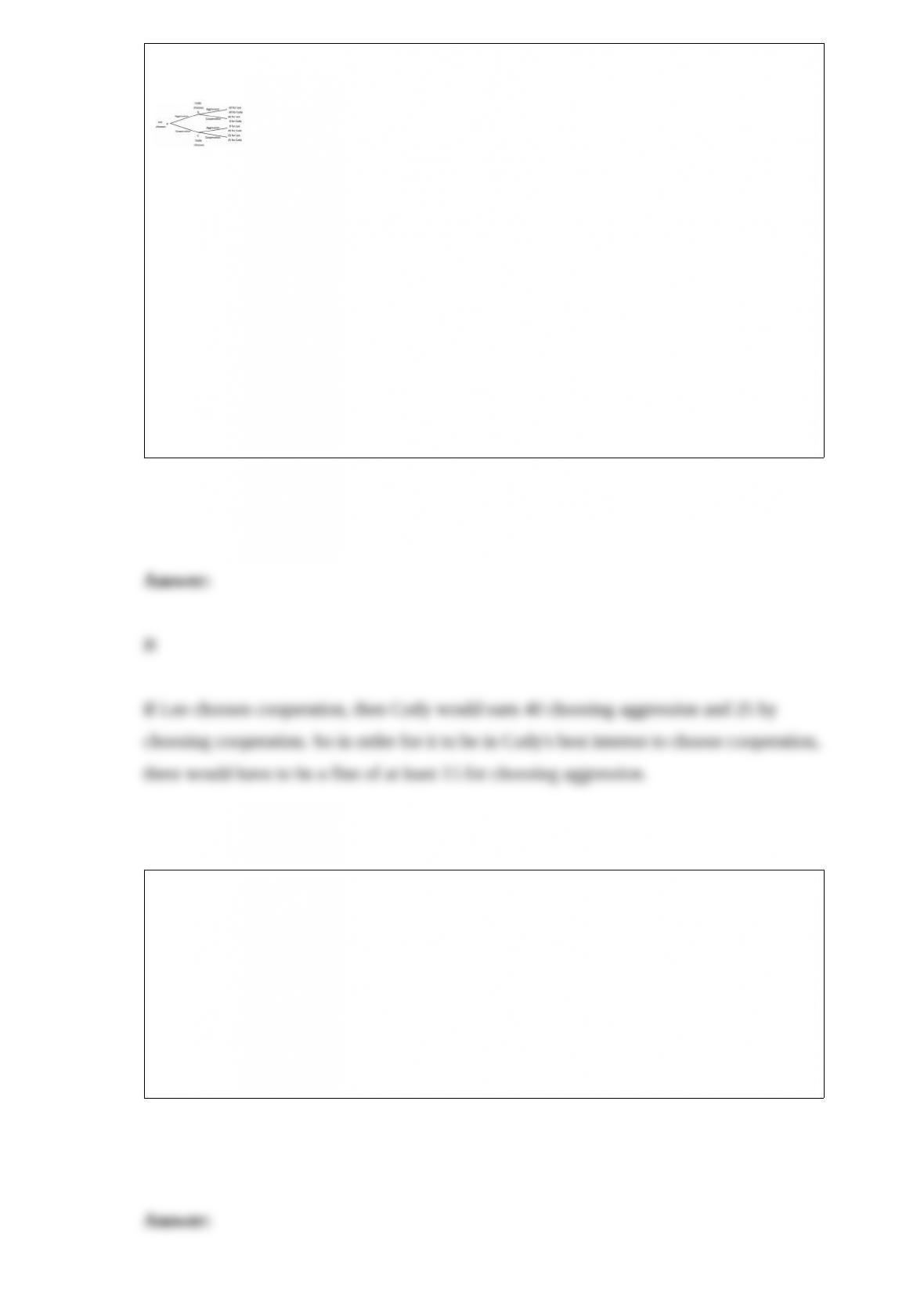
can see what Lee has chosen, must choose either aggression or cooperation at B or C.
Both players know the payoffs at the end of each branch.
Suppose Lee and Cody enter into a binding non-aggression agreement. As part of that
agreement, they negotiate a fine that Cody would have to pay to Lee if Cody chooses
aggression after Lee chooses cooperation. For the fine to be effective, it would have to
be:
A. less than 15.
B. at least 15.
C. equal to 40.
D. equal to 25
Each person who is 16 years or older is considered to be in one of the following
categories:
A. employed, unemployed, or discouraged worker.
B. part-time worker, full-time worker, or unemployed.
C. part-time worker, full-time worker, or out of the labor force.
D. employed, unemployed, or out of the labor force.

The quality adjustment bias of the CPI refers to the failure of statisticians to:
A. allow for the possibility that consumers switch from products whose prices are
rising.
B. allow for the possibility that consumers switch stores at which they shop.
C. take into account improvements in goods and services.
D. take into account price changes in goods and services.
Well-defined property rights:
A. are clearly written in English.
B. restrict the use of land and natural resources to productive uses.
C. allow the government to confiscate property.
D. clearly state who owns resources and how the resources can be used.
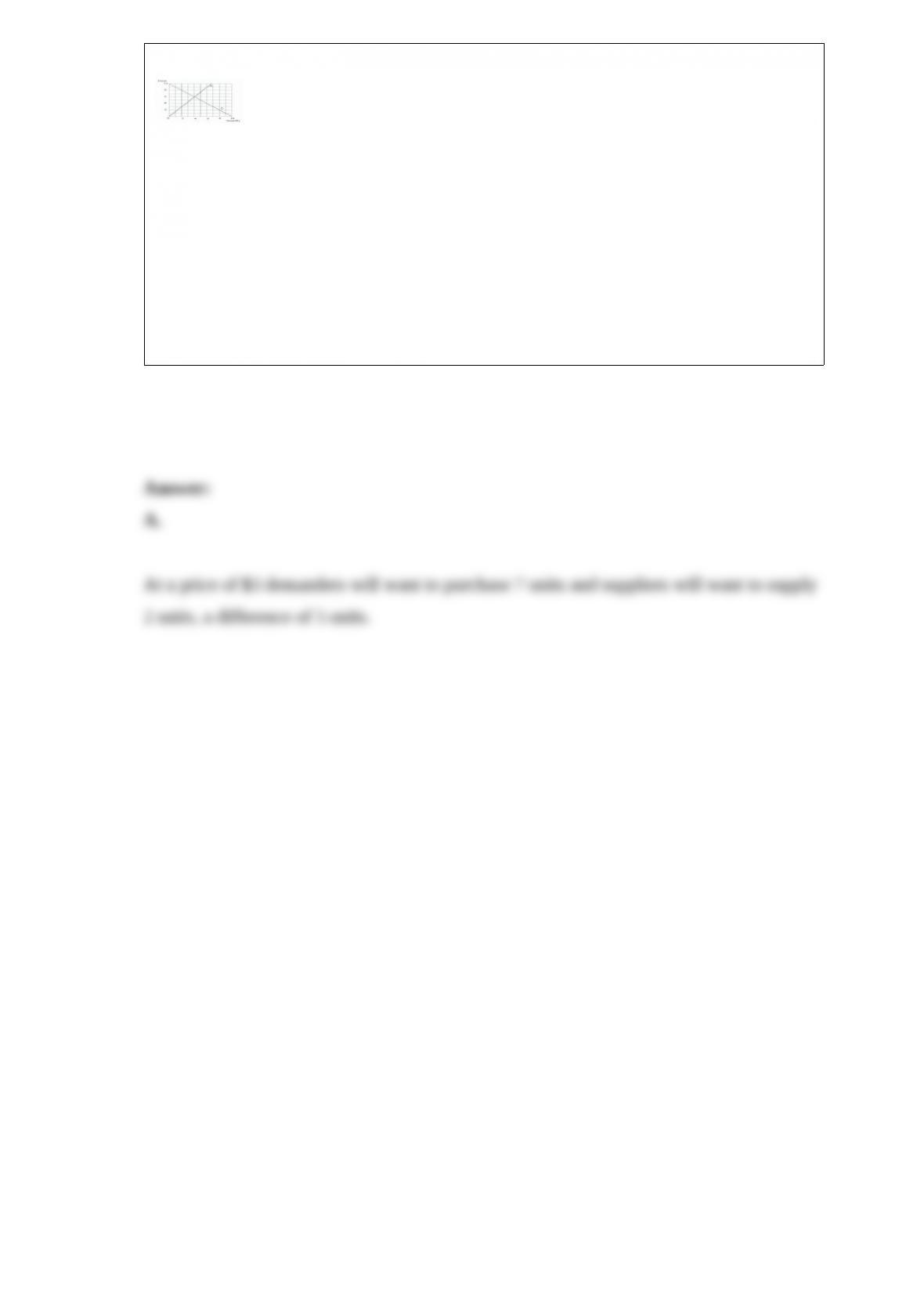
Refer to the figure above. At a price of $3, the market will experience ______________
in the amount of _________ units.
A. excess demand; 5 units
B. excess supply; 7 units
C. equilibrium; 4 units
D. excess supply; 3 units