
Commercial banks can borrow reserves directly from the Fed at the
a. prime interest rate.
b. federal funds rate.
c. discount rate.
d. real interest rate.
Which of the following was an underlying cause of the economic crisis of 2008?
a. a failure of government to impose regulations on Fannie Mae, Freddie Mac, and other
mortgage lenders
b. the imposition of government regulations on Fannie Mae, Freddie Mac, and other
lending institutions that eroded the conventional lending standards in place prior to the
mid-1990s
c. greedy mortgage lenders who extended risky loans to sub-prime borrowers even
though the regulators were trying to limit these loans
d. federal housing regulations that made it difficult for Fannie Mae, Freddie Mac, and
other lending institutions to obtain sufficient loanable funds for the finance of housing
construction
High transaction costs will tend to

a. reduce the number of mutually beneficial exchanges that occur.
b. allow easier specialization according to the law of comparative advantage.
c. increase the value created by exchanges in an economy.
d. increase the number of mutually beneficial exchanges that occur.
“If China and India continue their economic expansion, the world cannot provide
enough raw materials without terrible shortages worldwide.” Evaluate this statement.
a. True, increased demand from developing countries will swamp the existing supply of
resources.
b. True, increased demand from China and India will lead to large shortages in the
North America and Europe.
c. False, the shortage will be limited to China and India.
d. False, increasing scarcity will result in higher prices and the deployment of new
technologies that increase the efficiency of production, and together these markets
forces will help to balance demand and supply worldwide.
Which of the following is true?
a. Nations achieve high rates of economic growth primarily because of their natural

resource endowments.
b. Human and physical capital investments are largely irrelevant to economic growth.
c. Poor nations grow slowly because they do not have access to modern technology
d. A favorable institutional environment will tend to attract more investment in human
and physical capital.
If a budget deficit as a percent of GDP is greater than the growth of real output, the
national debt will
a. decrease relative to the size of the economy.
b. decrease in nominal terms.
c. increase in nominal terms but decrease relative to the size of the economy.
d. increase relative to the size of the economy.
Melanie has a choice of driving or flying from Durham, North Carolina to Knoxville,
Tennessee for a one-day business trip. If she travels by air, she will be able to work
seven hours in Knoxville, while if she drives, she will only have time to work four
hours once there. Her expected income from each hour of work in Knoxville is $40. If
Melanie a rational decision maker, she will chose to fly if and only if the price
differential (air cost minus driving cost) is less than
a. $40.
b. $120.
c. $160.
d. $280.
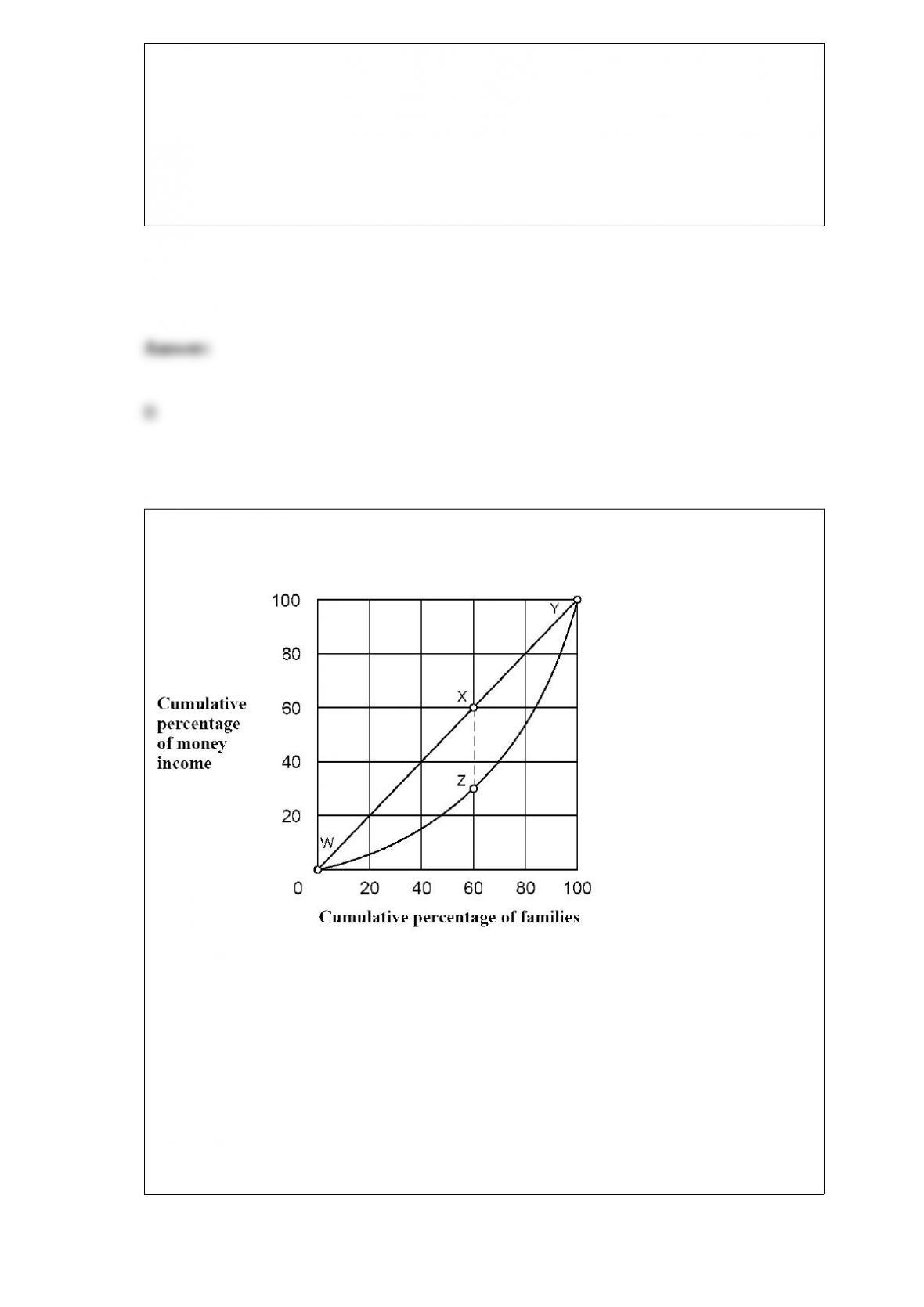
Figure 15-3
As shown in Figure 15-3, 40 percent of families earned a cumulative share of about
____ percent of income.
a. 5
b. 15
c. 30
d. 50

If there is an increase in foreign financial investment in the United States as the result
of large U.S. budget deficits and attractive interest yields,
a. fiscal policy will be more expansionary since there will be no crowding-out effect.
b. fiscal policy will be more expansionary since U.S. residents will increase their
savings, so they can repay the foreigners in the future.
c. foreign exchange value of the dollar will depreciate, which will lead to an increase in
net exports and aggregate demand.
d. foreign exchange value of the dollar will appreciate, which will lead to a decrease in
net exports and aggregate demand.
The owners of a business
a. are paid the market rate of return for resources they supply to the firm.
b. are residual income claimants.
c. have little incentive to monitor shirking on the part of employees.
d. have little incentive to provide their employees with an incentive system that
encourages operational efficiency.

A middleman is a person who
a. specializes in arranging trades and selling, guaranteeing, and servicing items traded.
b. acts as a middle person between the top management of a business firm and the
hourly employees who actually produce the goods and services.
c. adds to the seller’s expense and the buyer’s buying price without providing a service
to either.
d. levies a tax on private sector activity and uses the funds to support government
activities.
The price of a good will tend to fall when
a. there is excess demand for the good.
b. there is excess supply of the good.
c. demand for the good increases.
d. the supply of the good decreases.
How will an increase in the price of coffee affect the market for cocoa, a substitute
good?
a. The supply of cocoa will increase, leading to a reduction in the price of cocoa.

b. The supply of cocoa will decrease, leading to an increase in the price of cocoa.
c. The demand for cocoa will increase, leading to an increase in the price of cocoa.
d. The demand for cocoa will decrease, leading to a reduction in the price of cocoa.
Which of the following indicates why the role of vigilant investors and investment fund
managers is important for the efficient operation of an economy?
a. These investors generally serve on the boards of directors of corporations.
b. These investors tend to buy and sell stocks in a way that rewards good management.
c. These investors help allocate capital efficiently among firms and among investment
projects.
d. Both b and c are true.
If business decision makers expect that the inflation rate will increase in the near future,
a. long-run aggregate supply will increase.
b. long-run aggregate supply will decrease.
c. short-run aggregate supply will increase.
d. short-run aggregate supply will decrease.

Each member of a cartel
a. faces a temptation to cheat on the agreement because lowering its price slightly
below the established price will usually increase the firm’s sales and profit.
b. faces a temptation to cheat on the agreement because raising its price slightly above
the established price will usually increase the firm’s sales and profit.
c. has no temptation to cheat on the agreement because lowering its price slightly below
the established price will usually have no impact on the firm’s sales and profit.
d. has no temptation to cheat on the agreement because raising its price slightly above
the established price will usually decrease the firm’s sales and profit.
e. has no temptation to cheat on the agreement because lowering its price slightly below
the established price will usually lower the firm’s sales and profit.
How does inclusion of the current revenues and expenditures of the Social Security
trust fund into the budget calculation currently affect the reported budget deficit of the
federal government?
a. It increases the reported deficit.
b. It reduces the reported deficit.
c. It exerts no effect on the reported deficit.
d. It increases the deficit during an economic boom but reduces it during a recession.

When the nation of Venezia allows trade and as a result becomes an exporter of shoes,
a. residents who produce shoes become worse off; residents who buy shoes become
better off; and the economic well-being of Venezia rises.
b. residents who produce shoes become worse off; residents who buy shoes become
better off; and the economic well-being of Venezia falls.
c. residents who produce shoes become better off; residents who buy shoes become
worse off; and the economic well-being of Venezia rises.
d. residents who produce shoes become better off; residents who buy shoes become
worse off; and the economic well-being of Venezia falls.
Jim enjoys the feeling of wind in his hair enough to ride his motorcycle without a
helmet, even though he fully realizes the potential for injury it creates by not wearing
one in the unlikely event he is in an accident. To an economist, Jim is
a. making an irrational choice.
b. making a rational choice.
c. not fully considering the personal costs and benefits of his decision.
d. not responding to the incentives he faces.
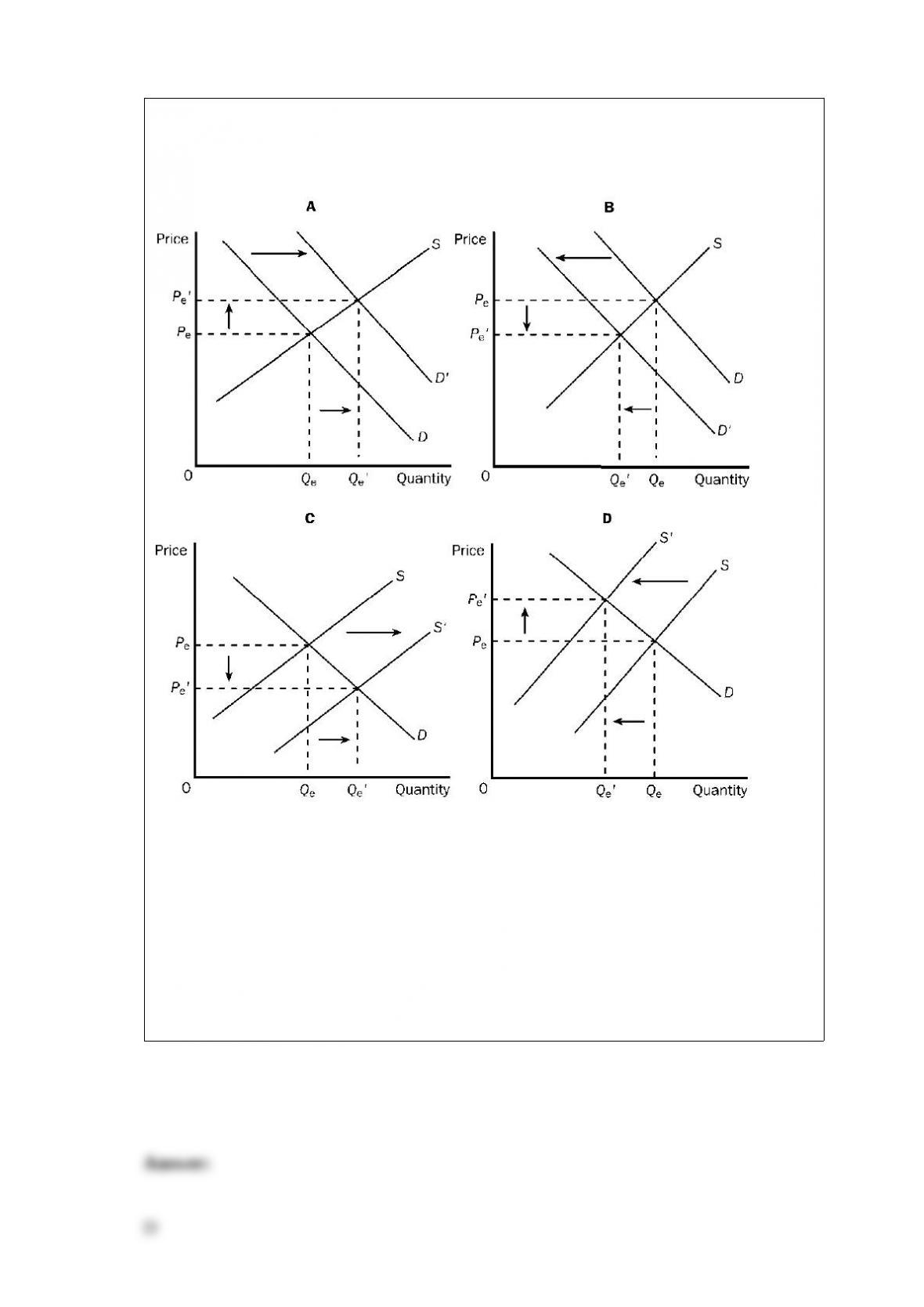
Figure 3-22
Refer to Figure 3-22. Graph C shows which of the following?
a. An increase in demand and an increase in quantity supplied.
b. An increase in demand and an increase in supply.
c. An increase in quantity demanded and an increase in quantity supplied.
d. An increase in supply and an increase in quantity demanded.
The earnings difference between men who have never been married and women is
a. significantly less than the earnings difference between married men and women.
b. about the same as the earnings difference between married men and women.
c. significantly more than the earnings difference between married men and women.
d. modestly more than the earnings difference between married men and women.
Use the figure to answer the following question(s).
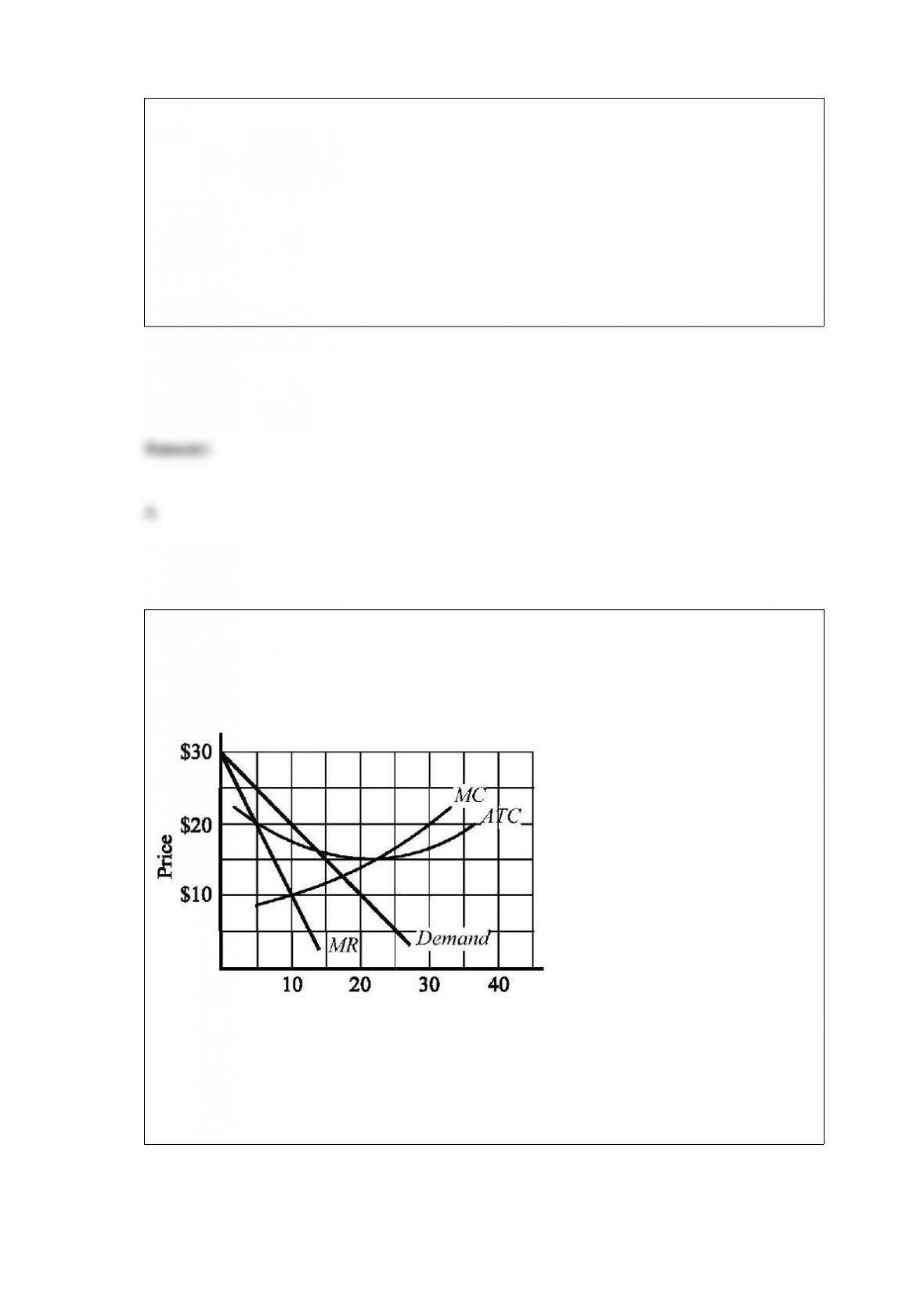
Figure 11-3
What is the maximum profit per month that the monopolist will be able to earn in
Figure 11-3?
a. zero
b. approximately $20,000
c. approximately $50,000
d. approximately $100,000

In an uncertain world, private investors
a. always make decisions that lead to economic profit.
b. never make decisions that generate economic losses.
c. sometimes make decisions that lead to economic losses.
d. rarely invest in human capital.
The modern view of the Phillips curve indicates that in the long run there
a. is no trade-off between inflation and unemployment.
b. is a definite trade-off between unemployment and inflation.
c. will be a trade-off if the rational expectations hypothesis is correct.
d. may be a long-run trade-off between unemployment and inflation, but there is no
such trade-off in the short run.

Which of the following is true of the tax and transfer programs of the United States?
a. Tax-transfer programs persistently redistribute income from the rich to the poor.
b. Social Security, the largest transfer program, redirects income toward the elderly, a
group with above-average levels of both income and wealth.
c. The bulk of agriculture subsidies go to large farmers with above-average incomes.
d. Taxes generally take a larger share of the income of the poor than is true for those
with higher incomes.
e. Both b and c are true.
In which statement(s) is “demand” used correctly?
(I) “An increase in the price of hamburgers will reduce the demand for hamburgers.”
(II) “An increase in the price of hamburgers will reduce the demand for hamburger
buns.”
a. in both statements I and II
b. in statement I only
c. in statement II only
d. in neither statements I nor II
The natural rate of unemployment
a. is an artificially low rate that cannot be maintained.
b. is a constant rate that is unaffected by changes in public policy.
c. is the rate of unemployment present when the economy is operating at full

employment.
d. is equal to the number of persons unemployed divided by the number in the labor
force.
The more inelastic the demand for a product, the more likely that the actual benefit of a
subsidy granted on the product will
a. go to sellers.
b. go to buyers.
c. go equally to both buyers and sellers.
d. do none of the above.
Which of the following policies would be most likely to reduce the rate of inflation?
a. sale of government bonds by the Federal Reserve
b. a reduction in the discount rate
c. an increase in the size of the federal budget deficit
d. a reduction in the required reserves imposed on the banking system

According to the critics of Keynesian economics, the rapid increase in government
spending and large budget deficits in response to the recession of 2008-2009 would
a. slow the recovery process and result in weak long-term growth of real GDP.
b. speed the recovery process and provide the foundation for strong long-term growth
of real GDP.
c. stimulate a more rapid recovery, but cause the economy to fall back into a recession
in the near future.
d. slow the recovery process, but provide a foundation for rapid long-term growth of
real GDP.
Holding all other forces constant, when the price of gasoline rises, the number of
gallons of gasoline demanded would fall substantially over a ten-year period because
a. buyers tend to be much less sensitive to a change in price when given more time to
react.
b. buyers tend to be much more sensitive to a change in price when given more time to
react.
c. buyers will have substantially more income over a ten-year period.
d. the quantity supplied of gasoline increases very little in response to an increase in the
price of gasoline.

Gross private domestic investment
a. excludes all investment in the United States by foreign firms.
b. includes all capital in the United States.
c. includes net additions to the capital stock plus all new corporate stocks and bonds.
d. includes business expenditures on new factories, tools, and machinery.
When a union successfully raises the wages of its members, it will also
a. increase total productivity, which will generally increase in proportion to the wage
rate.
b. encourage employers to purchase more of the union labor.
c. increase the share of income allocated to labor as opposed to capital.
d. increase the employer’s incentive to find substitutes for union labor.