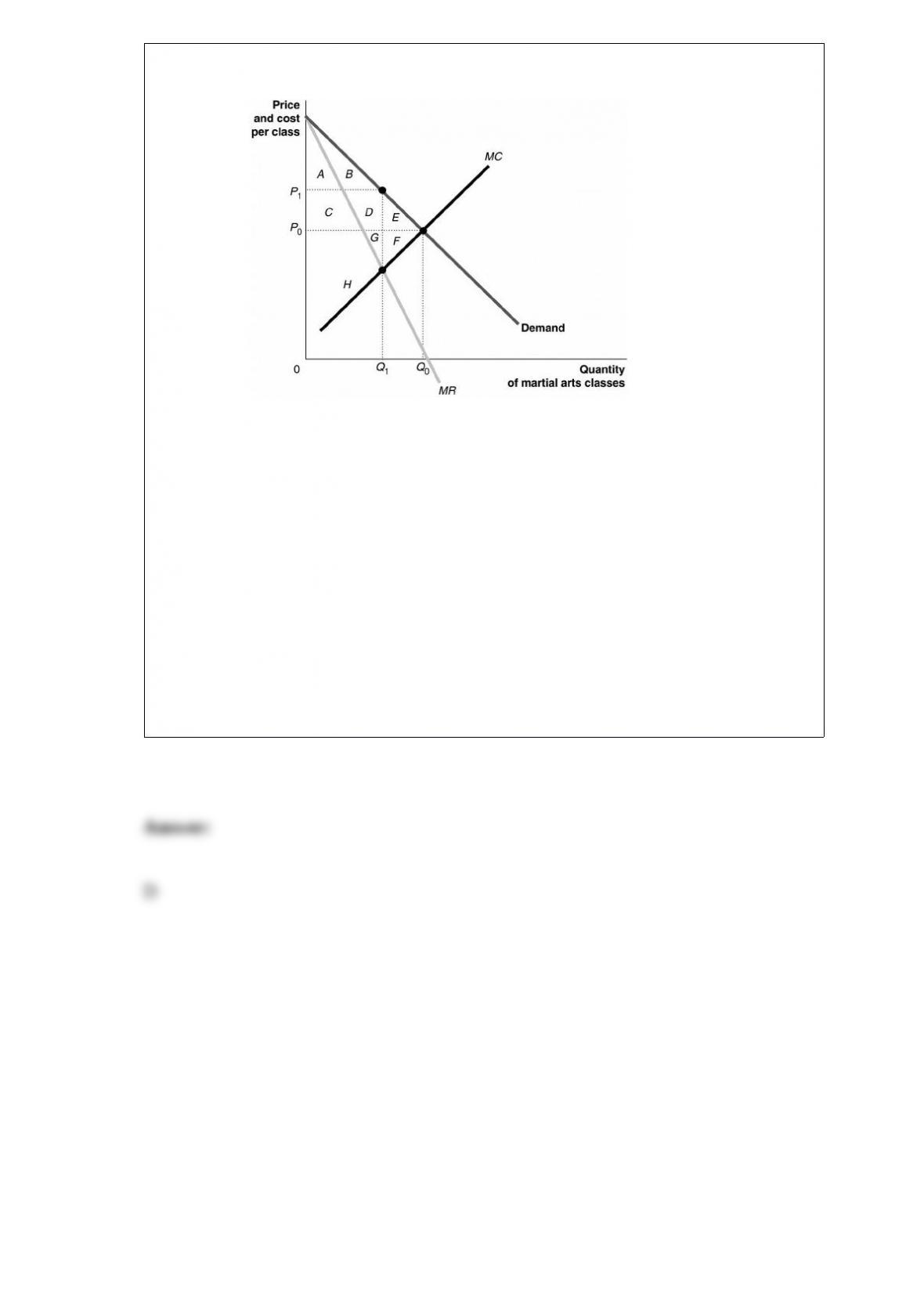
Figure 16-6 Watanabe Sensei
operates the only martial arts school in Hartfield. For simplicity, assume that consumers
have identical demand curves and that Sensei knows what this demand curve is. Figure
16-6 shows this demand curve.
With this pricing scheme€a competitive price for the classes and a one-time
membership fee€what amount of producer surplus will Sensei earn?
A) the area A + B + C + D + E.
B) the area E + F.
C) the area H + G + F.
D) the area A + B + C + D + E + F + G + H
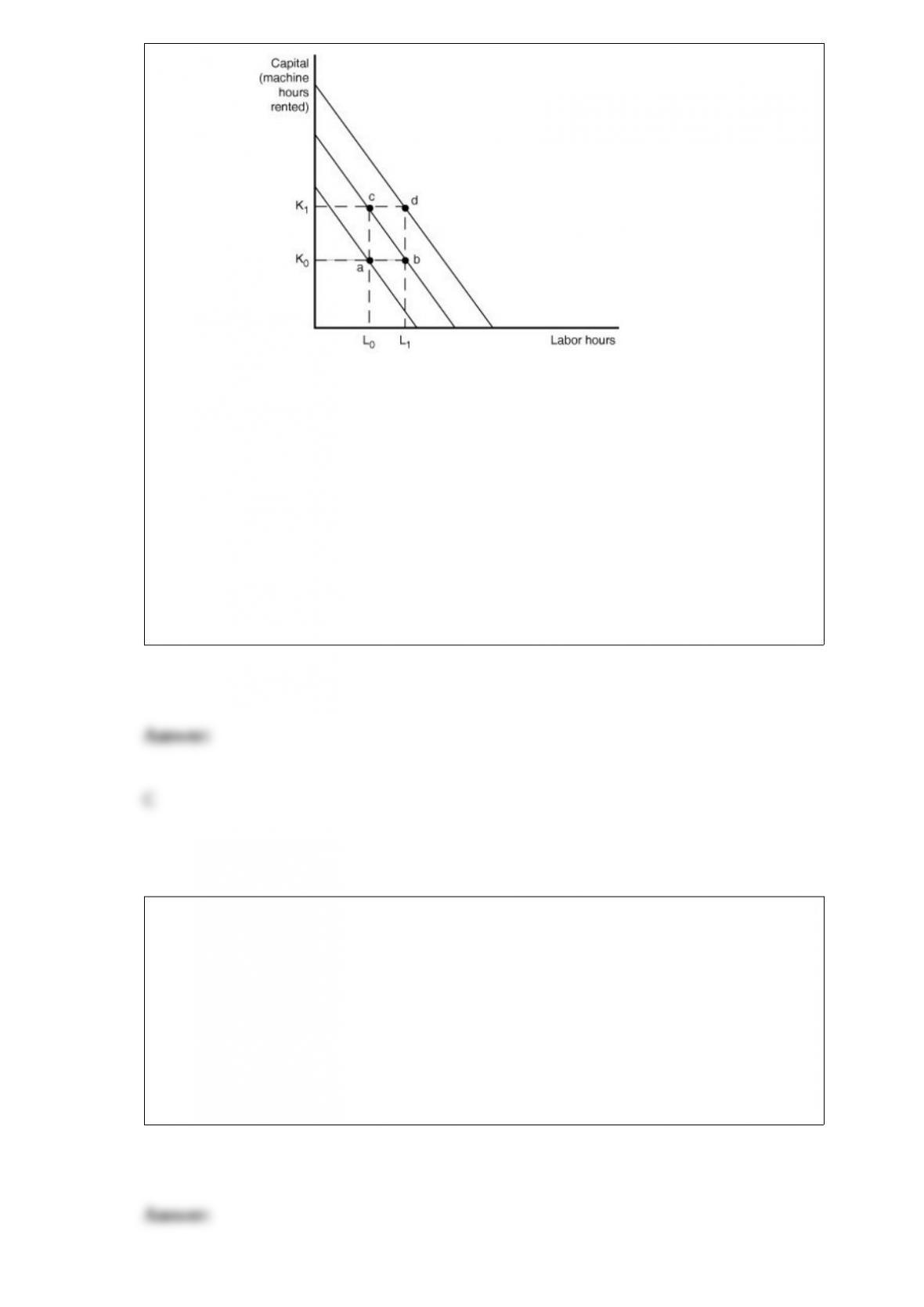
Figure 11-17
Assume that production isoquants are convex. Total cost and output produced must
increase for each of the following movements except one. Which movement is the
exception?
A) point a to point
B) point a to point c
C) point to point c
D) point to point d
In the United States in 2012, a majority of people received health care through
A) Medicare.
B) Medicaid.
C) their employers.
D) individually purchased insurance policies.
Which of the following will shift the aggregate demand curve to the left, ceteris
paribus?
A) an increase in interest rates
B) an increase in disposable income
C) an increase in expected profits for firms
D) an increase in net exports
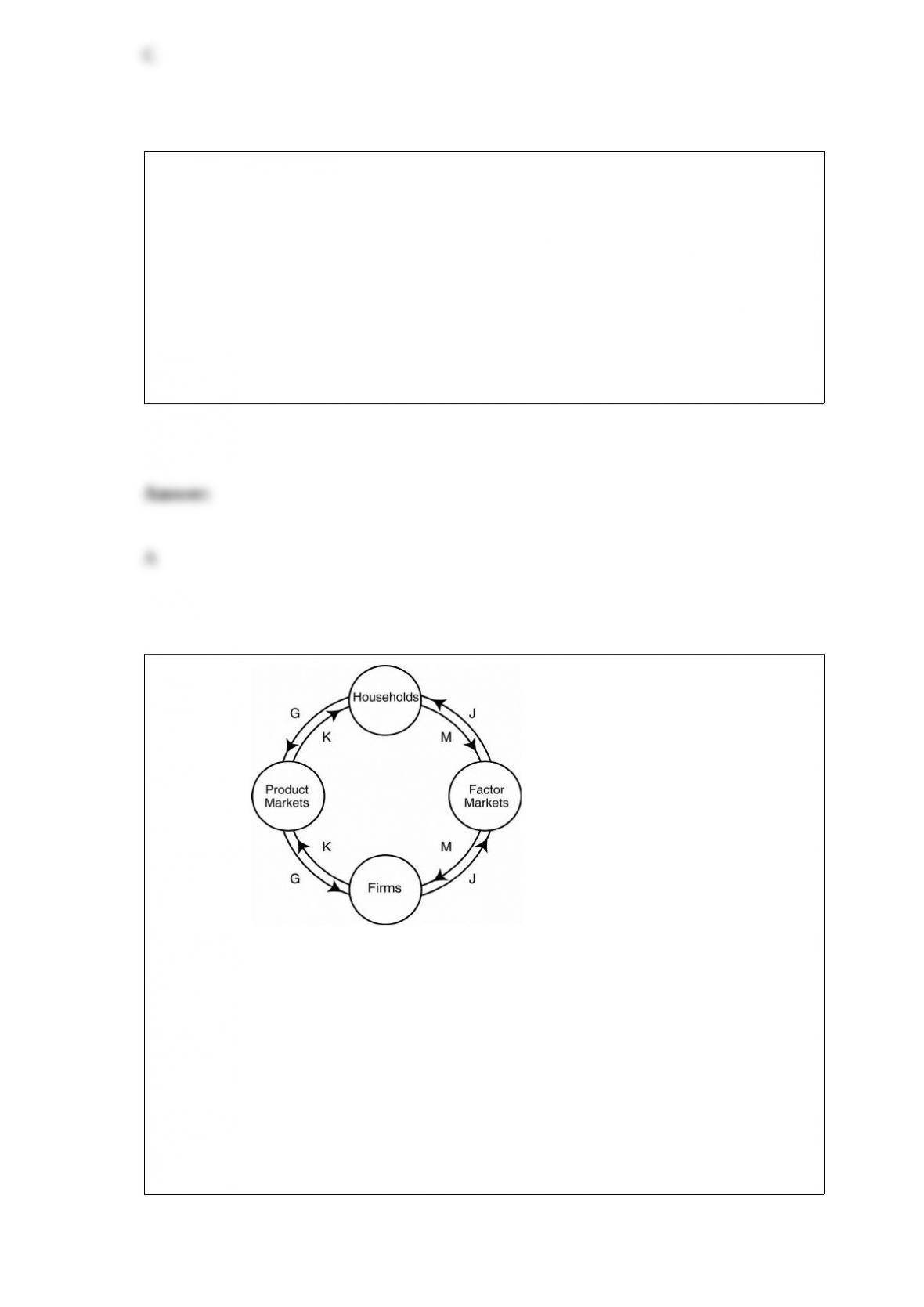
Figure 2-19
Which two arrows in the diagram depict the following transaction: Myrna earns $450
for working at HempHill’s Drug Store.
A) J and M
B) K and G
C) K and M
D) J and G

Each point on a demand curve shows
A) the willingness of consumers to purchase a product at different prices.
B) the consumer surplus received from purchasing a given quantity of a product.
C) the economic surplus received from purchasing a given quantity of a product.
D) the legally determined maximum price that sellers may charge for a given quantity
of a product.
If we include consideration of potential effects of a proposed tax reduction and
simplification on the labor supply, we would expect crowding out of investment and net
exports brought about by the tax cut to be
A) less than it would be without the supply-side effects.
B) increased as aggregate real income and output rise in the long run.
C) unaffected by the shifting long-run aggregate supply curve.
D) dependent upon the impact of this tax change on consumer disposable income.

Table 9-12 Production and
Consumption Production
Without Trade With Trade
Estonia and Morocco can produce both swords and belts. Table 9-12 shows the
production and consumption quantities without trade, and the production numbers with
trade.
Prior to trade, what was the opportunity cost to produce 1 sword in Estonia?
A) 1/2 of a belt
B) 4/5 of a belt
C) 1.25 belts
D) 2 belts
Which of the following transactions would take place in the “underground economy”?
A) Elizabeth tells her mother she’s going to work but really goes to see a movie.
B) Paul buys 15 gallons of gasoline for $3.29 a gallon, not realizing that $1.50 per
gallon of that price goes to the government as tax revenue.
C) John makes chain-link belts and necklaces and sells them at a local flea market for
cash to avoid paying taxes.
D) Matt bought an iPad for $499 but decided to sell it on eBay instead of keeping it.

If you are considering buying either an Apple iPhone or a Samsung Galaxy, and you
choose the Samsung only because the price is lower, then you consider
A) the iPhone and the Galaxy to be complements.
B) the iPhone and the Galaxy to be substitutes.
C) the iPhone to be a normal good and the Galaxy to be an inferior good.
D) the iPhone to be an inferior good and Galaxy to be a normal good.
Under which of the following circumstances would the government be running a
deficit?
A) G = $5 trillion
T = $5 trillion
TR = $1 trillion
B) G = $5 trillion
T = $7 trillion
TR = $1 trillion
C) G = $7 trillion
T = $7 trillion
TR = $0
D) G = $7 trillion
T = $10 trillion
TR = $3 trillion

Suppose a competitive firm is paying a wage of $12 an hour and sells its product at $3
per unit. Assume that labor is the only input. If hiring another worker would increase
output by three units per hour, then to maximize profits the firm should
A) not change the number of workers it currently hires.
B) not hire an additional worker.
C) hire another worker.
D) There is not enough information to answer the question.
Investment spending includes spending on
A) stocks.
B) food.
C) changes in business inventories.
D) transfer payments.
The recession of 2007-2009 made many consumers pessimistic about their future
incomes. How does this increased pessimism affect the aggregate demand curve?
A) This will move the economy up along a stationary aggregate demand curve.

B) This will move the economy down along a stationary aggregate demand curve.
C) This will shift the aggregate demand curve to the left.
D) This will shift the aggregate demand curve to the right.
When the price of gasoline rises, some consumers begin riding their bikes more
frequently or riding the bus instead of driving their cars. The fact that the CPI does not
fully account for such changes in consumer behavior is called
A) outlet bias.
B) increase in quality bias.
C) substitution bias.
D) discrimination bias.