The area below the demand curve and above the price line measures
A) consumer surplus.
B) economic profit.
C) elasticity of demand.
D) the total value obtained from consuming the good or service.
Use the following statements to answer this question:
I. Stock externalities depend on the accumulated results of actions by producers or
consumers, not on the incremental results that may occur in a given period of time.
II. Stock externalities are always negative externalities.
A) I and II are true.
B) I is true and II is false.
C) II is true and I is false.
D) I and II is false.
Consider the following three market baskets:
Table 3.1

Refer to Table 3.1. If preferences satisfy all four of the basic assumptions:
A) A is on the same indifference curve as B.
B) B is on the same indifference curve as C.
C) A is preferred to C.
D) B is preferred to A.
E) Both A and B answer choices are correct.
A local restaurant offers an “all-you-can-eat” salad bar for $3.49. However, with any
sandwich, a customer can add the “all-you-can-eat” salad bar for $1.49. This is an
example of
A) peak-load pricing.
B) second-degree price discrimination.
C) a two-part tariff.
D) tying.
E) none of the above

Assume that labor and capital are complements in production and that the wage
declines. Which of the following statements best describes the adjustment in the use of
labor?
A) Adjustments in labor use are not influenced by adjustments in capital use.
B) The MRPL curve shifts downward in this case.
C) More labor is used both because of the reduced wage and increased use of capital.
D) Changes in labor use are indeterminate because the reduced wage and reduced use
of capital have opposite influences on the use of labor.
You have won a contest and are allowed to choose between two prizes. One option is to
receive $200 today and another $200 one year from now. The second option is $100
today and an additional $325 one year from now. At what interest rate (if any) is the
present value of the two prizes identical?
A) 0 percent
B) 5 percent
C) 10 percent
D) 25 percent
E) none of the above

Scenario 4.5:
The demand curve for grilled cheese sandwiches has been estimated using statistical
techniques as follows:
log(Q) = -1.10 – 0.18 log(P) + 1.21 log(I) + 0.84 log(Ph)
where Q is the quantity of grilled cheese sandwiches
P is the price of grilled cheese sandwiches
I is income
Ph is the price of hamburgersSee Scenario 4.5. As the price of grilled cheese
sandwiches decreases, the price elasticity of demand:
A) increases.
B) does not change.
C) decreases.
D) none of the above
Jane is attempting to maximize utility by selecting a market basket of goods. For each
of the goods in the market basket the marginal utility per dollar spent is equal. There are
some goods which are affordable but do not appear in the Jane’s market basket. If Jane
has maximized utility, the marginal utility per dollar spent on each of the goods that
does not appear in the market basket is:
A) too high.
B) too low.
C) zero.

D) infinite.
E) none of the above
Which of the following costs may provide barriers to entry in a market?
A) High research and development expenditures
B) License fees
C) Sunk costs associated with specialized facilities
D) all of the above
For an individual consumer, a corner solution may be optimal such that MRS and MRT
are not equal,
A) but this is not possible in an Edgeworth Box due to the transitivity of preferences.
B) but this is not possible in an Edgeworth Box because price ratios must be positive.
C) and this may also occur in an Edgeworth Box.
D) and this may only occur in an Edgeworth Box under the perfect complements case.

Scenario 14.4:
John’s firm is a competitor in your product market and a monopsonist in the labor
market. The current market price of the product that your firm produces is $2. The total
product and marginal product of labor are given as:
TP = 100L – 0.125L2 MP = 100 – 0.25L
where L is the amount of labor employed. The supply curve for labor and the marginal
expenditure curve for labor are given as follows:
L = PL -5 MEL = 2L + 5
Refer to Scenario 14.4. Suppose that the price of the product rises to $5. Which of the
following curves shifts?
A) MP curve
B) MRP curve
C) Supply of labor curve
D) Marginal expenditure curve
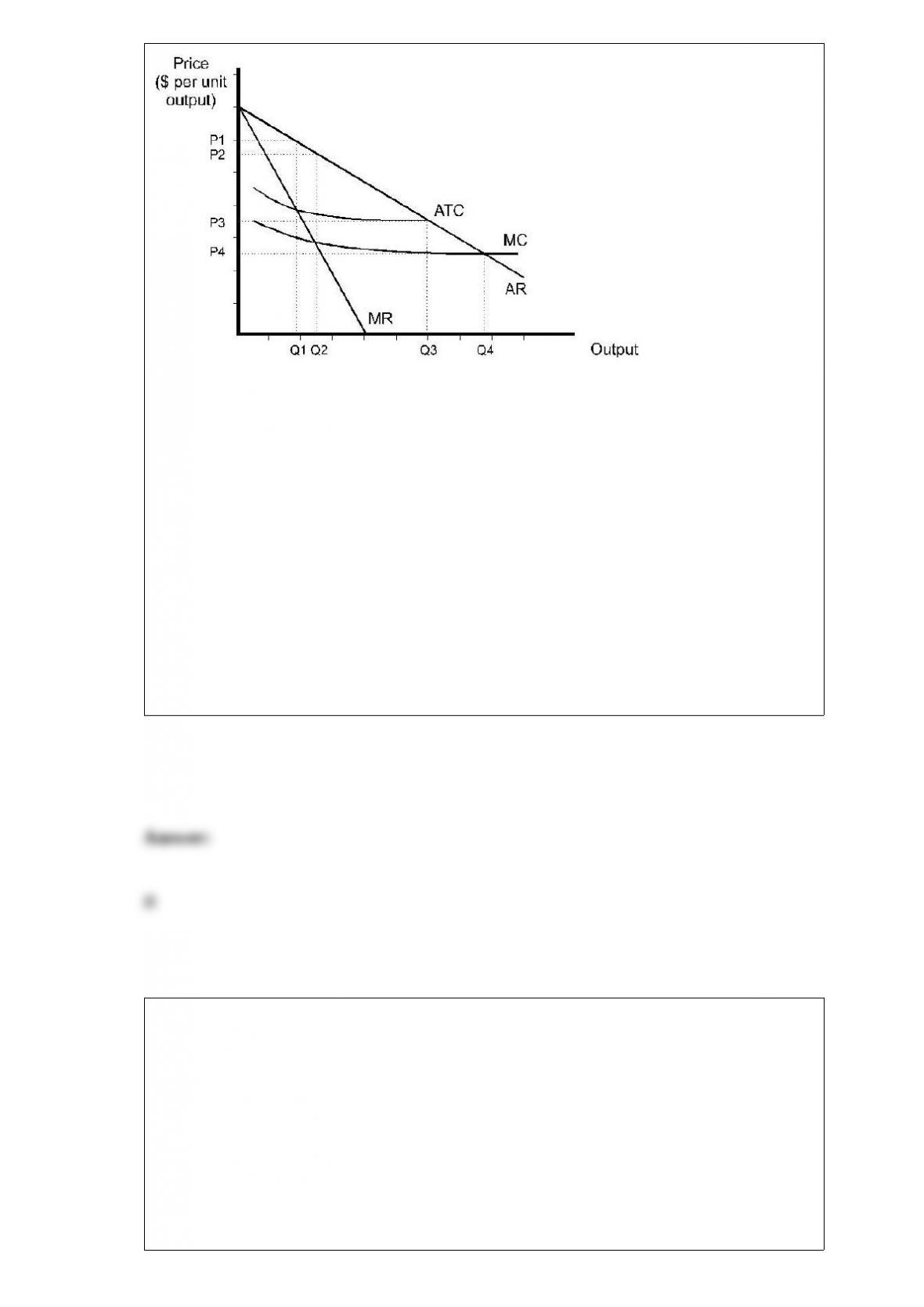
Figure 1
The revenue and cost curves in the diagram above are those of a natural monopoly
Refer to Figure 10.1. If the monopolist is not regulated, the price will be set at
________.
A) P1
B) P2
C) P3
D) P4
E) none of the above
Writing total output as Q, change in output as ΔQ, total labor employment as L, and
change in labor employment as L, the marginal product of labor can be written
algebraically as
A) ΔQ ∙ L.
B) Q / L.
C) ΔL / ΔQ.

D) ΔQ / ΔL.
Suppose the current stock of greenhouse gases in the atmosphere is 100 million tons,
the stock dissipation rate is 0.02, and we will emit 4 million tons into the atmosphere
this year. What is the stock level of greenhouse gases expected to be for next year?
A) 98 million tons
B) 100 million tons
C) 102 million tons
D) 104 million tons
Other things being equal, the increase in rents that occurs after rent controls are
abolished is smaller when
A) the own price elasticity of demand for rental homes is price inelastic.
B) the own price elasticity of demand for rental homes is price elastic.
C) the own price elasticity of demand for rental homes has unitary price elasticity.
D) rented homes and owned homes are complements.
E) rented homes and owned homes are substitutes.

Which of the following statements about natural monopolies is true?
A) Natural monopolies are only found in the markets for natural resources (like crude
oil and coal).
B) For natural monopolies, marginal cost is always below average cost.
C) For natural monopolies, average cost is always increasing.
D) Natural monopolies cannot be regulated.
C and S Metal Company produces stainless steel pots and pans. C and S can pursue
either of two distribution plans for the coming year. The firm can either produce pots
and pans for sale under a discount store label or manufacture a higher quality line for
specialty stores and expensive mail order catalogs. High initial setup costs along with C
and S’s limited capacity make it impossible for the firm to produce both lines. Profits
under each plan depend upon the state of the economy. One of three conditions will
prevail:
growth (probability = 0.3)
normal (probability = 0.5)
recession (probability = 0.2)
The outcome under each plan for each state of the economy is given in the table below.
Figures in the table are profits measured in dollars. The probabilities for each economic
condition represent crude estimates.
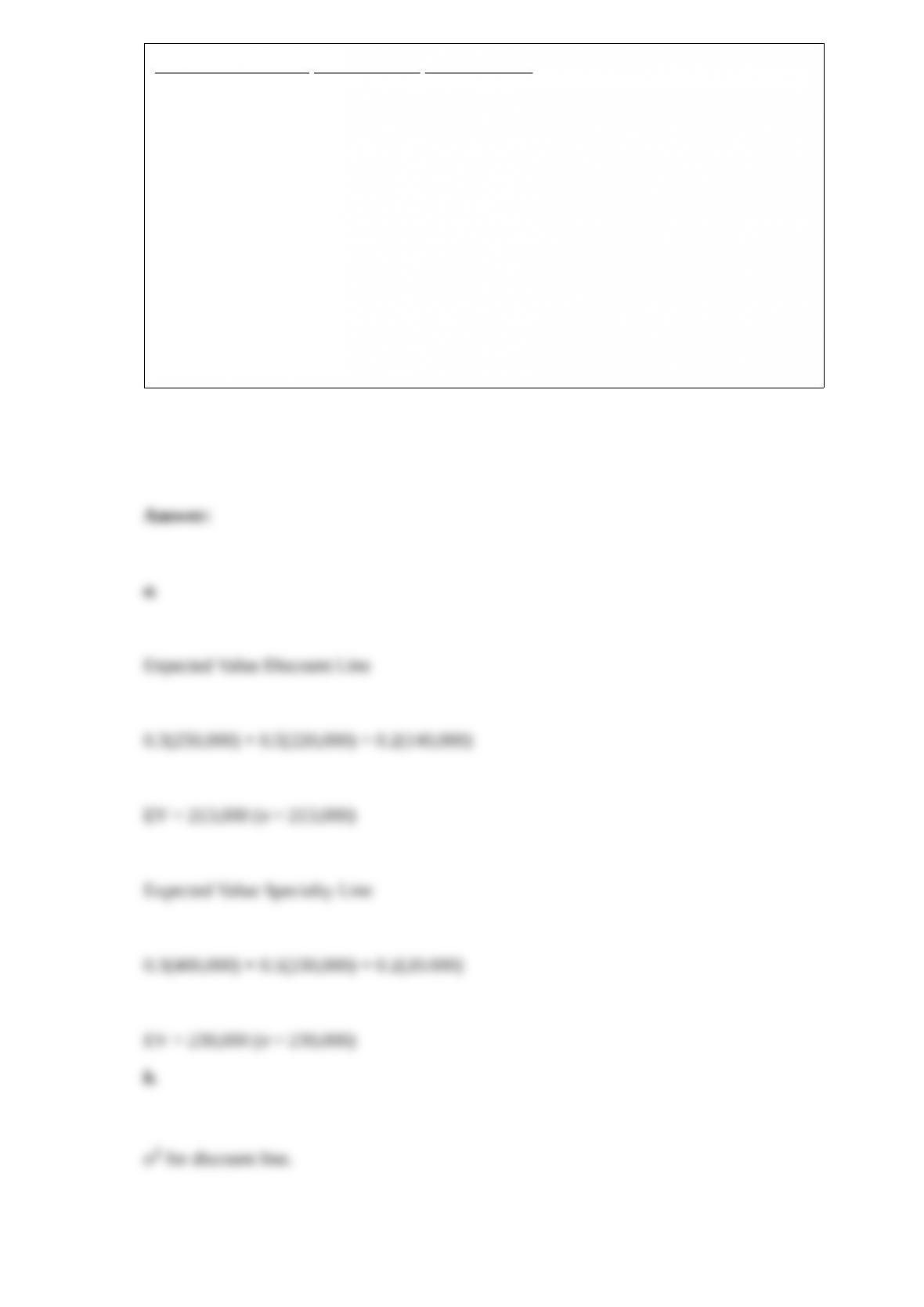
Economic Condition Discount Line Specialty Line
Growth 250,000 400,000
Normal 220,000 230,000
Recession 140,000 20,000
a. Calculate the expected value for each alternative.
b. Which alternative is more risky? (Calculate the standard deviation of profits for each
alternative.)
c. Taking into account the importance of risk, which alternative should an investor
choose?

Suppose the observed annual quantity of steel exchanged in the European market is 30
million metric tons, and the observed market price is 90 euros per ton. If the linear
demand function for steel takes the form Q = a – 0.9P, what is an appropriate value for
the intercept coefficient a?
A) a = -51
B) a = 51
C) a = 111
D) a = -111
When the government controls the price of a product, causing the market price to be
above the free market equilibrium price,
A) all producers gain.
B) both producers and consumers gain.
C) only consumers gain.
D) some, but not all, sellers can find buyers for their goods.

Scenario 5.2:
Randy and Samantha are shopping for new cars (one each). Randy expects to pay
$15,000 with 1/5 probability and $20,000 with 4/5 probability. Samantha expects to pay
$12,000 with 1/4 probability and $20,000 with 3/4 probability.
Refer to Scenario 5.2. Samantha’s expected expense for her car is
A) $20,000.
B) $19,000.
C) $18,000.
D) $17,500.
E) $15,000.
Which of these measures the responsiveness of the quantity of one good demanded to
an increase in the price of another good?
A) price elasticity.
B) income elasticity.
C) cross-price elasticity.
D) cross substitution elasticity.

What can account for the negative slope of the marginal revenue product curve?
A) Diminishing marginal utility
B) Diminishing marginal returns
C) Monopsony power
D) All workers eventually begin slacking.
E) none of the above
The point price elasticity of demand for red herring is -4. The demand curve for red
herring is: Q = 120 – P. What is the price of red herring?
A) $96
B) $80
C) $100
D) $120
E) none of the above

If only one firm in an industry could take advantage of a reduced wage and all other
firms continue paying the old wage, how would one best describe the one firm’s
reaction to this reduced wage assuming labor is the only variable input? The marginal
revenue product of labor curve
A) would remain unchanged, and the firm would hire more labor at the lower wage.
B) shifts to the left, and the firm hires more labor at the lower wage on the new curve.
C) shifts to the right, and the firm hires more labor at the lower wage on the new curve.
D) shifts to the left, and the firm hires less labor at the lower wage on the new curve.
E) shifts to the right, and the firm hires less labor at the lower wage on the new curve.
Use the following two statements to answer this question:
I. Economic theories are developed to explain observed phenomena by deducing from a
set of basic rules and assumptions.
II. Economic theories use value judgments to determine which people ought to pay
more taxes.
A) Both I and II are true.
B) I is true, and II is false.
C) I is false, and II is true.
D) Both I and II are false.

General Motors estimates that U.S. demand for its newest product will be: Qus =
30,000 – 0.5P. Export demand will be Qex = 25,000 – 0.5P. The total market demand
curve for this product will be a
A) straight line with a slope of -0.5.
B) straight line with a slope of -1.0.
C) kinked line with the kink at Q = 25,000.
D) kinked line with the kink at P = 50,000.
E) none of the above
An examination of the production isoquants in the diagram below reveals that:

A) capital and labor must be used in fixed proportions.
B) capital and labor are perfectly substitutable.
C) except at the corners of the isoquants the MRTS is constant.
D) Both B and C are correct.
E) none of the above
A consumer prefers market basket A to market basket B, and prefers market basket B to
market basket C. Therefore, A is preferred to C. The assumption that leads to this
conclusion is:
A) transitivity.
B) completeness.
C) all goods are good.
D) diminishing MRS.
E) assumption of rationality.
The industry demand curve for labor is the
A) horizontal sum of individual firm labor demand curves.

B) vertical sum of individual firm demand curves.
C) representative firm’s demand curve multiplied by the number of firms.
D) none of the above
From 1970 to 2010, the real price of a college education increased, and total enrollment
increased. Which of the following could have caused this increase in price and
enrollment?
A) A shift to the right in the supply curve for college education and a shift to the left in
the demand curve for college education.
B) A shift to the left in the supply curve for college education and a shift to the right in
the demand curve for college education.
C) A shift to the left in the supply curve for college education and a shift to the left in
the demand curve for college education.
D) none of the above
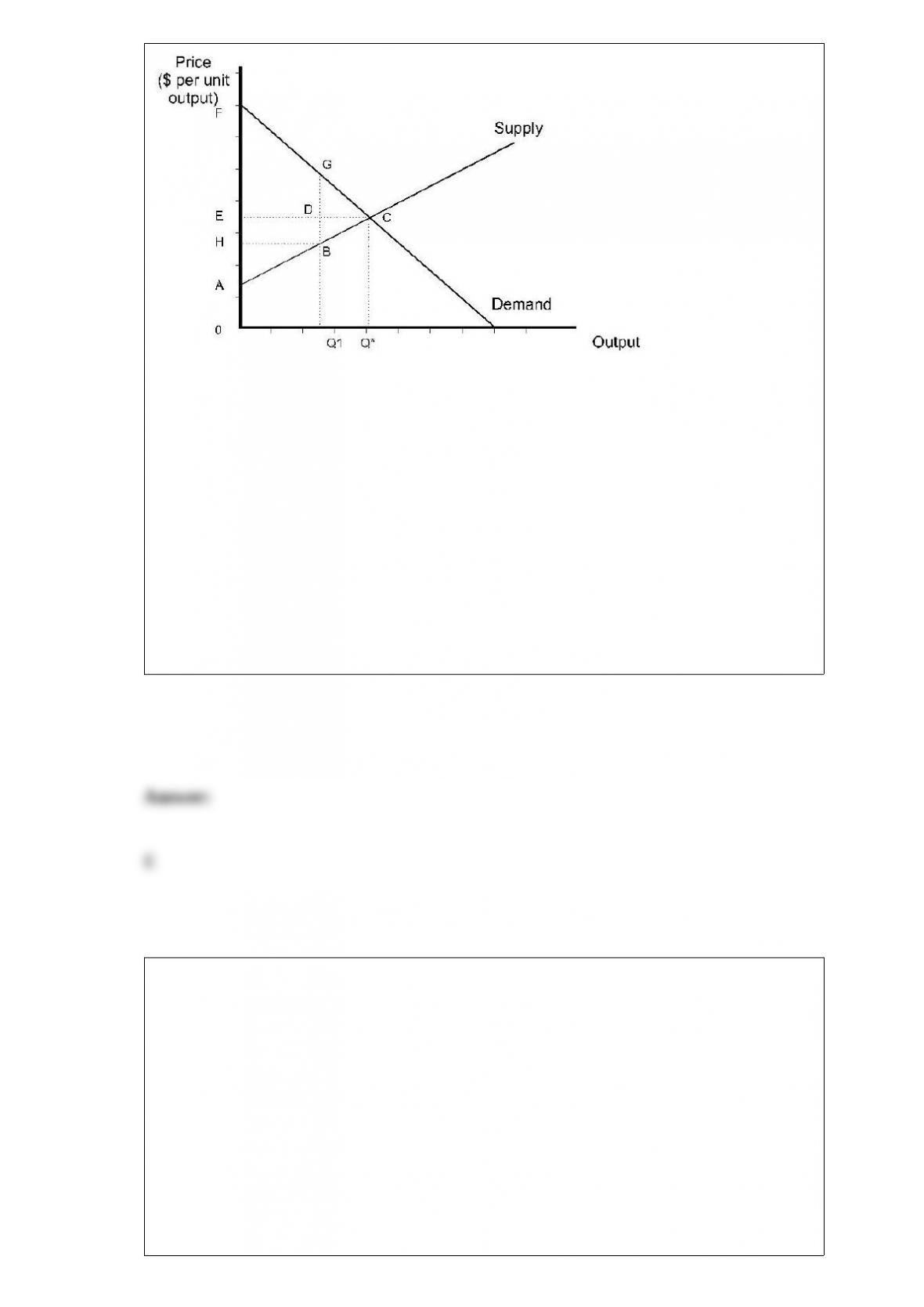
Figure 9.2
Refer to Figure 9.2. At price 0E and quantity Q*, producer surplus is the area
A) 0ACQ*.
B) 0ECQ*.
C) 0FCQ*.
D) EFC.
E) none of the above
A certain magazine offers its subscribers the opportunity to “Buy Now and Save.” If at
the time their subscription renewal is due they agree to pay for 2 years rather than 1, the
renewal price will be $50 per year rather than the usual $60 per year. At what interest
rate will the consumer, who is certain she will subscribe to the magazine for the next 2
years, decide to “Buy Now and Save”?
A) any interest rate under 50 percent
B) any interest rate over 1.5 percent
C) any interest rate over 150 percent

D) any interest rate under 5 percent
E) She will always take this offer if she is absolutely certain to buy the magazine for
another 2 years.
Which of the following statements about the optimal solution to the consumer problem
based on the Cobb-Douglas utility function is NOT true?
A) The cross-price elasticities of demand are zero.
B) Both goods have downward sloping demand curves.
C) Both goods are normal goods.
D) The marginal utility of income may be negative.
The price of lemonade is $0.50; the price of popcorn is $1.00. If Fred has maximized
his utility by purchasing lemonade and popcorn, his marginal rate of substitution will
be:
A) 2 lemonades for each popcorn.
B) 1 lemonades for each popcorn.
C) 1/2 lemonade for each popcorn.
D) indeterminate unless more information on Fred’s marginal utilities is provided.
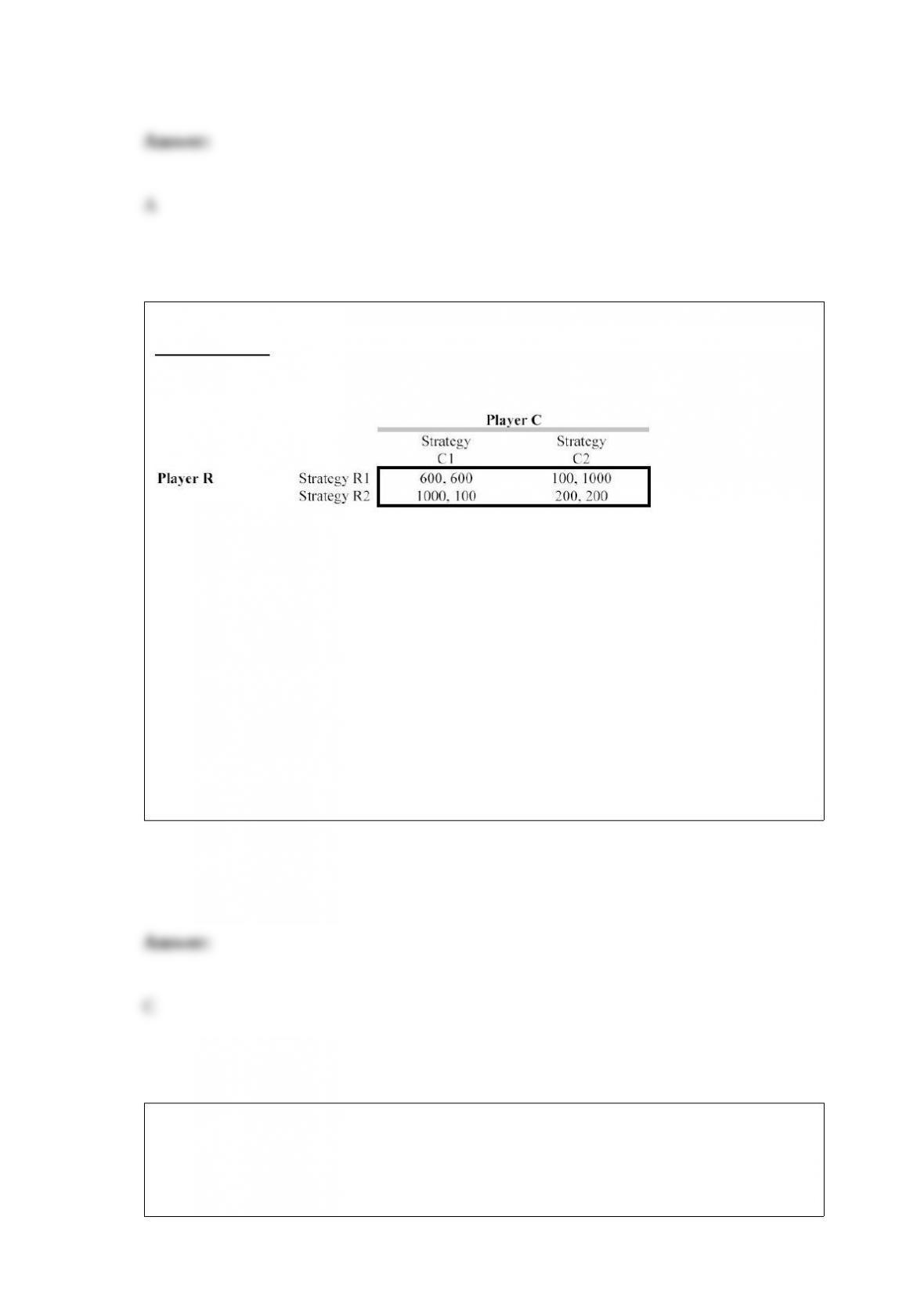
Scenario 13.11
Consider the game below:
What kind of game is shown in Scenario 13.11?
A) Axelrod’s Paradox
B) Stackelberg Match
C) Prisoners’ Dilemma
D) Cournot’s Duopoly Game
E) It is not possible to tell what kind of game it is because the strategies have not been
identified.
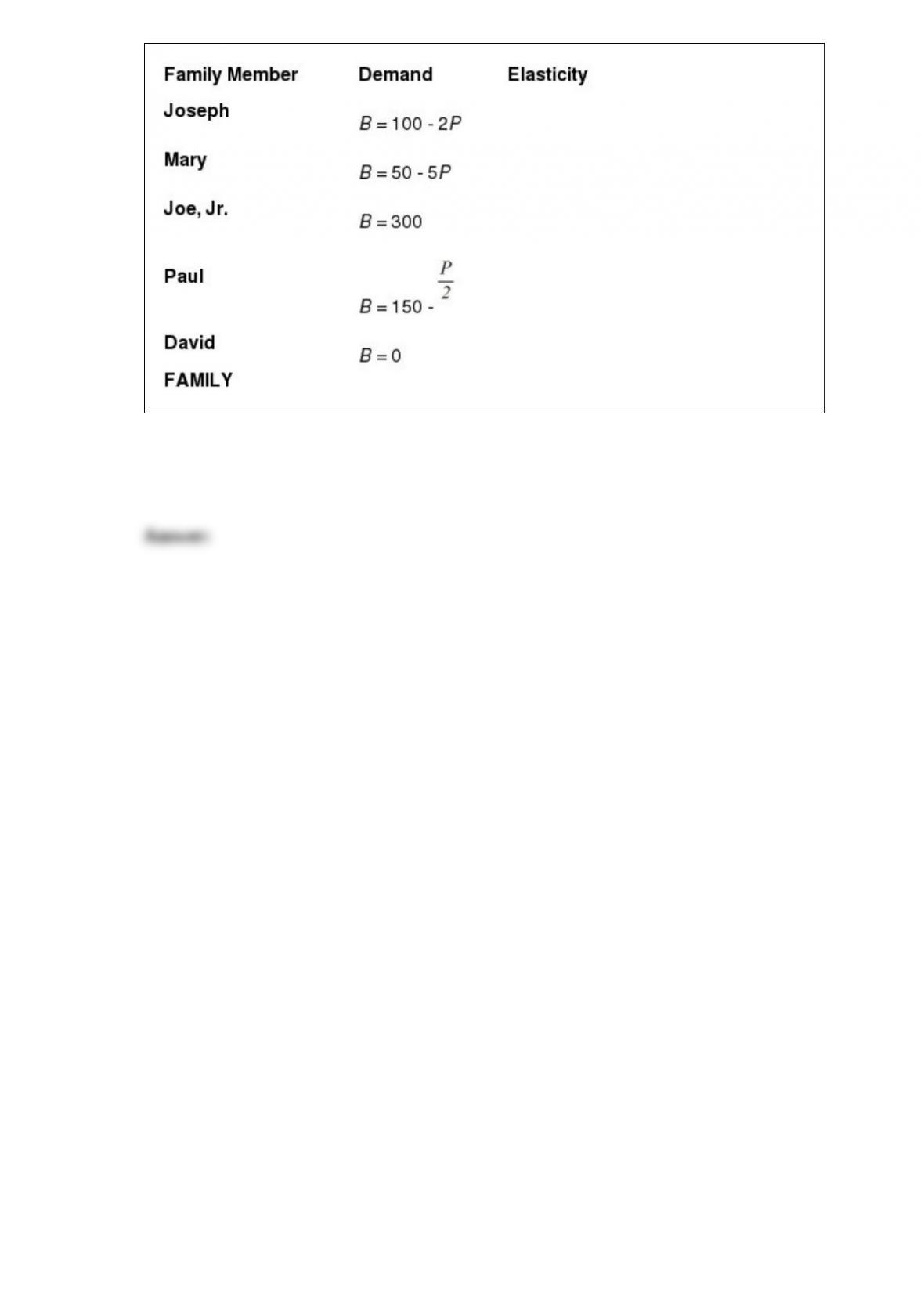
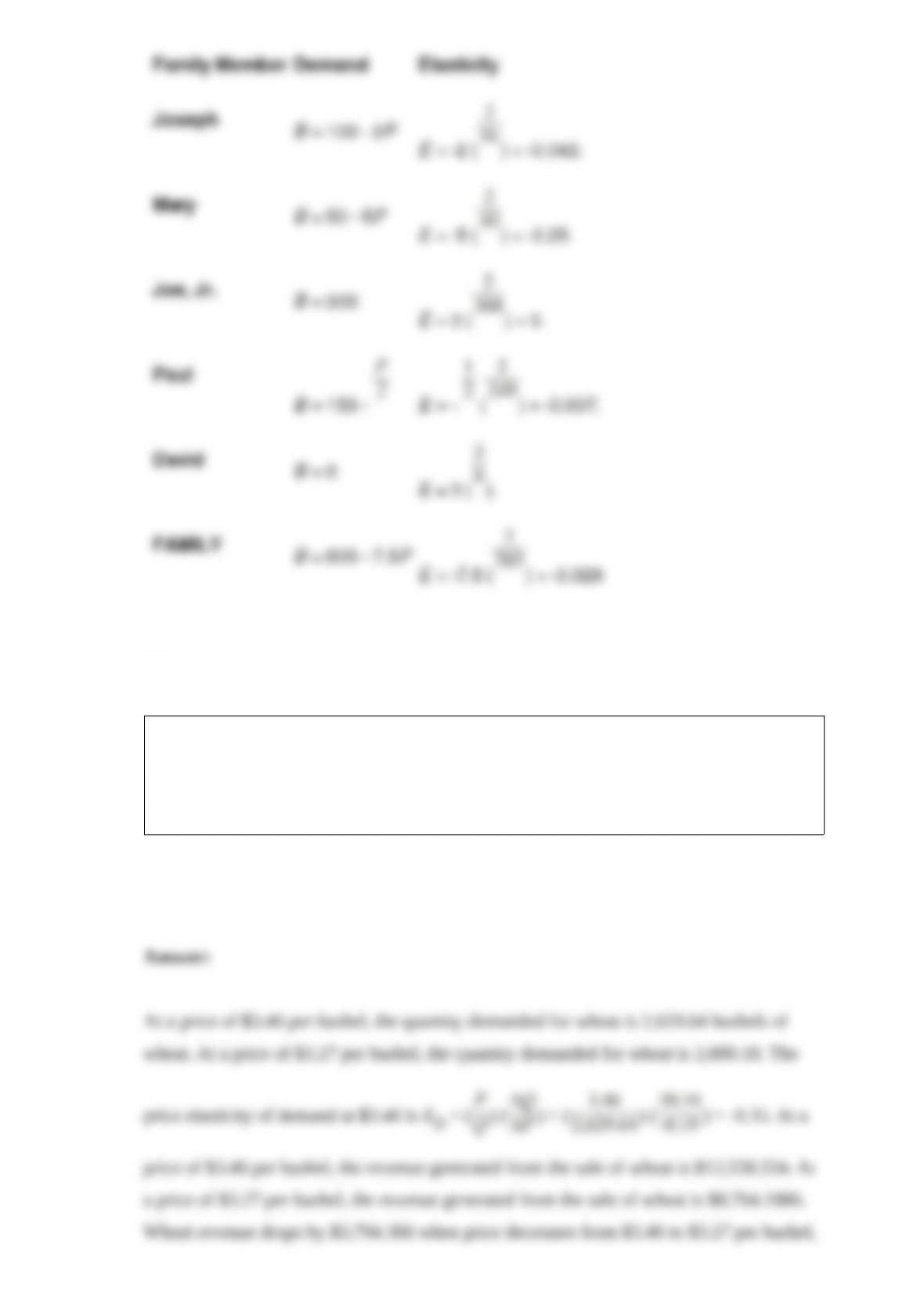
The table below lists the demand curve for sleeves of tennis balls for each member of
the Parker family. Use this information to determine the Parker’s aggregate family
demand for tennis balls. What is the price elasticity of demand for each member of the
family at $2.00? What is the price elasticity of family aggregate demand at $2.00?
The demand for a bushel of wheat in 1981 was given by the equation QD = 3550 –
266P. At a price of $3.46 per bushel, what is the price elasticity of demand? If the price
of wheat falls to $3.27 per bushel, what happens to the revenue generated from the sale
of wheat?
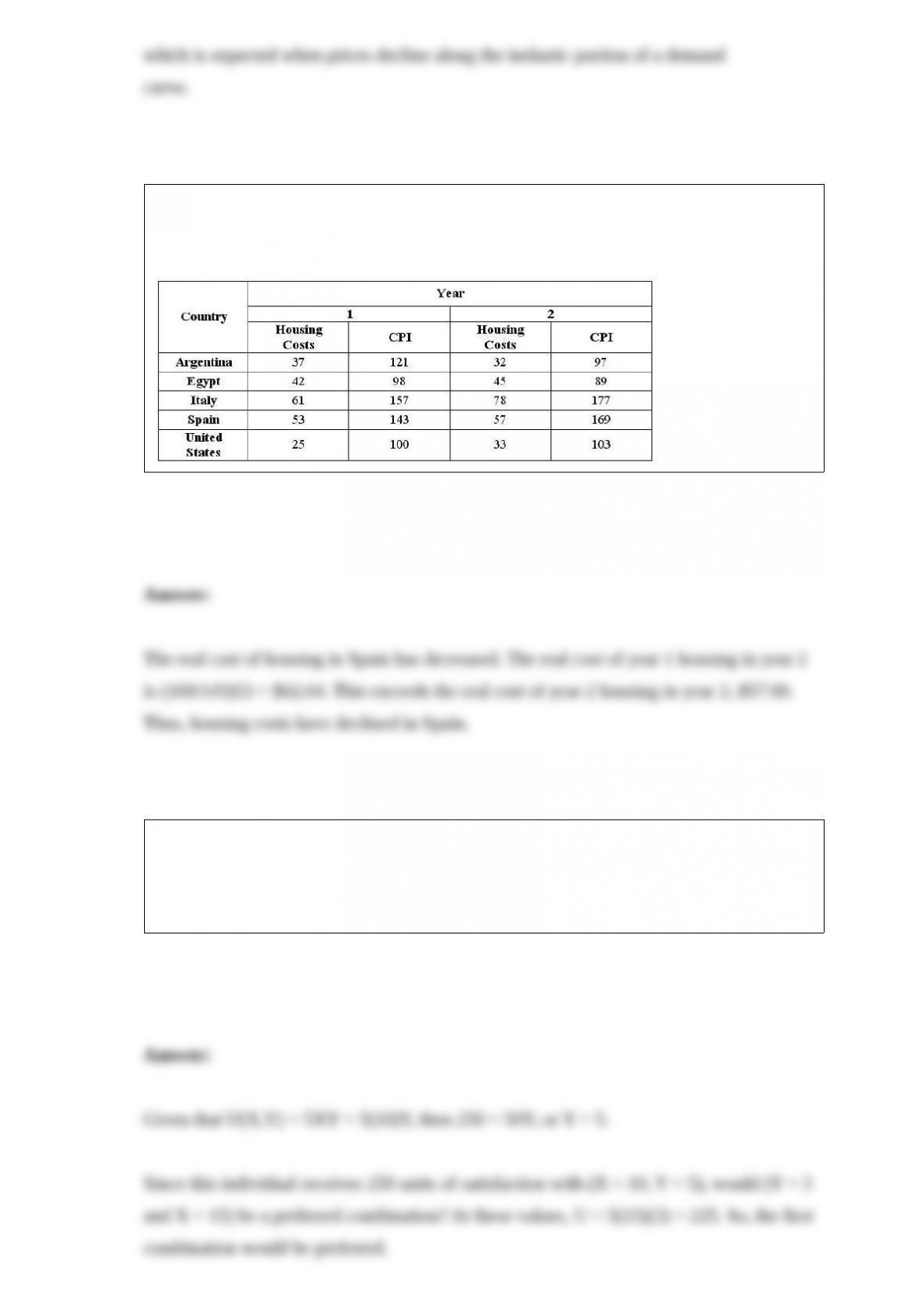
The following is a list of housing costs in five different countries along with their CPI.
For which country is the real cost of housing declining? Use year 2 as the base year in
your answer.
Consider Gary’s utility function: U(X,Y) = 5 XY, where X and Y are two goods. If the
individual consumed 10 units of X and received 250 units of utility, how many units of
Y must the individual consume? Would a market basket of X = 15 and Y = 3 be
preferred to the above combination? Explain.
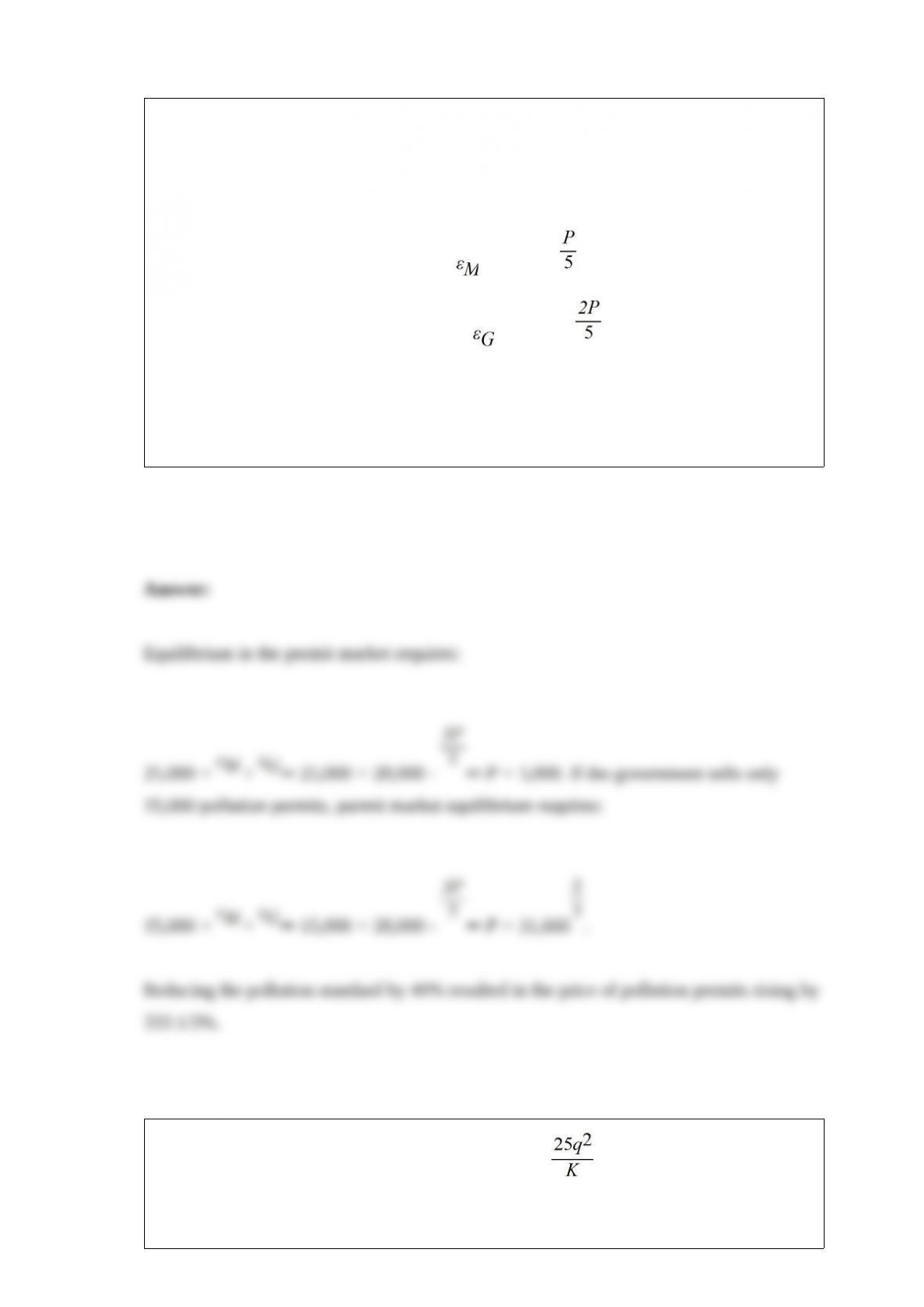
Smog Corporation and Grimy Corporation emit pollution in their production processes.
The local government has established a standard for the pollution levels of Smog
Corporation and Grimy Corporation of 25,000 units of pollution. To ensure this level of
pollution is achieved efficiently, the government sells permits to the corporations that
entitle them to emit a unit of pollution. Smog Corporation has the following demand
function for pollution emission permits: = 15,000 – . Grimy Corporation’s demand
function for pollution emission permits is: = 13,000 – .
What is the equilibrium price of pollution permits? If the government makes the
standard more stringent and allows only 15,000 units of pollution, what happens to the
equilibrium price of pollution permits?
Spacely Sprockets’ short-run cost curve is: C(q, K) = + 15K, where q is the
number of Sprockets produced and K is the number of robot hours Spacely hires.
Currently, Spacely hires 10 robot hours per period. The short-run marginal cost curve is:
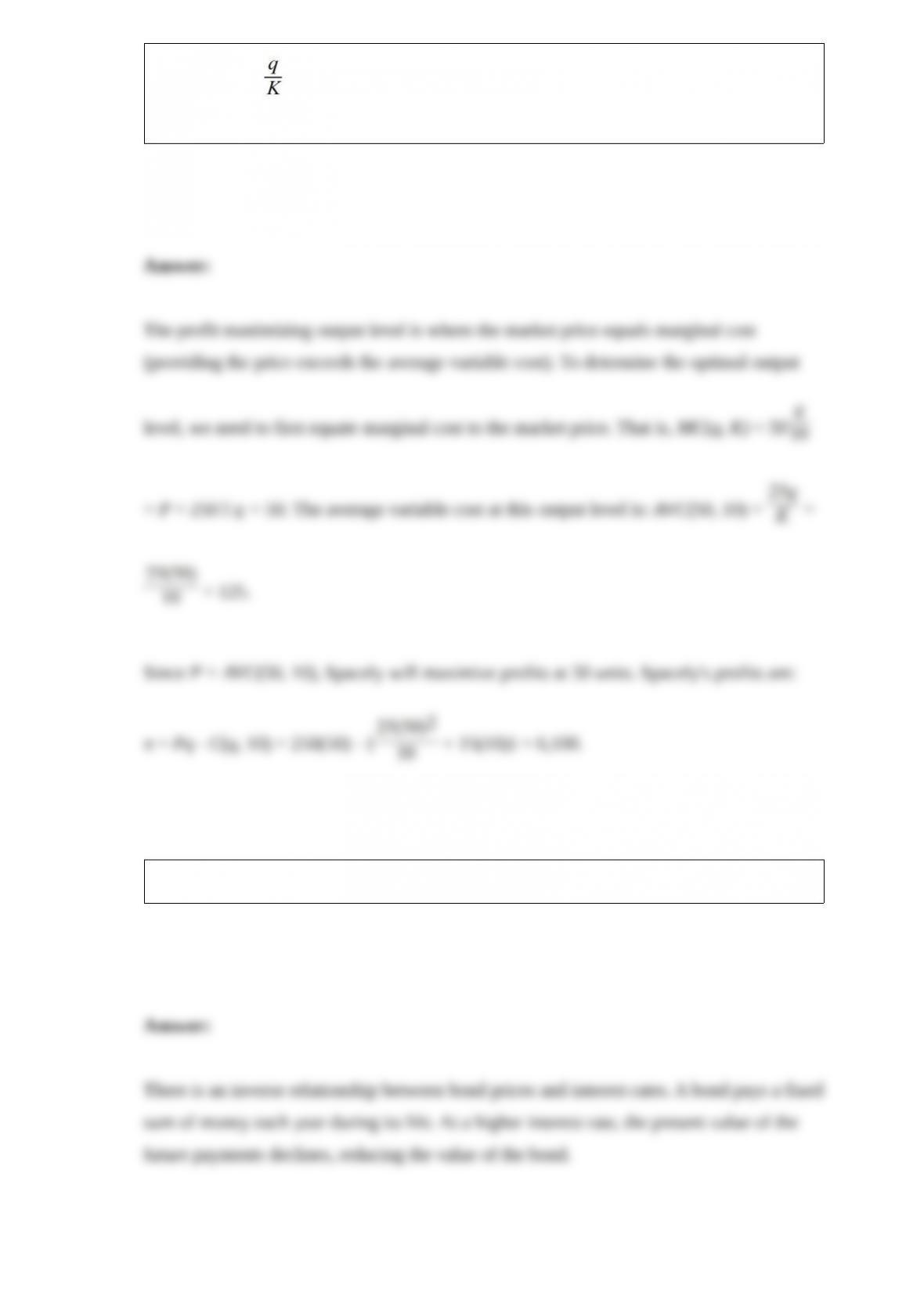
MC(q, K) = 50 . If Spacely receives $250 for every sprocket he produces, what is his
profit maximizing output level? Calculate Spacely’s profits.
What is the relationship between interest rates and bond prices? Explain.
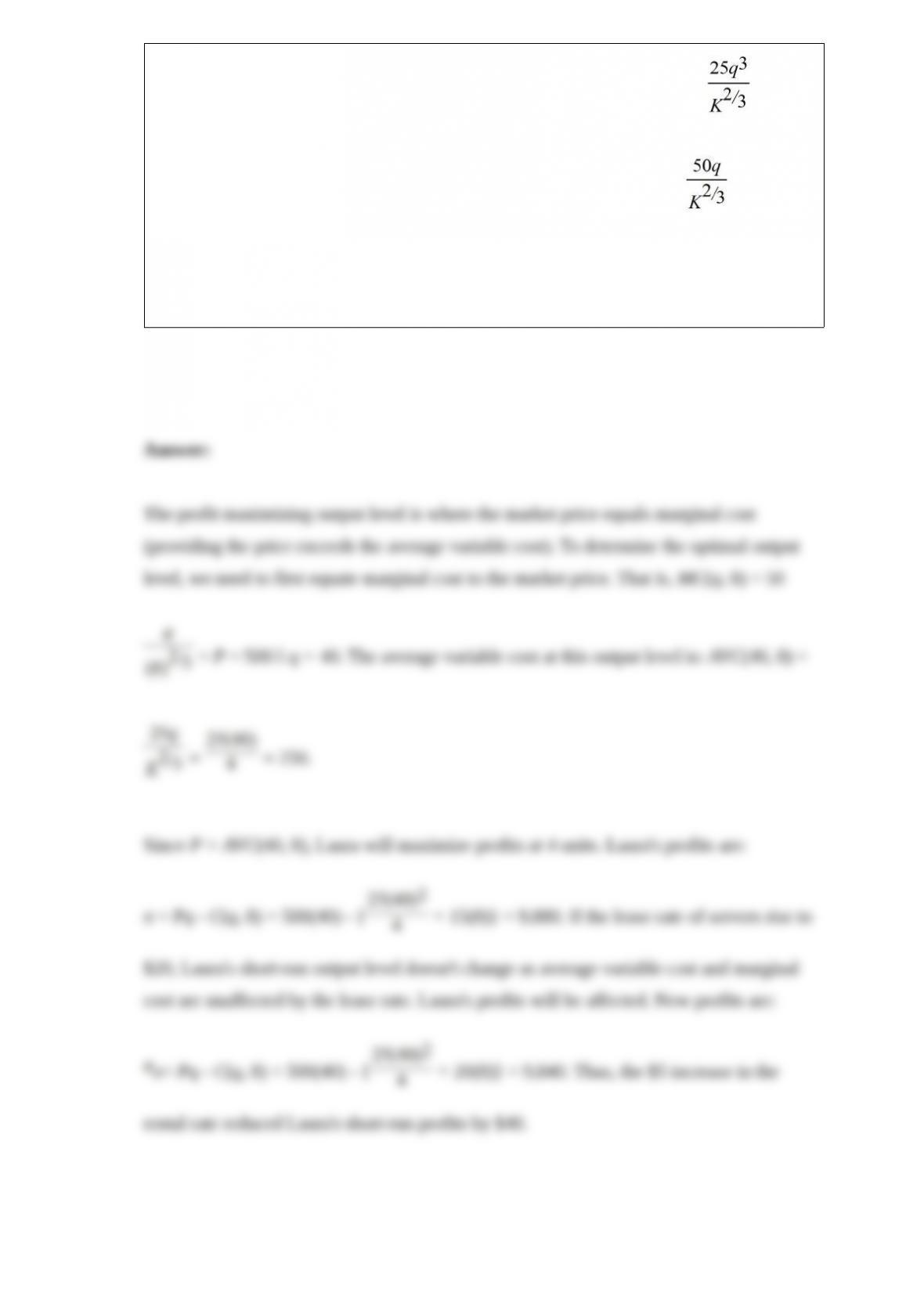
Laura’s internet services has the following short-run cost curve: C(q, K) = + rK
where q is Laura’s output level, K is the number of servers she leases and r is the lease
rate of servers. Laura’s short-run marginal cost function is: MC(q, K) = . Currently,
Laura leases 8 servers, the lease rate of servers is $15, and Laura can sell all the output
she produces for $500. Find Laura’s short-run profit maximizing level of output.
Calculate Laura’s profits. If the lease rate of internet servers rise to $20, how does
Laura’s optimal output and profits change?
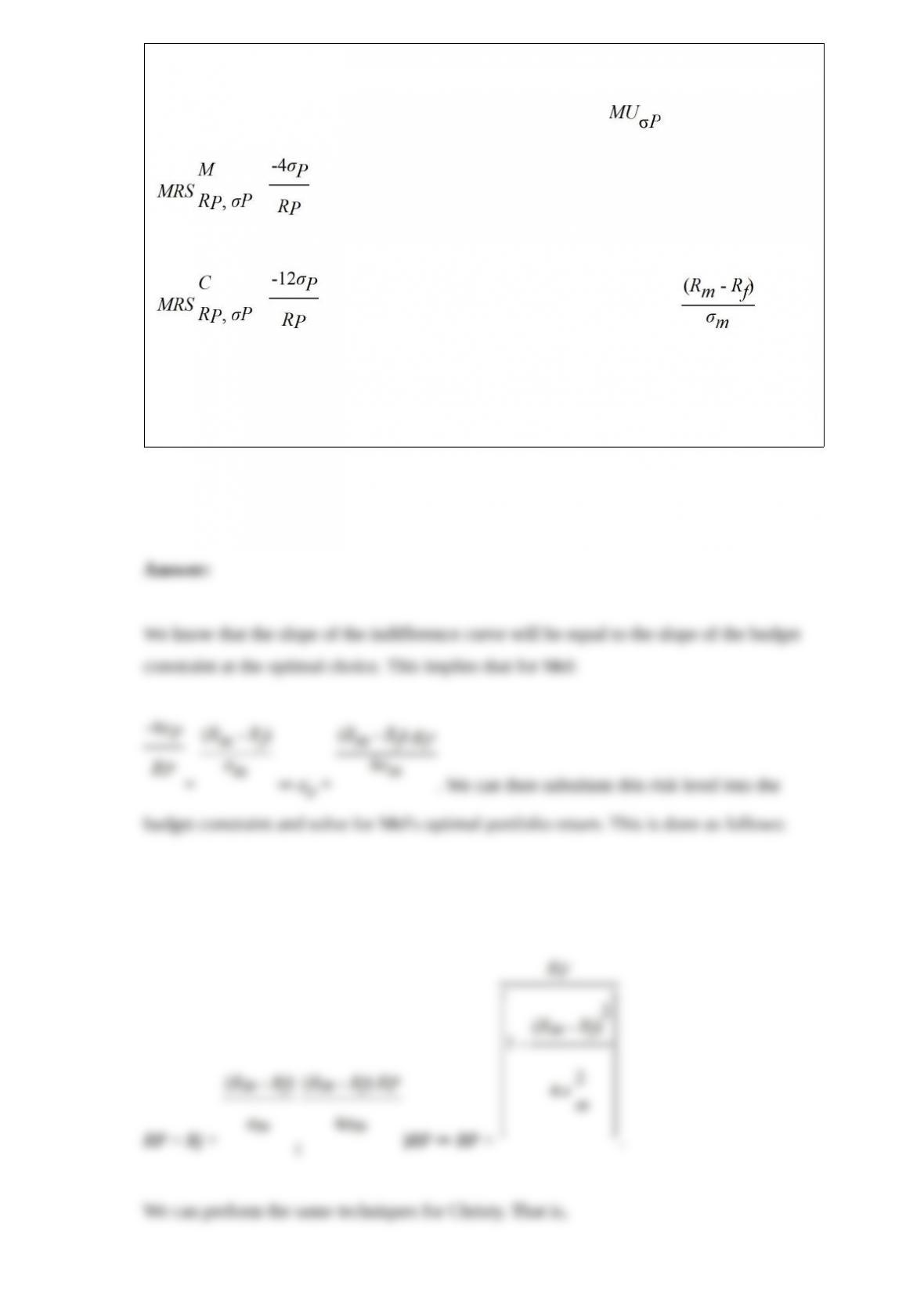
Mel and Christy are co-workers with different risk attitudes. Both have investments in
the stock market and hold U.S. Treasury securities (which provide the risk free rate of
return). Mel’s marginal rate of substitution of return for risk ( /MURP, σP) is
= where RP is the individual’s portfolio rate of return and σP is the
individual’s portfolio risk. Christy’s
= . Each co-worker’s budget constraint is RP=RF + σP,
where Rj is the risk-free rate of return, Rm is the stock market rate of return, and σm is
the stock market risk. Solve for each co-worker’s optimal portfolio rate of return as a
function of Rj, Rm, and σm.
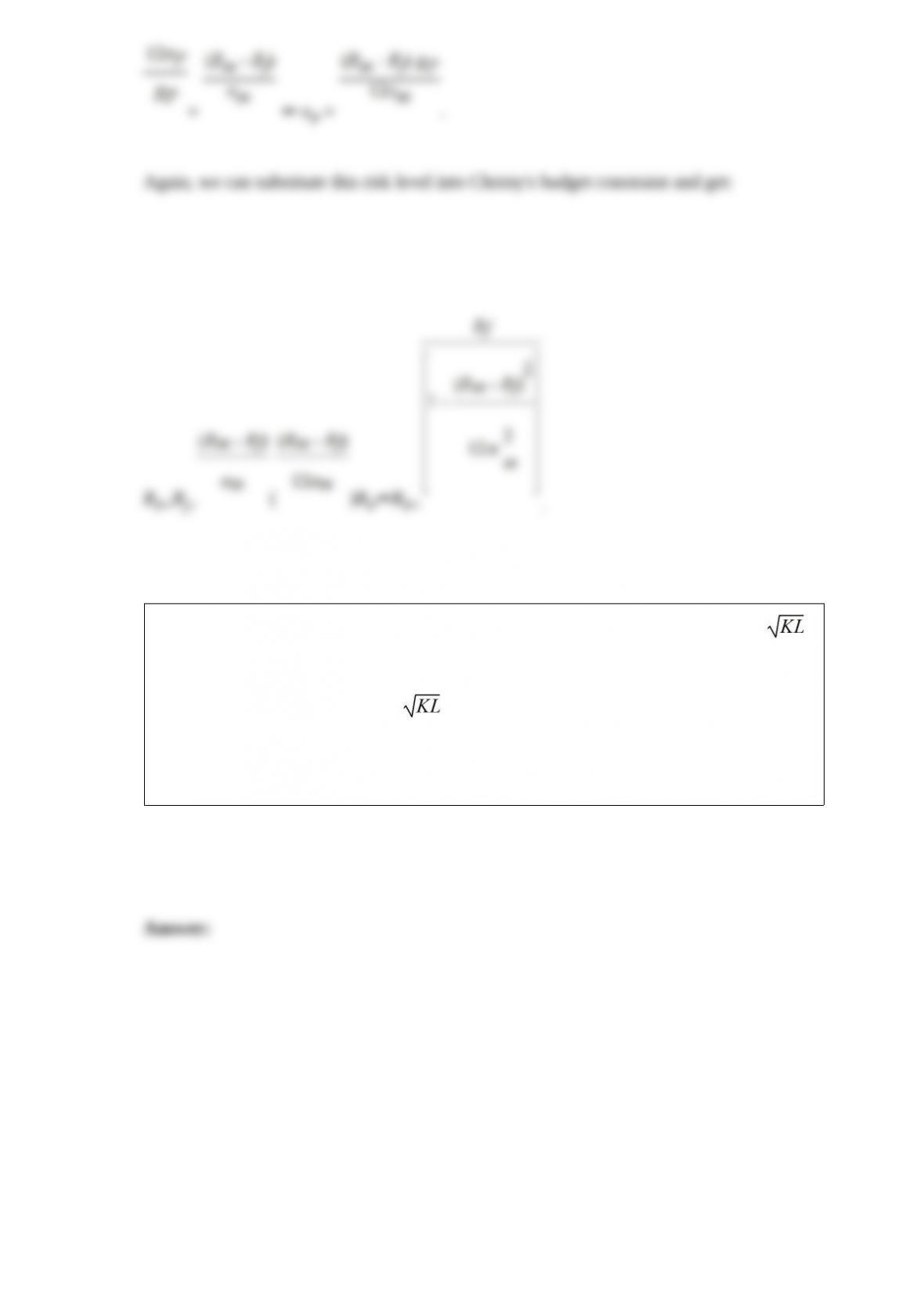
Ronald’s Outboard Motor Manufacturing plant production function is y(K, L) = 25 .
Ronald is investigating a new outboard motor manufacturing technique. Ronald
believes that if he adopts the new technique, his production function for outboard
motors will become: y(K, L) = 36 . Given that Ronald uses 4 units of machine
hours, sketch his production function with the old technique and the new technique as
he increases labor hours. With the new technique, do labor hours contribute more to
production?
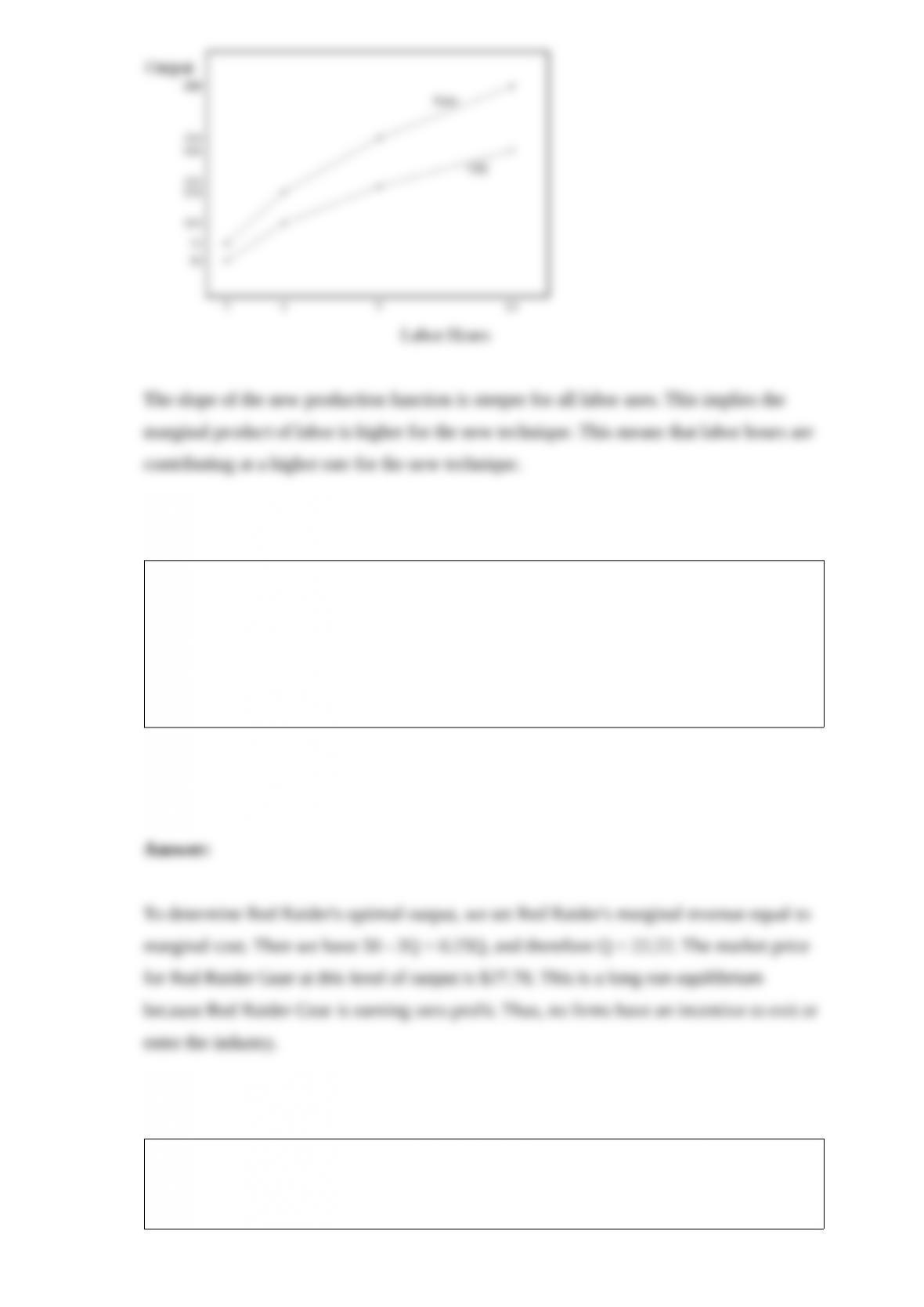
The market structure of Red Raider Gear is best characterized by monopolistic
competition. Red Raider Gear is one of the producers in this market. The demand for
Red Raider Gear is: Qd = 50 – P P = 50 – Qd. The resulting marginal revenue curve is
MR(Qd) = 50 – 2Qd. The Red Raider Gear cost function is C(Q) = (1/8)Q2 + 555.56.
Therefore we have MC (Q) = 0.25Q. Determine the profit maximizing level of output
and the price charged to customers for Red Raider Gear. Is this a long-run equilibrium?
The CPI in 1970 was 38.8 and in 1998 the CPI was 163.0. If the real value of a 1970
gallon of milk in terms of 1998 dollars is $0.70, what was the nominal price of milk in
1970?

The Vortex Corp. has an opportunity to invest $1,500,000 in investment A or in
investment B. Investment A promises to pay $500,000 profit at the end of the first year,
$550,000 at the end of two years, $600,000 at the end of three years, and $625,000 at
the end of four years. Investment B promises to pay $25,000 profit at the end of the first
year, $100,000 at the end of two years, $600,000 at the end of the third year, and
$1,000,000 at the end of four years. Assume that nine percent per year is an appropriate
discount rate for each investment. Also, assume a zero scrap value for each investment
at the end of four years. Determine which investment promises to be the better of the
two for the company.
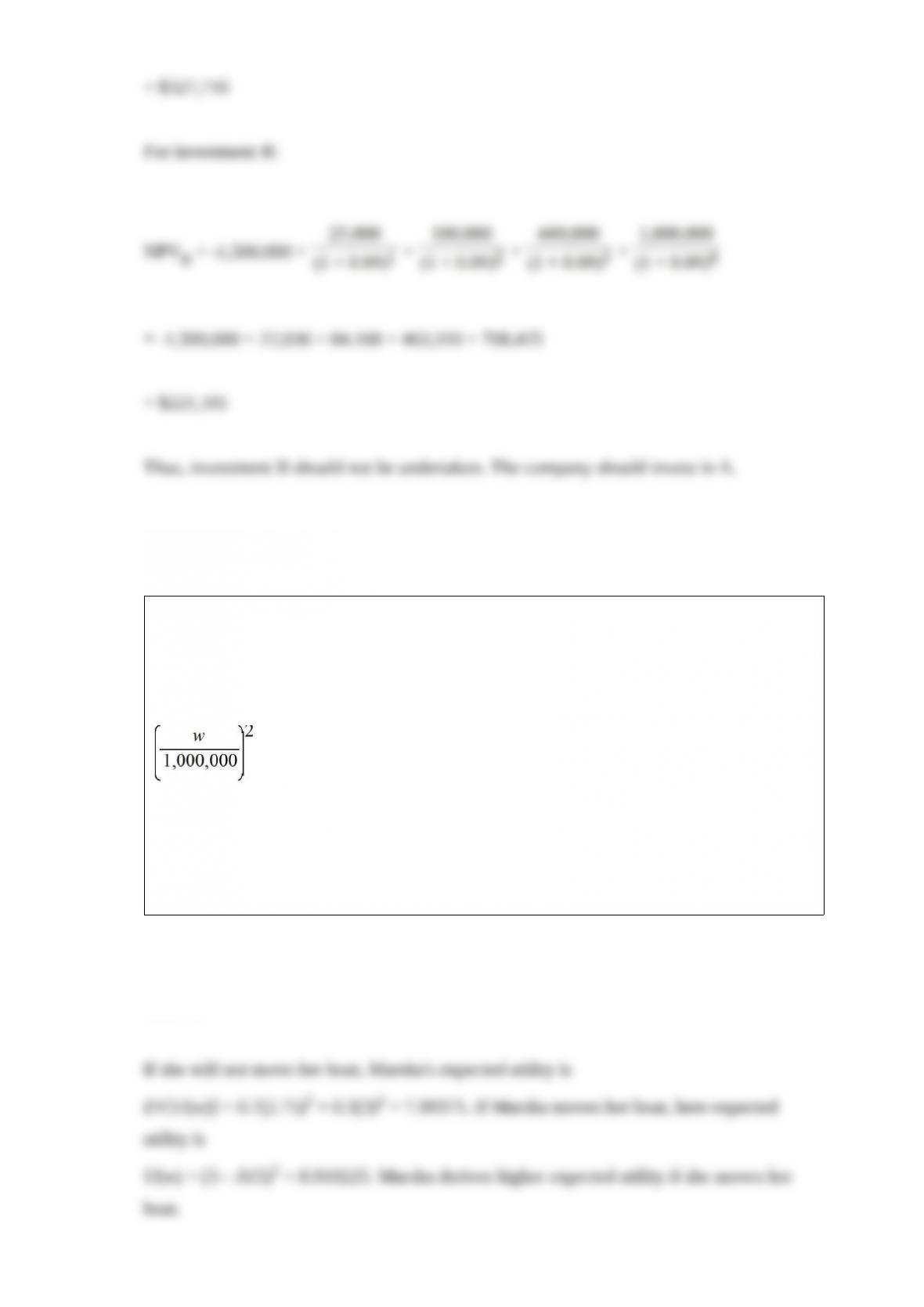
Marsha owns a boat that is harbored on the east coast of the United States. Currently,
there is a hurricane that is approaching her harbor. If the hurricane strikes her harbor,
her wealth will be diminished by the value of her boat, as it will be destroyed. The
value of her boat is $250,000. It would cost Marsha $15,000 to move the boat to a
harbor out of the path of the hurricane. Marsha’s utility of wealth function is U(w) =
. Marsha’s current wealth is $3 million including the value of the boat. Past
evidence has influenced Marsha to believe that the hurricane will likely miss her harbor,
and so she plans not to move her boat. Suppose the probability the hurricane will strike
Marsha’s harbor is 0.7. Calculate Marsha’s expected utility given that she will not move
her boat. Calculate Marsha’s expected utility if she moves her boat. Which of the two
options gives Marsha the highest expected utility?
Jim’s Hardware Supply has theft insurance. Jim also has an alarm system. The alarm
system has just recently malfunctioned. If Jim has the alarm system repaired, it will cost
him $100. The probability of a theft occurring is p = 0.0001. If a theft occurs and there
is no alarm system, the value of stolen materials will be $125,000. However, Jim’s
insurance will compensate him fully for the loss. No thefts will occur if the alarm
system is in place. What is the expected cost to Jim of repairing the alarm system? What
is the expected cost to society of not repairing the alarm system?
Farmer Brown grows wheat on his farm in Kansas, and the weather during the growing
season makes this a risky venture. Over the many years that he has been in business, he
has learned that rainfall patterns can be categorized as highly productive (HP) with a
probability of .2, moderately productive (MP) with a probability of .6, and not
productive at all (NP) with a probability of .2. With these various rainfall patterns, he
has also learned that the inflation adjusted yields are $25,000 with NP weather, $10,000
with MP weather, and $50,000 with HP weather. Calculate the expected yield from
growing wheat on Farmer Brown’s farm. What can be learned about Brown’s attitude
toward risk from this problem? Explain.
The market supply curve of rubber erasers is given by QS = 35,000 + 2,000P. The
demand for rubber erasers can be segmented into two components. The first component
is the demand for rubber erasers by art students. This demand is given by qA = 17,000 –
250P. The second component is the demand for rubber erasers by all others. This
demand is given by qO = 25,000 – 2000P. Derive the total market demand curve for
rubber erasers. Find the equilibrium market price and quantity. Also, determine the
consumer surplus for each component of demand.
Ms. Moneynickel has a monopoly in oil refinement in the local market. The demand for
Ms. Moneynickel’s oil is: P = 75 – q. The relevant marginal revenue function is: MR(q)
= 75 – 2q. Ms. Moneynickel’s marginal cost function is: MC(q) = 5q. In the refinement
of oil, Ms. Moneynickel emits pollution that has the marginal external cost function:
MEC(q) = What level of output will Ms. Moneynickel select to maximize profits? What
is the marginal social cost of Ms. Moneynickel’s profit maximizing output? What do
consumers pay for Ms. Moneynickel’s refined oil? Is this level of output efficient?
Should more or less oil be refined to reach the optimum output level? Should the local
government charge Ms. Moneynickel a pollution fee for each unit of oil she refines?