A person buys a bond with a face value of $10,000 for $9,325. Each year until the
maturity date the bond buyer receives a coupon payment of
$650 from the issuer of the bond. The coupon rate on the bond is
a. 9.11 percent.
b. 6.5 percent.
c. 7.0 percent.
d. 6.75 percent.
Evidence seems to indicate that the distribution of income prior to adjusting for taxes
and in-kind transfer payments is
a. less equal than after adjusting for taxes and in-kind transfer payments.
b. more equal than after adjusting for taxes and in-kind transfer payments.
c. the same as after adjusting for taxes and in-kind transfer payments.
d. impossible to determine.
The demand curve facing a monopolistic competitive firm will be __________ than the
demand curve facing a perfectly competitive firm because the price elasticity of
demand for the monopolistic competitive firm’s product is __________ than that for the
perfectly competitive firm.
a. steeper; higher
b. flatter; higher
c. steeper; lower
d. flatter; lower
Diseconomies of scale are said to exist when inputs are increased by some percentage
and output increases by a(n) __________ percentage, causing unit costs to __________.
a. greater; fall
b. smaller; fall
c. greater; rise
d. smaller; rise
e. equal; fall
If union action leads to a rise in the relative price of factors that are substitutes for union
labor,
a. the supply of union labor falls.
b. the quantity demanded of union labor falls.
c. the demand for union labor rises.
d. the supply of union labor rises.
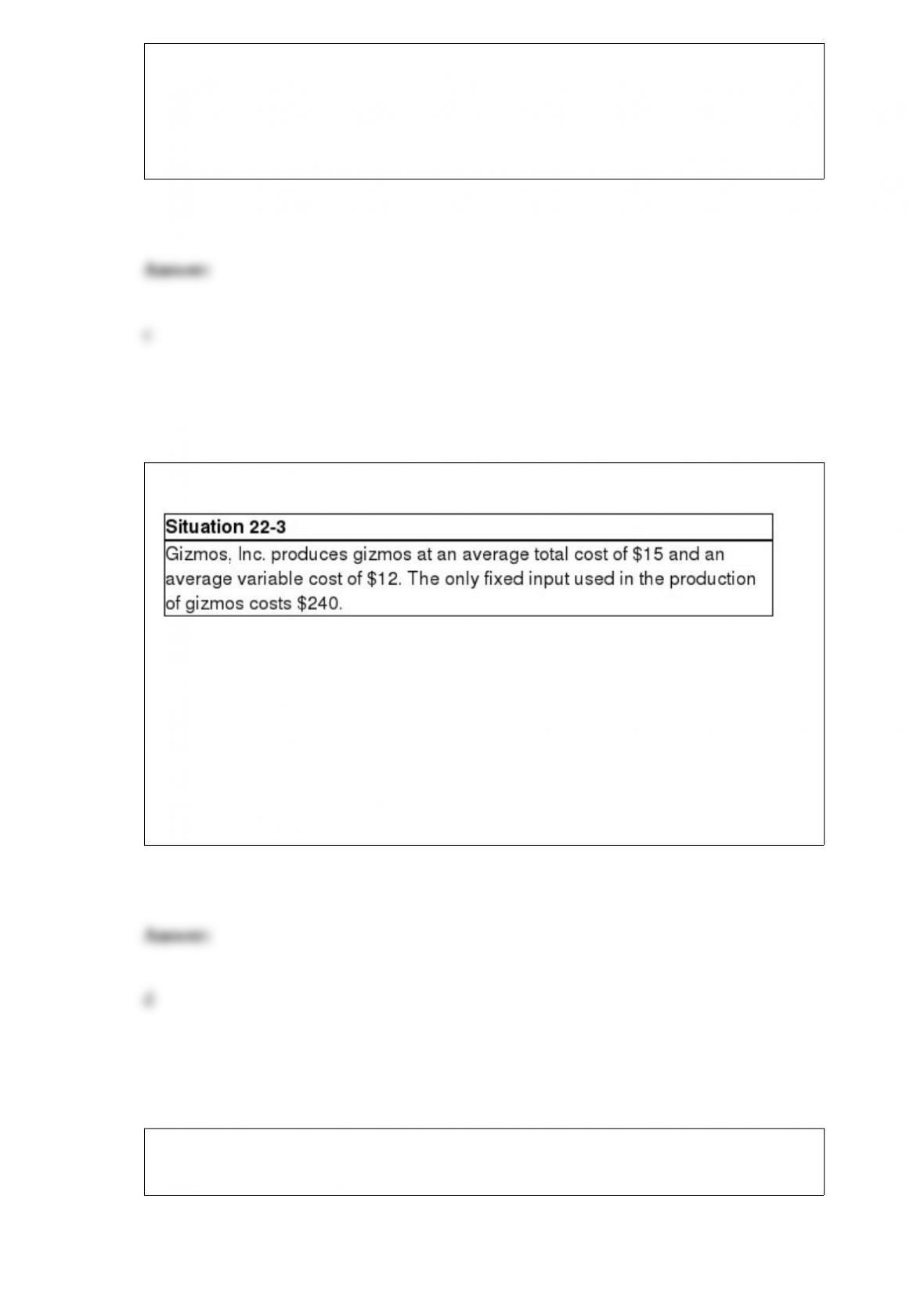
Refer to Situation 22-3. What are the total variable costs?
a. $1,200
b. $2,400
c. $840
d. $960
e. There is not enough information to answer the question.
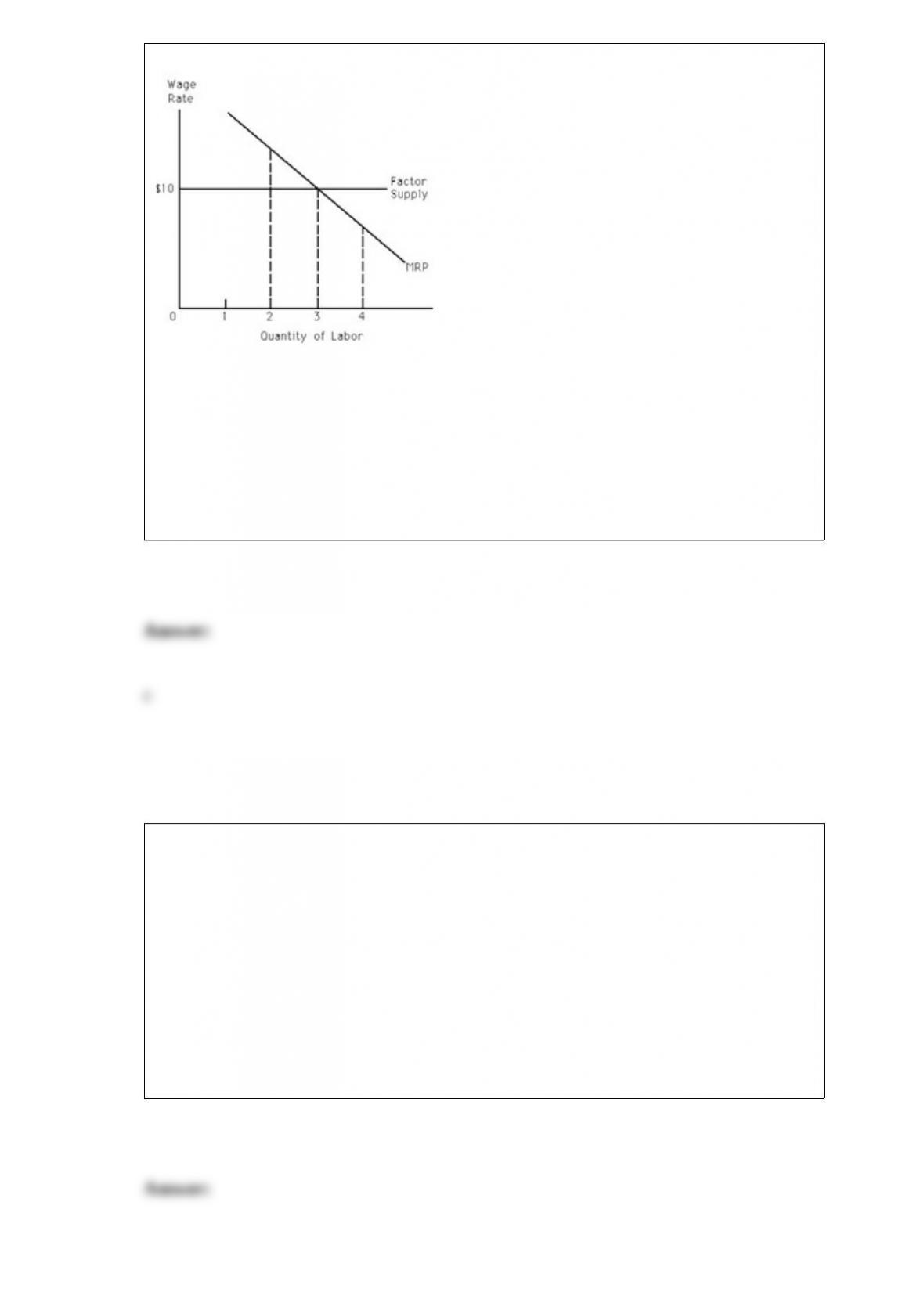
Refer to Exhibit 27-4. How many units of labor should this firm employ?
Exhibit 27-4
a. 1
b. 2
c. 3
d. 4
Vernon spends the following percentages of his budget on the goods A, B, C, and D: 23
percent on good A, 11 percent on good B, 1 percent on good C, and 3 percent on good
D. For which good is price elasticity of demand the highest, ceteris paribus?
a. good A
b. good B
c. good C
d. good D
For a natural monopoly firm, the resource-allocative efficient output is 200 units. The
highest per-unit price that can be charged for this output is $3. Average total cost at 200
units is $3.50. For the natural monopoly firm that produces and sells 200 units of
output,
a. marginal cost is below its average total cost.
b. it takes losses of $0.50 per unit.
c. fixed costs must be zero.
d. a and b
e. b and c
Two candidates, Smith and Jones, are running for the same political office. Last night
they were in a debate. It is generally accepted that Smith is perceived more to the left
after the debate than before the debate. This is bad news for Jones if before the debate
Smith was perceived
a. too far right.
b. too far left.
c. as being in the middle of the political spectrum.
d. b or c
e. none of the above
At a price below the equilibrium price, there is
a. a surplus.
b. a shortage.
c. excess supply.
d. sub-equilibrium.
e. none of the above
If Smith will give up three units of Y to get one additional unit of X, then
a. he has transitive preferences.
b. his budget constraint is upward sloping.
c. his indifference curve is downward sloping.
d. the price of X must be three times as high as the price of Y.
e. none of the above
The social insurance justification for government welfare assistance holds that
a. individuals want to provide welfare assistance to the needy because this is the right
thing to do.
b. individuals currently not receiving welfare think they might one day need welfare
assistance and thus they support welfare programs today.
c. it is society’s duty or obligation to provide health insurance to those who cannot
afford it.
d. a person benefits from the alleviation of poverty even if he doesn’t contribute to
alleviating poverty.
e. none of the above
A negative externality can be internalized by
a. persuasion.
b. the imposition of a tax.
c. the assignment of property rights.
d. a voluntary agreement.
e. all of the above
The monopolist’s demand curve is perfectly inelastic.
a. True
b. False
Which of the following is not an assumption of the theory of monopoly?
a. There is one seller.
b. The single seller sells a product for which there are many close substitutes.
c. There are extremely high barriers to entry.
d. b and c
e. a and c