Suppose the supply curve for digital cameras shifts to the right. This will cause a
relatively large decrease in the price of digital cameras if both demand and supply are
inelastic.
GDP is not a complete measure of well-being.
The Fed can use expansionary monetary policy to lower interest rates to stimulate
aggregate demand.
Since 1960, out-of-pocket spending on health care has increased sharply as a fraction of
all health care spending.

The principal-agent problem that exists between shareholders and managers also exists
between managers and workers.
One problem with using a command and control approach to pollution reduction is that
the monitoring costs may be too high.
Among countries that purchased U.S. stocks and bonds in 2012, China was the biggest
customer, accounting for over 50 percent of all purchases.
The basis for trade is comparative advantage, not absolute advantage.

If a firm’s total variable cost exceeds its total revenue, the firm should stop production
by shutting down temporarily.
Demand for staples such as dairy products and bread is likely to be both income and
price inelastic.
An economic model is a complex version of reality used to analyze real-world
economic situations.
The ability of a firm or country to produce a good or service at a lower opportunity cost
than other producers is called absolute advantage.

If inflation falls from 11% to 5%, there is deflation.
Real GDP per capita is calculated by dividing the value of real GDP for a country by
the country’s adult population.
What is a ‘structural” relationship?
A) a relationship that depends on the size of firm investments in capital such as
buildings and other structures
B) a relationship that depends on the basic behavior of consumers and firms and
remains unchanged over long periods
C) a relationship between any two variables that is temporary
D) any relationship that cannot be anticipated
Suppose Congress increased spending by $100 billion and raised taxes by $100 billion
to keep the budget balanced. What will happen to real equilibrium GDP?
A) Real equilibrium GDP will fall.
B) Real equilibrium GDP will rise.
C) There will be no change in real equilibrium GDP.
D) Real equilibrium GDP will initially rise, but then fall below its previous equilibrium
value.
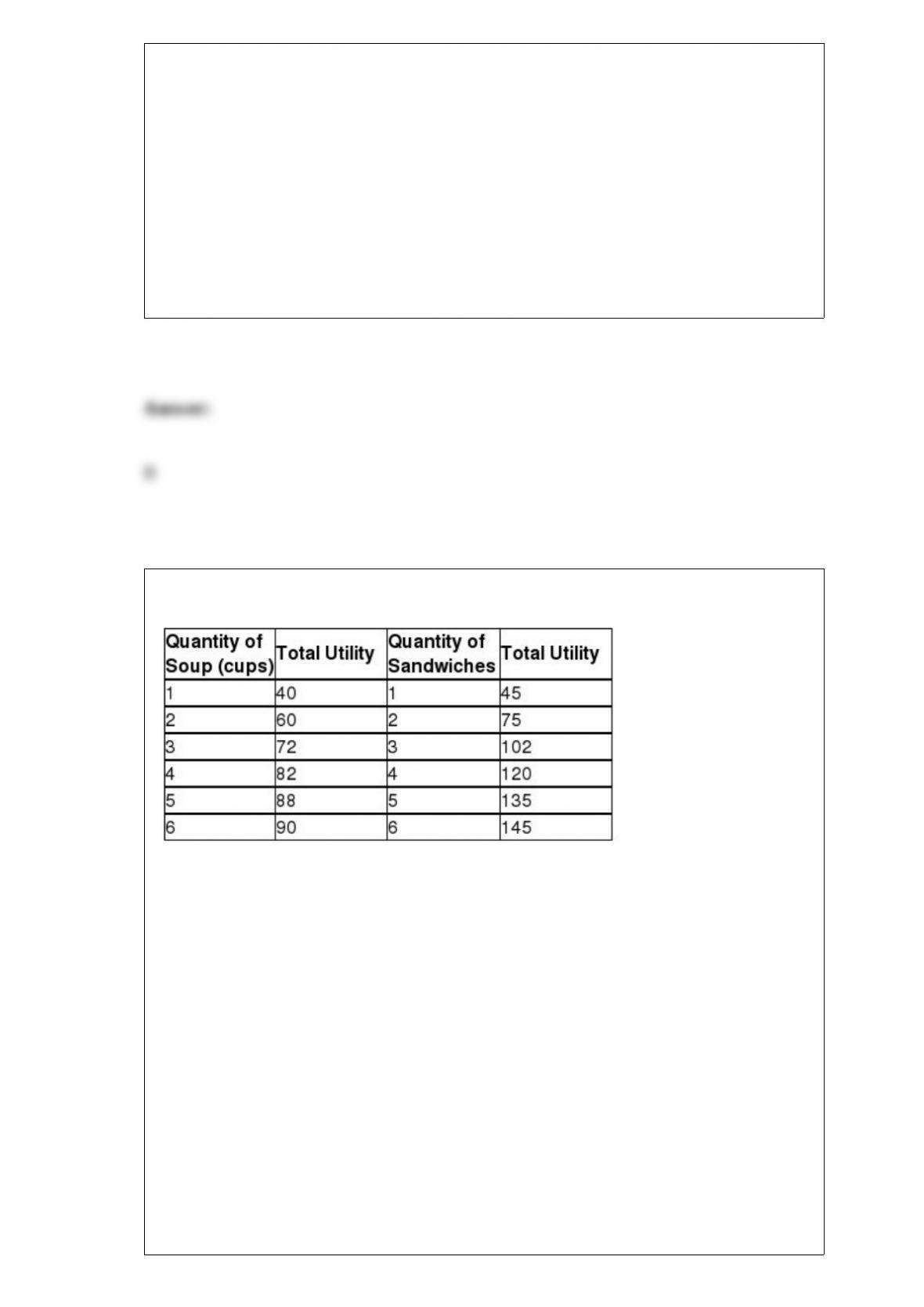
Table 10-2
Table 10-2 above shows Keira’s utility from soup and sandwiches. The price of soup is
$2 per cup and the price of a sandwich is $3. Keira has $18 to spend on these two
goods. Holding prices constant, when Keira’s income changes from $18 to $23, what
happens to her total utility and to the marginal utilities of the last cup of soup and the
last sandwich purchased?
A) Her total utility increases, but the marginal utilities of the last cup of soup and the
last sandwich consumed decrease.
B) Her total utility, the marginal utility of the last cup of soup consumed and the
marginal utility of the last sandwich consumed, all increase.
C) Her total utility decreases, but the marginal utilities of the last cup of soup and the
last sandwich consumed increase.
D) Her total utility and the marginal utility of the last cup of soup consumed increase,
but marginal utility of the last sandwich consumed decreases.
E) Her total utility and the marginal utility of the last sandwich consumed increase, but
marginal utility of the last cup of soup consumed decreases.
Which of the following describes the growth in real GDP per person in the United
States from 1900 to the present?
A) It has decreased.
B) It has increased by more than eight times.
C) It has doubled.
D) It has increased twenty times.
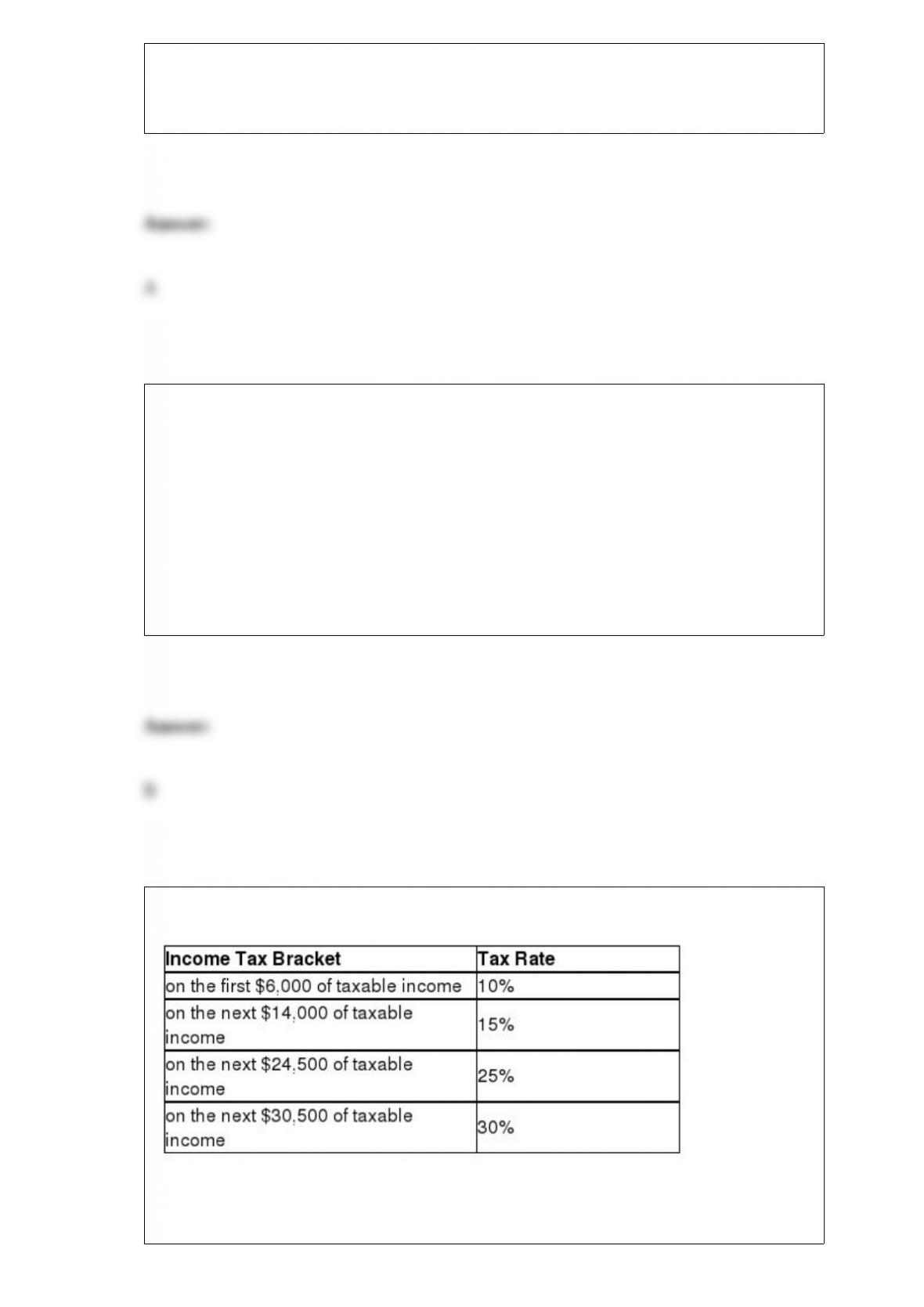
Table 18-10
Table 18-10 shows the income tax brackets and tax rates for single taxpayers in
Bauxhall. A tax exemption is granted for the first $10,000 earned per year. Suppose you
earn $75,000.

a. What is the amount of taxes you will pay?
b. What is your average tax rate?
c. What is your marginal tax rate?
An avocado orchard employs five full-time workers. Currently, the average product of
labor is 120 pounds of avocados per day. The orchard hires a 6th full-time worker and
his marginal product is 150 pounds of avocados. The average product of the six workers
will now be
A) more than 120 pounds.
B) less than 120 pounds.
C) equal to 120 pounds.
D) less than the marginal product of labor.
The international trade effect states that
A) an increase in the price level will raise net exports.
B) an increase in the price level will lower net exports.
C) an increase in the price level will raise exports.
D) an increase in the price level will lower imports.
In a typical year, ________ of new jobs are created by small firms.
A) less than 5 percent
B) 10 percent
C) 40 percent
D) 75 percent
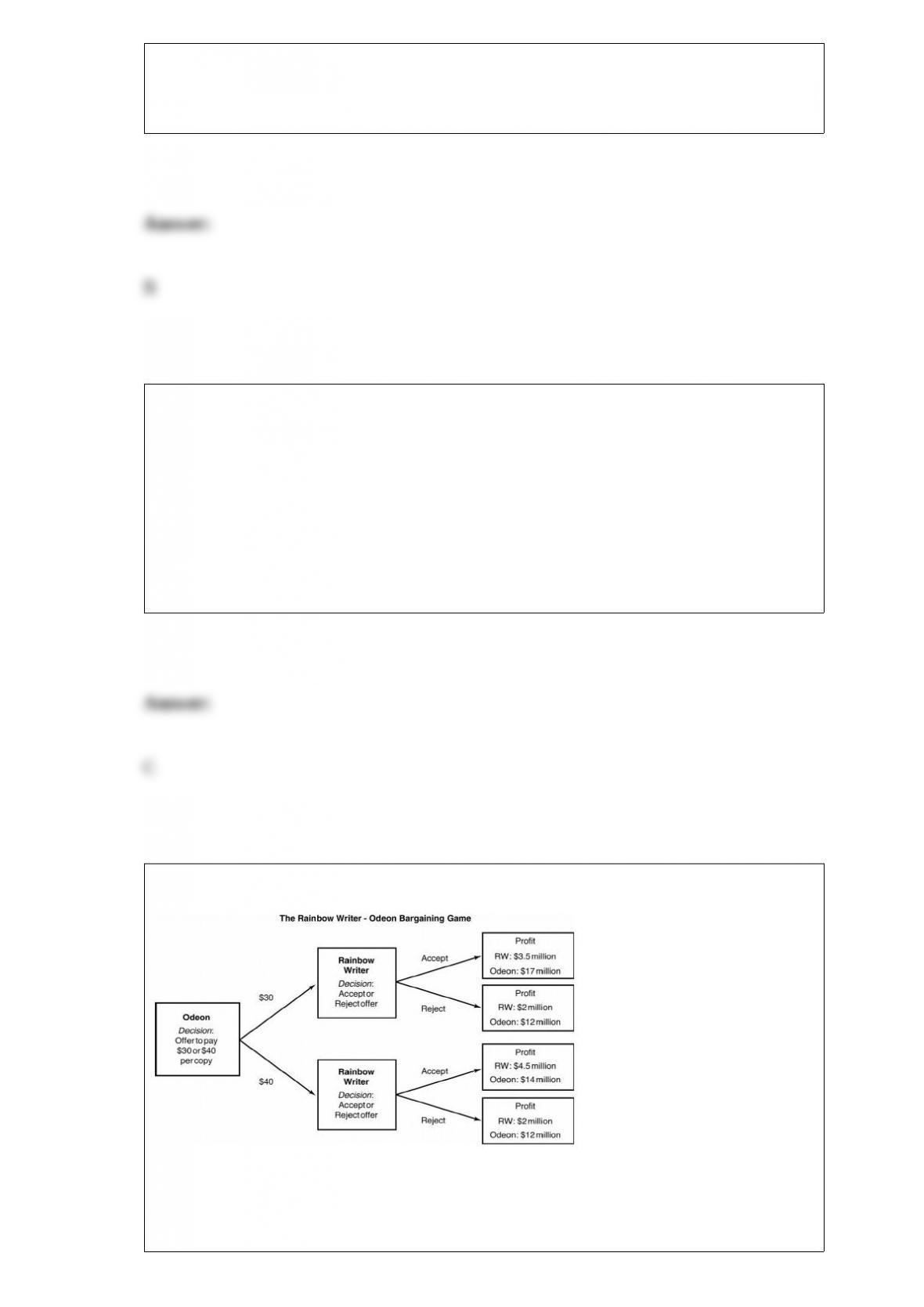
Figure 14-4
Rainbow Writer (RW) is a
small online company selling a highly rated software package for printing color labels
directly onto CDs. The firm currently earns a profit of $2 million per year selling its
package exclusively on its Web site. Odeon, the producer of the most popular software
package for editing and burning CDs and DVDs, has expressed interest in bundling

Rainbow Writer’s product into its own package. Odeon expects that bundling would
further boost its sales and allow it to sell the new bundled product at a higher price, thus
raising its profits beyond its current profit of $12 million. Figure 14-4 shows the
decision tree for the Rainbow Writer-Odeon bargaining game.
How will Rainbow Writer respond to Odeon’s two possible offers?
A) Rainbow Writer will reject either offer.
B) Rainbow Writer will only accept an offer of $30 per copy of the software package.
C) Rainbow Writer will only accept an offer of $40 per copy of the software package.
D) Rainbow Writer will accept either offer.
Electric car manufacturers want to sell more electric cars at a higher price. Which of the
following events would have this effect?
A) technological advancement in the production of electric car batteries.
B) an increase in the number of manufacturers of electric cars.
C) a decrease in the price of lithium, which is used in the electric car batteries.
D) an increase in the price of gasoline.
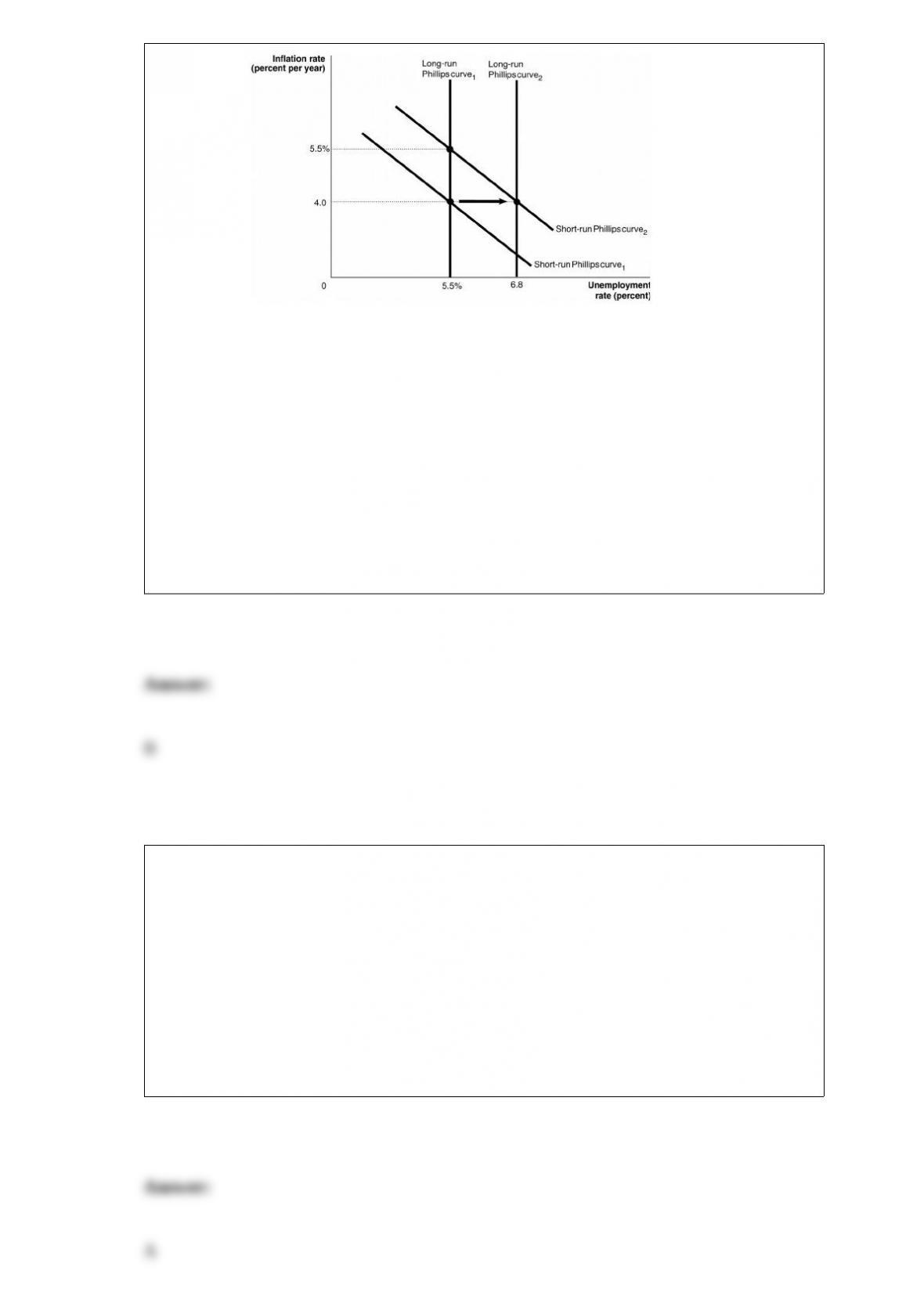
Figure 28-3
The shifts shown in the short-run and long-run Phillips curves between period 1 and
period 2 could be explained by
A) an increase in the expected inflation rate from 4.0 to 5.5 percent.
B) an increase in the natural rate of unemployment from 5.5 to 6.8 percent.
C) either an increase in expected inflation from 4.0 to 5.5 percent or an increase in the
natural rate of unemployment from 5.5 to 6.8 percent.
D) None of the above is correct.
In a competitive market the ________ curve shows the marginal benefit received by
consumers and the ________ curve shows the marginal cost to producers.
A) demand; supply
B) supply; demand
C) demand; market demand
D) supply; market supply
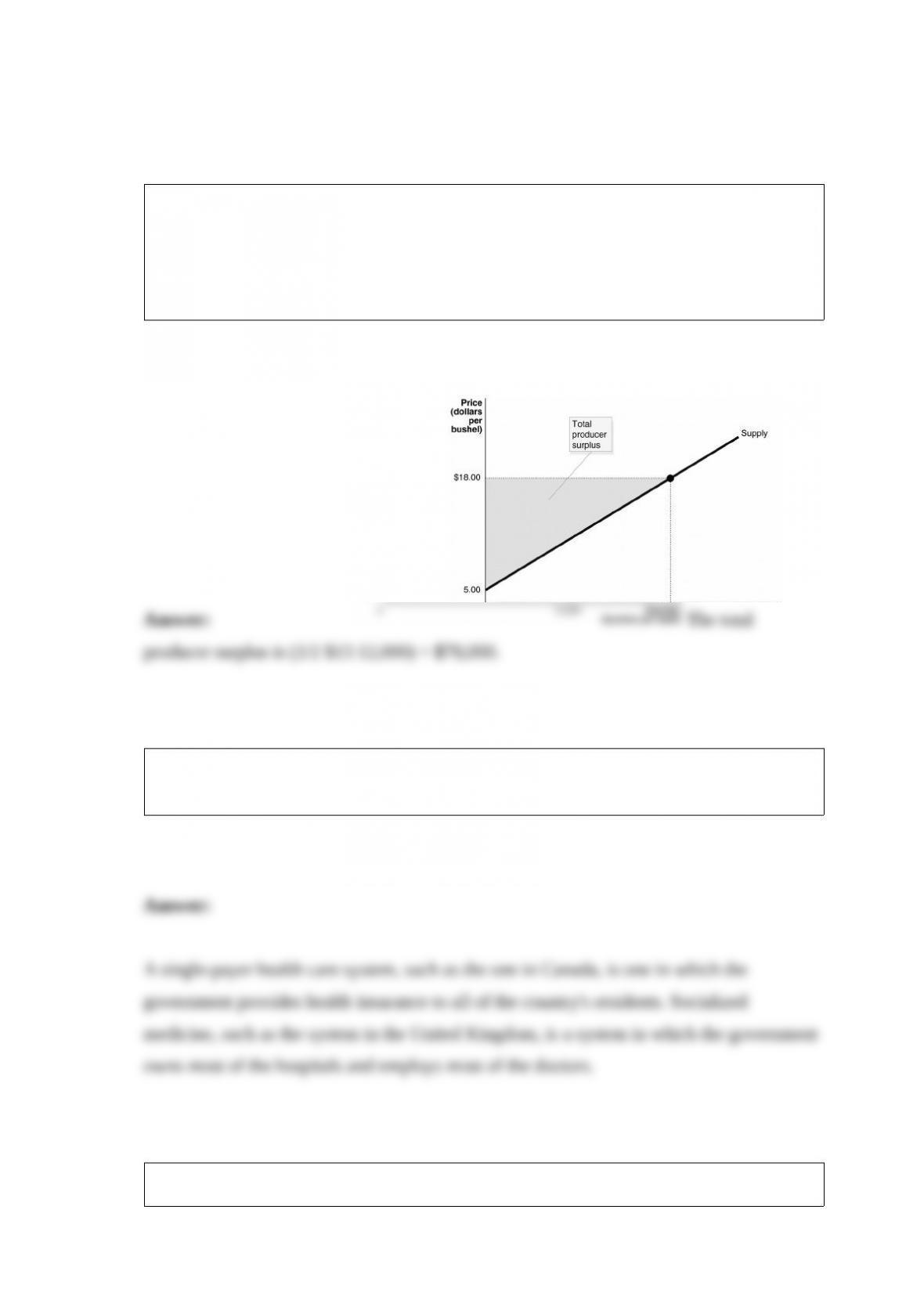
Assume the market price for tangerines is $18.00 per bushel. At the market price,
tangerine growers are willing to supply a quantity of 12,000 bushels per week. The
quantity supplied drops to zero when the price falls to $5.00 per bushel. Construct a
graph showing this data, calculate the total producer surplus in the market for
tangerines, and show the total producer surplus on the graph.
What is the main Difference between a single-payer health care system and socialized
medicine?
What does it mean when one currency is “pegged” against another currency?

How do the price and quantity of a monopoly compare to that of a perfectly competitive
industry?
What is the difference between between total costs, variable costs, and fixed costs?
What causes a production possibilities frontier to shift outward?

If the labor demand curve shifts to the right and the labor supply curve remains
unchanged, what will happen to the equilibrium wage and the equilibrium level of
employment? Illustrate your answer with a graph.
Table 26-4