
1) If country A can produce both goods X and Y more efficiently, that is, with smaller
absolute amounts of resources, than can country B:
A.mutually advantageous specialization and trade between A and B may still be
possible.
B.we can conclude that A is an industrially advanced economy and B is a developing
economy.
C.it will necessarily be advantageous for B to import both X and Y from A
D.then there is no possible basis for mutually advantageous specialization and trade
between A and B
2) the total income earned in any year by u.s. resource suppliers, plus taxes on
production and imports, is measured by:
a.di.
b.ni.
c.pi.
d.gdp.
3) If a nation imposes tariffs and quotas on foreign products, the immediate effect will
be to:
A.reduce the rate of domestic inflation.
B.increase efficiency in the world economy.
C.increase domestic output and employment.
D.reduce domestic output and employment.
4) the demand for a luxury good whose purchase would exhaust a significant portion of
one’s income is:
a.perfectly inelastic.
b.perfectly elastic.
c.relatively inelastic.
d.relatively elastic.
5) the main function of the entrepreneur is to:
a.make routine pricing decisions.
b.innovate.
c.purchase capital.
d.create market demand.
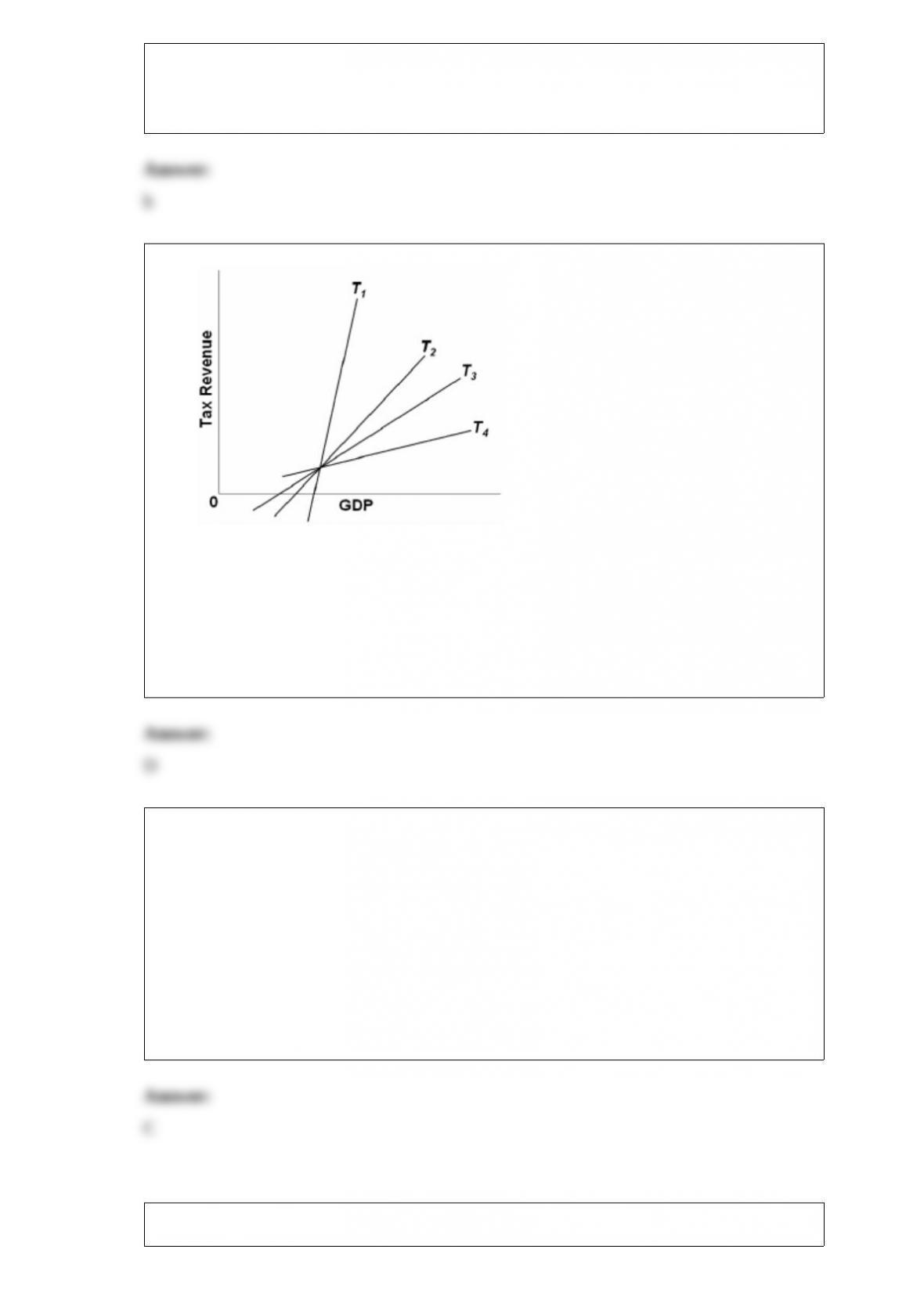
6)
Refer to the above diagram. Which tax system will generate the largest cyclical
deficits?
A.T4
B.T3
C.T2
D.T1
7) When the required reserve ratio is decreased, the excess reserves of member banks
are:
A.reduced, but the multiple by which the commercial banking system can lend is
unaffected.
B.reduced and the multiple by which the commercial banking system can lend is
increased.
C.increased and the multiple by which the commercial banking system can lend is
increased.
D. increased and the multiple by which the commercial banking system can lend is
reduced.
8) if a pure monopolist can engage in price discrimination:

a.the marginal revenue curve and the total revenue curve will now coincide.
b.the marginal revenue curve will now shift to a position above the demand curve.
c.the firm will face multiple marginal revenue curves.
d.marginal revenue will become less at each level of output than it would be without
price discrimination.
9) which of the following is correct?
a.when total product is rising, both average product and marginal product must also be
rising.
b.when marginal product is falling, total product must be falling.
c.when marginal product is falling, average product must also be falling.
d.marginal product rises faster than average product and also falls faster than average
product.
10) a nation’s true gain from international trade is:
a.increased employment in export industries.
b.an overall increase in output obtained through specialization and exchange.
c.added technological knowledge.
d.the tariff revenue that goes to the national treasury.
11) the basic characteristic of the short run is that:
a.barriers to entry prevent new firms from entering the industry.
b.the firm does not have sufficient time to change the size of its plant.
c.the firm does not have sufficient time to cut its rate of output to zero.
d.a firm does not have sufficient time to change the amounts of any of the resources it
employs.
12) determine, other things equal, the effects of a given change in a determinant of
demand or supply for product x upon (1) the demand (d) for, or supply (s) of, x, (2) the
equilibrium price (p) of x and (3) the equilibrium quantity (q) of x.
refer to the above. a decrease in the number of consumers of product x will:
a.decrease s, decrease p, and decrease q.
b.increase d, increase p, and increase q.
c.decrease d, decrease p, and decrease q.
d.decrease d, decrease p, and increase q.
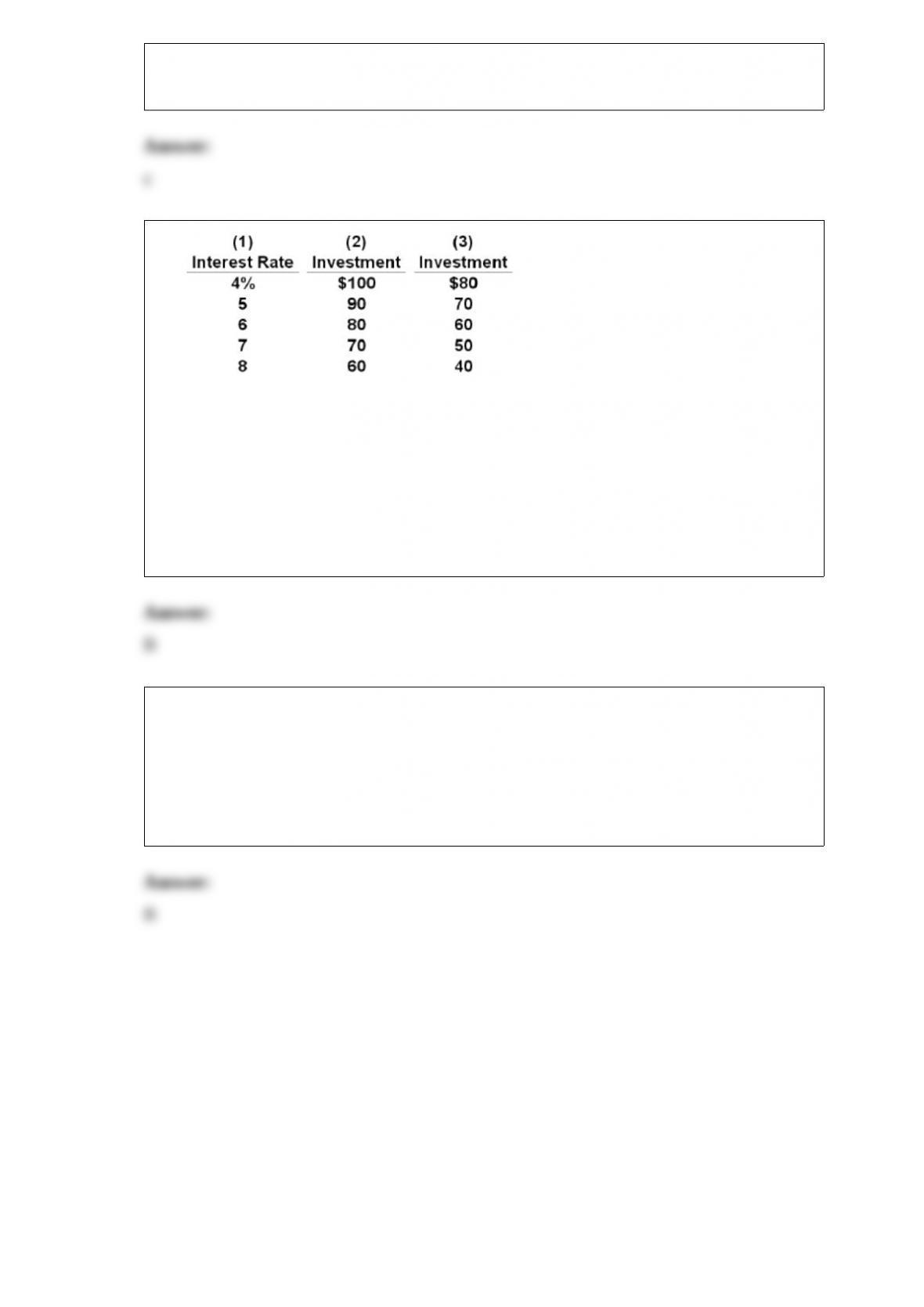
13)
Refer to the above table, in which investment is in billions. Suppose the Fed reduces the
interest rate from 6 to 5 percent at a time when the investment demand declines from
that shown by columns (1) and (2) to that shown by columns (1) and (3). As a result of
these two occurrences, investment will:
A.increase by $10 billion.
B.decrease by $10 billion.
C.increase by $20 billion.
D.decrease by $20 billion.
14) According to Congressional Budget Office projections made in March 2006, the
Federal budget is expected to remain in deficit until when?
A.2010
B.2012
C.2015
D.2020
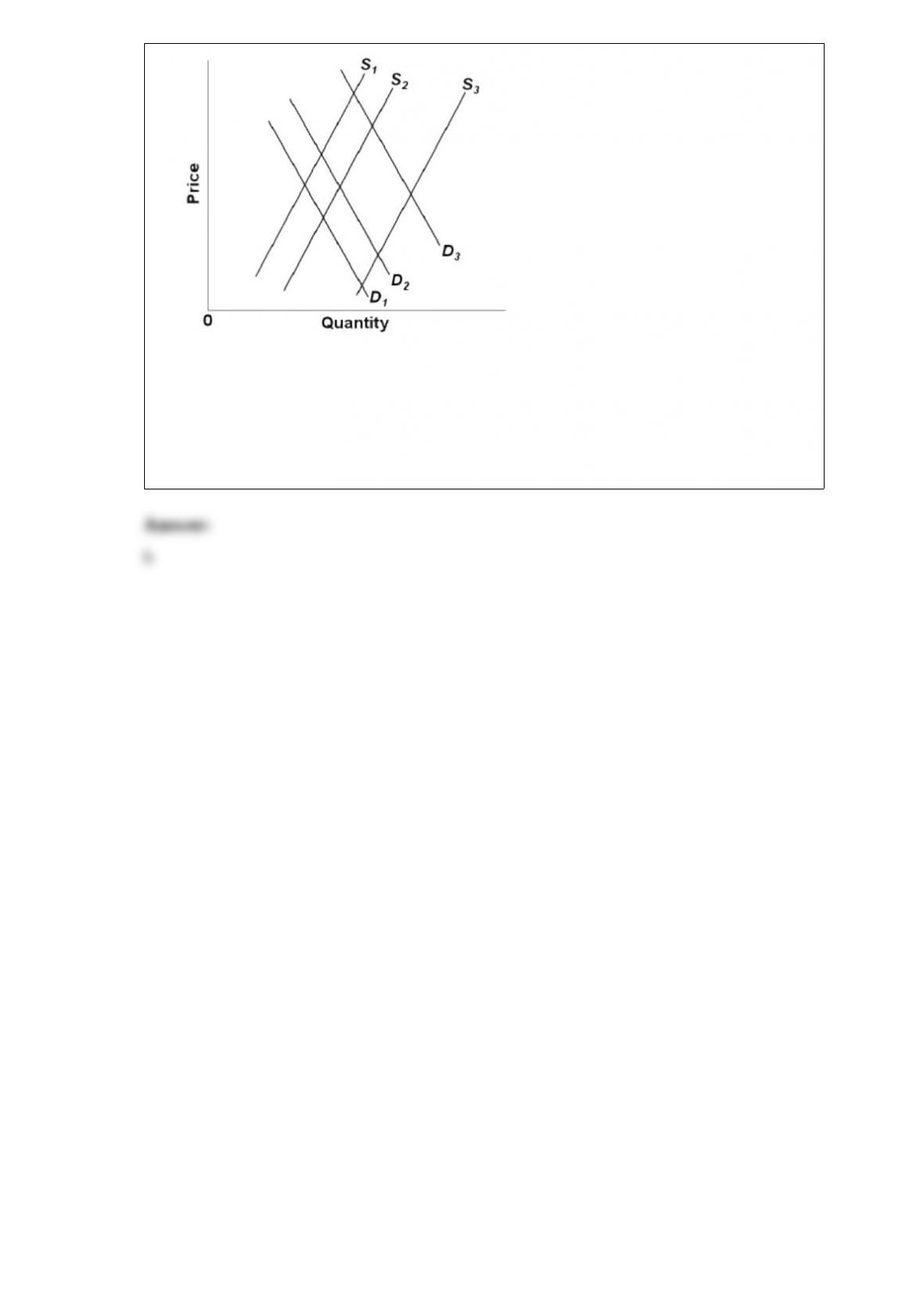
15)
refer to the above figure that shows the market for u.s. health care. other things equal,
which of the following would shift the supply curve for medical care from s2 to s1?
a.an aging population.
b.cost-increasing medical technology.
c.expansion of the medicare program to include prescription drugs.
d.lower medical malpractice insurance premiums.