
The term “market” refers only to trading arrangements that have been approved by the
government.
Contractionary fiscal policy involves decreasing government purchases or increasing
taxes.
Economies cannot function without money.
There are no costs to inflation if it is fully anticipated.

Investment (I) in the United States may increase with either an increase in national
saving or an increase in net foreign investment.
If consumers paid the full price of medical services instead of using health insurance
and third-party payers to cover part of the cost, the quantity of medical services
provided would decrease.
In 2012, Smileytown consumed 50,000 tubes of toothpaste. In 2013, toothpaste
consumption rose to 62,000 tubes. Calculate the percentage change in toothpaste
consumption.
A) 12%
B) 16.42%
C) 19.35%
D) 24%

Which of the following is a normative economic statement?
A) Rising global demand for diesel and heating oil has led to increases in the price of
crude oil.
B) With falling home prices and rising mortgage interest rates, the amount of
foreclosures has increased.
C) The federal government is considering raising the gasoline tax to promote the use of
public transportation.
D) Fashion designers should be allowed to copyright designs to promote innovation.
Allocative efficiency is achieved when
A) goods and services are fairly distributed among consumers in an economy.
B) firms produce the goods and services that consumers value most.
C) firms produce goods and services at the lowest cost.
D) there are no shortages or surpluses in the market.
How much is a bond that pays $50 in coupon payments for 3 years and $1,000 at the
end of the third year worth if the interest rate is 10%?
A) $876
B) $952

C) $1,045
D) $1,150
Which of the following would decrease the unemployment rate?
A) an increase in the minimum wage
B) an increase in the efficiency wage
C) an increase in labor union membership
D) government aid to retrain unemployed workers
The best measure of a country’s standard of living is
A) GDP per labor hour.
B) GDP per unit of capital.
C) GDP per capita.
D) total nominal GDP.

According to the short-run Phillips curve, if unemployment is 2.4% and inflation is
3.7%, a decrease in the inflation rate might result in which of the following?
A) an increase in the unemployment rate to 3.4%
B) a decrease in the unemployment rate to 3.0%
C) a decrease in the demand for labor in the economy
D) Both A and C are correct answers.
How do changes in income tax policies affect aggregate demand?
A) Higher taxes increase disposable income, consumption, and aggregate demand.
B) Higher taxes reduce disposable income, consumption, and aggregate demand.
C) Higher taxes increase corporate investment and aggregate demand.
D) Higher taxes increase aggregate supply and thus increase aggregate demand as well.
All of the following are true statements about the multiplier except
A) The formula for the multiplier overstates the real world multiplier when we take into
account the impact of changes in GDP on imports, inflation and the interest rate.
B) The larger the MPC, the larger the multiplier.

C) The multiplier is the ratio of the change in real GDP to the change in autonomous
expenditure.
D) The multiplier makes the economy less sensitive to changes in autonomous
expenditure.
The U.S. Health Resources and Services Administration (HRSA) forecasts that in 2020
A) there will be a shortage of doctors in the United States.
B) the number of doctors in the United States will decrease and the number of doctors
needed will increase.
C) the number of doctors in the United States will increase and the number of doctors
needed will decrease.
D) there will be a surplus of doctors in the United States.
Macroeconomics, as opposed to microeconomics, includes the study of what
determines the
A) average price levels of goods and services in the economy.
B) price charged for laptop computers by Dell.
C) wages paid to employees by Dell.
D) quantity of Dell employees.

The World Trade Organization (WTO) promotes foreign trade and investment, or
globalization. In recent years opposition to globalization has led to violent protests at
meetings of the WTO. All of the following are reasons for these anti-globalization
protests except
A) protestors believe the WTO favors the interests of high-income countries at the
expense of lower-income countries.
B) protesters believe that tariffs are needed to protect domestic firms from foreign
competition.
C) protesters believe that free trade destroys the distinctive cultures of many countries.
D) protesters object to the loss of intellectual property (such as software programs and
movies) that results from foreign trade and investment.
The real rate of interest is
A) the nominal interest rate plus the inflation rate.
B) the nominal interest rate minus the inflation rate.
C) the interest rate determined by the supply and demand in the money market.
D) the nominal interest rate.
Which of the following would cause an increase in the supply of cheese?
A) a decrease in the price of wine (assuming that cheese and wine are complements)
B) an increase in the price of cheese
C) an increase the price of a product that producers sell instead of cheese
D) an increase in the number of firms that produce cheese
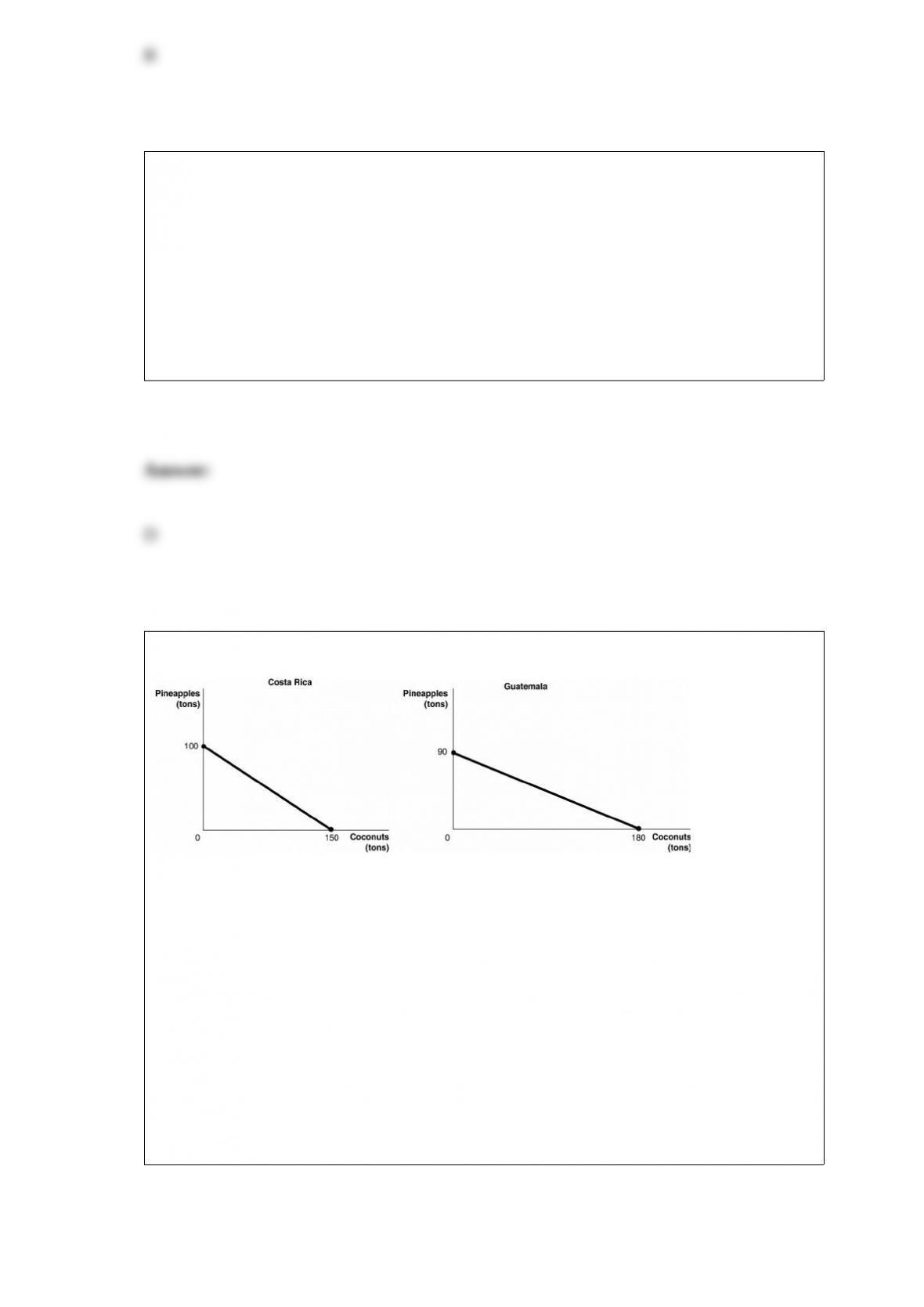
Figure 2-8
Figure 2-8 shows the production possibilities frontiers for Costa Rica and Guatemala.
Each country produces two goods, pineapples and coconuts.
Refer to Figure 2-8. Which country has a comparative advantage in the production of
pineapples?
A) Guatemala
B) They have equal productive abilities.
C) Costa Rica
D) neither country

Juanita goes to the Hardware Emporium to buy a new circular saw. She is willing to pay
$120 for a new saw, but buys one on sale for $85. Juanita’s consumer surplus from the
purchase is
A) $35.
B) $85.
C) $120.
D) $205.
The “Big Mac Theory of Exchange Rates” tests the accuracy of the purchasing power
parity theory. In July 2013, the Economist reported that the average price of a Big Mac
in the United States was $4.56. In Mexico, the average price of a Big Mac at that time
was 37 pesos. If the exchange rate between the dollar and the peso was 13.60 pesos per
dollar, explain how it would be profitable to buy Big Macs in Mexico instead of in the
United States.
Define allocative efficiency. Explain the significance of this concept in economics?
Define macroeconomics.
Give two reasons why GDP does not reflect total production in an economy.
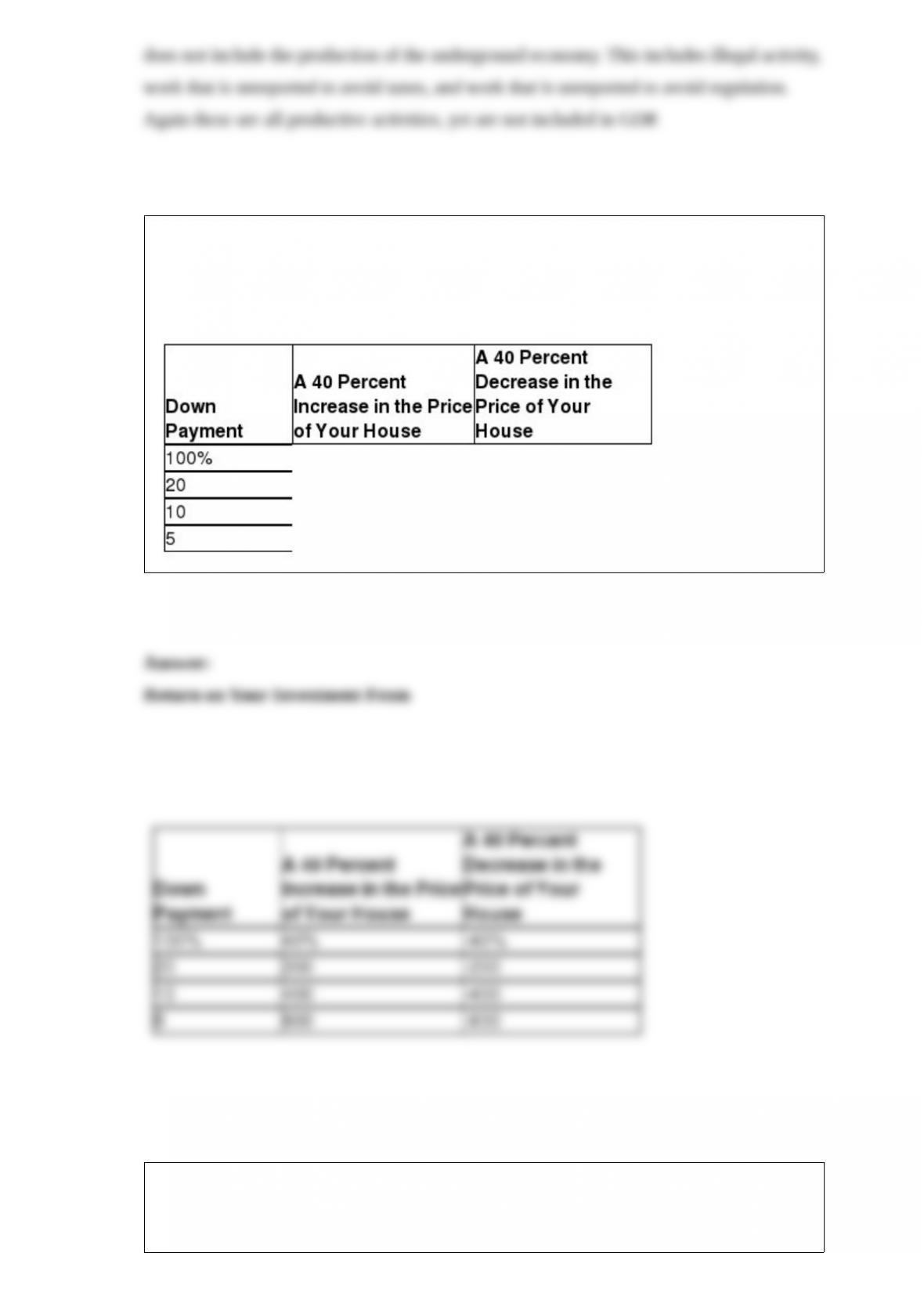
In the following table, fill in the columns for your return on investment if the price of
your house increased or decreased by 40 percent, based on the down payments
specified in the first column.
Return on Your Investment From
Hurricane Katrina resulted in a decline in oil production infrastructure along the gulf
coast. As a result there was an unexpected decline in oil and natural gas supplies in
2005. Suppose that this caused an increase in the price level and a decline in real GDP
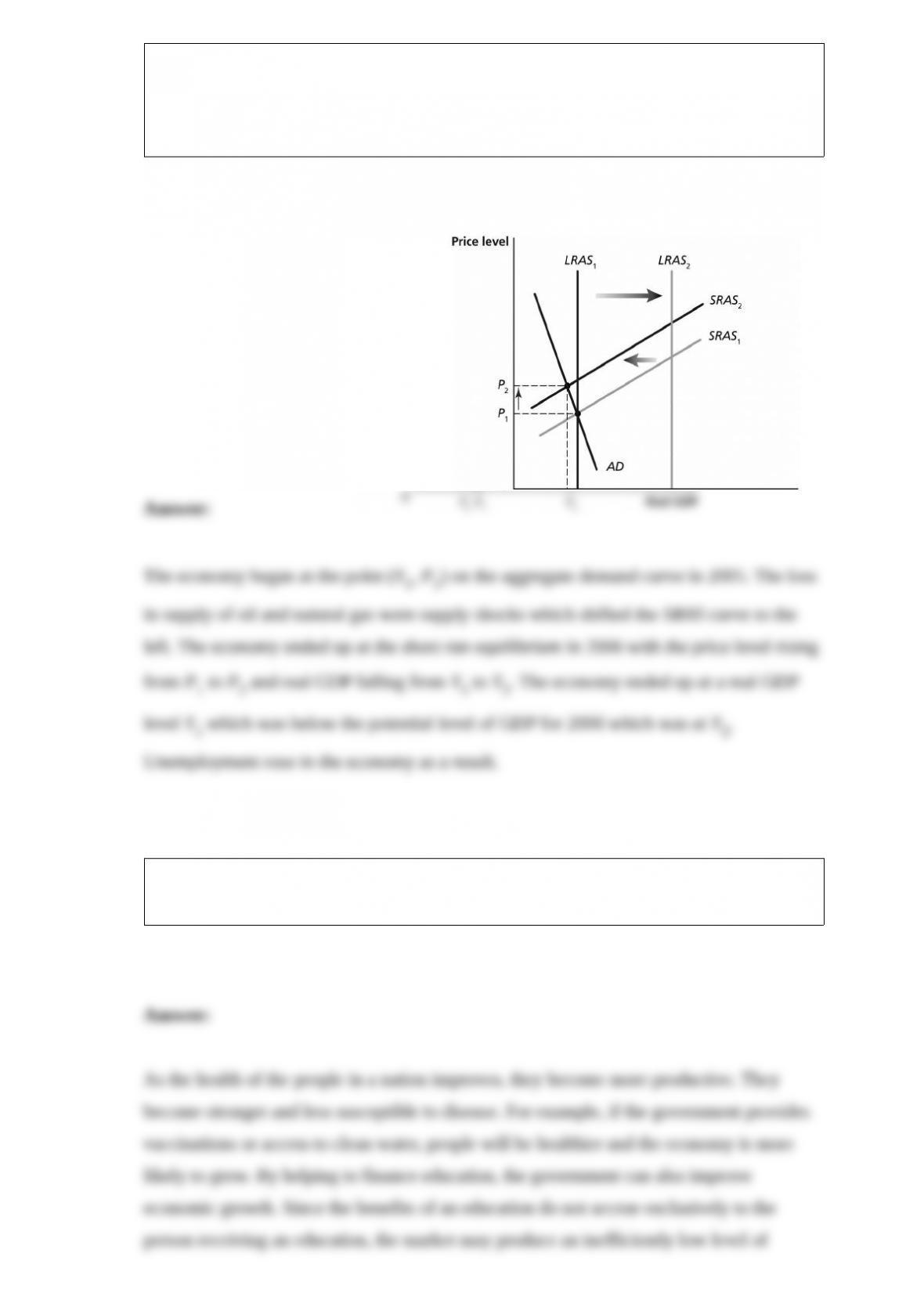
in 2006. Also assume that potential real GDP continued to grow due to other factors.
You can assume the aggregate demand curve did not change. Show the macroeconomic
equilibrium for 2005 and 2006 using the dynamic aggregate supply and aggregate
demand model.
How does government support of health and education programs foster economic
growth?