1)
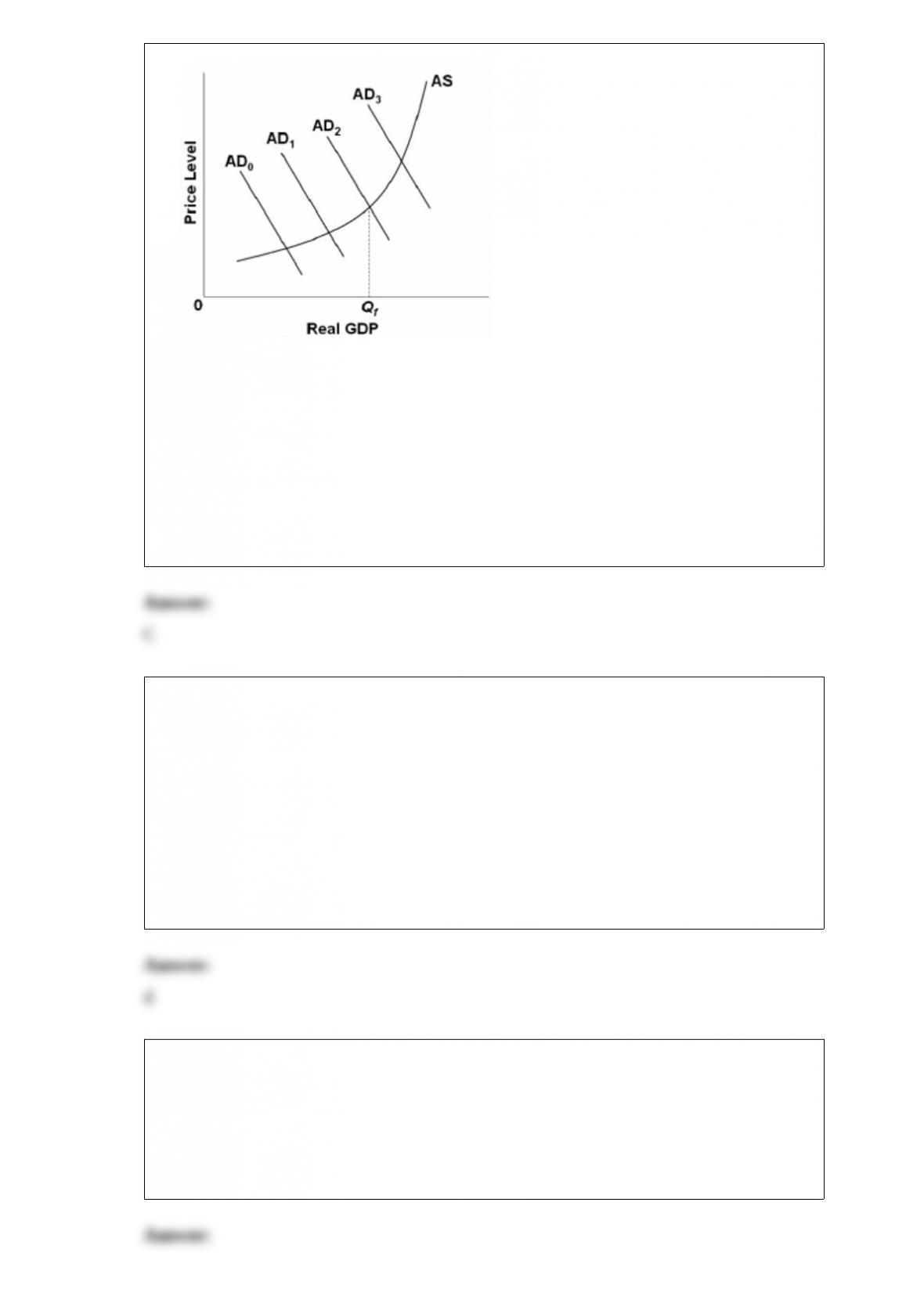
Refer to the above diagram, in which Qf is the full-employment output. If the
economy’s present aggregate demand curve is AD2:
A.the most appropriate fiscal policy is an increase of government expenditures or a
reduction of taxes.
B.the most appropriate fiscal policy is a reduction of government expenditures or an
increase of taxes.
C.government should undertake neither an expansionary nor a contractionary fiscal
policy.
D.the economy is achieving its maximum possible output.
2) if personal income exceeds national income in a particular year, we can conclude
that:
a.transfer payments exceeded the sum of social security contributions, corporate income
taxes, and taxes on production and imports.
b.the sum of social security contributions, corporate income taxes, and undistributed
corporate profits exceeded transfer payments.
c.consumption of fixed capital and taxes on production and imports exceeded personal
taxes.
d.transfer payments exceeded the sum of social security contributions, corporate
income taxes, and undistributed corporate profits.
3) gdp data are criticized as being inaccurate measures of economic welfare because:
a.they do not take into account changes in the amount of leisure.
b.they do not take into account all changes in product quality.
c.they do not take into account the adverse effects of economic activity on the
environment.
d.of all of these considerations.
4) In 2007, about ____ percent of the U.S. public debt was held by the Federal
government and Federal Reserve.
A.10
B.46
C.62
D.53
5)
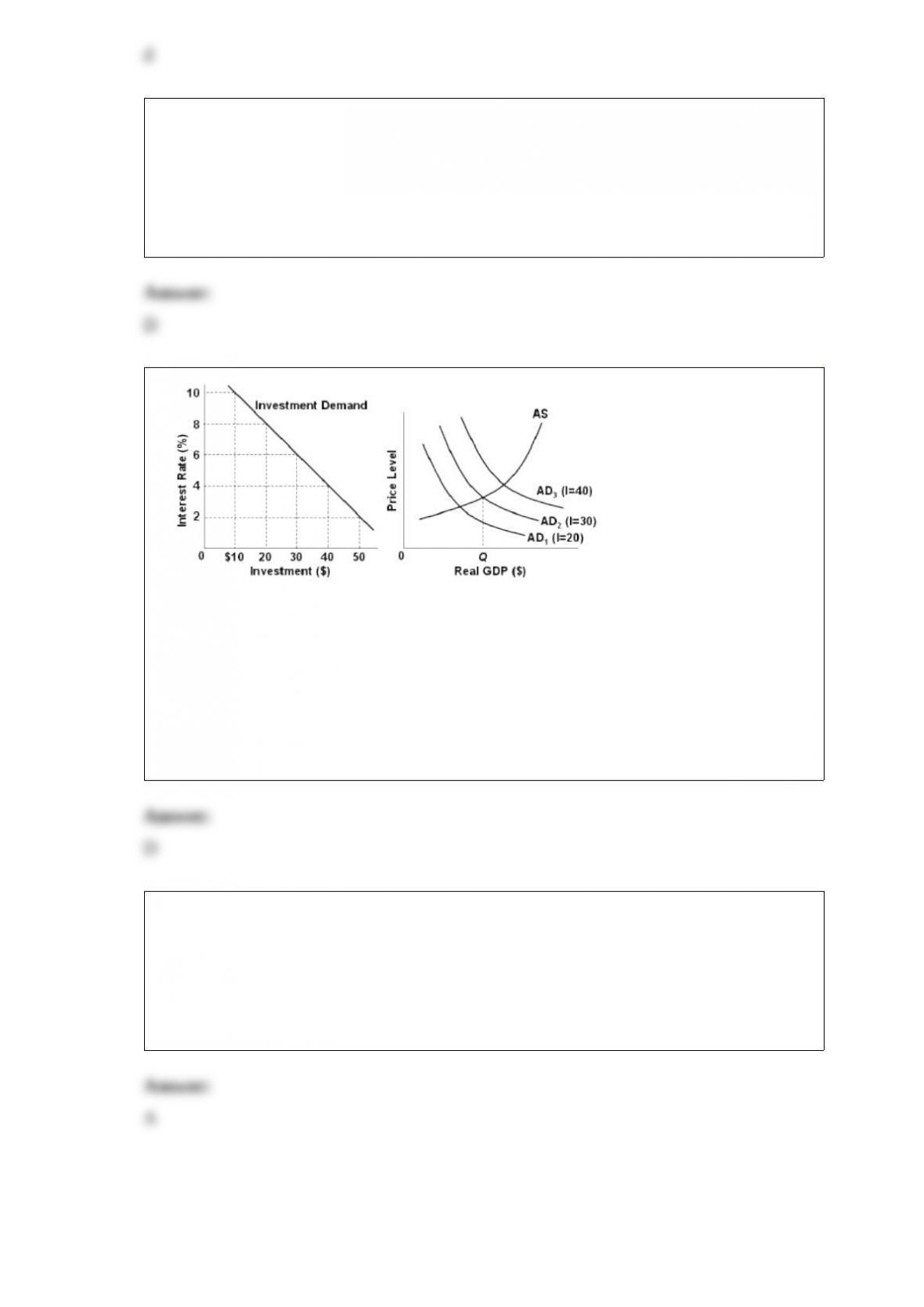
Refer to the above diagrams. The numbers in parentheses after the AD1, AD2, and AD3
labels indicate the levels of investment spending associated with each curve,
respectively. All numbers are in billions of dollars. If the interest rate is 6 percent and
the goal of the Fed is full-employment output of Qf, it should:
A.increase the interest rate from 6 percent to 8 percent.
B.decrease the interest rate from 6 to 4 percent.
C.decrease the interest rate from 6 to 2 percent.
D.maintain the interest rate at 6 percent.
6) The labor demand curve of a firm:
A.will shift to the left if the price of the product the labor is producing falls.
B.is perfectly elastic if the firm is selling its product in a purely competitive market.
C.reflects a direct relationship between the number of workers hired and the money
wage rate.
D.is the same as its marginal product curve.
7)
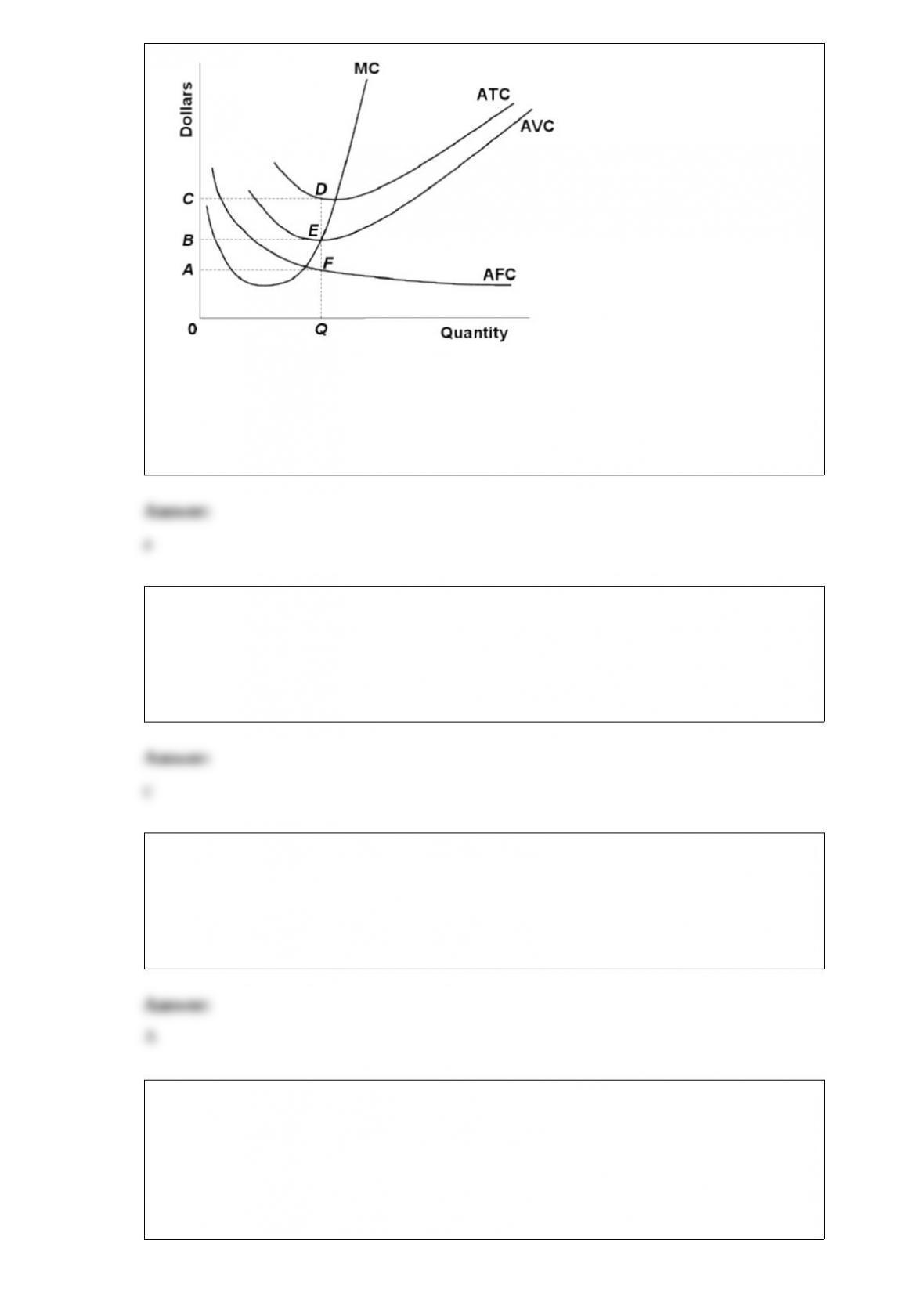
refer to the above diagram. at output level q:
a.marginal product is falling.
b.marginal product is rising.
c.marginal product is negative.
d.one cannot determine whether marginal product is falling or rising.
8) nominal gdp is adjusted for price changes through the use of:
a.the consumer price index (cpi).
b.the producer price index (ppi).
c.the gdp price index.
d.exchange rates.
9) For a private closed economy aggregate expenditures consist of:
A.C + Ig.
B.C – Ig.
C.C + S.
D.C – S.
10) The proposed monetary rule that would specify how the Fed should respond to
changes in GDP and inflation rates is called the:
A.Keynesian rule.
B.Friedman rule.
C.Taylor rule.
D.Lucas rule.

11) the distribution of income among the owners of land, labor, capital, and
entrepreneurial ability is known as:
a.income differentials.
b.the personal distribution of income.
c.the functional distribution of income.
d.the concentration ratio.
12) A firm might choose to pay its employees a wage higher than that which would
clear the market because:
A.the higher wage raises the opportunity cost of shirking.
B.the higher wage may shift the labor demand curve to the left.
C.the firm will have higher turnover, allowing “new blood” to invigorate older workers
who have a greater tendency to shirk.
D.this policy reduces the proportion of experienced to inexperienced workers, resulting
in a lower overall wage bill.
13) wait unemployment and search unemployment are both types of:
a.cyclical unemployment.
b.hidden unemployment.
c.frictional unemployment.
d.structural unemployment.
14) (last word) the fallacy of composition states that:
a.because economic systems are composed of so many diverse economic units,
economic laws are necessarily inexact.
b.the anticipation of a particular event can affect the composition of that event when it
occurs.
c.what is true for the individual must necessarily be true for the group.
d.because event a precedes event b, a is necessarily the cause of b.
15) which of the following statements is true about illegal immigration?
a.illegal immigrants are often willing to work for less pay, keeping costs and prices for
consumer goods and services lower.
b.illegal immigration can increase wages for u.s. workers who are complementary
inputs.
c.illegal immigration tends to reduce wages more for previous immigrants than for
native-born workers.
d.all of these.
16) Fiber-optic telephone lines are rapidly replacing copper telephone cable. This is an
example of:
A.capital-labor substitutability.
B.economies of scale.
C.market (or monopoly) power.
D.technological advance.
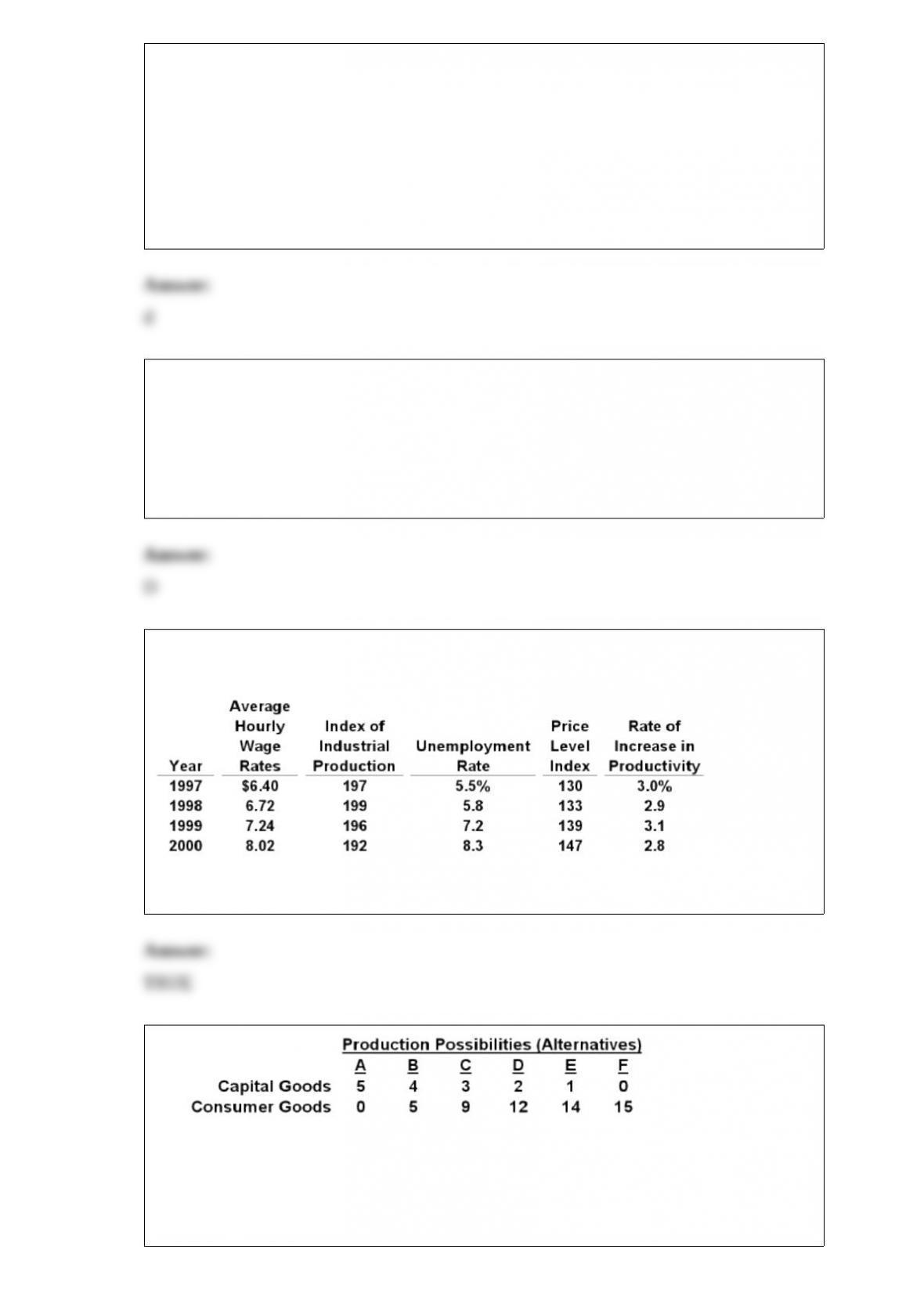
17) The following economic data for a hypothetical economy:
Refer to the above data. There is evidence that cost-push inflationary pressure is present
in this economy.
18)
refer to the above table. a total output of 3 units of capital goods and 4 units of
consumer goods:
a.is irrelevant because the economy is capable of producing a larger total output.
b.will result in the maximum rate of growth available to this economy.
c.would involve an inefficient use of the economy’s scarce resources.

d.is unobtainable in this economy.
19) Which of the following is a market imperfection that might explain persistent wage
differentials within an occupation?
A.geographical immobility of workers
B.readily available information about job opportunities and pay
C.principal-agent problems
D.compensating wage differentials