
Policymakers’ use of stabilization policy to eliminate output gaps is more appropriate
when an economy self corrects very ______ and when the output gap is very ____.
A. rapidly; large
B. rapidly; small
C. slowly; small
D. slowly; large
A good or service that is both highly nonrival and highly nonexcludable is a(n) _______
and a good or service that possesses some degree (but not a high degree) of being both
nonrival and nonexcludable is a ____
A. public good; pure public good.
B. pure public good; public good.
C. pure public good; private good.
D. public good; private good.
If the CPI equaled 1.43 in 2005 and 1.56 in 2006, then between 2005 and 2006 there
was:
A. inflation.
B. deflation

C. a recession
D. an expansion
On January 1, 2004, Anna invested $5,000 at 5% interest for one year. The CPI on
January 1, 2004 stood at 1.60. On January 1, 2005, the CPI was 1.68. The real rate of
interest earned by Anna was ______ percent.
A. -5
B. 0
C. 5
D. 8
During recessions, when some workers lose their jobs and have lower incomes, sales of
durable goods (goods with a life expectancy of 3 years or more) decline. Apparently,
durables are:
A. substitutes.
B. normal goods.
C. complements.

D. inferior goods.
Refer to the figure above. If S2 is the short-run industry supply curve for a maple syrup
producer, the profit maximizing output for a single firm is ______ gallons.
A. 500
B. 1000
C. 1500
D. 2000
In the past, some governments’ budget deficits became so large that they could not raise
sufficient taxes to finance the spending, so they ______, which led to ______.
A. reduced the amount of currency held by the public; a smaller money supply
B. increased bank reserves; a larger reserve/deposit ratio

C. printed large quantities of paper money; hyperinflation
D. ordered the central bank to sell government bonds; an increase in the money supply
The tragedy of the commons refers to the:
A. overuse of resources that have no price.
B. overuse of resources that have no cost.
C. under production of external benefits.
D. pollution of our natural resources.
Which of the following is NOT an example of a good with network economies?
A. Text messaging capabilities
B. An internet connection
C. A computer printer

D. Computer operating systems
Lower nominal interest rates ______ the amount of money demanded and a lower price
level ______ the amount of money demanded.
A. increase; increases
B. increase; decreases
C. increase; does not change
D. decrease; decreases
An imperfectly competitive firm is one:
A. that attempts but fails to compete perfectly.
B. with the ability to set price at any level it wishes.
C. that possesses some degree of control over its price.

D. that faces perfectly inelastic demand.
Which of the following factors would not contribute to increasing an existing
comparative advantage?
A. Productivity improvements from greater experience.
B. Less time lost by switching tasks.
C. Import restrictions.
D. Efficiency improvements due to learning.
The CPI in 1930 equaled 0.17. The CPI in 1931 equaled 0.15. The rate of inflation
between 1930 and 1931 was ______ percent.
A. -13.3
B. -11.8

C. 1.5
D. 11.8
If the elasticity of demand for labor is greater than one, then imposing a minimum wage
will cause
A. the firms’ total wage bill to fall.
B. employment to rise.
C. the firms’ total wage bill to rise.
D. no adverse employment effects.
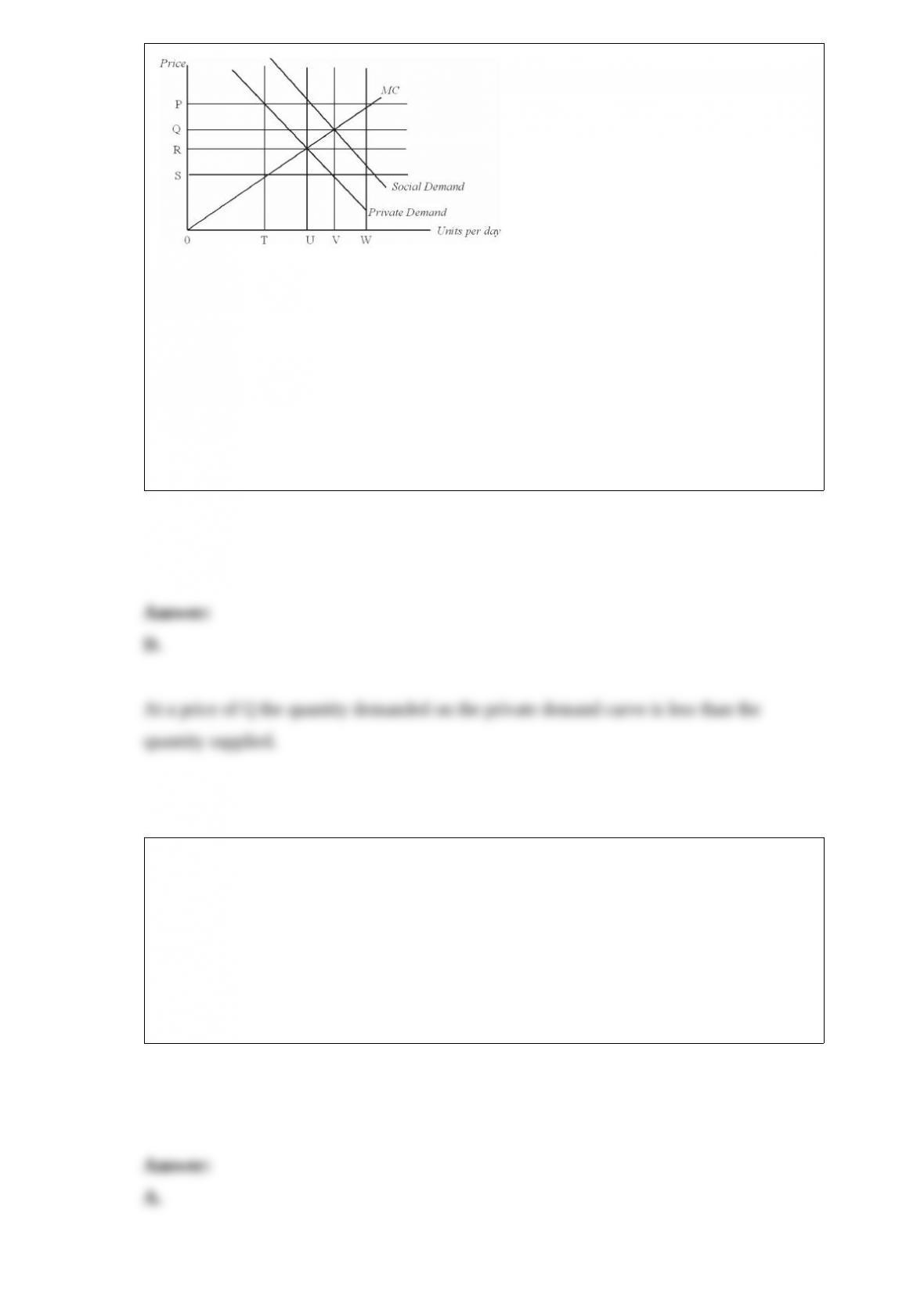
Refer to the figure above. At a price of Q:
A. firms are choosing according to private incentives, but ignoring social benefits.
B. firms are passing the entire cost of the externality to their customers.
C. the market will be in equilibrium at the socially optimal quantity of the good without
government interference.
D. there will be excess supply in this market if there is no government interference.
In an economy without international trade, investment must equal ______ saving.
A. national
B. private
C. public
D. life-cycle
Last summer, Casey took fresh vegetables to sell at the Farmer’s Market, but this year,
Casey did not plant any vegetables and went to work at the local bank.
Refer to the information above. If Casey’s decision to change careers did not change the
market price for vegetables at the Farmers’ Market, it is because:
A. demand for vegetables did not change.
B. the Farmers’ Market attracts a large number of vegetable farmers.
C. demand for vegetables increased this year.
D. the price is set by a regulatory body.
Refer to the figure above. The marginal utility of the 3rd dinner is
A. 60.
B. 75.
C. 135.
D. 160.

An increase in the size of the working-age population:
A. increases labor demand.
B. decreases labor demand.
C. increases labor supply.
D. decreases labor supply.
The increase in wage inequality resulting from globalization can be reversed through:
A. revoking the principle of comparative advantage.
B. increases in worker mobility.
C. decreases in worker mobility.
D. making markets more competitive.

Net exports plus net capital inflows equal:
A. net capital outflows.
B. the international trade gap.
C. zero.
D. the trade balance.
Velocity is determined by:
A. the Federal Reserve.
B. the size of the government budget deficit.
C. average labor productivity times the population growth rate.
D. payments methods and technology.
The table below shows the payoffs to the running of negative and positive political ads
by two candidates. The payoffs are the percentage increase or decrease in the number of
voters willing to vote for the candidate as a result of the campaign styles.
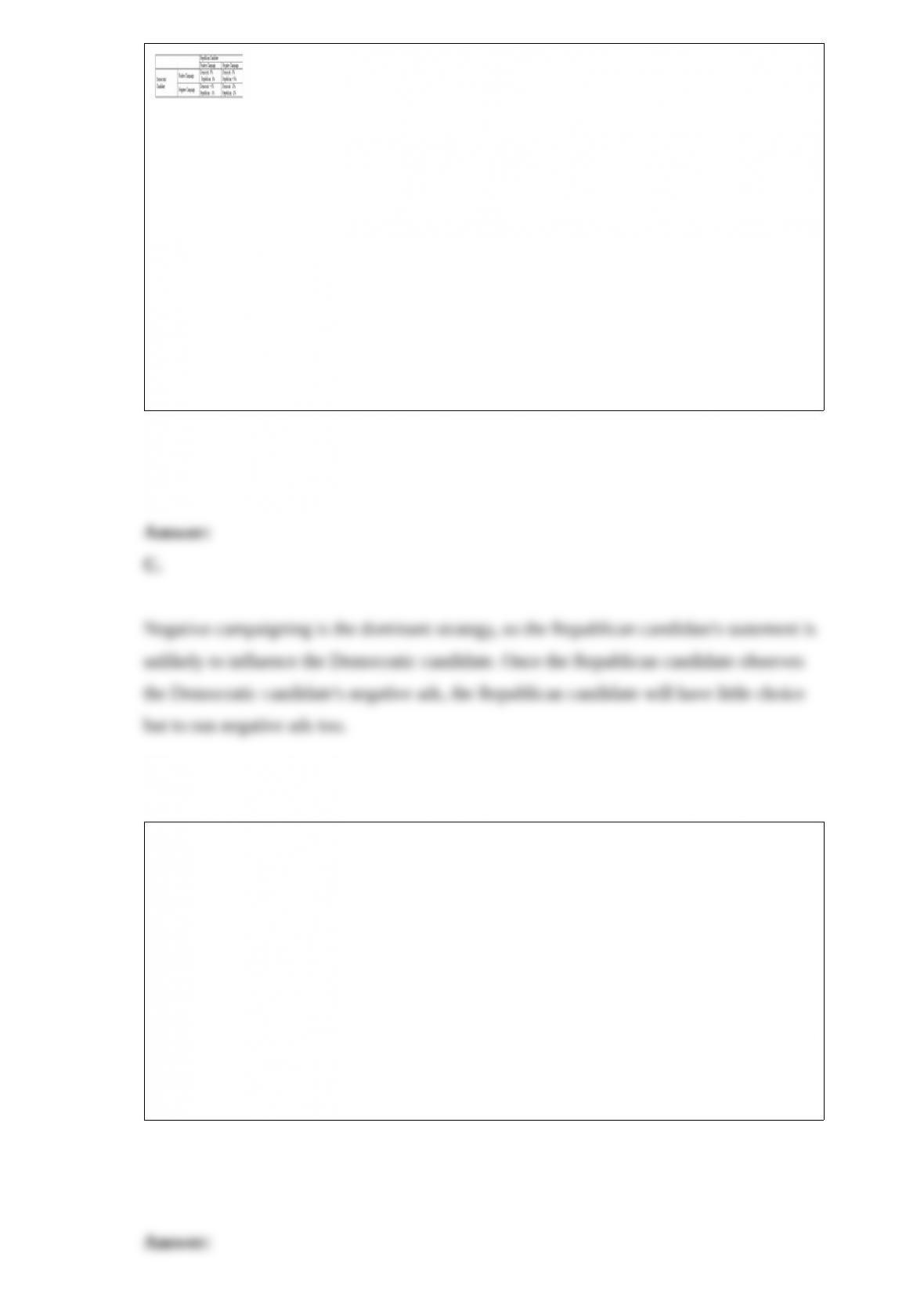
Refer to the figure above. Suppose that the Republican candidate tells the Democratic
candidate that he intends to run a positive campaign. The likely result is that:
A. both candidates will run a positive campaign.
B. the Republican candidate will run a positive campaign, but the Democratic candidate
will run a negative campaign.
C. the Republican candidate will eventually turn to negative campaigning because the
Democratic candidate will run a negative campaign.
D. the Democratic candidate will trust the Republican candidate’s statement and run a
positive campaign, but the Republican candidate will run a negative campaign.
The credibility of monetary policy is the:
A. recognition that open market purchases increase the money supply, even though
banks and the public affect the money multiplier.
B. degree to which the public believes the central bank’s promises to keep inflation low,
even if doing so may impose short-run costs.
C. pace at which monetary policy can return an economy to potential when inflationary
expectations are anchored.
D. practice of the Federal Reserve of relying primarily on open market operations rather
than discount rate lending or changes in reserve requirements.
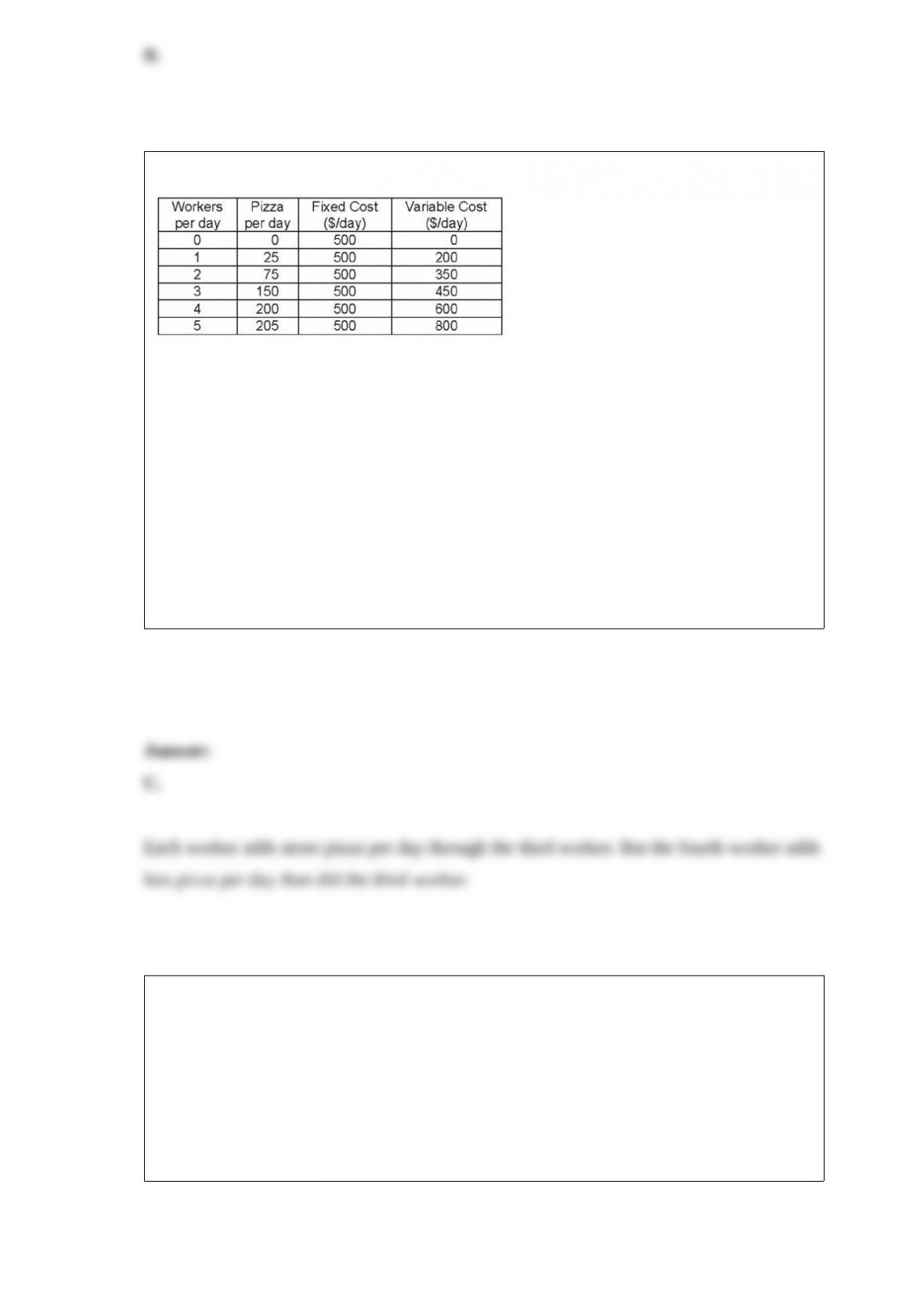
Pizzas sell for $10 each.
Refer to the figure above. The law of diminishing returns sets in after the ____ worker
per day.
A. 1
B. 2
C. 3
D. 4
Investment is a(n) ______ that changes the ______ of capital.
A. flow; stock
B. stock; flow
C. asset; liability
D. liability; asset

Suppose that all workers value a safe job $2,000/year more than a risky job. The cost of
safety is $700 per worker. Firms currently pay $35,000 per year to workers, without any
effort to improve safety.
Suppose new firms began to offer workers $34,000 per year and safe jobs. The total
cost of hiring a worker to the existing firms is __________ and to the new firms it is
__________.
A. $35,700; $33,700
B. $35,000; $34,700
C. $34,700; $35,000
D. $33,700; $35,700

Refer to the figure above. Demand for coffee last Monday is shown in bold and labeled
D(Monday). On Tuesday, the news featured a story explaining that the coffee crop has
been contaminated with disease-causing bacteria. The following week:
A. the demand function remained at D(Monday), but the quantity demanded decreased.
B. demand shifted to D(A) because some people decided to stop drinking coffee in light
of the health hazard.
C. demand shifted to D(B) in anticipation of future price increases.
D. there would be no change in either the demand function or the quantity demanded
because not enough time had passed for the report’s effects to be felt.
Which of the following would increase the net export component of U.S. GDP?
A. A bottle of California wine is purchased in London.
B. A car produced in Japan is purchased in California.
C. A bottle of French wine is purchased in New York.
D. A car produced in Michigan is purchased in Louisiana.
The AD curve slopes downward because an increase in ______ causes ______ to fall,

which in turn causes real GDP to fall.
A. the inflation rate; planned spending
B. planned spending; the inflation rate
C. real GDP; planned spending
D. real GDP; the unemployment rate
Suppose that the total production of an economy consists of 10 oranges and 5 candy
bars, each orange sells for $0.20, and each candy bar sells for $1.00. What is the market
value of production in this economy?
A. $1.20
B. $2.00
C. $5.00
D. $7.00