
1) We would expect a decline in personal and corporate income taxes to:
A.shift the aggregate demand curve rightward.
B.decrease consumption and investment spending.
C.decrease real output.
D.shift the aggregate supply curve leftward.
2) a pure monopolist is selling 6 units at a price of $12. if the marginal revenue of the
seventh unit is $5, then:
a.price of the seventh unit is $10.
b.price of the seventh unit is $11.
c.price of the seventh unit is greater than $12.
d.firm’s demand curve is perfectly elastic.
3) if the production possibilities curve were a straight downsloping line, this would
suggest that:
a.resources are perfectly shiftable between the production of these two goods.
b.it is possible to produce more of both products.
c.both products are equally capable of satisfying consumer wants.
d.the two products have identical prices.
4) The following schedule contains data for a private closed economy. All figures are in
billions. Use these data in answering the next question(s).
Refer to the above data. If a lump-sum tax of $20 is imposed, the consumption schedule
will become:
A.

B.
C.
D.
5) what is the primary reason that changes in total spending lead to cyclical changes in
output and employment?
a.government is unable to respond by changing the amount of money in circulation.
b.changes in total spending cause supply shocks that cause cyclical variation.
c.prices are sticky in the short run.
d.prices are flexible in the long run.
6) since 1996, cash welfare payments to immigrants have:
a.risen by 20 percent.
b.risen by 10 percent.
c.fallen by 73 percent.
d.fallen by 39 percent.
7) assume an economy that is producing only one product and that year 3 is the base
year. output and price data for a five-year period are as follows. answer the next
question(s) on the basis of these data.

refer to the above data. real gdp for year 5 is:
a.$160.
b.$49.
c.$40.
d.$64.
8) suppose you have a limited money income and you are purchasing products a and b
whose prices happen to be the same. to maximize your utility you should purchase a
and b in such amounts that:
a.their marginal utilities are the same.
b.their total utilities are the same.
c.their marginal and total utilities are proportionate.
d.the income and substitution effects associated with each are equal.
9) cost-push inflation:
a.reduces real output.
b.increases real output.
c.reduces the unemployment rate.
d.raises the natural rate of unemployment.
10) In 1985, the exchange rate between the U.S. dollar and the Japanese yen was $1 =
262 yen; in 2003, the rate was $1 = 110 yen.
Refer to the above information. Between 1985 and 2003 the:
A.dollar appreciated in value relative to the yen.
B.yen appreciated in value relative to the dollar.
C.dollar price of yen fell.
D.yen price of dollars rose.
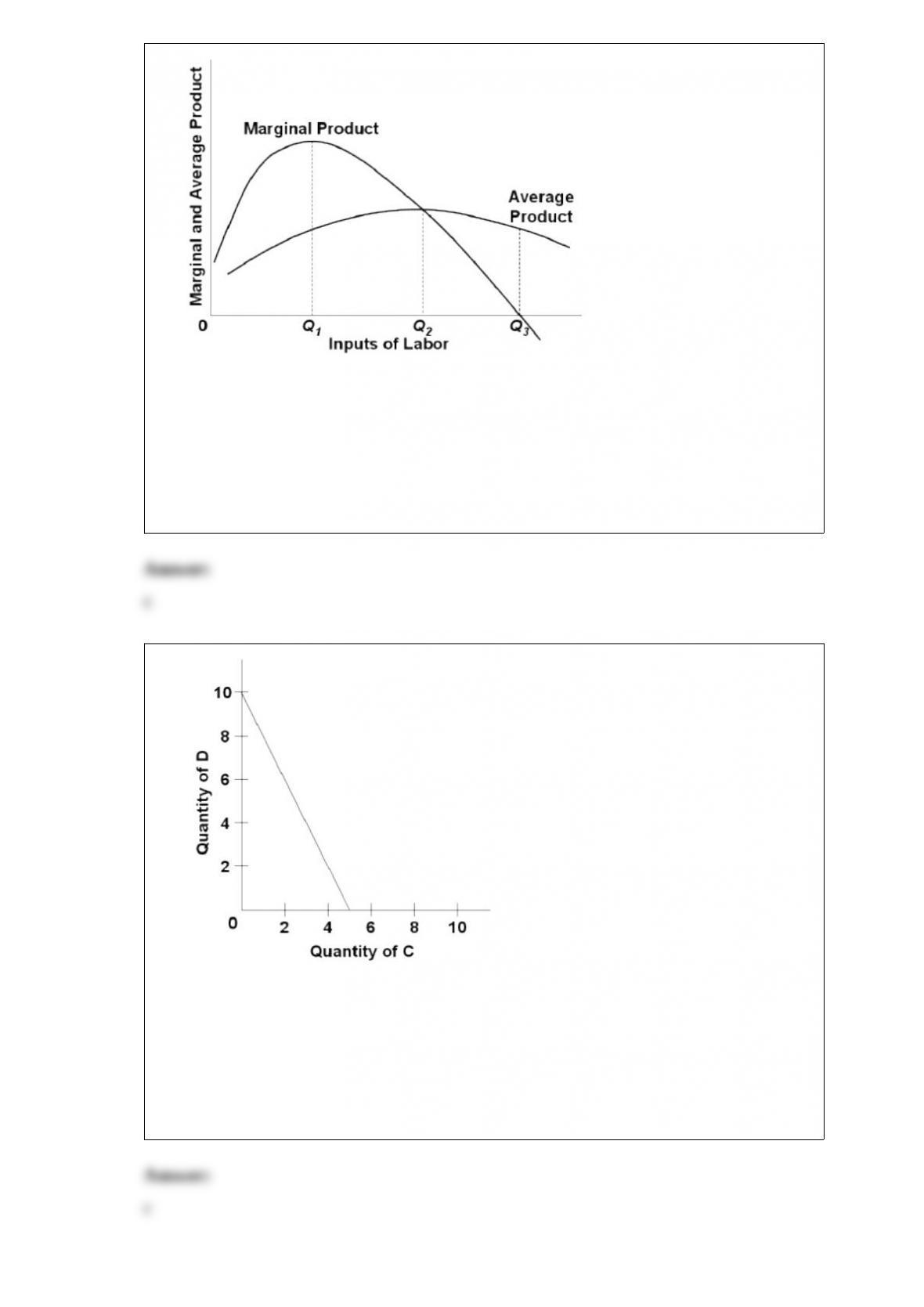
11)
refer to the above diagram, where variable inputs of labor are being added to a constant
amount of property resources. marginal cost will be at a minimum for this firm when it
is hiring:
a.q3 workers.
b.q2 workers.
c.q1 workers.
d.more than q3 workers.
12)
refer to the budget line shown in the diagram above. given the same money income,
reductions in the prices of both products c and d will:
a.shift the budget line outward on the horizontal axis, but leave it anchored at “10” on
the vertical axis.
b.shift the budget line to the left.
c.shift the budget line to the right.
d.have no effect on the budget line.

13) use the list below to answer the following questions:
1. improvements in technology
2. increases in the supply (stock) of capital goods
3. purchases of expanding output
4. obtaining the optimal combination of goods, each at least-cost production
5. increases in the quantity and quality of natural resources
6. increases in the quantity and quality of human resources
which set of items in the above list would move an economy from a point inside its
production possibilities curve to a point on its production possibilities curve?
a.1, 2, 5, and 6 only
b.3 and 4 only
c.3 only
d.1, 3, 4 only
14) suppose total output (real gdp) is $4000 and labor productivity is $8. we can
conclude that:
a.real gdp per capita must be $500.
b.the price-level index must be greater than 100.
c.nominal gdp must be $500.
d.the number of worker-hours must be 500.