
1) to achieve its full production potential, an economy must reach full employment.
2) illegal immigration has little effect on the average level of wages in the united states.
3) When C + Ig = GDP in a private closed economy, S = I and there are no unplanned
changes in inventories.
4) Marginal resource (labor) cost will exceed the wage rate when there is imperfect
competition in the hire of labor.
5) Present value allows us to weigh the benefits and costs of using resources today or in
the future.
6) the rationing function of prices refers to the fact that government must distribute any
surplus goods that may be left in a competitive market.
7) the accompanying table that shows average total costs (atc) for a manufacturing firm
whose total fixed costs are $10:
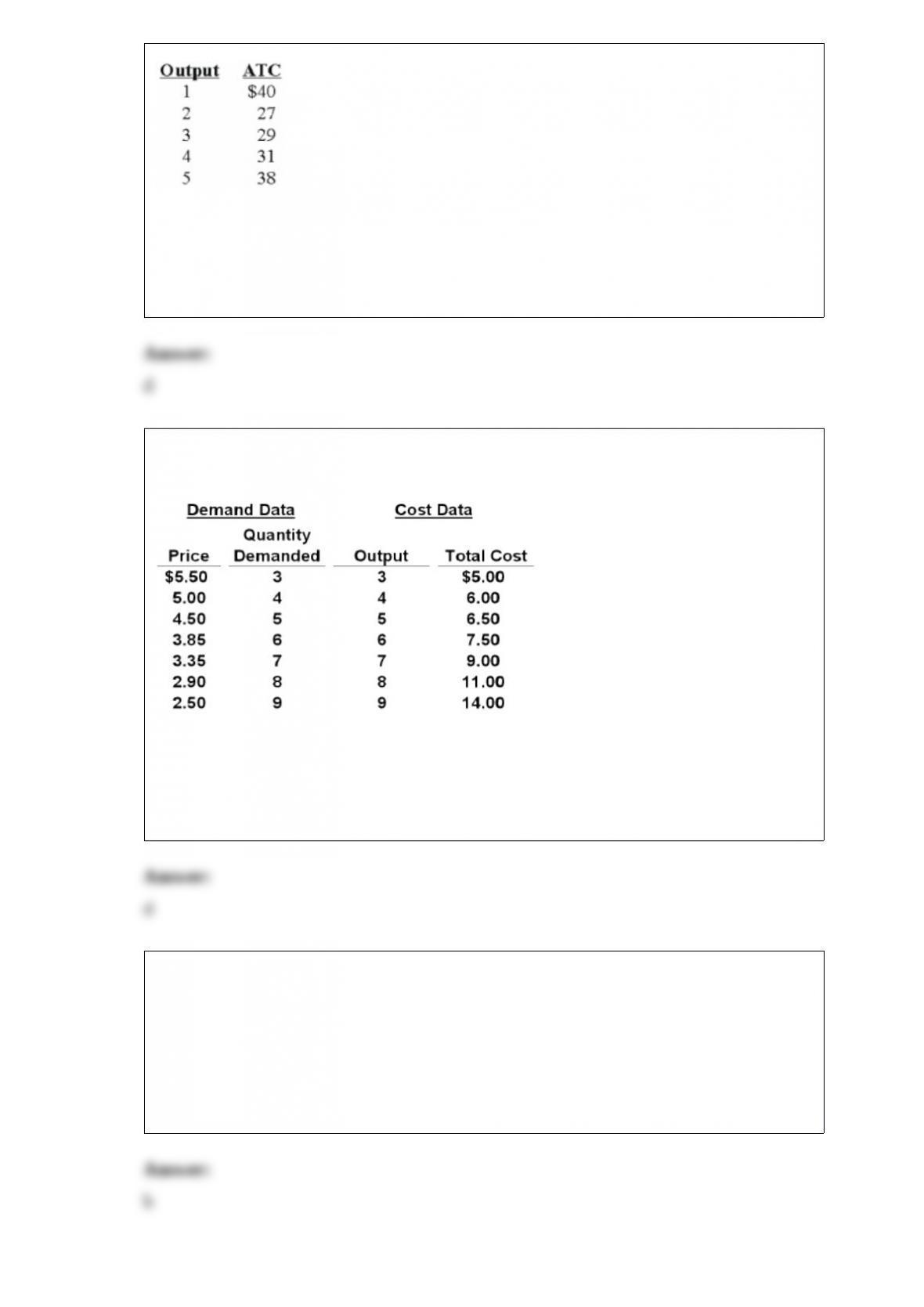
refer to the above data. the profit-maximizing level of output for this firm:
a.is 3
b.is 4
c.is 5
d.cannot be determined from the information given.
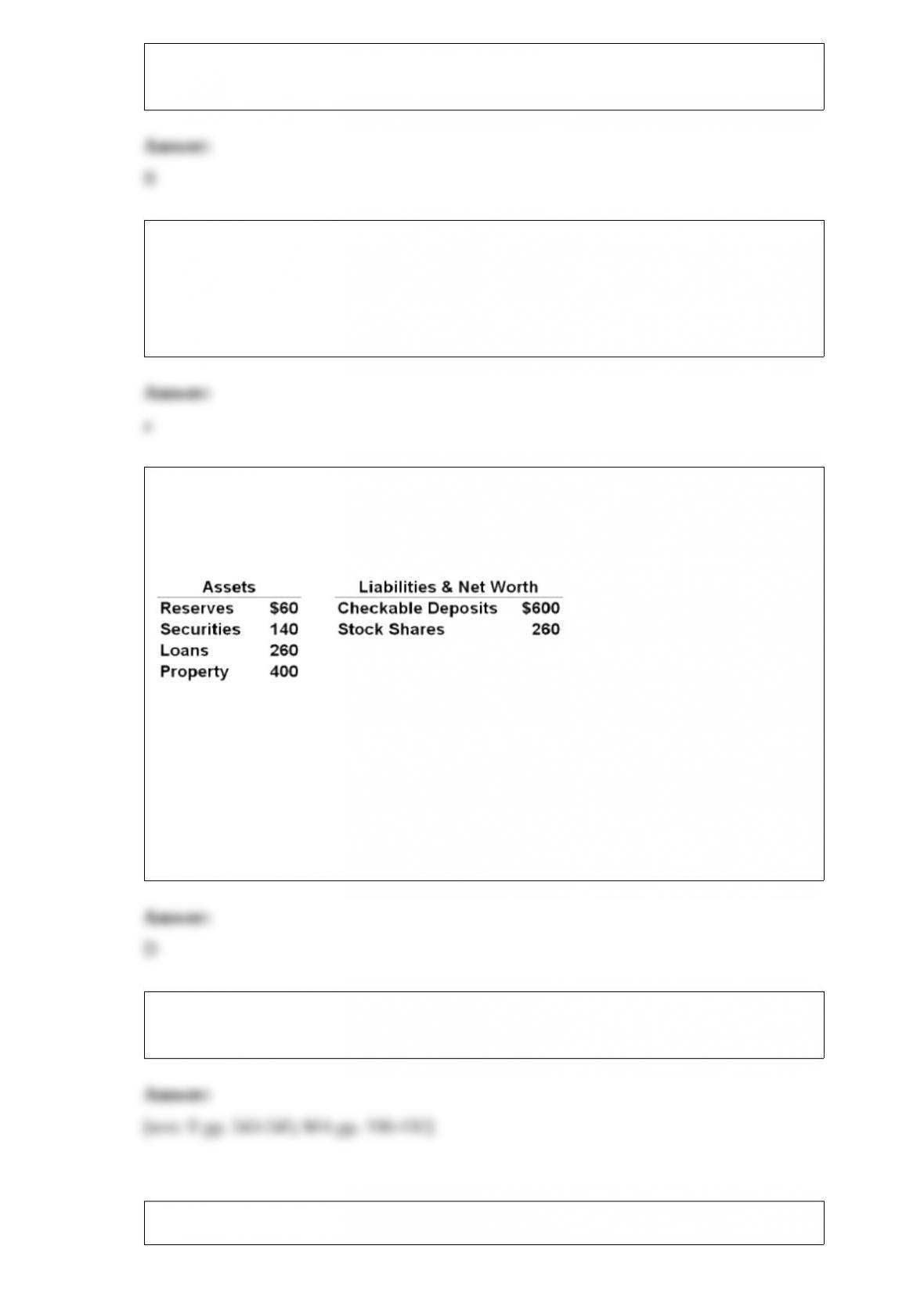
8) the following demand and cost data for a pure monopolist:
refer to the above data. the profit-maximizing price for the monopolist will be:
a.$5.00.
b.$2.90.
c.$3.35.
d.$4.50.
9) suppose that a fully-employed economy produces only two goods, hamburgers and
flat-panel tvs. if the economy is currently producing more than the optimal quantity of
hamburgers, then to attain the optimal allocation of resources it should:
a.produce more hamburgers and fewer tvs.
b.produce more tvs and fewer hamburgers.
c.produce more of both goods.
d.produce fewer of both goods.

10) the main problem posed by trade blocs for nonmember nations is that:
a.member nations may achieve growth rates that exceed those of nonmember nations.
b.nonmembers must exchange their currencies for foreign monies before they can
engage in export or import transactions.
c.nonmembers face tariffs that member nations do not.
d.member nations refuse to participate in tariff negotiations sponsored by gatt.
11) Suppose that government imposes a specific excise tax on product X of $2 per unit
and that the price elasticity of demand for X is unitary (coefficient = 1). If the incidence
of the tax is such that the producers of X pay $1.75 of the tax and the consumers pay
$.25, we can conclude that the:
A.supply of X is highly inelastic.
B.supply of X is highly elastic.
C.demand for X is highly inelastic.
D.demand for X is highly elastic.
12) The successful commercial introduction of a new product, the use of a new method,
or the creation of a new form of business enterprise is called:
A.innovation.
B.invention.
C.creative destruction.
D.diffusion.
13) Commercial banks and thrift institutions:
A.differ because thrifts cannot make loans.
B.differ because thrifts cannot offer checkable deposits.
C.have become less similar in recent years.
D.have become increasingly similar in recent years.
14) If the Fed were to set policy according to the Taylor rule, then if real GDP falls by 2
percent below potential GDP, the Fed should:
A.raise the Federal funds rate by 1 percentage point.
B.reduce the Federal funds rate by 1 percentage point.
C.raise the inflation rate by 1 percentage point.
D.change the Federal funds rate until inflation hits the target rate of 4 percent.
15) (last word) in 2006, massachusetts passed a law that required, as of july 1, 2007:
a.all residents of the state to have health insurance.
b.employers in the state to pay all insurance premiums for their employees.
c.all health care facilities to provide health care services at no charge to the patients.
d.the state government to provide health care to all residents.
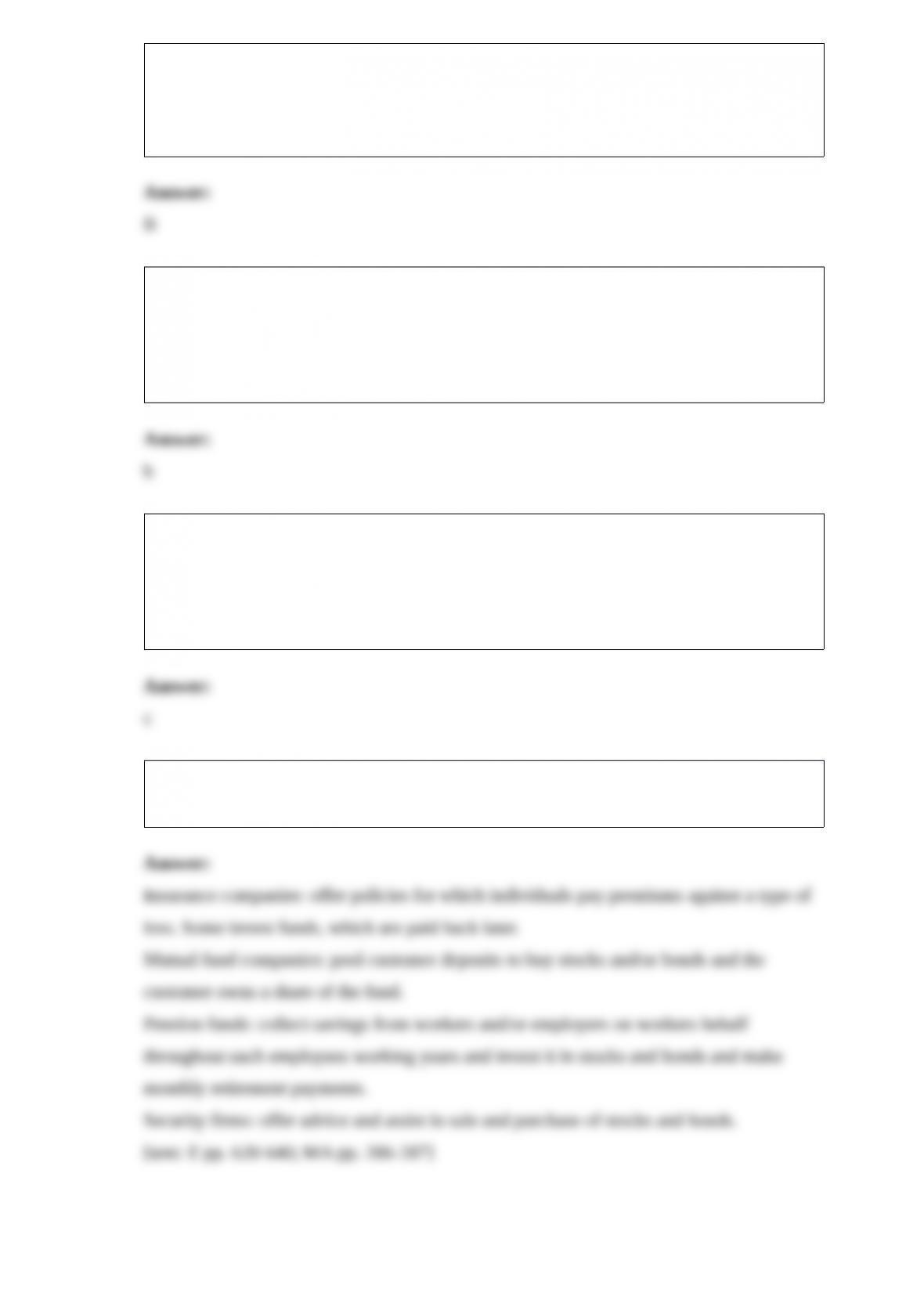
16) The following consolidated balance sheet of the commercial banking system.
Assume that the reserve requirement is 10 percent. All figures are in billions and each
question should be answered independently of changes specified in any preceding ones.
Refer to the above data. Suppose the Fed wants to increase the money supply by $400
billion to drive down interest rates and stimulate the economy. Assuming that the
money multiplier is operating to full effect, to accomplish the desired increase the Fed
could:
A.sell $20 billion of U.S. securities to the banks.
B.buy $20 billion of U.S. securities from the banks.
C.sell $40 billion of U.S. securities to the banks.
D.buy $40 billion of U.S. securities from the banks.
17) Complete the following table assuming that (a) MPS = 1/5, (b) there is no
government and all saving is personal saving.
18) The reserves of a commercial bank consist of:
A.the amount of money market funds it holds.
B.deposits at the Federal Reserve Bank and vault cash.
C.government securities that the bank holds.
D.the bank’s net worth.
19) when a firm does more of something, it gets better at it. this learning-by-doing is:
a.a source of diseconomies of scale.
b.a source of economies of scale.
c.called the principle of natural progression.
d.called ‘spreading the overhead.”
20) marginal revenue for a purely competitive firm:
a.is greater than price.
b.is less than price.
c.is equal to price.
d.may be either greater or less than price.
21) Besides banks and thrifts, what other types of financial services firms exist and
what do they do?
22) Cite five recent developments that have affected money and banking in the United
States.
23) David Ricardo, a nineteenth century economist, wrote The price of corn is not high
because a rent is paid, but a rent is paid because the price of corn is high. Explain this
statement in the context of supply and demand.
24) How does the aggregate expenditures analysis differ from the aggregate
demandaggregate supply analysis?
25) What are the three major characteristics of the twelve Federal Reserve Banks?
26) Explain what is meant by fractional reserve banking.
27) What is the relationship between the long-run supply curve in a constant-cost
industry and elasticity?