The “War on Poverty” was declared by President Ronald Reagan in 1982.
a. True
b. False
Define the following terms and explain their importance to the study of economics.
a. minimum wage law
b. income and substitution effects
c. backward-bending labor supply curve
d. human capital theory
e. dual labor markets
Opportunity cost always arises when a trade-off decision is made.
a. True
b. False
Cartels are

a. difficult to organize.
b. difficult to preserve.
c. especially unlikely to succeed if the members sell many varied products.
d. All of the above are correct.
Which of the following individuals would be most likely to support a balanced budget
amendment to the constitution?
a. “Christmas is when children ask Santa Claus for things and their parents pay for
them. Deficits is when adults ask government for things and their children pay for
them.”-Richard Lamm
b. “In a boom, inflation can be caused by allowing unlimited credit to support excited
enthusiasm of business speculators. But in a slump government expenditure is the only
sure means of obtaining quickly a rising output.”-J.M. Keynes
c. “If we face a recession we should not lay off employees. Employees are not guilty;
why should they suffer?”-Akio Morita
d. “Underbalancing the budget during a depression is not primarily a deliberate policy
but a practical necessity.”-Gunnar Myrdal
E&S Cooling Co. installs air conditioning systems in new houses for homebuilders, and
replacement systems for homeowners. Sales of which systems are included in this year’s
GDP?
a. Sales of replacement systems
b. Sales of both systems
c. Sales of systems in new houses
d. Neither system would be included, because they are always intermediate goods.
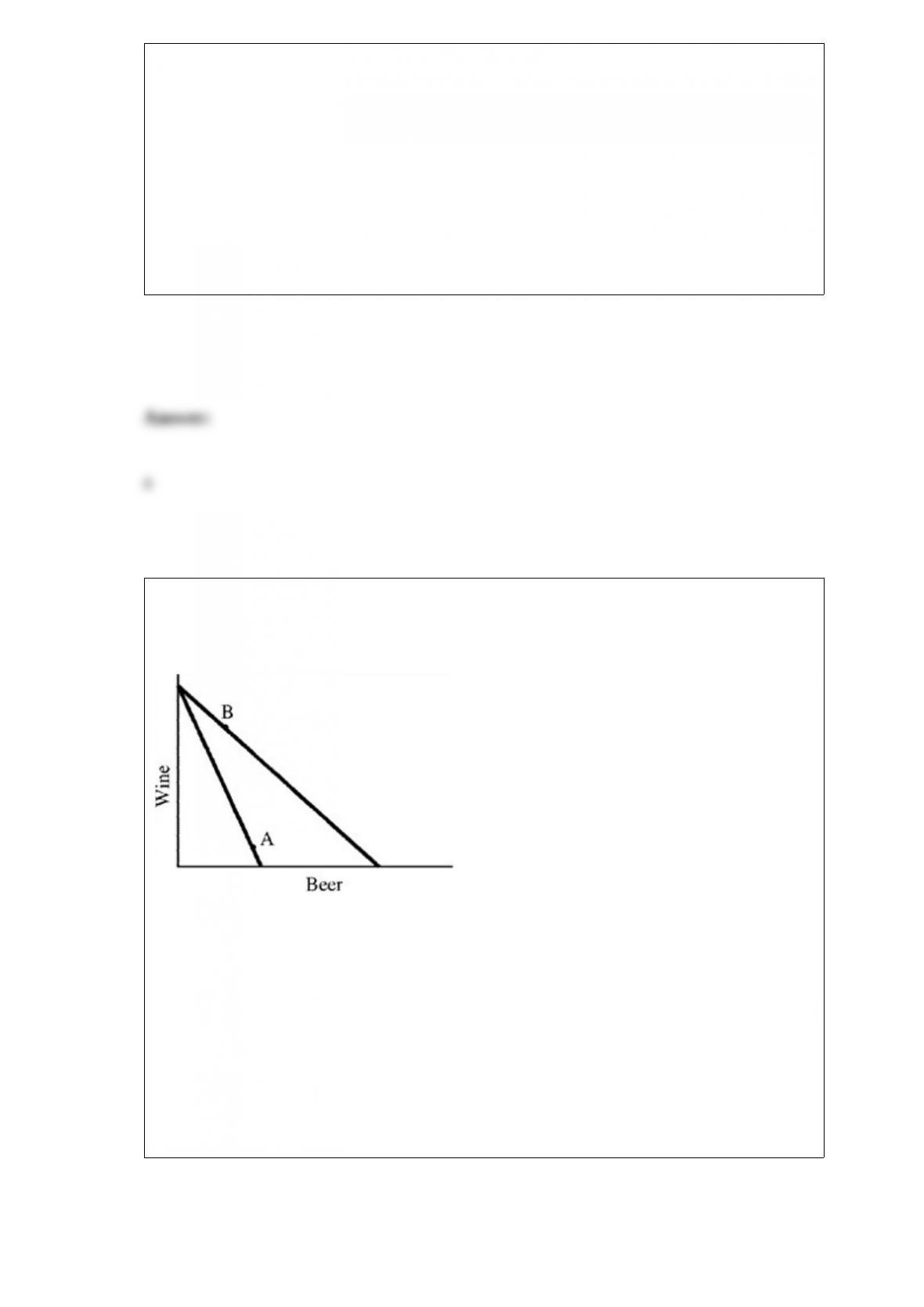
Figure 5-11
In Figure 5-11, a consumer is initially at point A. There is a price change and she moves
to B. It follows that
a. the demand for beer follows the law of demand.
b. the demand for beer does not follow the law of demand.
c. wine is an inferior good.
d. the consumer is confused.
Increased productivity of workers in manufacturing has
a. increased employment in manufacturing.
b. increased employment in agriculture.
c. decreased employment in agriculture.
d. decreased employment in services.
e. increased employment in services.
Input-output analysis was developed by Wassily Leontief.
a. True
b. False
A certain machine will last one year, will produce $120 in income (received one year
later), and will cost $100. The lowest interest rate at which this investment will be
unprofitable is
a. 10 percent.
b. 11 percent.
c. 19 percent.
d. 22 percent.
Government is unnecessary in a free enterprise economy such as the United States.
a. True
b. False
If an economy’s resources are fully employed,
a. a great deal of unemployment will be needed to achieve even a small reduction in
inflation.
b. the aggregate supply curve (and thus the Phillips curve) will be flat.
c. the aggregate supply curve (and thus the Phillips curve) will be steep.
d. Both a and c are correct.
Mutually beneficial trade is possible because of differing marginal utilities.
a. True
b. False
If you as a lender want an increase in purchasing power of 4 percent from making a
loan and you set the nominal interest rate at 9 percent, then your
a. real rate of interest is 13 percent.
b. expected rate of inflation is 5 percent.
c. expected rate of inflation is 13 percent.
d. real rate of interest is 36 percent.
Anthony Downs, in The Economic Theory of Democracy, argues that voters choose to
remain “rationally ignorant” when they vote in elections, knowing relatively little about
the candidates or the issues. What economic principle would you invoke to explain this
behavior?
a. public good theory
b. moral hazard
c. the cost of information
d. risk aversion
Voluntary exchange requires that there must be mutual gain.
a. True
b. False
Value judgments are based on people’s tastes, preferences, and ethical opinions.
a. True
b. False
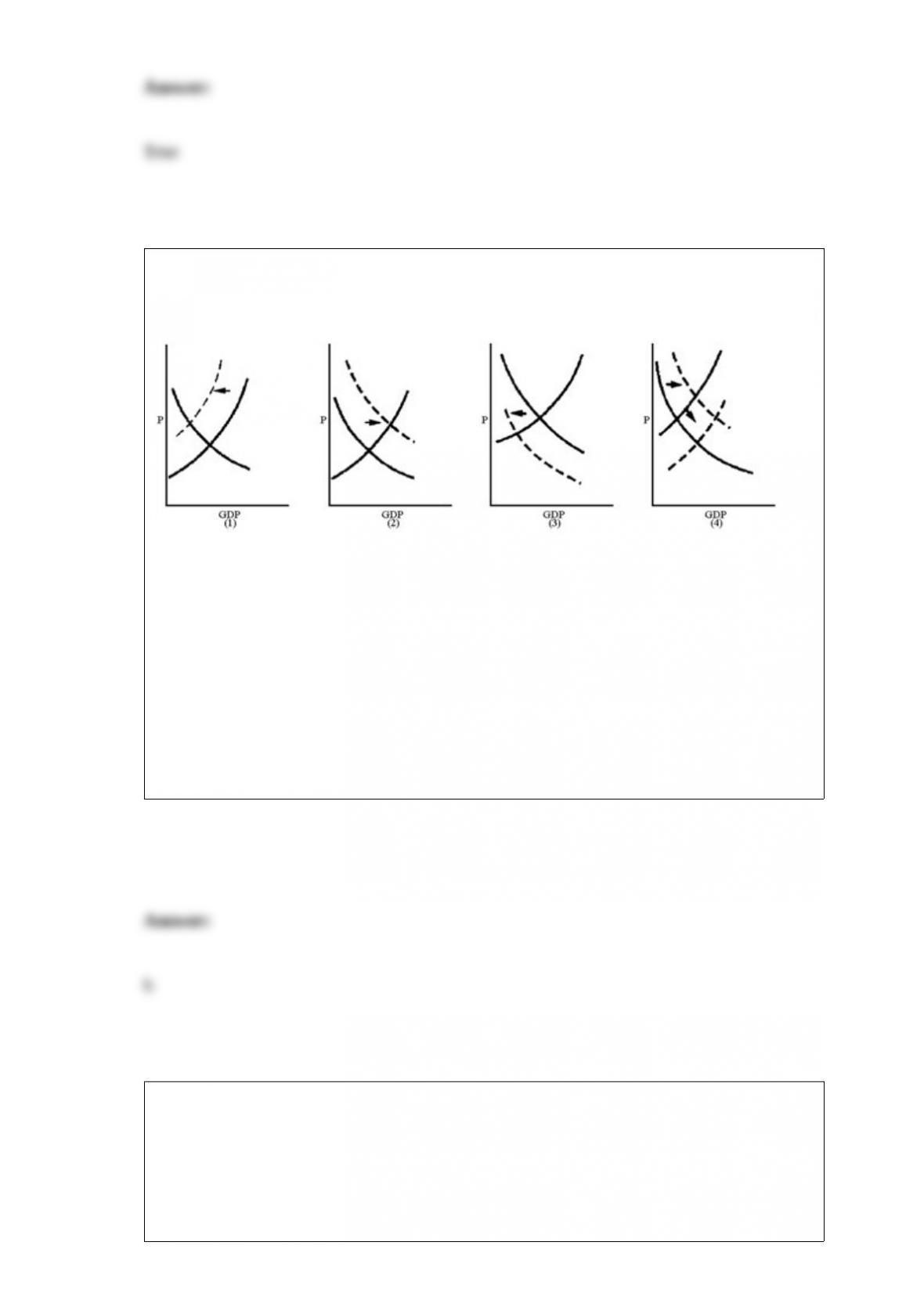
Figure 11-2
Which graph in Figure 11-2 best reflects a Keynesian’s view of the impact of raising
taxes on saving?
a. 1
b. 2
c. 3
d. 4
The fastest growing economy between 1870 and 1979 was
a. the United Kingdom.
b. the United States.
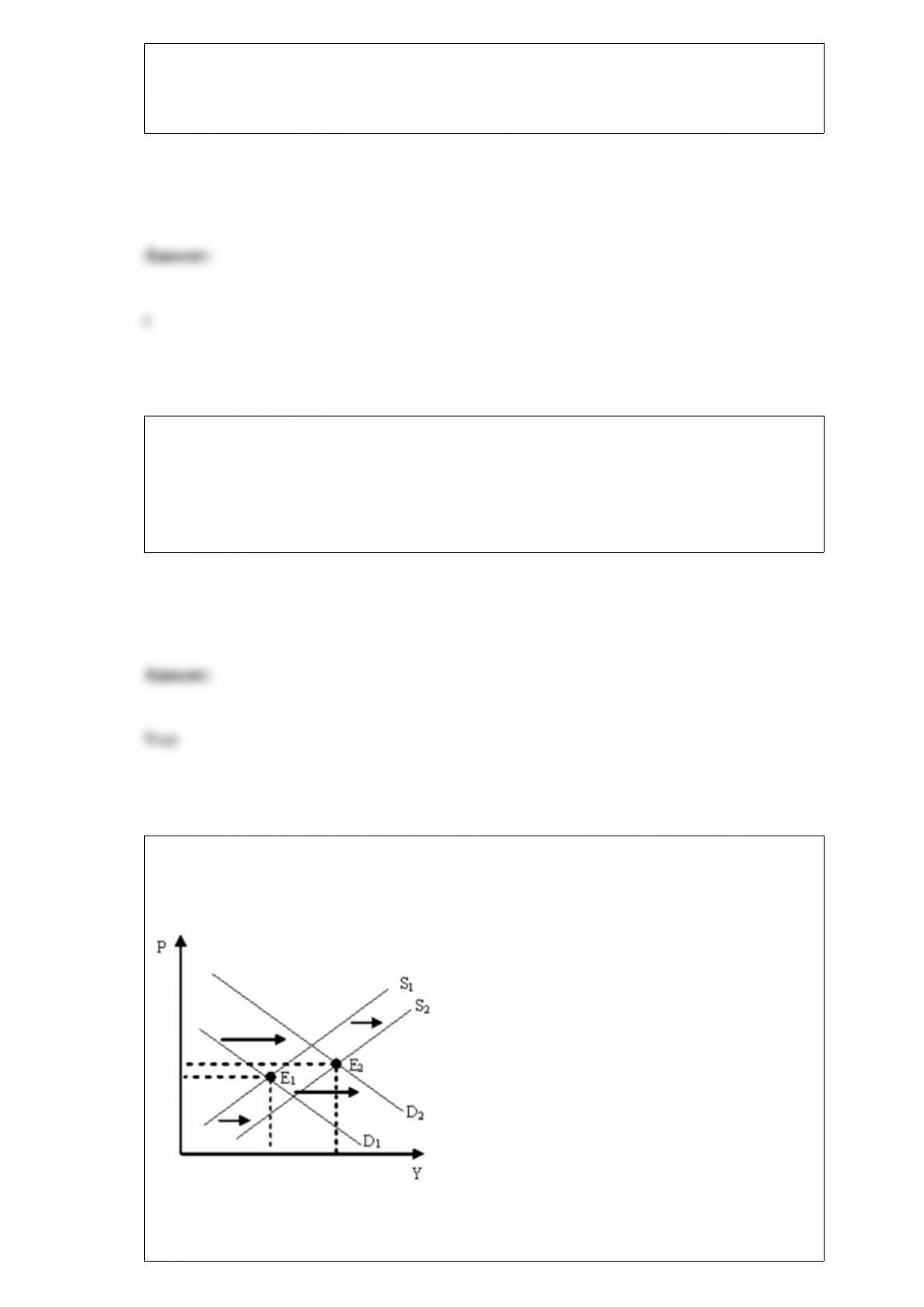
c. Japan.
d. Brazil.
Expenditures for attending college can be viewed as an investment in human capital.
a. True
b. False
Figure 10-9
Figure 10-9 illustrates a period of
a. economic growth and high inflation.
b. economic growth and low inflation.
c. economic recession and high inflation.
d. economic recession and low inflation.
The crowding-in effect depends on the sensitivity of investment to
a. GDP, as does the crowding-out effect.
b. interest rates, whereas the crowding-out effect depends on the sensitivity of
investment to GDP.
c. interest rates, as does the crowding-out effect.
d. GDP, whereas the crowding-out effect depends on the sensitivity of investment to
interest rates.
Properly enforced property rights will usually cause
a. lower levels of investment spending.
b. lower levels of real interest rates.
c. higher levels of investment spending.
d. higher levels of real interest rates.
The distribution of income in the United States
a. became slightly more equal during the 1980s.
b. did not change significantly during the 1980s.
c. has become more unequal since 1980.
d. has become more equal since 1980.
Suppose that the U.S. personal income tax was eliminated and replaced with a fixed tax
that raised the exact same amount of revenue. The multiplier would be
a. larger.
b. unchanged.
c. smaller.
d. incalculable.
Deficits are created by governments running a large debt.
a. True
b. False
It has been found that
a. less-developed countries have more equality of income distribution.
b. more-developed countries have more equality of income distribution.
c. only prior communist countries have more equality of income distribution.
d. income distribution cannot be measured among countries with different political and
economic systems.
Suppose that the rate of interest increases. What will happen to the discounted present
value of an investment?
a. It will increase.
b. It will decrease.
c. It will remain unchanged.
d. It depends on the magnitude of the change.
Opportunity cost cannot be measured in money terms, only in conceptual terms.
a. True
b. False
If the interest rate rises, a profit-maximizing firm will tend to
a. invest in more projects (such as new plants) with payoffs in the future.
b. invest in fewer projects with payoffs in the future.
c. increase both current output and future output.
d. reduce both current output and future output.
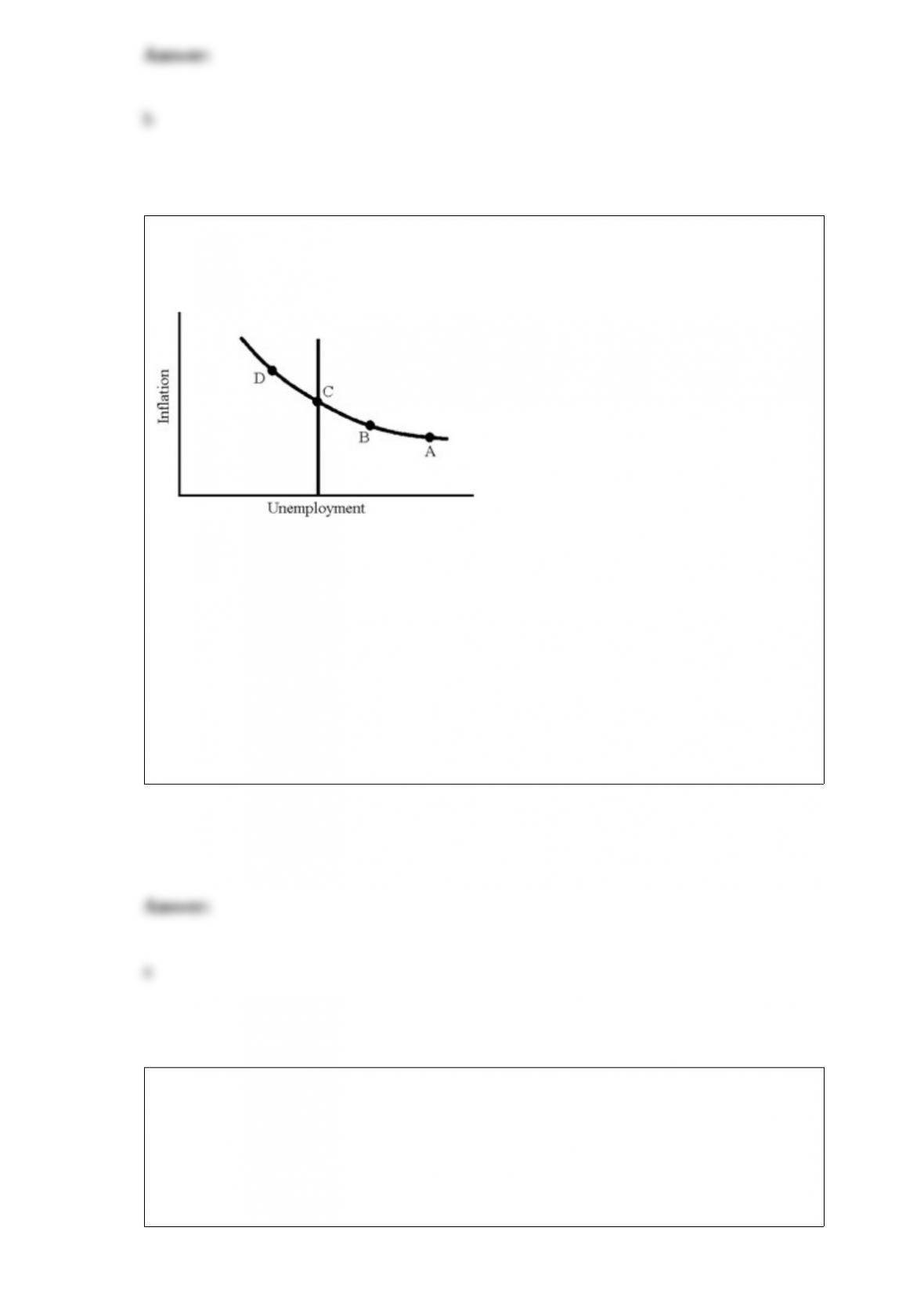
Figure 17-7
In Figure 17-7, the case for expansionary monetary policy and fiscal policy is strongest
at point
a. A.
b. B.
c. C.
d. D.
If the dollar appreciates, American consumers will buy more foreign goods and
services.
a. True
b. False
Monopolists may in the long run
a. earn positive economic profit.
b. be protected by barriers to entry.
c. grow wealthy at the expense of their consumers.
d. All of the above are correct.
The exchange rate between yen and dollars at one point in 2010 was 83 yen per dollar.
If a Big Mac, fries, and a Coke cost $3.91 in San Francisco, how much should the same
order cost in yen in Osaka?
a. 0.03
b. 325
c. 392
d. 422
Explain the “too big to fail” doctrine.
It has been said that well-educated citizens are necessary for democracy. Discuss this
idea in economic terms. What market imperfection might occur and what are the
appropriate government policies to correct it?
Whether or not deficits create a burden depends on how and why the government
incurred the deficits in the first place. Explain.
The federal budget went $161 billion in fiscal year 2007 to $1 trillion in the next two to
three years. What are the main factors that contributed to this increase?
Explain the importance of the shape of supply curve for undertaking stabilization
policies.
What is a multiplier? How does the multiplier effect occur?
Which oligopoly model leads to price rigidity? Graphically show why.
Competition reduces some but not all discrimination. Where can one expect
competition to reduce discrimination, and where is discrimination likely to go on even
if there is competition?
Explain how the current U.S. tax system levies taxes on capital gains and earned
interest. What does this mean for the costs of inflation?
In the spring of 2002, the United States imposed tariffs on imported steel to protect the
jobs of American steel workers and protect the production of the American steel
industry. Why might this policy not work to increase overall employment in the United
States?
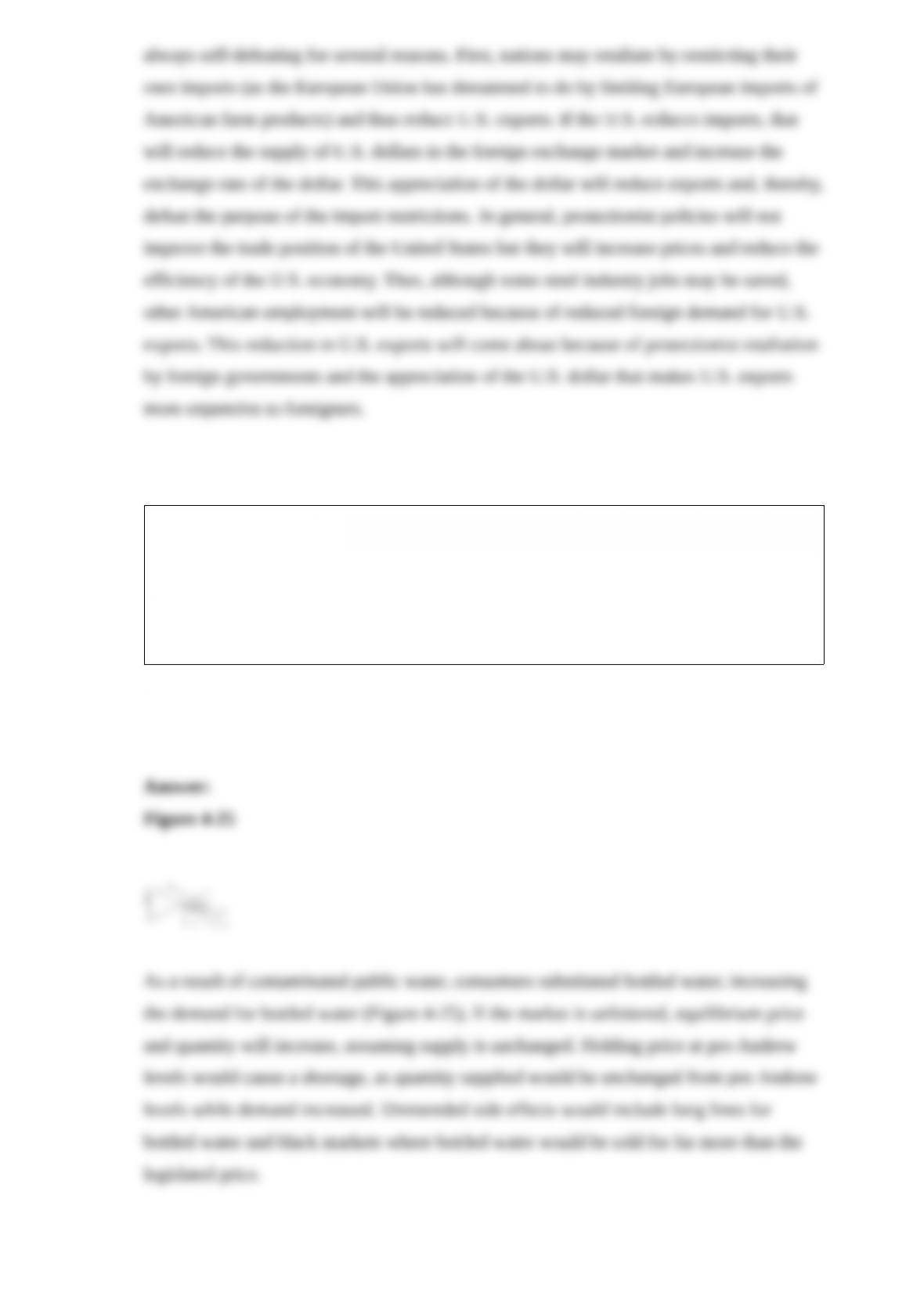
Producers were accused of price gouging as the price of bottled water soared after
Hurricane Andrew. Consumers clamored for price controls to keep bottled water at
pre-Andrew levels. Use supply and demand analysis to graphically show the effect of
setting a price ceiling on bottled water after Hurricane Andrew at the pre-hurricane
equilibrium price. Use your graph to assist in explaining the likely unintended effects of
such a price control. Be sure that your graph is completely and correctly labeled.
The Sandy Deli operates near a college campus. It has been selling 325 sandwiches a
day at $1.75 each and is considering a price cut. It estimates 450 sandwiches would sell
per day at $1.50 each. Calculate the marginal revenue of such a price cut and the
elasticity between the two points.
Describe the particular policy mix that accounts for the favorable economic conditions
of the late 1990s. Be sure to specify the fiscal and monetary policies pursued during this
period.
What quantity of output and price do they try to set, when a group of oligopoly firms
form a cartel? Will there be any changes in the price and quantity supplied if the cartel
gets broken down?
Describe some of the steps used to combat inflation. What are their side-effects?
Explain what happens to the magnitude of price elasticity of demand as price increases
along a straight-line demand curve.
Describe the process that would occur in the long run in a competitive industry if there
were economic profits. Illustrate this with a diagram.
What is meant by an economy’s self correcting mechanism? Explain the process
through which self correcting mechanism reduces inflationary gap.
Alice has $10 to spend on wine and cheese. If wine is $2.50 a glass and cheese $2, draw
the corresponding budget line. Then draw three indifference curves, one showing the
amount of wine and cheese Alice would choose, one showing less preferred
combinations of wine and cheese, and the last showing preferred but unaffordable
combinations.