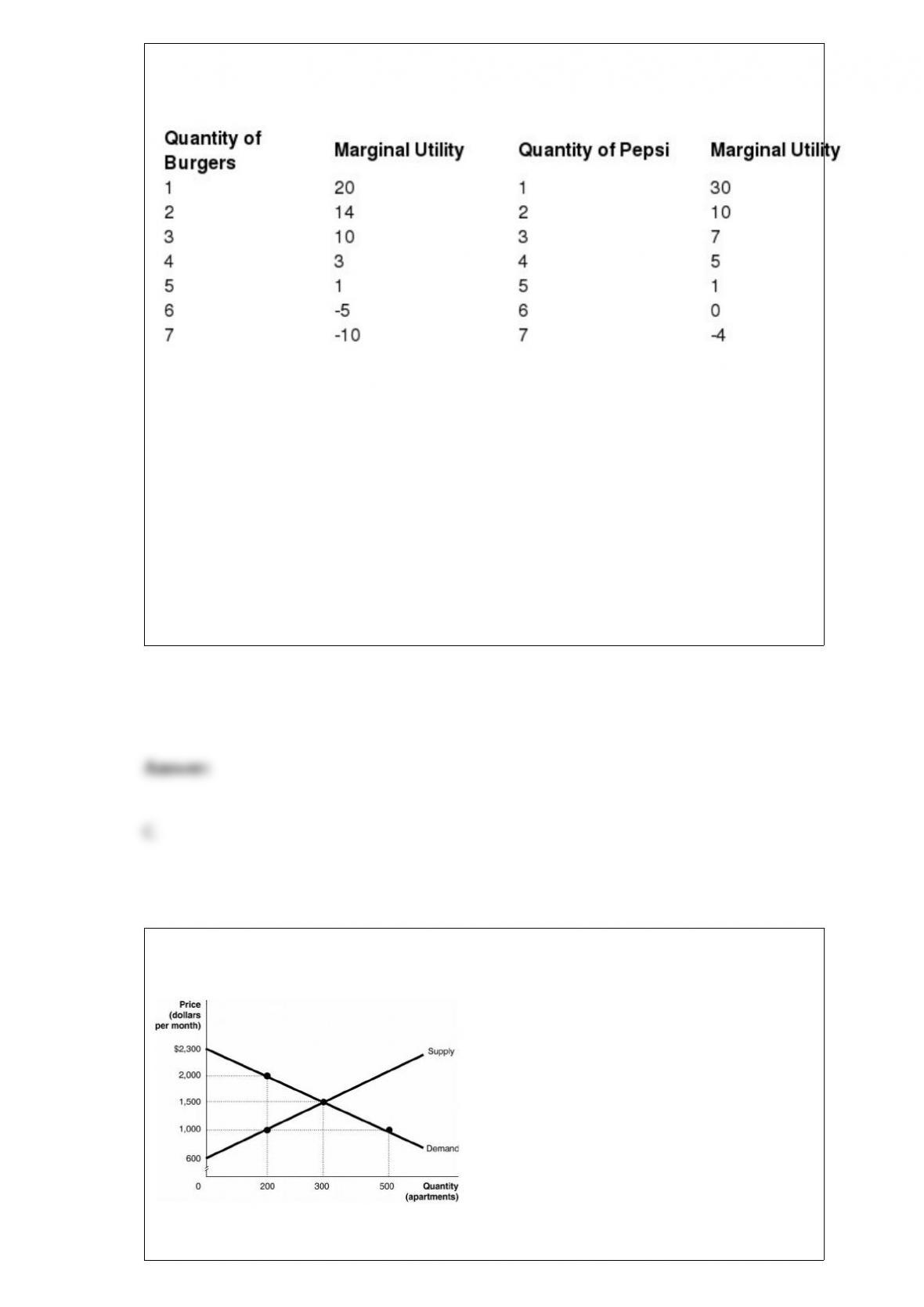
Table 10-6
Table 10-6 lists Jay’s marginal utilities for burgers and Pepsi. Jay has $7 to spend on
these two goods. The price of a burger is $2 and the price of a can of Pepsi is $1.
Refer to Table 10-6. If Jay can eat all the burgers he wants for free, how many burgers
will he consume?
A) 7 burgers
B) 6 burgers
C) 5 burgers
D) 3 burgers
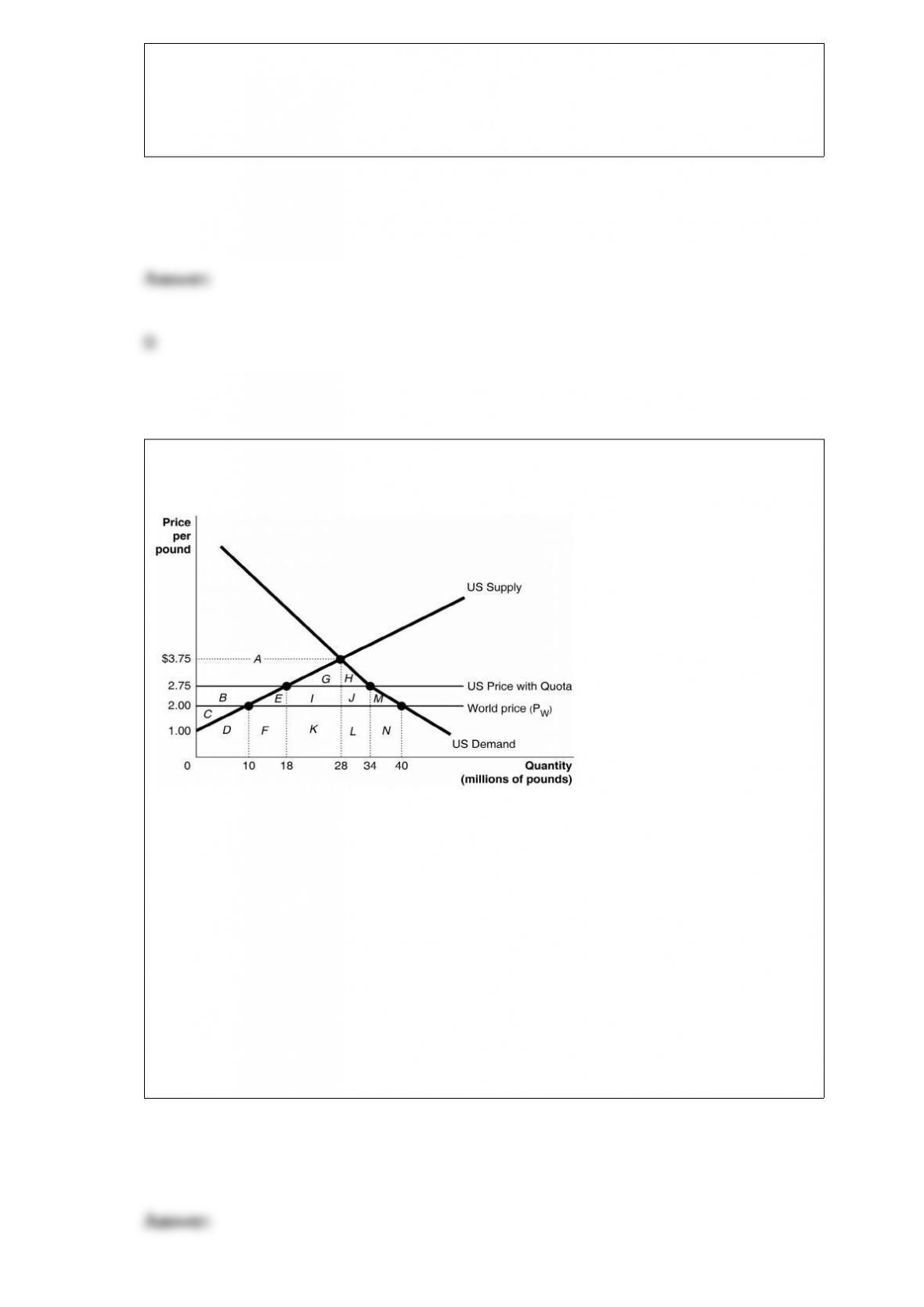
Figure 4-5
Figure 4-5 shows the market for apartments in Springfield. Recently, the government

imposed a rent ceiling of $1,000 per month.
Refer to Figure 4-5. What is the value of consumer surplus after the imposition of the
ceiling?
A) $120,000
B) $230,000
C) $270,000
D) $430,000
An organization of employees that has the legal right to bargain with employers about
wages and working conditions is called a
A) closed shop.
B) guild.
C) labor union.
D) monopsony.
What is regulatory capture?
A) It is a situation in which a policy maker seeks to improve his election prospects by
aligning himself with a powerful special interest group which will finance his political

campaign.
B) It is the exchange of political support between a regulatory agency and the regulated
firm resulting in both parties capturing economic rents.
C) It is a situation in which a firm being regulated successfully influences the
regulatory agency’s actions to benefit the interests of the firm, rather than the public
interest.
D) It is a situation in which a regulatory agency uses its authority to force actions that
are not favored by the regulated firms but are in the public’s interest.
When new firms are encouraged to enter a monopolistically competitive market
A) some existing firms must be earning economic profits.
B) they do so because there is insufficient product differentiation.
C) the demand curve facing an existing firm shifts to the right.
D) the marginal cost curve facing an existing firm shifts downwards.
A tax bracket is
A) the percent of taxable income paid in taxes at a specific income bracket.
B) the income range within which a particular tax rate applies.
C) the type of tax structure for which a range of taxes applies.
D) the range, from the high to the low tax rate, of a particular type of tax.
Figure 9-3
Since 1953 the United States has imposed a quota to limit the imports of peanuts.
Figure 9-3 illustrates the impact of the quota.
Refer to Figure 9-3. What is the area that represents revenue to foreign producers who
are granted permission to sell in the U.S. market when there is a quota?
A) I + J
B) E + I + J + M
C) I + J + K+ L
D) G + H + I + J

An article in the Wall Street Journal noted the following: Instead of relying on a
full-coach, round-trip unrestricted fare of about $2,000 between Cleveland and Los
Angeles …Continental [Airlines] since June has offered a $716 unrestricted fare in that
market …. Through October, the test resulted in about the same revenue that Continental
thinks it would have collected with its higher fare.
Source: Scott McCartney, “Airlines Try Cutting Business Fares, Find They Don’t Lose
Revenue,” Wall Street Journal, November 22, 2002.
What is the absolute value of the price elasticity of demand on this airline route?
A) 0
B) less than 1
C) greater than 1
D) approximately 1
Small companies selling traditional products benefit from ________.
A) the barriers to trade that restrict their products from crossing domestic boundaries
B) increased investment by foreign competitors in domestic markets
C) government policies that seek to regulate the flow of capital across national borders
D) technology that lowers the costs and difficulties of global communication

The key characteristics of a monopolistically competitive market structure include
A) few sellers.
B) sellers selling similar but differentiated products.
C) high barriers to entry.
D) sellers acting to maximize revenue.
Joss is a marketing consultant. Iris and Daphne are potential customers interested in
commissioning Joss to undertake a market survey and compile the findings in a report.
Iris is willing to pay $500 for the service while Daphne is willing to pay $800. Suppose
that the opportunity cost of Joss’s time is $1,200. Assume that Iris and Daphne do not
know each other. If Joss charges the same price per copy to both Iris and Daphne
A) the report will not get written.
B) only Daphne will commission the job and the report will be written.
C) both Iris and Daphne will commission the job and the report will be written.
D) no conclusion can be drawn without information on the price.

A firm using a two-part tariff faces a tradeoff because
A) the only way to increase the fixed-fee portion of the price is to lower the per-unit
portion of the price.
B) the only way to increase total revenue is to lower per-unit profit.
C) any increase in consumer surplus must be offset by a decrease in producer surplus.
D) the smaller the variation between the parts of the price, the greater the deadweight
loss generated by the pricing scheme.
The Organization of Petroleum Exporting Countries (OPEC) controls about 75 percent
of the world’s proven oil reserves. Economists refer to OPEC as a cartel because
A) OPEC is a monopoly, but it is located outside of the boundaries of any one country.
This is the definition of a cartel.
B) this is the term used for an oligopoly that is controlled by national governments
rather than private firms.
C) it is a group of firms that collude to restrict output to increase prices and profits.
D) this is the term economists use to describe an oligopoly that sells a standardized
product, such as oil, rather than a differentiated product, such as automobiles.

The bargaining power of suppliers increases if
A) the cost of switching suppliers is relatively low.
B) there are only a few competitors to the supplier.
C) the input in question is not a critical component of production.
D) the input supplied is relatively standardized.
Tastes for products such as beer differ. As a result
A) we see countries specializing completely in the production of beer.
B) consumers of beer have difficulty deciding what type of imported beer to buy.
C) the quality of imported beer is less than it could be.
D) different countries may each have a comparative advantage in producing different
types of beer.
Technology is defined as
A) the process of developing and revising models.
B) new innovations and creations.

C) the processes used to produce goods and services.
D) the process of recycling products.
Which of the following statements is true?
A) If the price of a good is lowered and total revenue decreases, demand is elastic.
B) If the price of a good is raised and total revenue does not change, demand is
perfectly elastic.
C) If the price of a good is raised and total revenue increases, demand is inelastic.
D) If the price of a good is lowered and total revenue increases, demand is inelastic.
Farah has $100 to spend each month on bread and chicken. Suppose the price of bread
is $4 a loaf and the price of chicken is $5 per pound.
a. Draw her budget constraint and label it BC0. Put bread on the horizontal axis and
chicken on the vertical axis. Be sure to identify the intercept values.
b. Suppose Farah is a utility maximizer and she consumes 10 loaves of bread and 12
pounds of chicken. On the same graph you drew in part (a), draw an indifference curve
to identify her optimal bundle. Label this bundle “E.”
c. Is her budget exhausted? Verify your answer.
d. Now suppose Farah’s income falls to so that she can now devote $80 to the two
goods. Prices however remain unchanged. In the same diagram, graph her new budget
constraint and label it BC1. Be sure to identify any new intercept values.
e. Following the change in income, can Farah consume the same bundle “E“? Explain
your answer.
f. What must happen to her total utility following the decrease in her income?
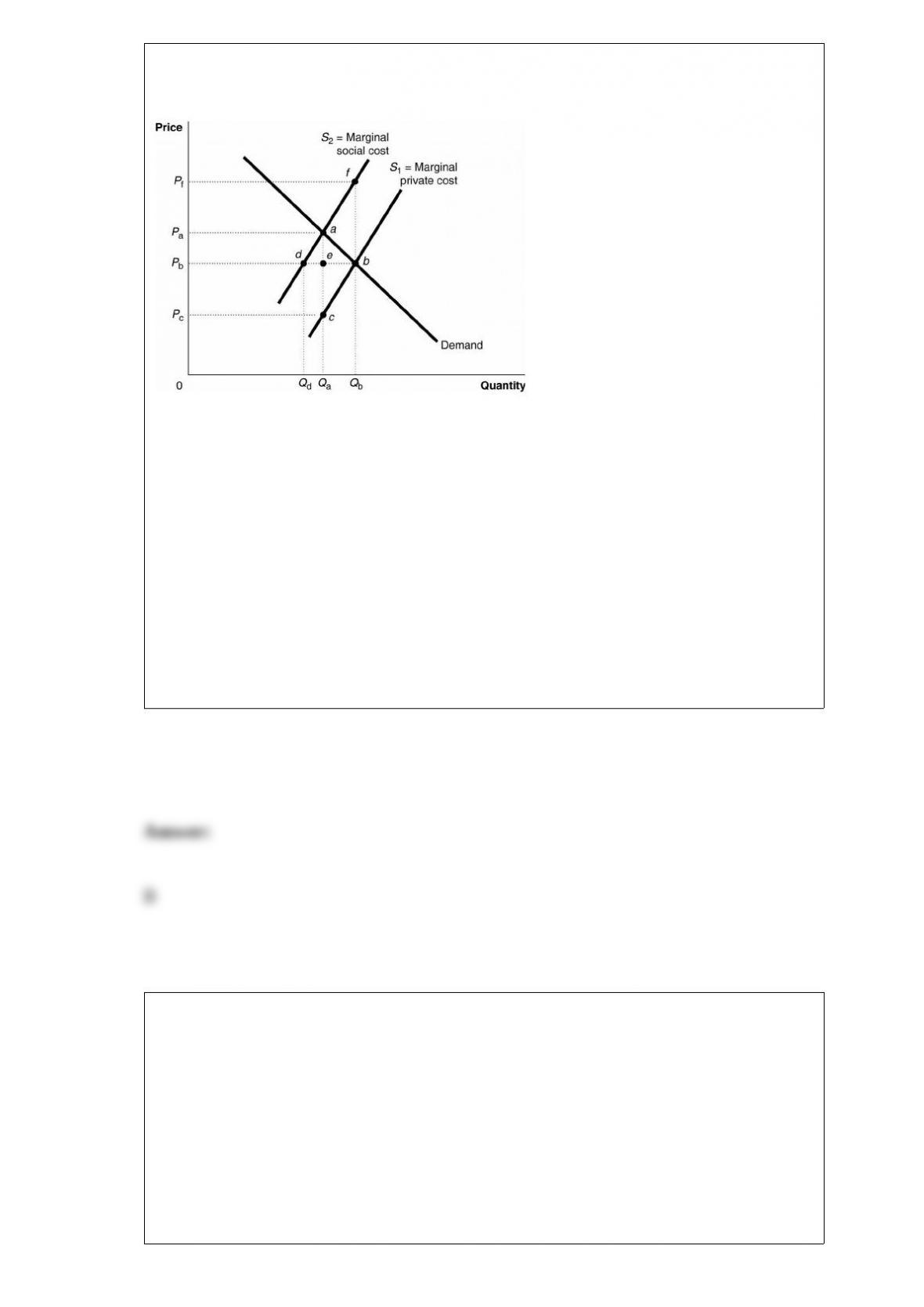
Figure 5-2
Figure 5-2 shows a market with a negative externality.
Refer to Figure 5-2. The marginal benefit of the last unit produced is represented by the
price
A) Pa.
B) Pb.
C) Pc.
D) Pf.
Why are decision trees useful to managers who plan business strategies?
A) Decision trees explain the level of concentration in an industry.
B) Decision trees can be used to increase the amount of product differentiation; this
enables managers to charge higher prices for their products.
C) Decision trees provide a systematic way of thinking through the implications of a
strategy.
D) Using a decision tree always leads to a dominant strategy.
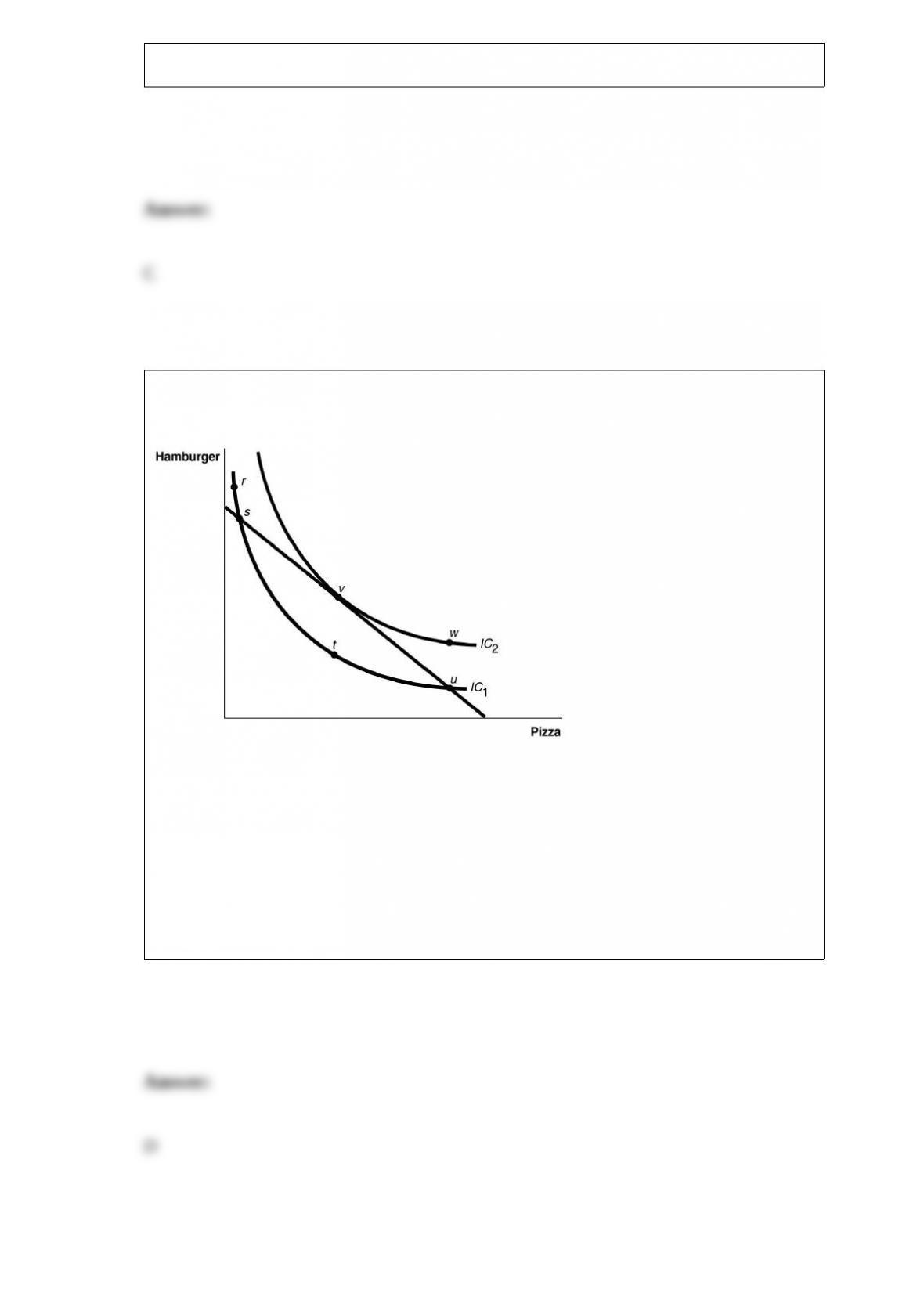
Figure 10-5
Refer to Figure 10-5. Which of the following statements is true?
A) The consumer gets more utility from bundle r than from bundlev.
B) The consumer gets less utility from bundle w than from bundlev.
C) Bundlesr, s, t andu all cost the same.
D) Bundlesr andw are not affordable.

If you want to know the present value of $10,000 received in one year, and the interest
rate is 4 percent, what formula can you use?
A) Present value equals $10,000 times 0.04.
B) Present value equals $10,000 divided by 1.04
C) Present value equals 1.04 divided by $10,000.
D) Present value equals $10,000 times 1.04.
The Federal Trade Commission (FTC) Act
A) gave the FTC full power to regulate mergers.
B) closed the loopholes in the Sherman and Clayton Acts.
C) divided authority to police mergers between the FTC and the Department of Justice.
D) prohibited charging buyers different prices if the result would reduce competition.
A goal of market-based reforms of the health care system is to give patients an incentive
to pay more attention to the prices of medical services. This would tend to ________
economic efficiency by ________ the costs of medical services
A) increase; increasing

B) increase; decreasing
C) decrease; increasing
D) decrease; decreasing
Economists working at federal government agencies have estimated that the marginal
social cost of carbon is about
A) $2 per ton.
B) $9 per ton.
C) $21 per ton.
D) $47 per ton.
Which of the following statements is true of developing countries that have embraced
globalization?
A) The countries have experienced an increase in life expectancy.
B) As a result of extensive commercialism, there has been a decline in personal income.
C) Relying upon developed countries for technology has rendered their talent pool
stagnant.
D) Their rich cultural diversity hasn’t been affected by exposure to new cultures.
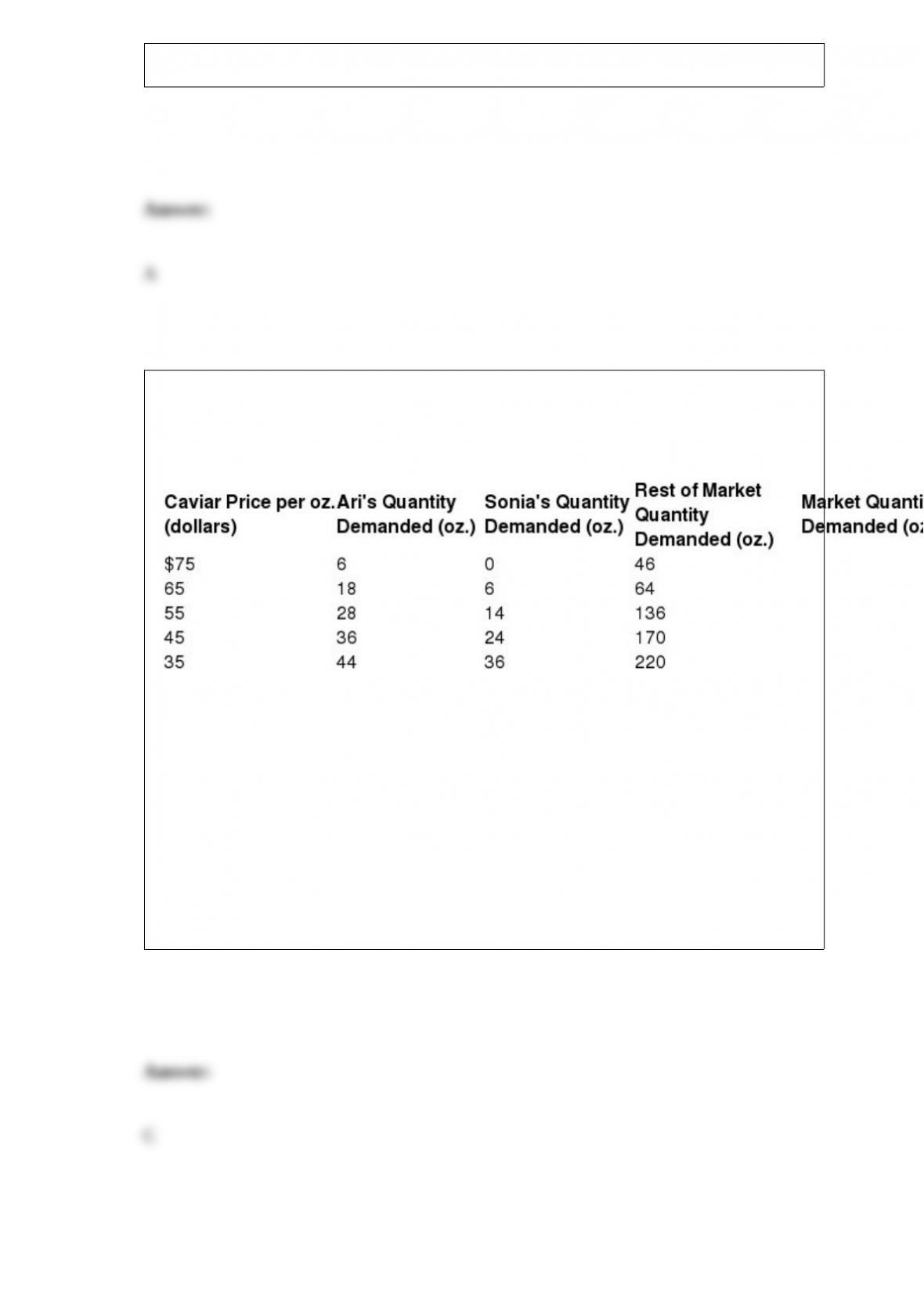
Table 3-2
Refer to Table 3-2. The table above shows the demand schedules for caviar of two
individuals (Ari and Sonia) and the rest of the market. At a price of $55, the quantity
demanded in the market would be
A) 42 oz.
B) 136 oz.
C) 178 oz.
D) 233 oz.
Identify the type of merger in each of the following situations and indicate how the
post-merger concentration ratio for the industry is affected.
a. A steel company merges with a coal and iron ore mining company.b. Staples, a
retailer of office supplies, acquires Office Depot, another retailer of office supplies.c.
An oil company merges with pipeline, shipping, and railroad companies as well as
refineries and gas stations.
A tragedy of the commons occurs when a resource is
A) rival and excludable.
B) ) rival and non-excludable.
C) non-rival and non-excludable.
D) non-rival and excludable.
To calculate the price elasticity of supply we divide

A) the percentage change in price by the percentage change in quantity supplied.
B) the percentage change in quantity supplied by the percentage change in price.
C) rise by the run.
D) the average price by the average quantity supplied.
Which of the following is a necessary condition for successful price discrimination?
A) The seller must possess market power.
B) The buyer must possess market power.
C) Transaction costs must be zero.
D) Buyers must have identical inelastic demands.
A monopoly firm is the only seller of a good or service that
A) has a perfectly elastic demand.
B) has no close complements.
C) does not need to be advertised.
D) does not have a close substitute.

If a firm produces 20 units of output and incurs a total cost of $1,000 and a variable cost
is $700, calculate the firm’s average fixed cost of production if it expands output to 25
units.
A) $300
B) $15
C) $12
D) It is impossible to determine without additional information.
Which of the following factors will not cause the labor demand curve to shift?
A) increases in human capital
B) changes in technology
C) change in the price of the product produced with labor
D) the wage rate