
The purchase of a new living room sofa from a major furniture store would be explicitly
counted when computing the gross domestic product by the ________ approach.
a. income
b. expenditures
c. surplus value
d. intermediate product
e. standard of living
The redistributive effects of high inflation rates tend to favor
a. the saver who keeps money in a cookie jar.
b. those who work under long-term contracts.
c. no one because the prices of goods and services rise.
d. pensioners and others who live on fixed incomes.
e. speculators in assets such as land, art, and bullion.
One of the major long-term effects of rent controls in New York City has been
a. an increase in the average size of an apartment.
b. the creation of above-average profits for landlords.
c. the creation of surpluses of affordable housing units.
d. a rapid increase in the rate of New York’s population growth.
e. the abandonment of buildings, reducing the number of rental units available to
consumers.
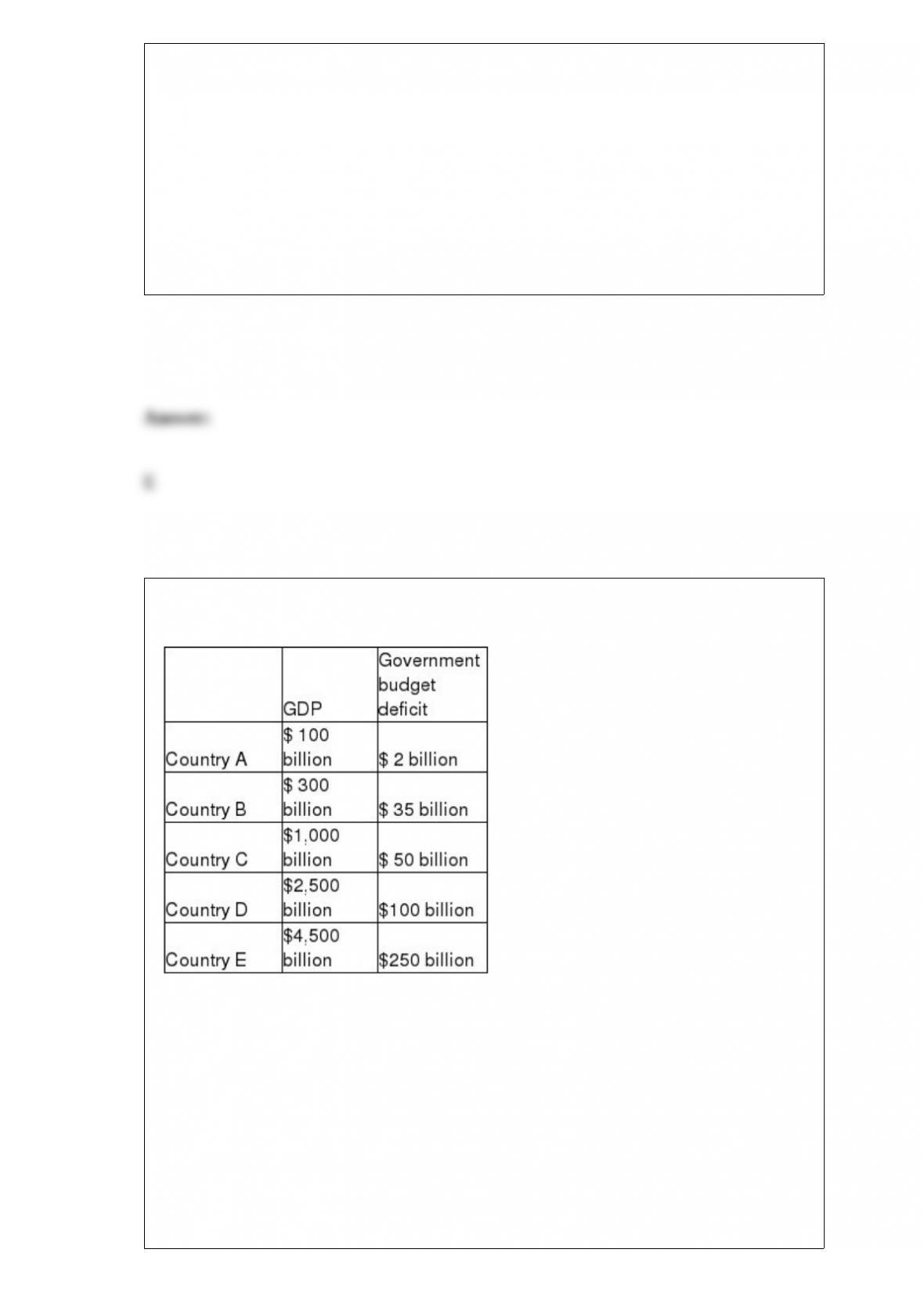
In the 1980s and early 1990s the annual federal budget deficit was ________ percent of
GDP.
a. less than 1
b. 1 to 3
c. 3 to 6
d. slightly under 10

e. over 50
A decrease in demand
a. results from a decrease in supply.
b. means that the demand curve has shifted to the left.
c. increases the quantity sold in the market.
d. reflects an increasing consumer preference for the item.
e. causes the equilibrium price to rise.
According to the video on Monopolies, one of the major forces that weakens monopoly
power over the long run is
a. government ownership of large firms.
b. regulation by federal, state, and local governments.
c. a rapid pace of technological change and innovation.
d. significant economies of scale.
e. high taxes on profits in excess of normal returns.

If a commercial bank has $8 million in demand deposits and $1.4 million in legal
reserves and the legal reserve requirement is 16 percent, then the bank has excess
reserves of
a. $0.
b. $120,000.
c. $224,000.
d. $1,176,000.
e. $1,280,000.
The greatest source of revenue for local governments is the ________ tax.
a. personal income
b. corporate income
c. estate and gift
d. general sales
e. property
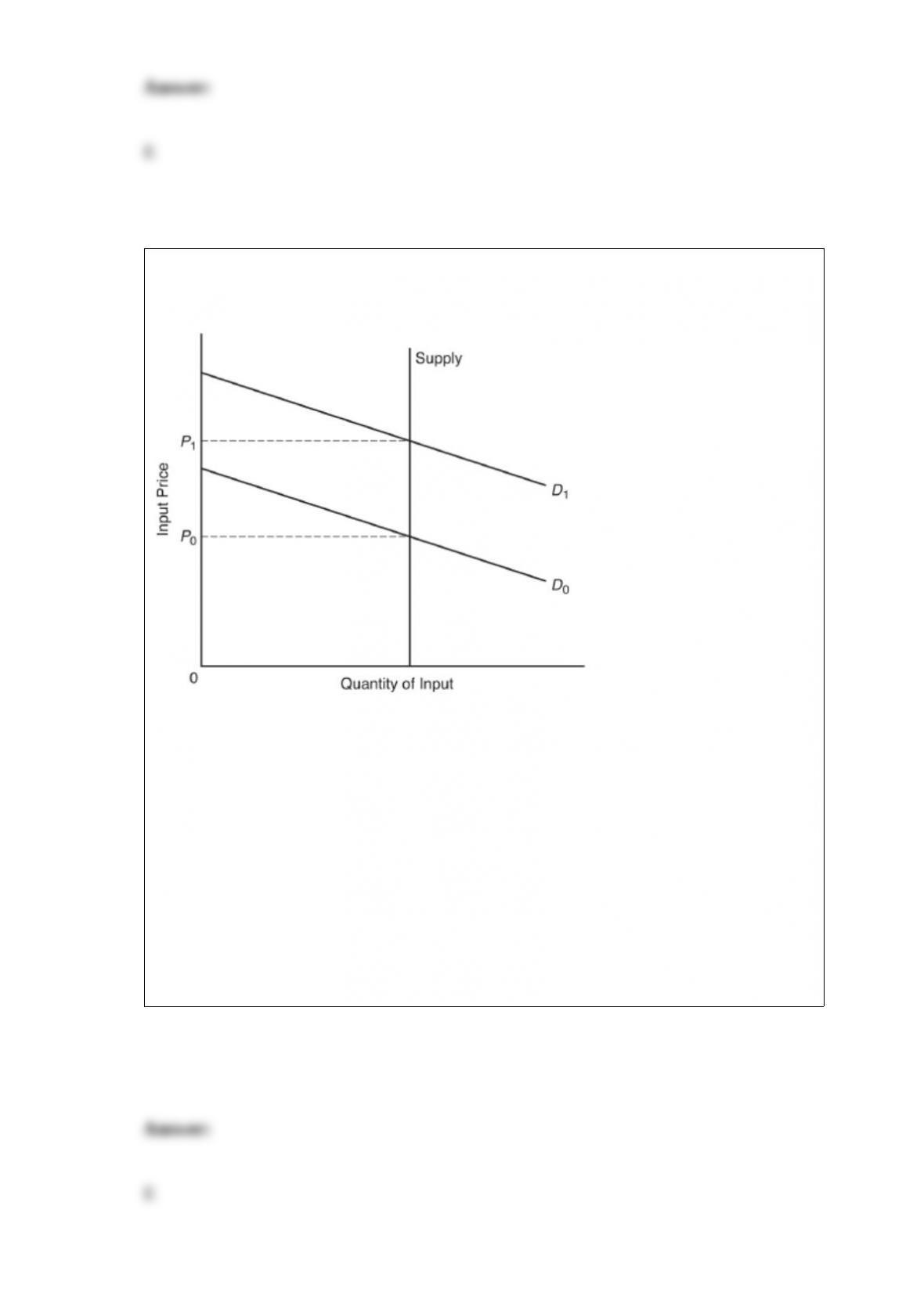
The following questions are based on the following diagram, representing the supply
and demand curves for an input:
An increase in the price of some rural acreage resulting from the construction of a
nearby interstate highway is an example of
a. capital formation.
b. consumer surplus.
c. parity.
d. risk.
e. rent.

Society’s pool of knowledge concerning the industrial arts is called
a. labor.
b. land.
c. capital.
d. opportunity cost.
e. technology.
In an economy as complex as ours, the only way to achieve a meaningful estimate of
what we produce is to
a. reduce everything to a common denominator: money.
b. consider the number of hours of labor involved in production.
c. calculate the ultimate value of each product to our social welfare.
d. count only tangible products, not intangible services.
e. aggregate all financial transactions for a given year.
A supply-side inflation that the Fed accommodates is best illustrated by a

a. leftward shift in the aggregate demand curve.
b. rightward shift in the aggregate supply curve.
c. leftward shift in the aggregate demand curve with a rightward shift in the aggregate
supply curve.
d. leftward shift in both the aggregate demand and aggregate supply curves.
e. leftward shift in the aggregate supply curve and a rightward shift in the aggregate
demand curve.
A fall in bond prices must mean that
a. interest rates have fallen.
b. interest rates have risen.
c. bond purchases and sales will cease.
d. money is easy and credit is readily available.
e. the amount of money demanded for investment will rise.
When a prospering economy began to show signs of hitting a slump, President
Eisenhower, despite diverse suggestions from all sides, held the tax rate stable and, in
effect, did nothing. In hindsight, most economists of the 1990s agree that Eisenhower’s

strategy
a. led to a long period of economic stagnation during the 1950s.
b. was hopelessly naive; a tax increase would have been the right move.
c. would have been enhanced by increased government spending and more attention to
balancing the budget.
d. represented a tragic return to the old, worn theories of classical economics.
e. was right given the effects of automatic stabilizers on the economy.
Personal and corporate income taxes serve as automatic stabilizers by causing
a. tax revenues to fall as GDP rises.
b. the government budget to run a surplus during recessions.
c. continuous prosperity.
d. government tax revenues to rise and fall as GDP rises and falls.
e. discretionary fiscal programs to become meaningless.
The following questions are based on the following diagram:
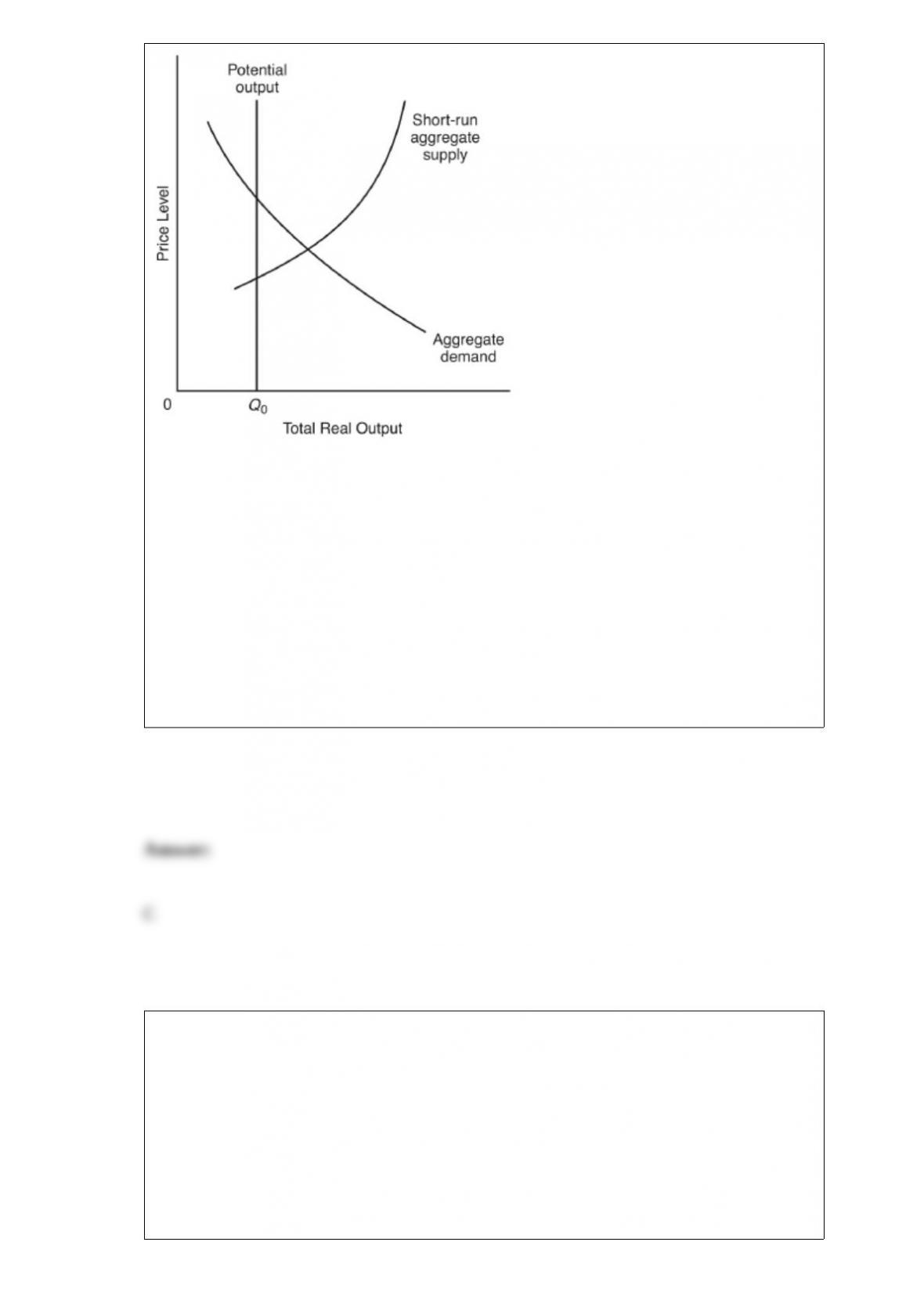
Which of the following events would correct the condition shown?
a. an increase in spending by the private sector
b. a decrease in potential output because of a natural disaster
c. an increase in wages and other input prices
d. an increase in the money supply by the government
e. an increase in government spending accompanied by a tax cut
The value added by an industry is the value of the goods and services produced minus
a. depreciation.
b. taxes.
c. wages.
d. inflation.

e. the cost of intermediate goods.
The number of U.S. dollars it takes to purchase a British pound is called the
a. purchasing parity price.
b. balance of payments.
c. equation of exchange.
d. appreciation price ratio.
e. exchange rate.
If the United States can produce 10,000 personal computers or 20,000 TVs with 1 unit
of resources and Japan can produce 12,000 personal computers and 36,000 TVs with 1
unit of resources
a. Japan has a comparative advantage in personal computers.
b. the United States has a comparative advantage in personal computers.
c. neither country has a comparative advantage, but Japan has an absolute advantage in
both personal computers and TVs.
d. both countries have a comparative advantage in both commodities, so trade would

not be beneficial to either.
e. both countries would produce TVs and import personal computers from somewhere
else.
In a 1999 study, Professor Robert Gordon showed that the gains in productivity during
the 1990s
a. were nonexistent when adjusted for changes in the unemployment rate.
b. occurred primarily in the traditional manufacturing sector.
c. were due entirely to gains in the high-tech sector.
d. were in line with the earlier results of a Federal Reserve Bank study.
e. matched the performance of the economy during the 1970s and 1980s.
An important characteristic of the discount rate is that it
a. has a powerful effect on the money supply.
b. has a direct impact on bank reserves without changing the money supply.
c. can be changed frequently and substantially.
d. structurally alters bank credit creation.

e. has no effect on financial markets.
When an increase in price produces a decline in the total amount spent on a commodity,
demand is said to be
a. of absolute elasticity.
b. income inelastic.
c. of unitary elasticity.
d. price inelastic.
e. price elastic.
There is neither excess supply nor excess demand when
a. actual price equals equilibrium price.
b. the quantity supplied plus the quantity demanded equals total output.
c. price equals quantity.
d. surpluses equal shortages.
e. the number of buyers equals the number of sellers.

Which of the following provides the best distinction between assets and liabilities?
a. Assets are cash reserves; liabilities are money in other forms.
b. Assets are what the bank owns; liabilities are what it owes.
c. Assets are investments from which the bank earns a profit; liabilities are investments
on which the bank loses money.
d. Assets are equal to the bank’s net worth; liabilities represent a charge against the
bank’s net worth.
e. Assets consist mainly of buildings and equipment; liabilities are cash and securities.
Suppose the required ratio of reserves to deposits is 1:9, banks have no excess reserves,
one person withdraws $10,000 from a checking account and stuffs it under a mattress,
and no other person withdraws cash from the banking system. When the process has
worked itself out, the money supply will show an additional decline of
a. $1,111.
b. $8,889.
c. $11,111.
d. $80,000.
e. $90,000.

According to economist Richard Gill in the video presentation, the experience of Marin
County residents during the drought of the 1970s shows that
a. scarcity is not as much of a factor in determining price as economists once thought.
b. people tend to be very careful in their use of scarce resources.
c. price has more impact on total utility than on marginal utility.
d. when there is no substitute for a resource its demand is high.
e. the total utility of water rises as it becomes less available.
In general, when people hold excess money balances, they
a. use them to bid up interest rates.
b. hoard them indefinitely.
c. use them to buy financial assets.
d. supplement them by borrowing.
e. use them to force down the prices of stocks and bonds.

If one pictures the Federal Reserve System as a pyramid, the bottom of the pyramid
represents
a. the 12 Regional Reserve banks.
b. the U.S. consumers.
c. the Federal Advisory Council and other economic advisers.
d. commercial banks.
e. Congress.
Supply-side economics had its greatest influence on economic policy debate during the
a. 1920s.
b. 1930s.
c. 1940s and 1950s.
d. 1960s.
e. 1970s and 1980s.

The marginal product of capital decreases because of
a. increases in population growth that decrease the average product of labor.
b. the law of diminishing returns.
c. technological advances.
d. rising capital productivity.
e. growing investment opportunities.
Perhaps the single greatest criticism economists have of monopolies is that monopolies
tend to
a. oppose technological development.
b. create misallocation of resources.
c. make monopolists rich.
d. produce goods and services that are of questionable social benefit.
e. require government regulation in order to be efficient.

The Malthusian model seems particularly relevant for the
a. agricultural sector.
b. less-developed countries.
c. industrialized nations.
d. countries of eastern Europe.
e. western world.
Supply-siders argue that federal budget surpluses should be used to
a. pay down the national debt.
b. increase government spending on education and health care.
c. finance tax reductions.
d. eliminate the deficit in the balance of payments.
e. increase the money supply.
In recent years, many economists believe that changes in taxes rather than changes in
government expenditures should be the primary fiscal weapon to fight unemployment
or inflation because

a. it is easier to get Congress to take speedy action on tax changes than on spending
changes.
b. changes in government spending shift the aggregate supply curve rather than the
aggregate demand curve.
c. taxes directly affect the income of the government, making it easier to balance the
budget every year.
d. taxes change disposable income while having no impact on GDP.
e. it is better to base the level of government spending on its long-run merits than
short-term stabilization considerations.