
Balancing the government’s budget every year
a. is necessary because all debts eventually come due.
b. is a fundamental tenet of Keynesian economics.
c. is sensible for the same reasons as is balancing the family budget.
d. makes it difficult to use fiscal policy to stabilize the economy.
e. results in simultaneous inflation and unemployment.
In the U.S. economy, a major deterrent to bank runs is
a. the fact that most banks keep 50 percent of their deposits as reserves.
b. government ownership of commercial banks.
c. the stock of gold owned by the government.
d. the ability of commercial banks to create money when needed.
e. the FDIC.
A leading pioneer in the efforts to provide the first estimates of U.S. income and output
was
a. Alexander Hamilton.
b. David Schoenmacher.
c. Franklin D. Roosevelt.
d. John Maynard Keynes.
e. Simon Kuznets.
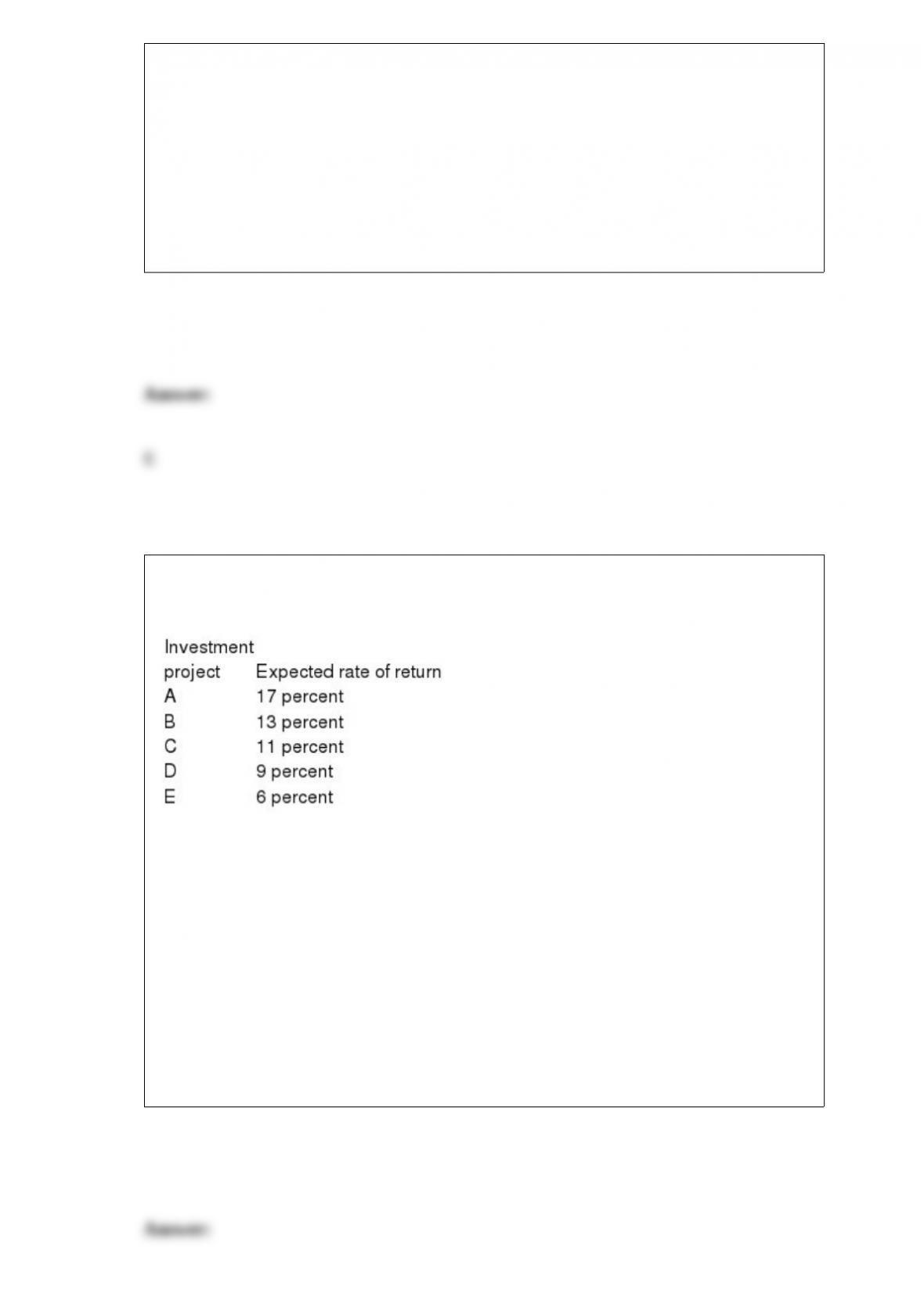
The following questions are based on the following rates of return for five independent
investment projects:
If the rate of interest is 12 percent, the number of projects that would be undertaken is
a. 1.
b. 2.
c. 3.
d. 4.
e. 5.

It would NOT pay a firm to produce anything in the short run if price were
a. above average total cost.
b. equal to marginal cost and above average variable cost.
c. equal to total revenue divided by output.
d. below average variable cost.
e. below marginal average cost.
A tax that takes a smaller proportion of one’s income as that income rises is called a(n)
________ tax.
a. progressive
b. regressive
c. income
d. excise
e. proportional

Normative economics frequently plays a valid role when
a. making an economic forecast.
b. formulating economic theory.
c. gathering data.
d. considering economic policy questions.
e. testing an economic model.
The distinction between the short run and the long run is
a. strictly a calendar matter; the long run is over 10 years.
b. dependent solely on the time period necessary to vary all relevant inputs.
c. that, in the short run, neither inputs nor outputs can be changed.
d. that the law of diminishing marginal returns is operational in the long run but not in
the short run.
e. operationally meaningless since firms continually plan for the future.

The federal government is the source of over ________ of all research and development
(R&D) funds.
a. one-third
b. one-half
c. two-thirds
d. three-quarters
e. four-fifths
The basic difference between explicit and implicit costs is that
a. explicit costs are measurable; implicit costs are not.
b. implicit costs are measurable; explicit costs are not.
c. explicit costs are private costs; implicit costs are social costs.
d. explicit costs are fixed costs; implicit costs are variable costs.
e. explicit costs reflect externally supplied resources; implicit costs reflect
owner-supplied resources.
Economic growth is an increase in

a. population.
b. price levels.
c. unemployment.
d. real output.
e. consumption.
If country A can produce either 1,000 bushels of wheat or 500 bushels of rice with 1
unit of resources while country B can produce 600 bushels of wheat or 400 bushels of
rice with 1 unit of resources, country
a. B must give up fewer bushels of rice to get 1 unit of wheat than country A.
b. B must have an absolute advantage in wheat production.
c. A should specialize in the production of both wheat and rice because trade with B
would yield no benefit.
d. A must sacrifice less wheat to produce 1 unit of rice than country B.
e. B has a comparative advantage in rice production.
Our nation’s currency is

a. created by the commercial banks in the Federal Reserve System.
b. created by both the commercial banking system and the Federal Reserve System.
c. issued by the Federal Reserve System.
d. a fractional-reserve currency.
e. issued by the Treasury.
The major liability of the Federal Reserve System is
a. gold certificates.
b. government securities.
c. loans to commercial banks.
d. Federal Reserve notes.
e. treasury deposits.
A market consisting of a few firms producing similar products with significant barriers
to entry is characteristic of
a. perfect competition.

b. monopoly.
c. monopolistic competition.
d. oligopoly.
e. libertarianism.
High rates of inflation discourage research and development by
a. making long-run forecasting more hazardous, increasing the risk on longer-term
programs.
b. raising the price of bonds sold to finance new investment.
c. forcing the government to lower taxes to fight inflation.
d. reducing the amount of discretionary money households and businesses have to
spend on research and development.
e. encouraging investors to seek opportunities in areas where the return is high but the
outcome is less predictable than in basic research.
The following questions are based on the following graph showing the market for corn:
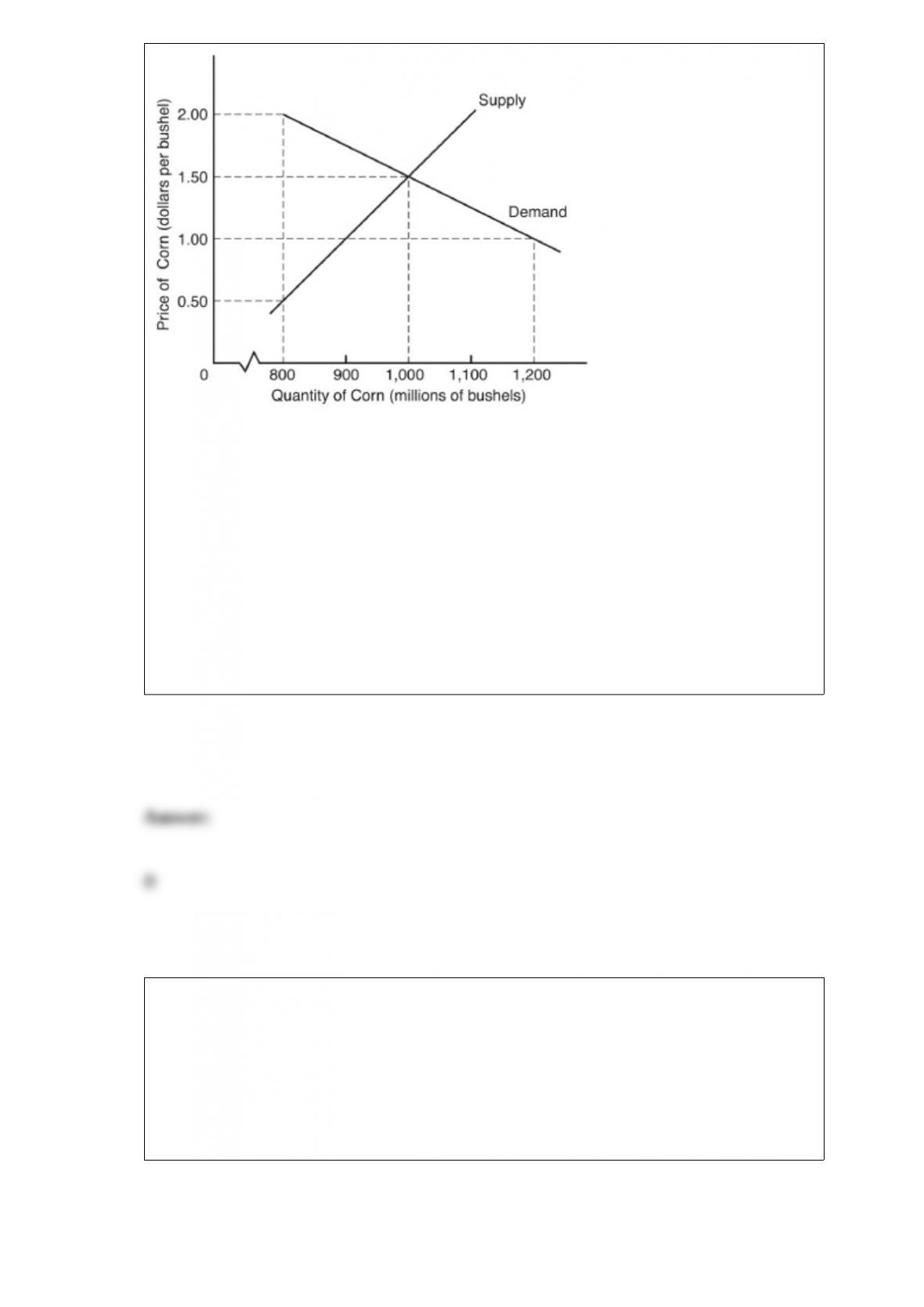
At the price of $1 per bushel, there would be an excess ________ million bushels.
a. demand of 200
b. demand of 300
c. demand of 400
d. supply of 200
e. supply of 300
Structural unemployment exists when those looking for jobs
a. are voluntarily unemployed.
b. lack employable skills.
c. can easily find work.
d. currently hold part-time positions at prevailing wages.
e. are not eligible for unemployment.

A firm uses inputs A and B when the price of A is $3 per unit and the price of B is $5
per unit. The marginal product of A is 15 units. If the firm is making an optimal input
decision, the marginal product of B must be
a. 1.
b. 9.
c. 15.
d. 25.
e. 45.
The demand curve for money (holding real GDP and the price level constant) is the
relationship between
a. money and near monies.
b. levels of income and demand for money.
c. the money supply and the level of GDP.
d. the transactions and precautionary demands for money.
e. the interest rate and the quantity of money demanded.

Economists generally assume that the actual market price of an item approximates the
equilibrium price. They make this assumption because
a. their information is too limited to permit a more accurate guess.
b. as soon as the actual price shifts, the equilibrium price shifts.
c. forces in the market tend to push actual price toward equilibrium.
d. very few products ever vary in price from the equilibrium.
e. actual prices are set by the government.
Land is defined by economists as an input whose ________ is fixed.
a. price
b. value
c. tax rate
d. quantity
e. revenue

Critics of real business cycle models argue that
a. the model works only under conditions of inflexible wages and prices.
b. its proponents fail to identify supply shock events that could be used to explain most
of the actual booms and recessions.
c. the theory places too much emphasis on fluctuations in the money supply and its
velocity of circulation.
d. only the Great Depression of the 1930s fits the real business cycle theory closely.
e. its assumption of a vertical long-run aggregate demand curve does not conform to
either sound economic theory or empirical evidence.
Which of the following firms is the best example of one that has achieved its monopoly
advantage because of network externalities?
a. General Motors
b. General Electric
c. Alcoa
d. Union Pacific Railroad
e. Microsoft

Using monetary policy to help close a recessionary gap
a. shifts the aggregate supply curve to the left.
b. is ineffective if the short-run aggregate supply curve is close to horizontal.
c. requires that people not spend excess money balances to ensure falling wages and
prices.
d. leads to increased unemployment unless price levels rise.
e. has inflationary consequences if the short-run aggregate supply curve is very steep.
Ricardo, in his work on income distribution, emphasized the struggle between
a. workers and industrialists.
b. landowners and the aristocracy.
c. England and Spain.
d. farmers and workers.
e. industrialists and landowners.

Most economists today hold a certain respect for Marx’s economic perspectives because
a. most of Marx’s predictions have come true, pretty much in the way he said they
would.
b. most economists today are strong labor sympathizers.
c. Marx was the first to recognize the inherent dangers of government intervention.
d. Marx demonstrated that in the final analysis, there is always a market for goods and
the labor that produces them.
e. Marx was the first to conceptualize a business cycle in which good times eventually
produced bad times and vice versa.
The Board of Governors of the Federal Reserve System is made up of
a. 12 elected commercial bankers.
b. five elected presidents of Federal Reserve banks and seven commercial bankers
appointed by the president of the United States.
c. seven people appointed by the president of the United States.
d. the 12 district presidents of the Federal Reserve System.
e. the treasurer of the United States, a member of the House and Senate Banking
Committee, three commercial bankers, and two Federal Reserve Bank presidents.
In the short run the perfectly competitive firm will produce at a loss rather than
discontinue production if

a. there is an output rate at which price exceeds average variable cost.
b. total losses exceed total fixed cost.
c. there is an output rate at which price equals marginal cost.
d. the firm’s supply curve is upward sloping.
e. total revenue can be increased by producing more.
Holding technology constant, increases in investment in plant and equipment
a. raise the rate of return.
b. reduce the ratio of capital to output.
c. raise the average product of capital.
d. reduce the marginal product of capital.
e. raise the profitability of investment.
Which of the following reasons for the existence of profits is LEAST socially
justifiable?
a. Profits serve as an incentive for risk taking.

b. Profits serve to signal entry and exit of resources in an economic system.
c. Profits reward economically efficient producers.
d. Profits appear where there are contrived scarcities in product or resource markets.
e. Profits accrue to successful innovators.
To compute value added in an industry, we must
a. add indirect taxes.
b. subtract the cost of intermediate goods from the value of sales.
c. add the cost of intermediate goods to the value of output.
d. divide by the rate of inflation.
e. add depreciation.