
The long-run average annual growth of real GDP per person is the United States is
approximately ______ percent.
A. one
B. two
C. five
D. seven
Refer to the figure above. If the market is unregulated, the value of producer surplus is:
A. $16.
B. $24.
C. $32.
D. $48.
If a producer is operating at an inefficient point on a production possibilities curve
using currently available resources, that producer:
A. cannot produce more of one good without giving up some of the other good.
B. can produce more of one good without producing less of the other good.
C. must be at an unattainable point on the production possibilities curve.
D. must be specializing in activities for which it has a comparative advantage.
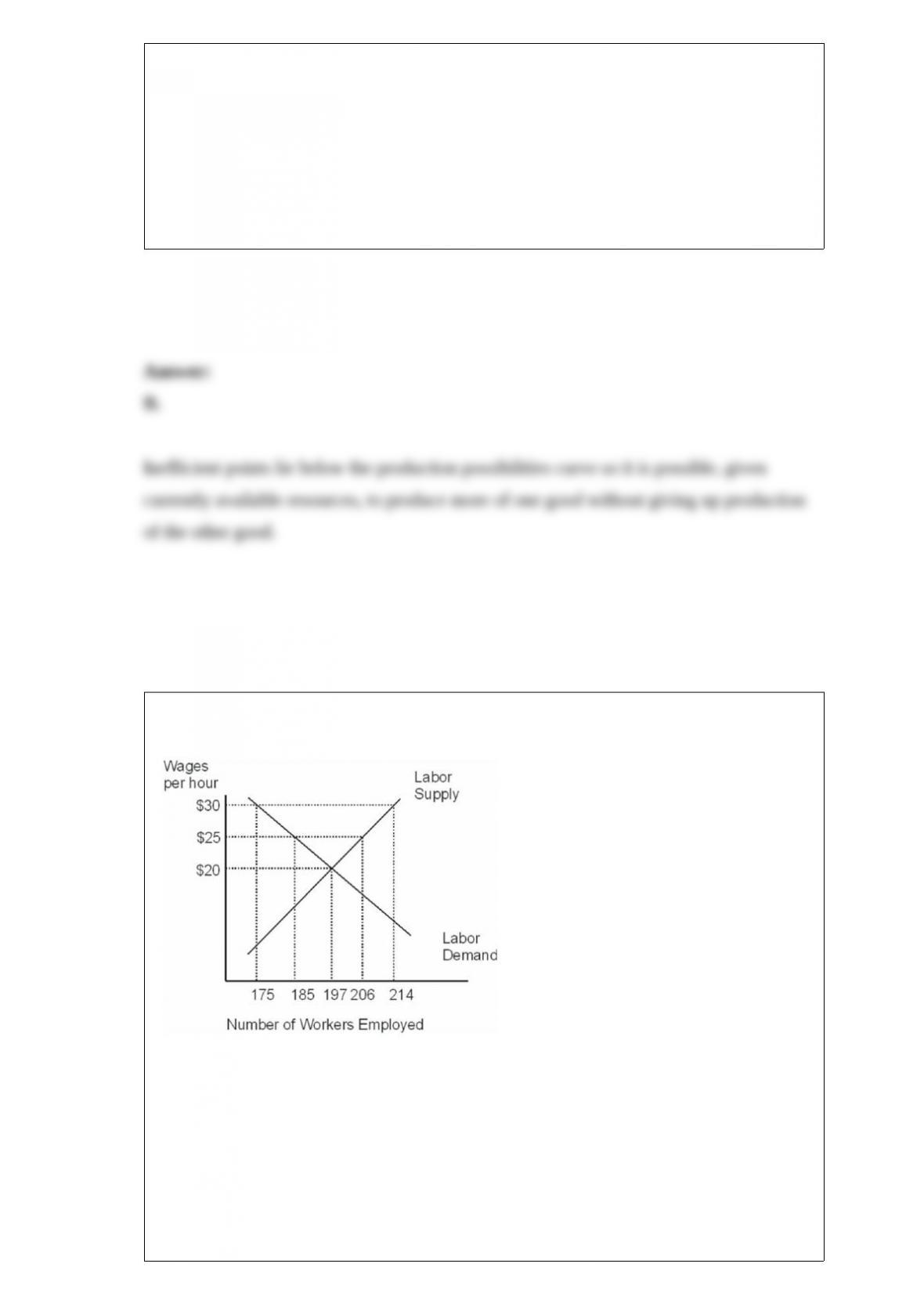
Based on the figure, if a union contract requires that the wage workers are paid be
raised from $25 to $30 per hour, the number of unemployed workers will increase by
______ workers.
A. 8
B. 10
C. 17

D. 18
Inflation inertia is the tendency for inflation to:
A. equal zero.
B. change relatively slowly from year to year.
C. decrease when the Fed increases interest rates.
D. increase when the Fed decreases interest rates.
According to the textbook, national advertising campaigns
A. should be discounted because they provide no real basis for choice.
B. are a credible signal of the company’s belief that its product is superior.
C. are only credible signals of quality if they mention a money-back guarantee.
D. are a waste of resources.

Sydney sells snow globes from a cart. When the cart is located on the sidewalk near a
discount store, Sydney’s customers have reservation prices of $5. When Sydney’s cart is
located on a sidewalk in an upscale mall, wealthier customers with reservation prices of
$10 buy snow globes. Assume that Sydney can sell the same volume at either location
and that marginal and average costs are $3 per globe at both locations.
Maximization of total economic surplus indicates that Sydney should
A. alternate between the two locations and price discriminate.
B. sell only near the discount store and charge $5.
C. sell only in the upscale mall and charge $10.
D. alternate between the two locations and charge $5 at both locations.
Pat has 4 hours to spend either studying for a test or playing a new video game. If Pat
spends all of that time studying, Pat can score a 92 on the test. If Pat plays for 1 hour,
Pat’s test score falls 5 points. For playing a second hour, Pat’s score falls by another 7
points. Playing for a third hour will lower Pat’s score by another 10 points.
Refer to the information above. Pat’s PPC for test score versus hours playing a new
video game is:
A. upward-sloping.
B. downward-sloping.
C. first upward- and then downward-sloping.
D. first downward- and then upward-sloping.

Which of the following would increase the consumption component of U.S. GDP?
A. You purchase a bottle of California wine.
B. A person in Paris purchases a bottle of California wine.
C. A restaurant in Denver purchases a bottle of California wine to include on its wine
list.
D. The U.S. government buys a bottle of California wine to serve at a state dinner in the
White House.
A decrease in stock prices alters the consumption function by:
A. increasing the mpc.
B. decreasing the mpc.
C. increasing the constant term.
D. decreasing the constant term.

According to the textbook, owners of restaurants have solved the _______ their wait
staff by paying low wages and encouraging tipping by customers.
A. credible threats by
B. commitment problem with
C. credible promises by
D. salary problems of
Suppose that the equilibrium price of pickles falls while the equilibrium quantity rises.
The most consistent explanation for these observations is:
A. a decrease in demand for pickles with no change in supply.
B. an increase in demand for pickles with no change in supply.
C. a decrease in the supply of pickles and a decrease in the demand for pickles.
D. an increase in the supply of pickles with no change in demand.

The substitution bias in the CPI arises because the CPI:
A. is based on a fixed basket of goods and services.
B. does not adequately allow for improvements in products.
C. measures prices at two different times.
D. understates the “true” rate of inflation.
The introduction of a new technology that raises the marginal product of new capital
will:
A. decrease real interest rates and increase the equilibrium quantity of saving supplied
and demanded.
B. decrease real interest rates and the equilibrium quantity of saving supplied and
demanded.
C. increase real interest rates and the equilibrium quantity of saving supplied and
demanded.
D. increase real interest rates and decrease the equilibrium quantity of saving supplied
and demanded.

To say that a given welfare program is means-tested indicates that
A. in order to qualify, one must have the means.
B. the size of the payment reflects the mean value of consumption based on family size.
C. in order to qualify, one must show that one means to find a job.
D. the more income one earns, the smaller the size of the benefit.
Which of the following is an example of an activity with an external cost?
A. Raising honeybees where neighbors on all sides grow apples.
B. Keeping the front yard clean.
C. Speeding on the interstate.
D. Having to buy batteries for the new remote that came with a TV.

Spending on new capital goods, new homes, and the addition of unsold goods to
company inventories is included in:
A. consumption expenditures.
B. investment.
C. government purchases.
D. service spending.
When the Fed eases U.S. monetary policy, domestic interest rates ______, making U.S.
assets relatively less attractive to foreign investors, and ______ the equilibrium
exchange rate.
A. rise; increasing
B. fall; increasing
C. fall; decreasing
D. rise; decreasing
The portion of planned aggregate expenditure that is independent of output is called
______ expenditure.
A. potential

B. planned
C. actual
D. autonomous
An economy produces only 500,000 tables valued at $100 each. Of these, 100,000 are
sold to consumers, 200,000 are sold to businesses, 100,000 are sold to the government,
and 50,000 are sold abroad. No tables are imported. The unsold tables at the end of the
year are held in inventory by the table manufacturers. What is the value of the
investment component of GDP?
A. $2 billion
B. $10 million
C. $20 million
D. $25 million
The key variable in determining changes in a country’s standard of living is the:
A. interest rate.
B. inflation rate.

C. unemployment rate.
D. long-run rate of economic growth.
A perfectly elastic demand curve has a slope of ______ while a perfectly inelastic
demand curve has a slope of ______.
A. infinity; 0
B. 1; 0
C. 0; 1
D. 0; infinity
Casey earns $150 a week and consumes only fish and shrimp. The price of fish is $3 a
pound and the price of shrimp is $5 a pound.
The price of fish decreased to $1.50 a pound and the price of shrimp remains $5 a
pound. At Casey’s original income of $150 per week Casey can buy a maximum of
_____ pounds fish or a maximum of _____ pounds shrimp.

A. 10, 30
B. 30, 50
C. 30, 100
D. 100, 30
When an American buys stock in a French company, from the perspective of the United
States, this is a(n):
A. import.
B. export.
C. capital outflow.
D. capital inflow.
Suppose that this graph describes the current labor market for high school teachers:
Suppose the market were to re-equilibrate following a shift of the supply curve to the
left. At the new equilibrium, wages would be
A. higher, and more teachers would be hired.
B. higher, and fewer teachers would be hired.
C. the same, but fewer teachers would be hired.
D. the same, and more teachers would be hired.
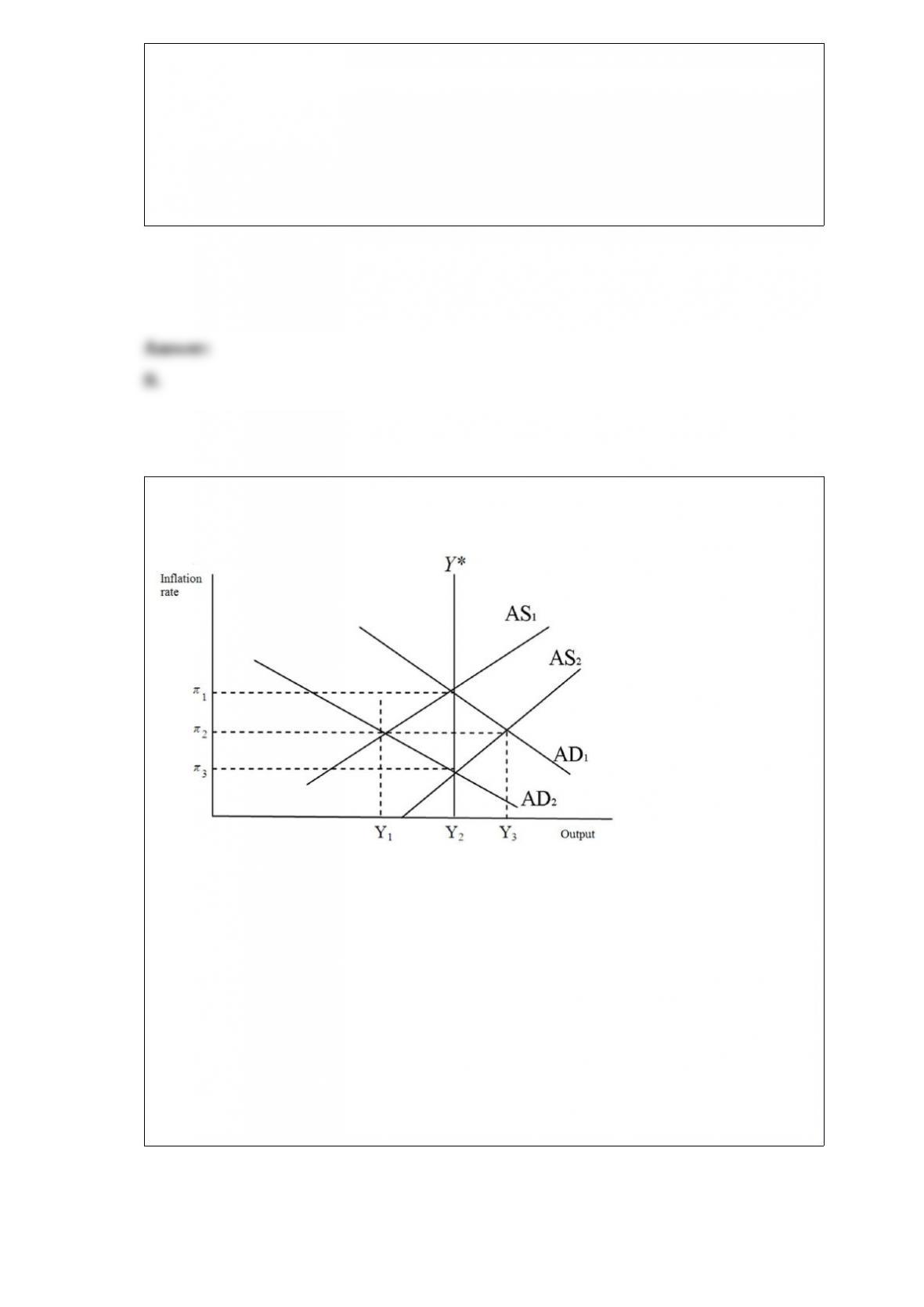
Refer to the figure above. Suppose the economy is in a short-run equilibrium at output
Y3 and inflation rate π2. The economy is currently experiencing ______, and the correct
monetary policy response to this situation, to return the economy to potential GDP, is to
______.
A. a recessionary gap; raise taxes
B. an expansionary gap; cut taxes
C. a recessionary gap; increase the money supply
D. an expansionary gap; decrease the money supply

One thing that distinguishes normative principles from positive principles is that:
A. normative principles are pessimistic and positive principles are optimistic.
B. normative principles reflect the social norms of the community, and positive
principles reflect universal truths.
C. normative principles tell us how people should make economic decisions, and
positive principles tell us how people actually do make decisions.
D. normative principles tell us how people actually make economic decisions, and
positive principles tell us how people should make decisions.
The shutdown condition applies
A. in the long run and in the short run.
B. only in the short run.
C. only to firms that are just breaking even.
D. to all firms, all the time.

The CPI in year one equaled 1.45. The CPI in year two equaled 1.51. The rate of
inflation between years one and two was ______ percent.
A. 4.0
B. 4.1
C. 4.5
D. 6.0
Regular interest payments made to bondholders are called ______ payments.
A. diversification
B. reserve
C. coupon
D. dividend
A profit-maximizing firm will shut down when:
A. total revenues are less than the total cost of fixed and variable factors of production.
B. total revenues are less than the cost of variable factors of production.
C. total revenues are less than the cost of fixed factors of production.
D. profits are zero.
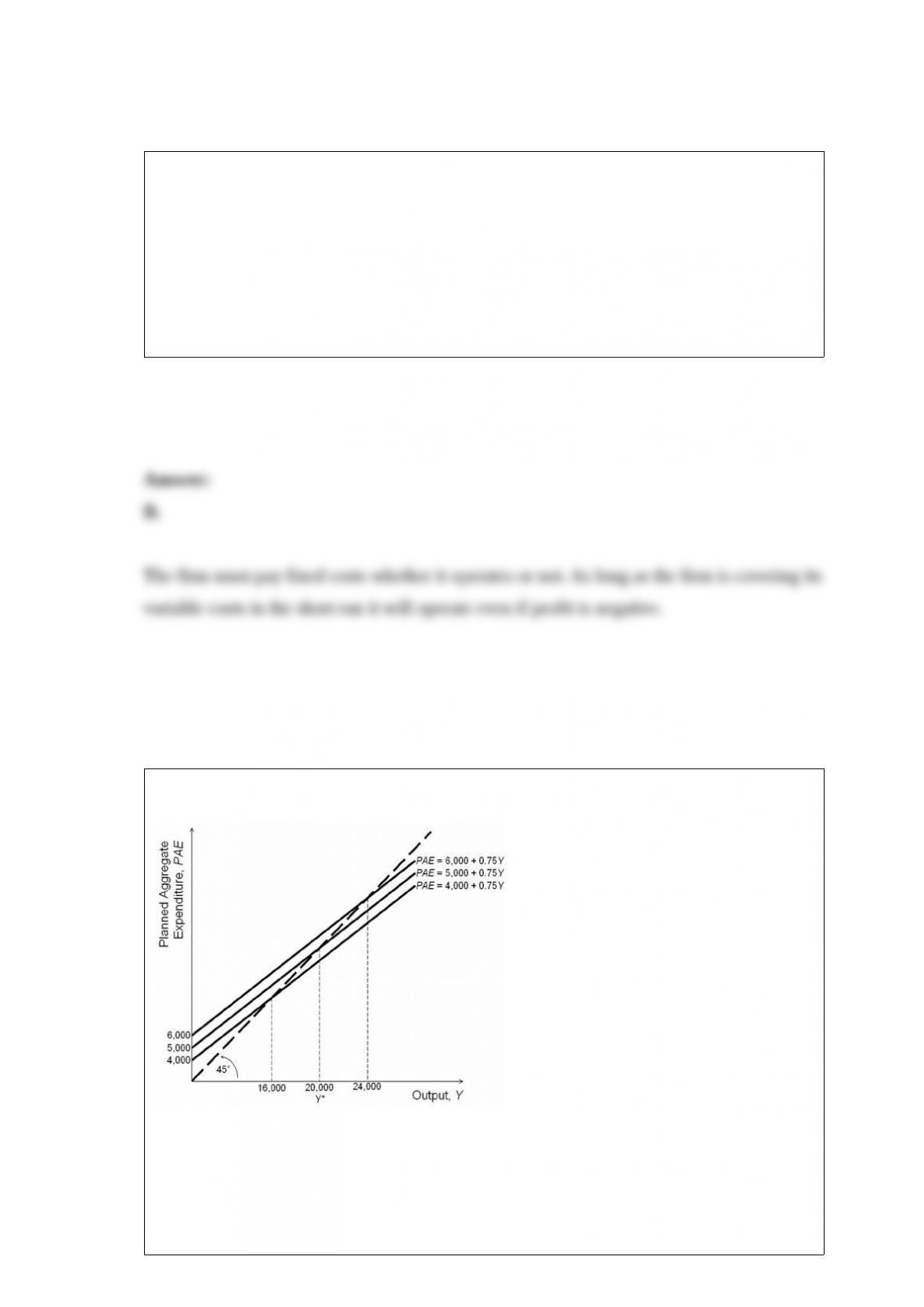
Refer to the figure above. Based on the figure, and starting from an initial short-run
equilibrium where output equals 20,000, if autonomous consumption spending
decreases by 1,000, then the new short-run equilibrium is at an output (Y) equal to:
A. 24,000.

B. 16,000.
C. 14,000.
D. 22,000.