
Credit cards typically provide lower risk-adjusted returns than other types of consumer
loans.
Answer:
In general, bank capital ratios have increased over the last 100 years.
Answer:
A low days inventory on hand and a high inventory turnover relative to industry norms
indicates less efficient inventory management and/or more liquidity.
Answer:
Universal banks were originally centered in Western Europe.

Answer:
Smaller banks rely more heavily on internally generated capital than larger banks.
Answer:
The duration of a liability that does not pay interest must be equal to 0.
Answer:
A significantly undercapitalized bank is one that does not meet the minimum levels for
all three capital ratios.
Answer:

Super-regional banks typically have limited global operations.
Answer:
Many bankers focus on eliminating the error of denying a loan to a customer who
ultimately would repay the debt.
Answer:
Static GAP analysis focuses on managing net interest income in the short-run.
Answer:

The yield curve is typically inverted at the peak of the business cycle.
Answer:
Banks can often replicate on-balance sheet transactions with off-balance sheet
contracts.
Answer:
The largest banks have, on average, reduced their dependence on loans relative to
smaller banks.
Answer:
A bank with a duration gap of 1 is more sensitive to changes in the economic value of
equity than a bank with a duration gap of –1.5.

Answer:
Balance sheet items are calculated for a particular point in time.
Answer:
When an investment bank acts as a broker, it does not take ownership of the underlying
security.
Answer:
It is more difficult for multibank holding companies to realize economies of scale if
they allow subsidiary banks to retain key decision-making authority.

Answer:
Periodic GAP analysis compares rate-sensitive assets and rate-sensitive liabilities across
each single “time bucket.”
Answer:
Common size ratio comparisons enable comparisons across firms in the same industry.
Answer:
Speculators take a position to reduce their risk profile.
Answer:

Negative cash flow will automatically eliminate the possibility that a bank will loan a
firm funds.
Answer:
More liquid assets tend to earn lower returns, everything else the same.
Answer:
A FICO score summarizes an individual’s credit history in one number.
Answer:
A bank with a negative GAP is said to be liability sensitive.

Answer:
The primary focus of a values driven bank is on the bank’s annual profit plan.
Answer:
Banks can circumvent capital requirements by moving assets off the books.
Answer:
Thrifts are supervised by the Office of Thrift Supervision.
Answer:

There is an inverse relationship between a bond’s duration and its price volatility.
Answer:
Effective duration considers a security’s embedded options.
Answer:
State-chartered banks must be members of the Federal Reserve System.
Answer:

Consumers are prohibited from disclosing if they receive public assistance when
applying for credit.
Answer:
The most prominent risk banks assume in making loans is interest rate risk.
Answer:
During the past 20 years, the number of distinct U.S. banking organizations has
increased.
Answer:
The FDIC insures credit union accounts up to $250,000.

Answer:
Most consumer loans are secured.
Answer:
When it comes to making international loans, political risk is easier to assess than
economic risk.
Answer:
Duration gap analysis focuses on changes in net interest income.
Answer:

An ACH transaction is a sale that uses a smart card.
Answer:
Bond prices and interest rates move in the same direction.
Answer:
___-corps have favorable tax treatment because a qualifying firm does not pay
corporate income taxes.
a. C
b. Q
c. S
d. V
e. Z

Answer:
Which of the following is considered a measure of bank productivity?
a. Return on assets
b. Return on equity
c. Assets per depositor
d. Assets per employee
e. All of the above are measures of bank productivity
Answer:
Banks use financial derivatives for all of the following except:
a. hedge asset yields.
b. adjust maturities by creating synthetic liabilities.
c. adjust the sensitivity of earnings to changes in interest rates.
d. lock-in the cost of liabilities.
e. Banks use financial derivatives for all of the above.

Answer:
Which of the following refers to the principles that drive a bank’s lending activity?
a. Loan policy
b. Credit culture
c. Credit analysis
d. Credit review
e. Loan documentation
Answer:
When the final Basel III rules are implemented in 2019, the minimum Tier 1
capital/risk-weighted assets percentage will be:
a. 4%
b. 6%
c. 8%
d. 8.5%
e. 10.5%

Answer:
What type of GAP analysis directly measures a bank’s net interest sensitivity through
the last day of the analysis period?
a. Earnings
b. Net Income
c. Maturity
d. Periodic
e. Cumulative
Answer:
Recoveries refer to:
a. the dollar value of loans actually written off as uncollectible.
b. the dollar amount of loans that were previously charged-off but now collected.
c. net charge-offs.
d. loans not currently accruing interest.
e. loans that regulators have required the bank to “recover”.

Answer:
__________ have a large international presence.
a. Global banks
b. Nationwide banks
c. Super regional banks
d. Regional banks
e. Specialty Banks
Answer:
The _________ authorized the Treasury to purchase debt securities issued by the Fannie
Mae, Freddie Mac, and the Federal Home Loan Banks and to purchase common stock.
a. Treasury Emergency Authority Provisions
b. Foreclosure Prevention Act
c. Troubled Asset Relief Program
d. Primary Dealer Credit Facility
e. Check 21 Act

Answer:
During 2007 – 2008, many borrowers had ________ in their homes causing individuals
to “walk away” from their homes.
a. positive equity
b. negative equity
c. positive market value
d. negative market value
e. positive asset value
Answer:
Which of the following is not part of the four-stage process for evaluating the financial
aspects of commercial loans?
a. An analysis of the firm’s management, operations, and industry.
b. Performing financial ratio analysis.
c. Analyze the firm’s cash flow.
d. Examining the backgrounds of the sales force.
e. Project the borrower’s financial condition.

Answer:
A new charter to start a state bank must be obtained from the:
a. Federal Reserve.
b. Federal Deposit Insurance Corporation.
c. Office of the Comptroller of the Currency.
d. Office of Thrift Supervision.
e. State banking department.
Answer:
A time draft for payment at a future date, often used in international trade is known as:
a. a reverse repurchase agreement.
b. a repurchase agreement.
c. a line of credit.
d. a letter of credit.
e. a bankers acceptance.
Answer:

Many insurance companies have organized as a _____________ in order to own a
depository institution and bypass prohibitions in the Glass-Steagall Act and the Bank
Holding Company Act.
a. unitary thrift holding company
b. commercial bank
c. mortgage company
d. savings bank
e. credit union
Answer:
Use the following information.
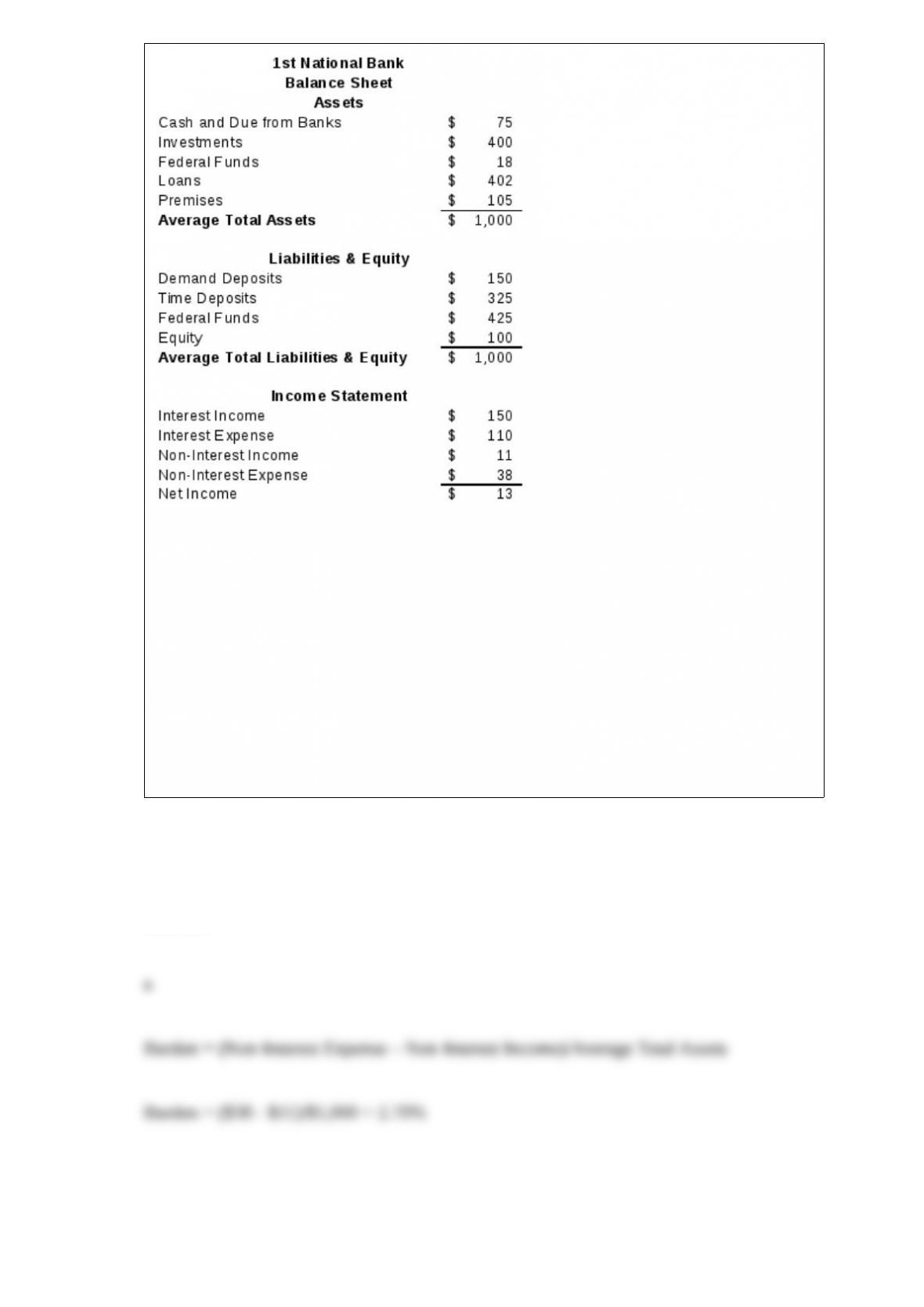
What is 1st State’s burden ratio?
a. 2.7%
b. 17.5%
c. 25.0%
d. 75.5%
e. 82.5%
Answer:

When increasing liabilities to meet liquidity needs, a bank should consider all of the
following except:
a. brokerage fees.
b. required reserves.
c. FDIC insurance premiums.
d. lost interest income.
e. All of the above should be considered when increasing liabilities to meet liquidity
needs.
Answer:
Which of the following is not true of forward rate agreements (FRA)?
a. The two counterparties to an FRA agree to a notional principal.
b. FRAs are traded on an organized exchange.
c. The buyer of a FRA agrees to pay a fixed-rate coupon payment.
d. FRAs are not as liquid as most futures contracts.
e. FRAs can be used to manage interest rate risk.
Answer:

Which of the following led to the sharp decline in bank profits in 2008?
a. Record high loan loss provisions
b. Record gains in trading activities
c. Significant goodwill impairment expenses
d. All of the above.
e. a. & c. only.
Answer:
A primary purpose of maintaining the safety and soundness of banks is to:
a. encourage loan growth.
b. protect depositors.
c. ensure liquidity for the stock market.
d. prevent discrimination.
e. minimize bank losses.
Answer:

______________ represent amounts owed by Goldman Group to brokers, the firm’s
customers, and counter-parties to derivative contracts.
a. Collateralized agreements
b. Financial instruments
c. Collateralized financings
d. Receivables
e. Payables
Answer:
Banks experience economies of scale when:
a. marginal costs increase as total costs decrease.
b. total costs decrease as output decreases.
c. total costs increase as output increases.
d. average unit costs increase as output increases.
e. average unit costs decrease as output increases.
Answer:

Bank holding companies and financial holding companies generally do not pay income
tax because:
a. they are always chartered as non-profit corporations.
b. most of their income is subsidiary paid dividends, of which 80% is tax-exempt.
c. the subsidiaries always operate at a net loss.
d. bank holding companies must carry deposit insurance.
e. bank holding companies are not subject to Internal Revenue Service regulations.
Answer:
The largest component of “non- interest cash and due from banks” is:
a. cash items in process of collection.
b. deposits held at other financial institutions.
c. federal funds sold.
d. vault cash.
e. loans from the Federal Reserve.
Answer:

If a bond is a par bond, then:
a. the yield to maturity is less than the coupon rate.
b. the yield to maturity is greater than the coupon rate.
c. the yield to maturity is equal to the coupon rate.
d. its duration must be greater than its maturity.
e. its duration must be equal to its maturity.
Answer:
The least expensive source of funds for a typical bank is:
a. certificates of deposit.
b. negotiable order of withdrawal accounts.
c. savings accounts.
d. demand deposit accounts.
e. federal funds purchased.
Answer:

Which of the following is not represented in the CAMELS ratings.
a. Cash adequacy
b. Asset quality
c. Management quality
d. Liquidity
e. Sensitivity to market risk.
Answer:
Which of the following is are only available to non-commercial customers?
a. Money Market Demand Accounts
b. Demand deposit accounts
c. Mortgage loans
d. Negotiable Orders of Withdrawal (NOW) accounts
e. Auto leases
Answer:

An instrument that derives its value from another underlying asset is known as a(n):
a. hedge.
b. derivative.
c. basis.
d. backdate agreement.
e. original document.
Answer:
If you invest $3,000 today at 8% compounded interest for three years, the value of the
investment to the nearest dollar at the end of the three years will be:
a. $3,000
b. $3,240
c. $3,720.
d. $3,779.
e. $4,081.
Answer:

The _________ repealed the Glass-Steagall Act.
a. Riegle-Neal Interstate Banking and Branching Efficiency Act
b. Gramm-Leach-Bliley Act
c. Financial Institutions Reform, Recovery and Enforcement Act
d. Federal Deposit Insurance Corporation Improvement Act
e. Depository Institutions Deregulation and Monetary Control Act
Answer:
Earnings sensitivity analysis differs from static GAP analysis by:
a. looking at a wide range of interest rate environments.
b. using perfect interest rate forecasts.
c. calculating a change in net interest income given a change in interest rates.
d. Earnings sensitivity analysis differs from static GAP analysis in all of the above
ways.
e. Earnings sensitivity analysis and static GAP analysis do not differ. They are different
names for the exact same analysis.
Answer:

Banks generate their largest portion of income from:
a. loans.
b. short-term investment.
c. demand deposits.
d. long-term investments.
e. certificates of deposit.
Answer: