
Lower inflation rates are usually correlated with lower unemployment rates.
a. True
b. False
GDP can be calculated by the value-added approach, which
a. is useful in avoiding double counting.
b. includes only the value-added portion from the sale of goods and services.
c. includes the revenue a firm receives from selling a product minus the amount paid for
goods purchased from other firms.
d. All of the above correct.
Economists believe that trade is necessary for prosperity because
a. every country lacks some vital resources that it can get only by trade.
b. each country’s climate makes it a relatively efficient producer of some goods, and an
inefficient producer of other goods.
c. specialization permits large outputs and can produce economies of scale.
d. All of the above are correct.

Investment is a(n) ____ and capital is a(n) ____ variable.
a. physical, financial
b. stock, flow
c. asset, liability
d. flow, stock
Changes in relative prices during inflationary periods usually lead to
a. decreases in real income.
b. some people gaining real income.
c. increases in the purchasing power of money.
d. increases in real income.

In the short run, which are most important in determining changes in output?
a. marginal costs and revenue
b. total costs and revenue
c. average costs and revenue
d. fixed costs
Zero economic profits for a perfectly competitive firm in the long run means
a. the firm must exit the industry.
b. the firm is in equilibrium.
c. the firm will shut down until the market improves.
d. average revenue is insufficient to cover long-run average cost.
Speculators in the stock market
a. aggravate instability in the market.
b. create shortages of certain stocks.

c. smooth out fluctuations in the market.
d. reduce the profits of firms that issued the stock.
Economists consider price discrimination to always be undesirable.
a. True
b. False
When the price level falls, consumers may feel wealthier and the consumption function
will shift upward.
a. True
b. False
A tariff is
a. a tax on imports.
b. a tax on exports.
c. a payment by the government to an exporter.
d. a legal limit on the amount of a good that may be imported.
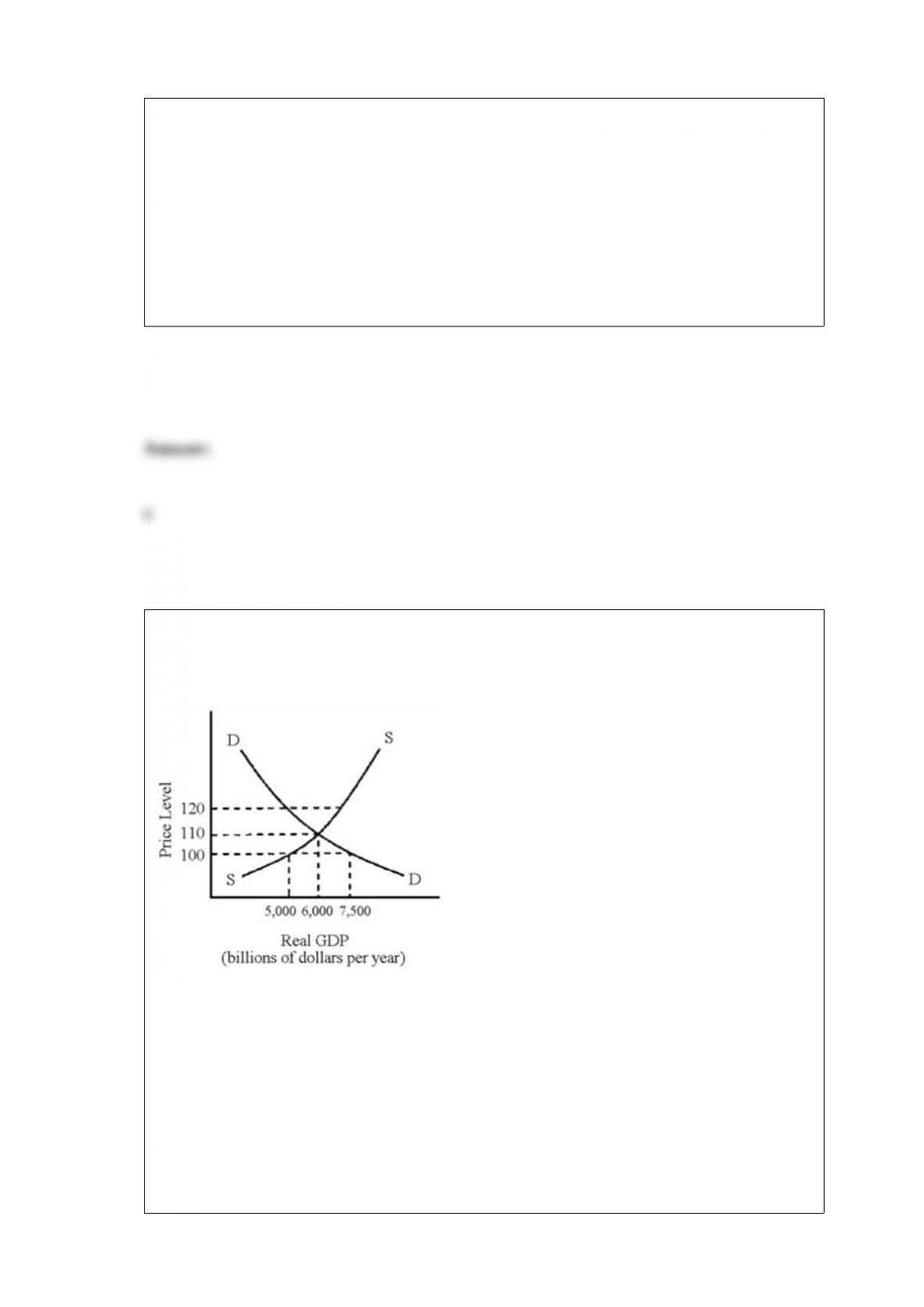
Figure 10-1
In Figure 10-1, what is the equilibrium level of real GDP and equilibrium price?
a. $6,000 billion real GDP and price level of 110
b. $5,000 billion real GDP and price level of 120
c. $5,000 billion real GDP and price level of 110
d. $7,500 billion real GDP and price level of 100

Monetary and fiscal policy are primarily tools for long-run economic stabilization.
a. True
b. False
The Bretton Woods system worked fairly well for a number of years, but it finally broke
down over
a. lack of agreement on how to settle the problems of the surplus nations.
b. its inability to devalue the U.S. dollar.
c. the huge debts of the IMF to less-developed countries.
d. the controversies generated by surplus nations wanting to devalue their currencies.
A firm’s fixed cost

a. does not vary with output.
b. does not change between the short run and the long run.
c. is generally a higher percentage of its total cost at high output quantities than at low
output quantities.
d. All of the above are true.
The opportunity cost of any good or service is the
a. actual dollar cost of doing or making it.
b. highest price that a seller can get for the item.
c. value of the next best alternative.
d. cost associated with a value judgment.
e. cost of producing the good or service.
The aggregate supply curve will shift to the left if
a. energy prices fall.
b. technology and productivity increase in the economy.

c. the capital stock of the economy increases.
d. the money wage rate increases.
Which of the following is included in GDP?
a. the value of illegally produced goods
b. the value of housework by a stay-at-home dad
c. the value of volunteer work done at a local homeless shelter
d. the cost of government-provided social services
Economists probably agree more often than they disagree.
a. True
b. False

Under monopoly, resources are allocated as efficiently as in perfect competition.
a. True
b. False
Private goods are characterized by two important attributes. What are they?
a. marginality and depletability
b. scalability and desirability
c. repeatability and reliability
d. depletability and excludability
Are money and income the same thing?
a. No, money is measured at a point in time and income is measured for a period of
time.
b. No, money is measured for a period of time and income is measured at a point in

time.
c. Yes, they are just measured in different ways.
d. Yes, the only difference is real versus nominal.
Fiat money is
a. always backed by gold or silver.
b. useful in buying Italian cars.
c. only backed by government decree.
d. not as liquid as precious metals.
The monetary expansion of the mid-1990s was expected to lead to a currency
appreciation.
a. True
b. False

The issue of bonds in corporate financing
a. is cheaper than stocks in the long run to the issuer.
b. is riskier than stocks to the issuer.
c. commits the issuer to make fixed annual payments even if profits are negative.
d. All of the above are correct.
Adhering to a strict fixed exchange rate system means that
a. no country will experience inflation or recession.
b. each nation improves control over its money supply.
c. each nation loses some control of its monetary policy and its domestic economy.
d. each nation improves control over its fiscal policy and aggregate demand.
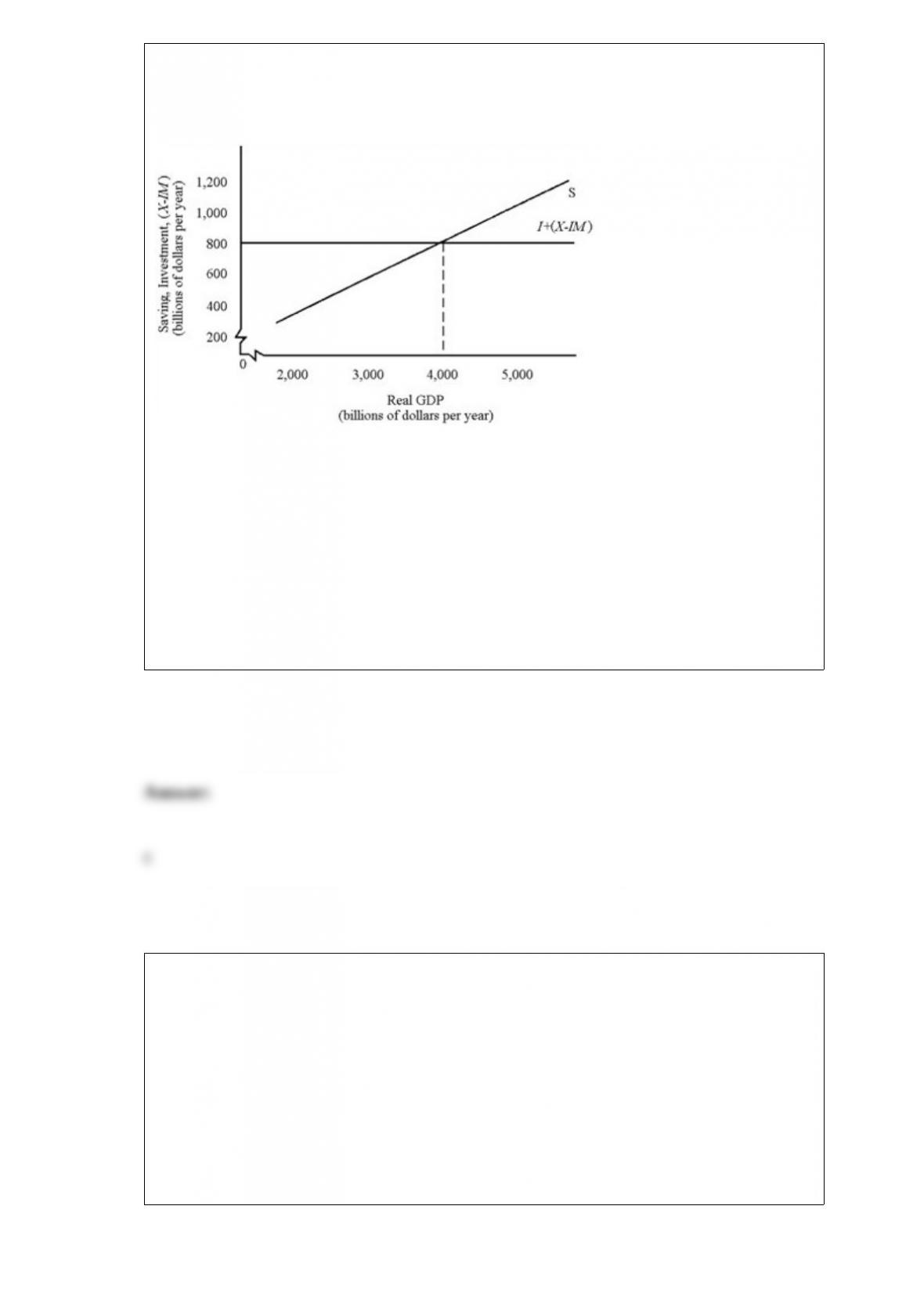
Figure 9-3
In Figure 9-3, equilibrium GDP is
a. $2,000 billion.
b. $3,000 billion.
c. $4,000 billion.
d. $5,000 billion.
Define the following terms and explain their importance to the study of
macroeconomics:
a. money
b. M1
c. near money
d. bank run
If a currency increases in value in response to market forces, this process is known as
a. reflation.
b. revaluation.
c. appreciation.
d. value-added.

If the marginal cost of producing steel exceeds the marginal utility of using steel, then
for economic efficiency,
a. the price of steel should fall.
b. society should produce less steel.
c. the price of goods made with steel should fall.
d. society should direct resources toward steel production and away from the production
of other goods.
A buyer’s response to a change in income is an example of a “change in demand.”
a. True
b. False
The budget line facing a household includes information on
a. prices of two goods and household income.
b. household income and the price of money.
c. the price of one good and household income.
d. the price of two goods but no information on household income.

e. preferences of goods at various prices.
Purchasing power parity is widely accepted as a better explainer of short-run changes in
exchange rates than interest rate effects.
a. True
b. False
Necessities such as food and shelter have inelastic demand.
a. True
b. False