
Alan Krueger conducted a survey of fans at the 2001 Super Bowl who purchased tickets
to the game for $325 or $400. Krueger found that (a) 94 percent of those surveyed
would not have paid $3,000 for their tickets, and (b) 92 percent of those surveyed
would not have sold their tickets for $3,000. These results are an example of
A) the tendency of people to be unwilling to sell a good they already own even if they
are offered a price that is greater than the price they would be willing to pay if they did
not already own it.
B) the tendency for consumers to account for monetary costs but to ignore sunk costs.
C) consumers placing a high value on a product because it makes them appear to be
fashionable.
D) the law of demand.
Before its IPO, Facebook was an example of a private firm. As a private firm, Facebook
was
A) not subject to government regulations and taxation.
B) run by stockholders and a board of directors.
C) run by its founder, Mark Zuckerberg.
D) not legally allowed to raise funds through venture capital firms.
According to the quantity theory of money, the inflation rate equals
A) the money supply minus real output.

B) the growth rate of the money supply minus the growth rate of real output.
C) real output minus the money supply.
D) the growth rate of real output minus the growth rate of the money supply.
The provision of the Patient Protection and Affordable Care Act (ACA) which states
that every firm with more than 200 full-time employees must offer health insurance to
its employees and must automatically enroll them in the plan is the ________ provision.
A) employer mandate
B) state health exchanges
C) individual mandate
D) regulation of health insurance
Bank panics have largely disappeared in the United States because
A) banks are now required to hold a larger fraction of deposits as reserves.
B) bank loans are more closely monitored by the Federal Reserve.
C) of low interest rates.
D) of deposit insurance.

In an attempt to bring lenders and borrowers together following the financial crisis of
2008, the Federal Reserve made a large amount of new funds available to financial
markets. Any of these new funds that are loaned out by banks would be classified as
________ of the banks.
A) required reserves
B) excess reserves
C) deposits
D) liabilities
The income effect of an increase in the price of peaches is
A) the change in the quantity demanded of peaches that results from the price increase
making peaches more expensive than other fruit, holding constant the effect of the price
change on consumer purchasing power.
B) the change in the demand for peaches as a result of the change in the price of
peaches, holding all other factors constant.
C) the change in the quantity demanded of other fruit that results from the impact of the
price change on purchasing power, holding all other factors constant.
D) the change in the quantity demanded of peaches that results from the effect of the
change in price on consumer purchasing power, holding all other factors constant.
The De Beers Company, one of the longest-lived monopolies, is facing increasing
competition. One source of competition comes from people who might resell their
previously owned diamonds. Why is De Beers worried that people might resell their
previously owned diamonds?
A) because De Beers will not be able to guarantee the quality of previously owned
diamonds and fears that its reputation might be harmed
B) because the availability of previously owned diamonds would increase the market
demand for diamonds and dilute De Beers’ monopoly
C) because previously owned diamonds would be a close substitute to newly mined
diamonds and therefore reduce De Beers’ market power
D) because the availability of previously owned diamonds would make the market
demand curve for diamonds more inelastic and force De Beers to lower its price
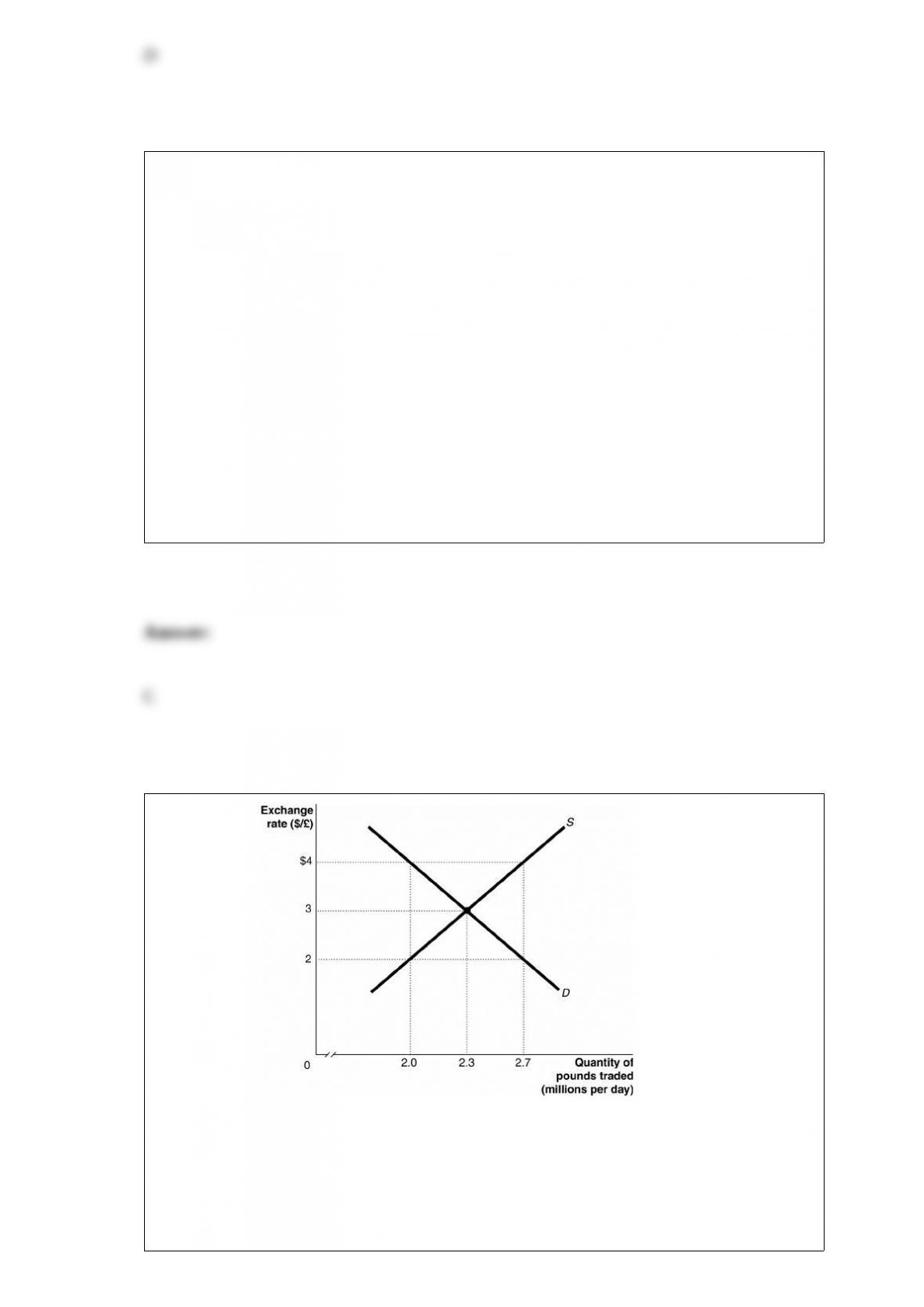
Figure 19-10
Under the Bretton Woods System of exchange rates, if the par exchange rate was $2 per
pound in the figure above, and equilibrium persisted at $3, then a revaluation of the
currency would have
A) increased the price of British exports to the United States.
B) increased the price of imports to Britain.
C) led to a current account surplus.
D) led to a balance of trade surplus.
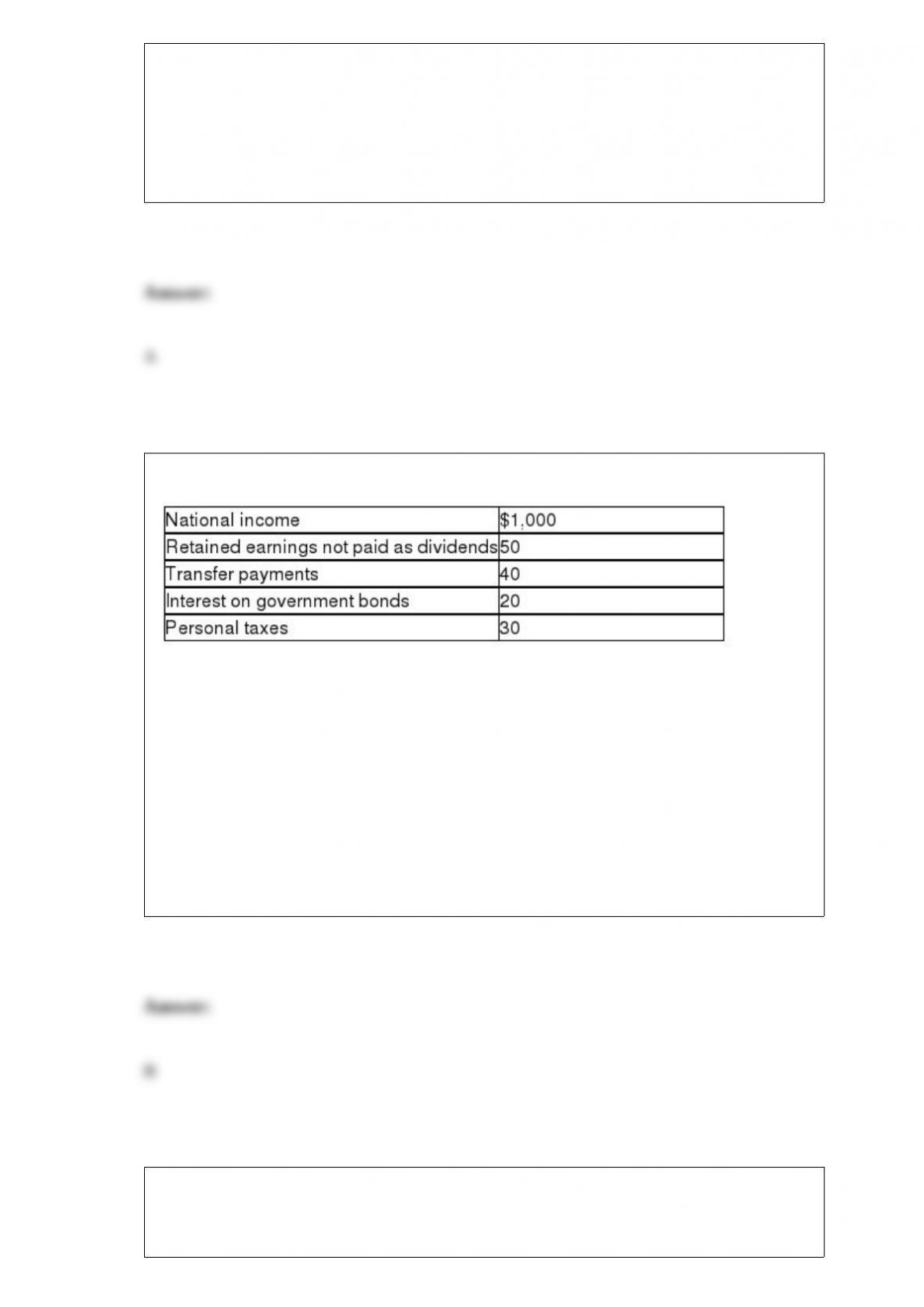
Table 8-27
The components of national income for an economy are represented in Table 8-27
above. All values are in billions of dollars. What is the level of personal income for this
economy?
A) $1,140 billion
B) $1,010 billion
C) $990 billion
D) $860 billion
In the long run, the Federal Reserve can control which of the following?
A) the inflation rate

B) the unemployment rate
C) the growth rate of real GDP in the economy
D) the natural rate of unemployment
Contractionary monetary policy on the part of the Fed results in
A) an increase in the money supply, an increase in interest rates, and an increase in
GDP.
B) a decrease in the money supply, an increase in interest rates, and a decrease in GDP.
C) an increase in the money supply, a decrease in interest rates, and an increase in GDP.
D) a decrease in the money supply, a decrease in interest rates, and a decrease in GDP.
Select the phrase that correctly completes the following statement. “An increase in input
prices caused a decrease in the supply of baseballs. As a result ________.”
A) the price of baseballs increased and the demand for baseballs decreased
B) the equilibrium quantity of baseballs increased
C) the price of baseballs increased and the quantity demanded of baseballs decreased
D) the price of baseballs increased. The higher price caused the supply of baseballs to
increase
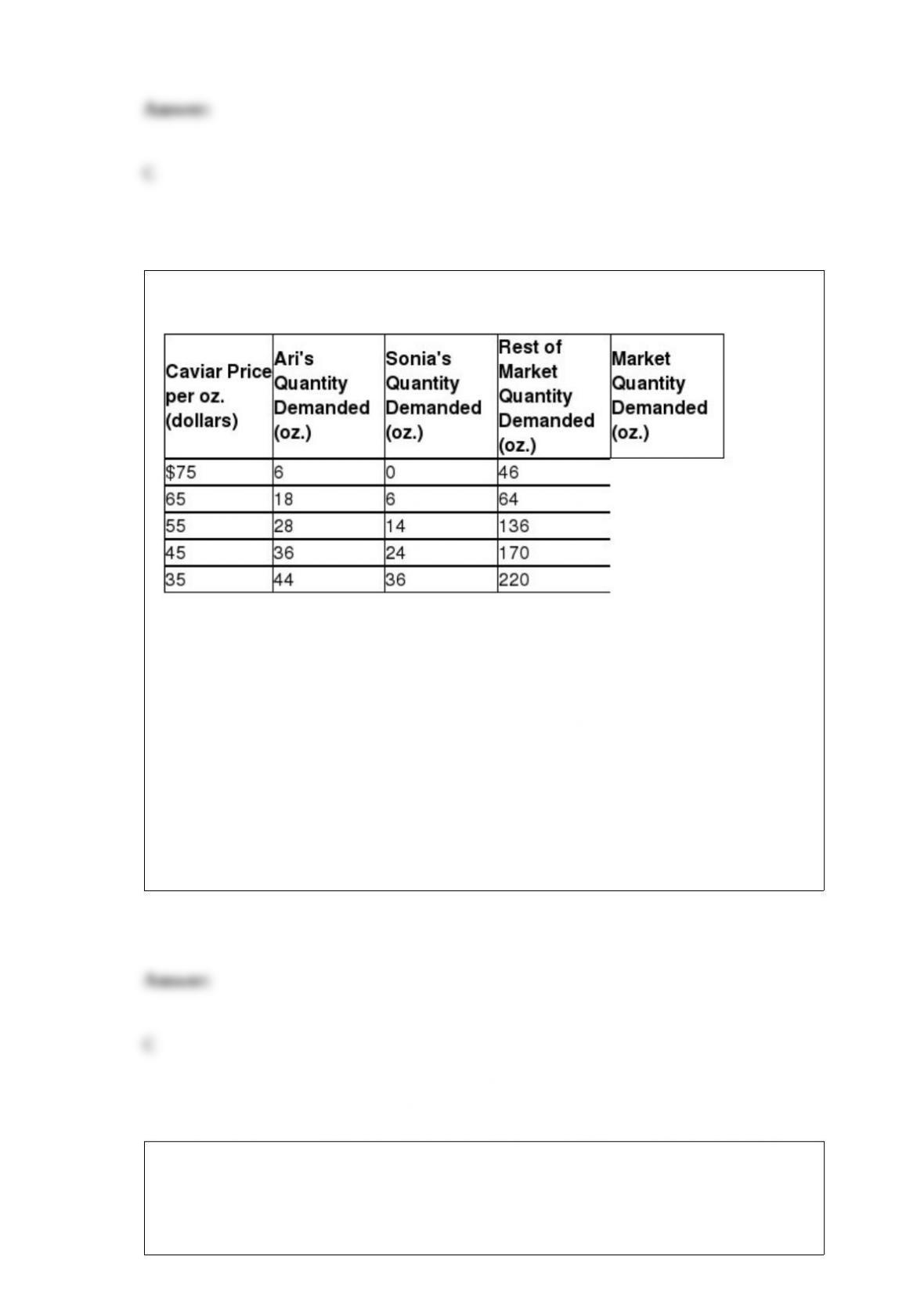
Table 3-2
The table above shows the demand schedules for caviar of two individuals (Ari and
Sonia) and the rest of the market. At a price of $75, the quantity demanded in the
market would be
A) 6 oz.
B) 46 oz.
C) 52 oz.
D) 127 oz.
Compensating differentials are
A) non-monetary benefits from being employed, such as health-care benefits.

B) wages paid to workers where the supply of labor is great relative to demand.
C) higher wages that compensate workers for unpleasant aspects of a job.
D) higher wages that compensate the more experienced workers in a field.
If workers leave a country to seek out better opportunities in another country, then this
will
A) shift the short-run aggregate supply curve of the original country to the left.
B) shift the short-run aggregate supply curve of the original country to the right.
C) move the original economy up along a stationary short-run aggregate supply curve.
D) move the original economy down along a stationary short-run aggregate supply
curve.
Figure 3-8

The graph in this figure illustrates an initial competitive equilibrium in the market for
motorcycles at the intersection of D1 and S1 (point A). If the price of motorcycle
engines increases, and the wages of motorcycle workers increase, how will the
equilibrium point change?
A) The equilibrium point will move from A to E.
B) The equilibrium point will move from A to B.
C) The equilibrium point will move from A to C.
D) The equilibrium will first move from A to B, then return to A.
Which of the following countries actually experienced negative economic growth from
1960 to 2010?
A) Israel
B) Singapore
C) Niger
D) Malaysia
Which of the following is not an appropriate policy for a central bank to follow if the
economy is plagued with deflation?
A) increasing the target interest rate on overnight loans

B) using expansionary monetary policy to drive down interest rates
C) consistently pursuing policy to promote the credibility of the central bank
D) explicitly and credibly targeting inflation