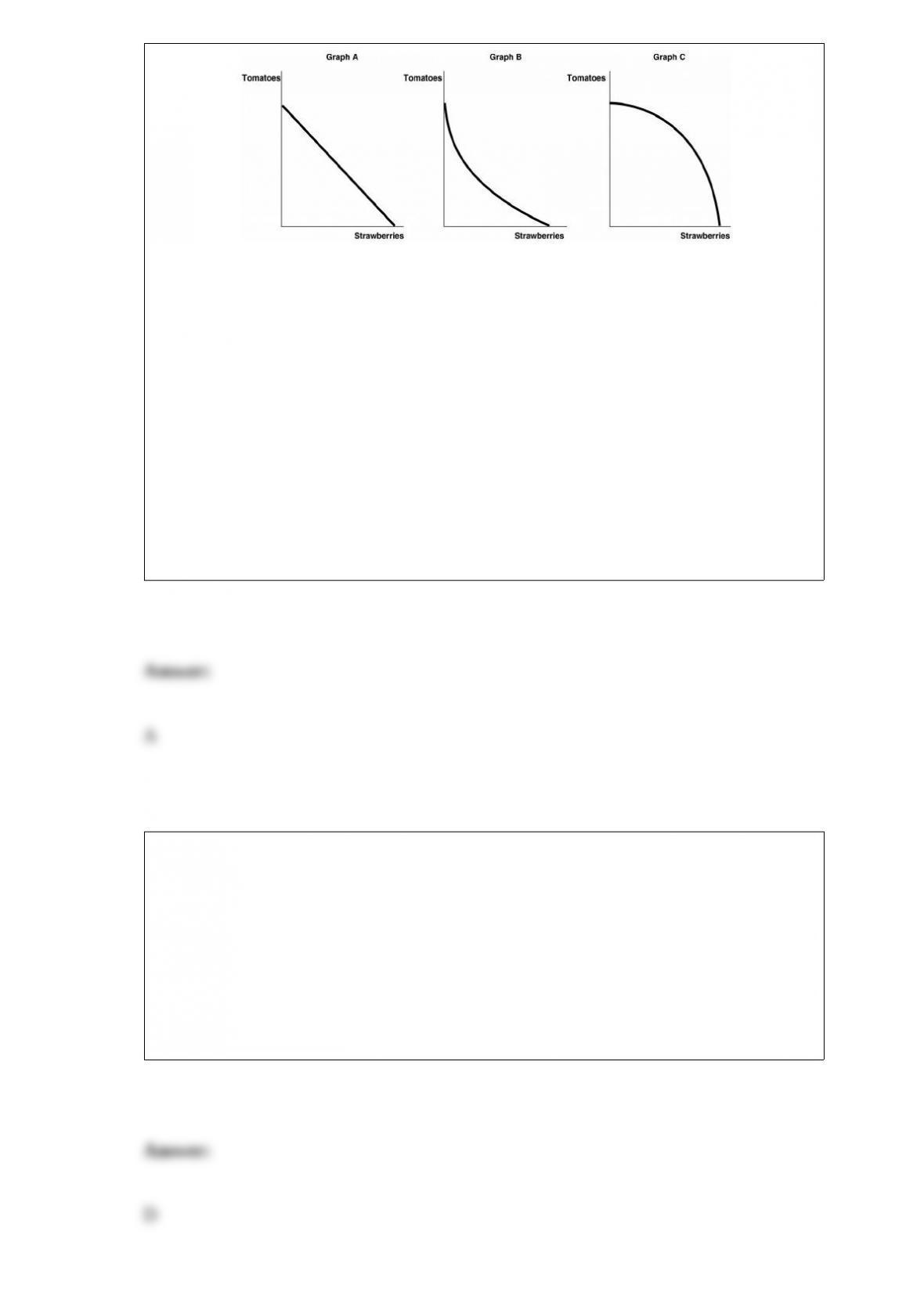
Figure 2-9
Carlos Vanya grows tomatoes and strawberries on his land. His land is equally suited
for growing either fruit. Which of the graphs in Figure 2-3 represents his production
possibilities frontier?
A) Graph A
B) Graph B
C) Graph C
D) either Graph A or Graph B
E) either Graph B or Graph C
Along a downward-sloping linear demand curve, total revenue is the greatest
A) where demand is normal.
B) where demand is the most inelastic.
C) where demand is the most elastic.
D) where demand is unit-elastic.
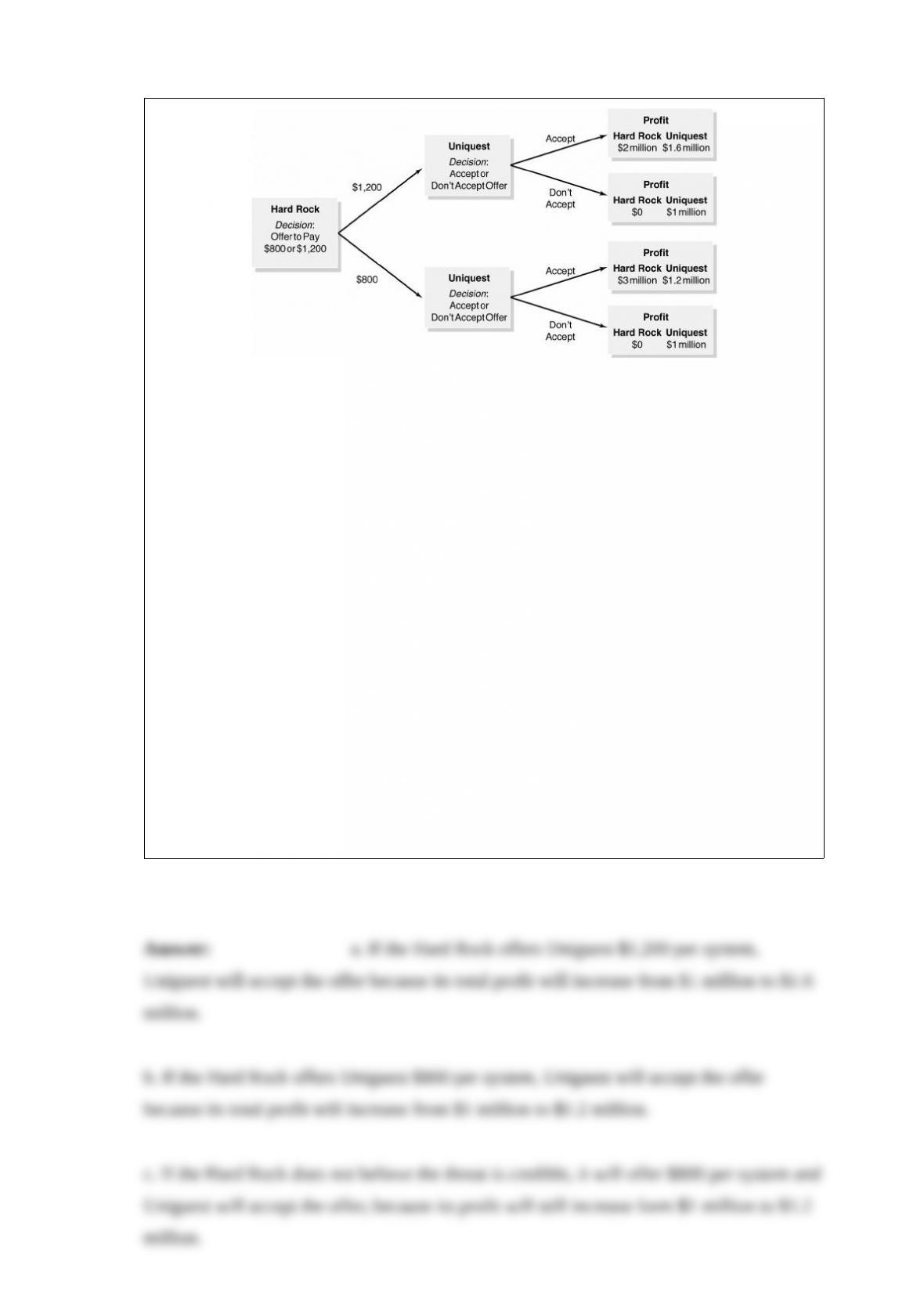
Figure 14-9
Uniguest, Inc. is a company that provides PCs with internet access and touch-sensitive
screens to hotels. Suppose the Hard Rock Hotel and Casino in Las Vegas informs
Uniguest that it is considering installing these systems in its hotel rooms. The Hard
Rock expects to be able to charge higher prices for these rooms if it installs Uniguest’s
systems in its rooms. The two companies begin bargaining over what price the Hard
Rock will pay Uniguest for its systems, and the decision tree shown above illustrates
this bargaining game. Note that the profit figures listed in the decision tree are
additional profits for the Hard Rock and total profits for Uniguest.
a. Suppose the Hard Rock offers Uniguest $1,200 per system. Will Uniguest accept or
reject this offer? Why?
b. Suppose the Hard Rock offers Uniguest $800 per system. Will Uniguest accept or
reject this offer? Why?
c. Suppose Uniguest attempts to obtain a favorable outcome from the bargaining by
telling the Hard Rock it will reject an $800-per-system offer. If the Hard Rock does not
believe the threat is credible, what will it do? Why? What will Uniguest do? Why?
d. Is there a sub-game perfect equilibrium in this situation? Explain.
A barter economy is an economy where
A) goods and services are exchanged for money.
B) money is exchanged for goods and services.
C) goods and services are exchanged for other goods and services.
D) goods and services are exchanged for liabilities.
When Potbelly sold stock to the public in its IPO, it did so through the NASDAQ
market. This was an example of Potbelly using ________ to raise funds.
A) indirect finance
B) direct finance
C) bonds
D) corporate governance

If the exchange rate between the U.S. dollar and the Mexican peso (pesos per dollar) is
less than the relative purchasing power between the two countries, which of the
following would be true?
A) There are opportunities for profit by purchasing goods in the United States and then
selling them in Mexico.
B) Purchasing power parity predicts that the value of the dollar will fall as traders take
advantage of arbitrage opportunities.
C) Purchasing power parity predicts that the dollar is overvalued as traders take
advantage of arbitrage opportunities.
D) There are no arbitrage opportunities for which traders can take advantage.
The per-worker production function has a ________ slope, indicating that increases in
capital per hour worked ________ real GDP.
A) negative; increase
B) positive; increase
C) negative; decrease
D) positive; decrease
Protectionism

A) is the use of cheap labor to protect firms from paying high wages.
B) is the use of trade barriers to protect domestic firms from foreign competition.
C) refers to reductions in tariffs and other barriers that protect consumers from paying
high prices.
D) refers to the use of copyright and trademark laws to protect inventors and artists
from losing the rights to their creative efforts.
According to the ________ Phillips curve, the unemployment rate and the inflation rate
are negatively related.
A) long-run
B) short-run
C) long-run and short-run
D) rational expectations
An increase in the demand for orthodontic services leads to
A) an increase in the supply of orthodontists.
B) lower prices for orthodontic care.
C) an increase in the demand for orthodontists.

D) a rise in the rates of dental insurance.
Southwest Airlines wants to raise $20 million to finance the renovation of their
corporate offices, and the company wishes to raise the funds through direct finance.
Which of the following methods could it use?
A) It could issue $20 million in stocks.
B) It could sell $20 million in bonds.
C) It could borrow $20 million from a bank.
D) It could choose either A or B.
The Bureau of Labor Statistics would categorize a retiree who is not working as
A) employed.
B) unemployed.
C) a discouraged worker.
D) out of the labor force.
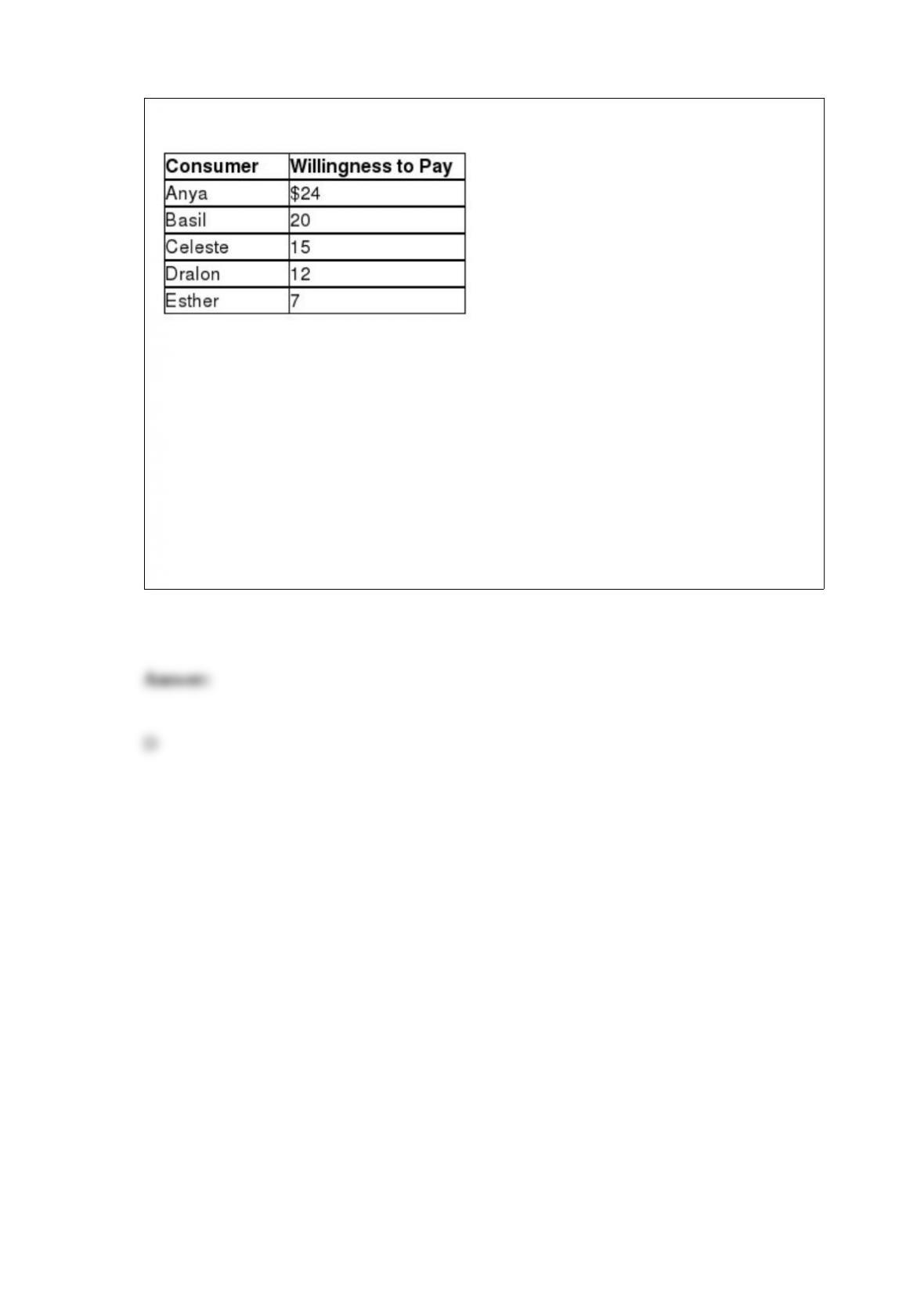
Table 4-2
The table above lists the highest prices five consumers are willing to pay for a theater
ticket. If the price of one ticket is $25
A) everyone will buy a ticket.
B) consumer surplus will be maximized.
C) Anya’s consumer surplus is $1.
D) no one will buy a ticket.