
1) along a supply curve, product price and producer surplus are inversely related.
2) Noncompeting groups of workers are the result of geographic immobilities.
3) Present law forbids all trades or sales of pollution rights.
4) A $20 billion decrease in investment in a private closed economy that has an MPS
of .5 will reduce saving by $10 billion once the multiplier process has ended.
5) The Laffer Curve shows the tradeoff between the price level and tax rates.
6) Many demographers expect world population to:
A.increase exponentially into the foreseeable future.
B.decline from its current level in the next two decades.
C.peak at 9 billion or fewer, and then decline.
D.plateau at around 7.5 billion, and then continue to increase rapidly.
7) If the price level does not change from one period to the next:
A.the money supply must have been constant during the period.
B.velocity must have been constant during the period.
C.nominal GDP must have remained constant during the period.
D.none of these responses are valid.
8) If prices and wages are inflexible downward, a decrease in aggregate demand will:
A.reduce the price level but not real output.
B.increase short-run aggregate supply.
C.decrease short-run aggregate supply.
D.reduce real output but not the price level.
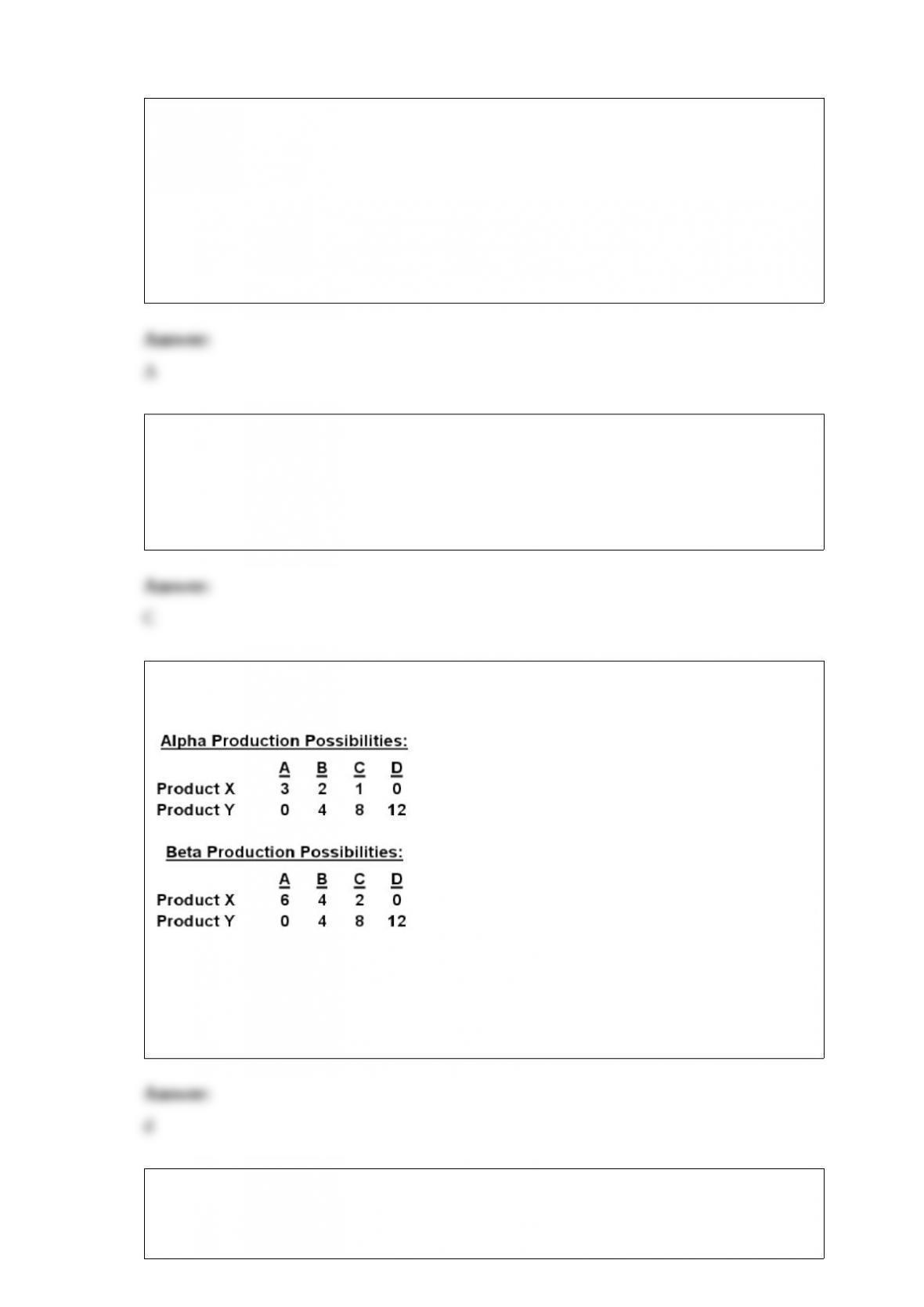
9)
refer to the above diagram. curve b is a:
a.production possibilities curve indicating constant opportunity costs.
b.production possibilities curve indicating increasing opportunity costs.
c.demand curve indicating that the quantity of consumer goods demanded increases as
the price of capital falls.
d.technology frontier curve.
10)
The long-run trend of real wages:
A.cannot be determined from available data on nominal wages and the price level.
B.has been downward because the price level has risen faster than nominal wages.
C.has been upward.
D.has been downward because labor’s share of the domestic income has fallen.
11) According to the Taylor rule:
A.if real GDP rises by 2 percent above potential GDP, the Fed should raise the Federal
funds rate by 1 percentage point.
B.when real GDP is equal to potential GDP and inflation is equal to its target of 4
percent, the Federal funds rate should be kept at 2 percent.
C.if inflation falls by 1 percentage point below its target of 2 percent, then the Fed
should raise the Federal funds rate by one-half a percentage point.
D.all of these are appropriate Fed actions.
12) Henry George advocated a single tax on:
A.real capital.
B.entrepreneurial profits.
C.land.
D.labor income.
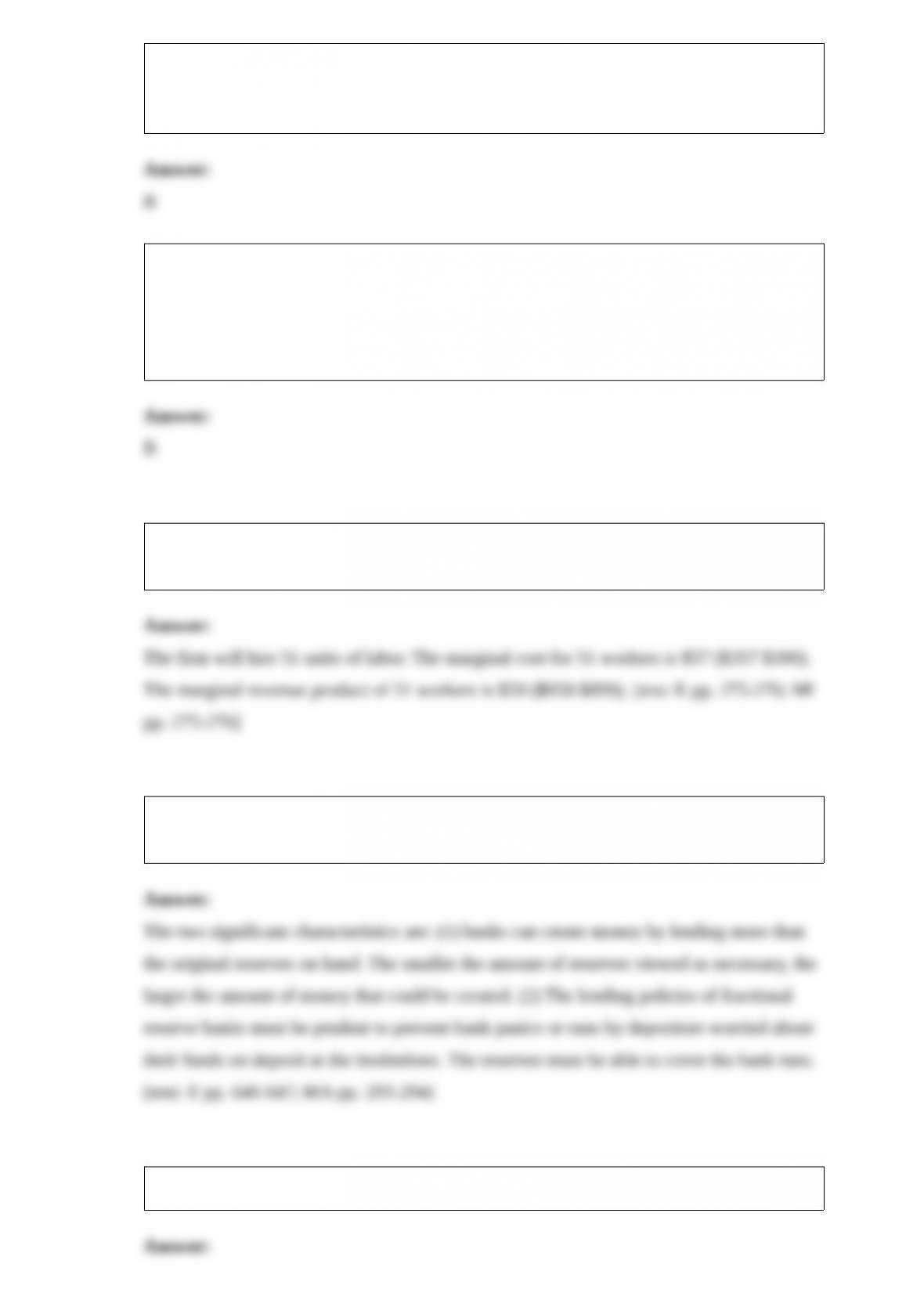
13) the following production possibilities tables for countries alpha and beta:
refer to the above tables. according to the concept of comparative advantage:
a.alpha should specialize in x; beta in y
b.beta should produce some x and some y
c.alpha should produce some x and some y
d.beta should specialize in x; alpha in y
14) Suppose the price level is fixed, the MPC is .5, and the GDP gap is a negative $100
billion. To achieve full-employment output (exactly), government should:
A.increase government expenditures by $100 billion.
B.increase government expenditures by $50 billion.
C.reduce taxes by $50 billion.
D.reduce taxes by $200 billion.
15) The basis for the Bretton Woods international monetary system was:
A.a completely fixed system of exchange rates.
B.an adjustable peg system of exchange rates.
C.the gold standard.
D.a freely flexible system of exchange rates.
16) Use the following data to answer the question.
How many units of labor will this firm hire in maximizing its profits?
17) What are the two significant characteristics of the fractional reserve banking
system?
18) What are the major components of the capital and financial account?
19) The price level in the United States is more flexible downward than upward.
FALSE
20) Why does price discrimination work in the sale of seats to children and adults at
baseball games, but not to the sale of food at concession stands to children and adults at
baseball games?
21) Describe the difference between real GDP and nominal GDP. Which concept is
more useful for measuring change in the economy over time? Why?
22) Explain how the firm decides on the optimal amount of research and development.