
1) although individual purely competitive firms can influence the price of their product,
these firms as a group cannot influence market price.
2) specialized production and international trade increase a nation’s productivity and
increase the availability of goods and services.
3) growth in well-being tends to be understated by growth in real gdp because of
increases in leisure time.
4) because of their large-scale level of production, pure monopolists overallocate
resources to their industry by producing beyond the p = mc output.
5) Renewable energy sources account for about 50 percent of U.S. electricity
generation.
6) natural monopoly may result where products produce substantial network effects and
can be simultaneously consumed by a large number of consumers.
7) The free-land era of U.S. history reflected a situation in which the quantity of land
available at a zero price exceeded the quantity of land demanded.
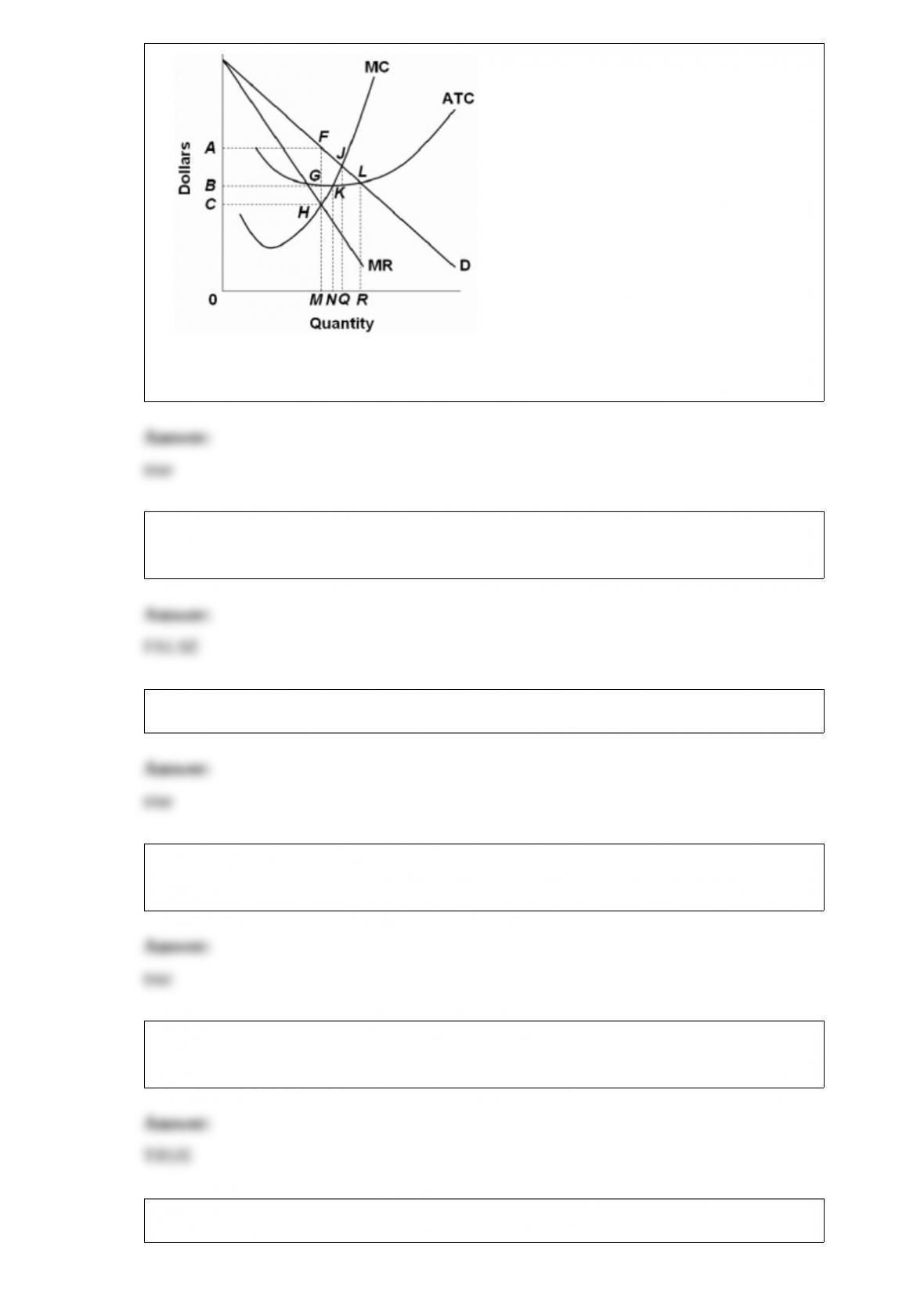
8)
refer to the above diagram for a nondiscriminating monopolist. the profit-maximizing
output for this firm is m.
9) The adverse selection problem is the tendency for workers to shirk when they are not
being monitored.
10) consumers buy more of normal goods as their incomes rise.
11) illegal immigration can result in higher wages for domestic-born workers who are
complementary inputs.
12) The United States produces more than twice as much output per million BTUs of
energy consumed than it did in 1950.
13) Producers should hire resources until the total output of each is equal.
14) an economy cannot produce at a point outside of its production possibilities curve
because human economic wants are insatiable.
15) The asset demand for money:
A.is unrelated to both the interest rate and the level of GDP.
B.varies inversely with the rate of interest.
C.varies inversely with the level of real GDP.
D.varies directly with the level of nominal GDP.
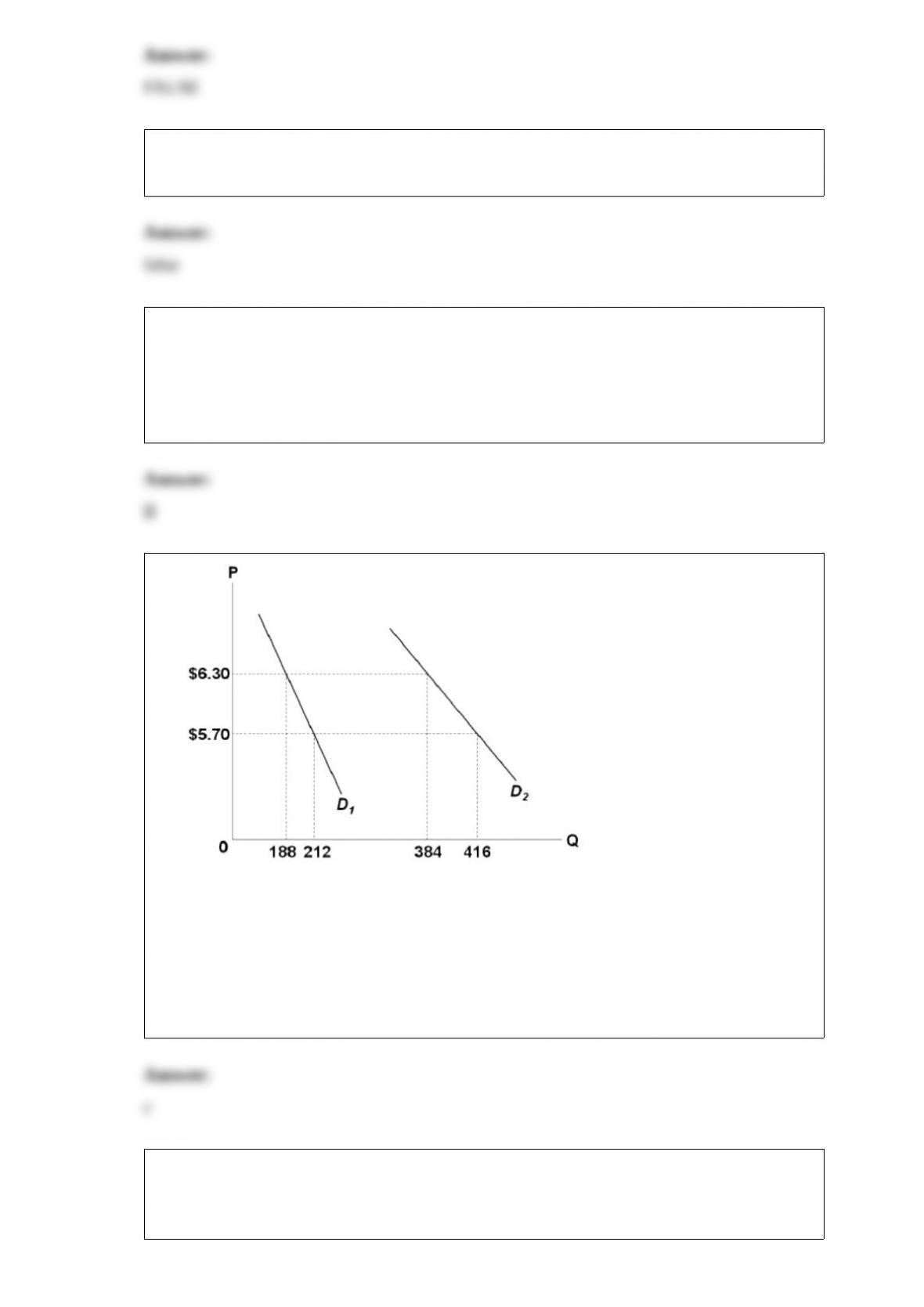
16)
refer to the above diagram and assume a single good. if the price of the good increased
from $5.70 to $6.30 along d1, the price elasticity of demand along this portion of the
demand curve would be:
a.0.8.
b.1.0.
c.1.2.
d.2.0.
17) “remittances” occur when:
a.two countries send immigrants to each other in approximately equal numbers.
b.physical capital flows into a country that has lost labor due to migration.
c.immigrants send financial payments back to family in their country of origin.
d.migrants return to their home country.
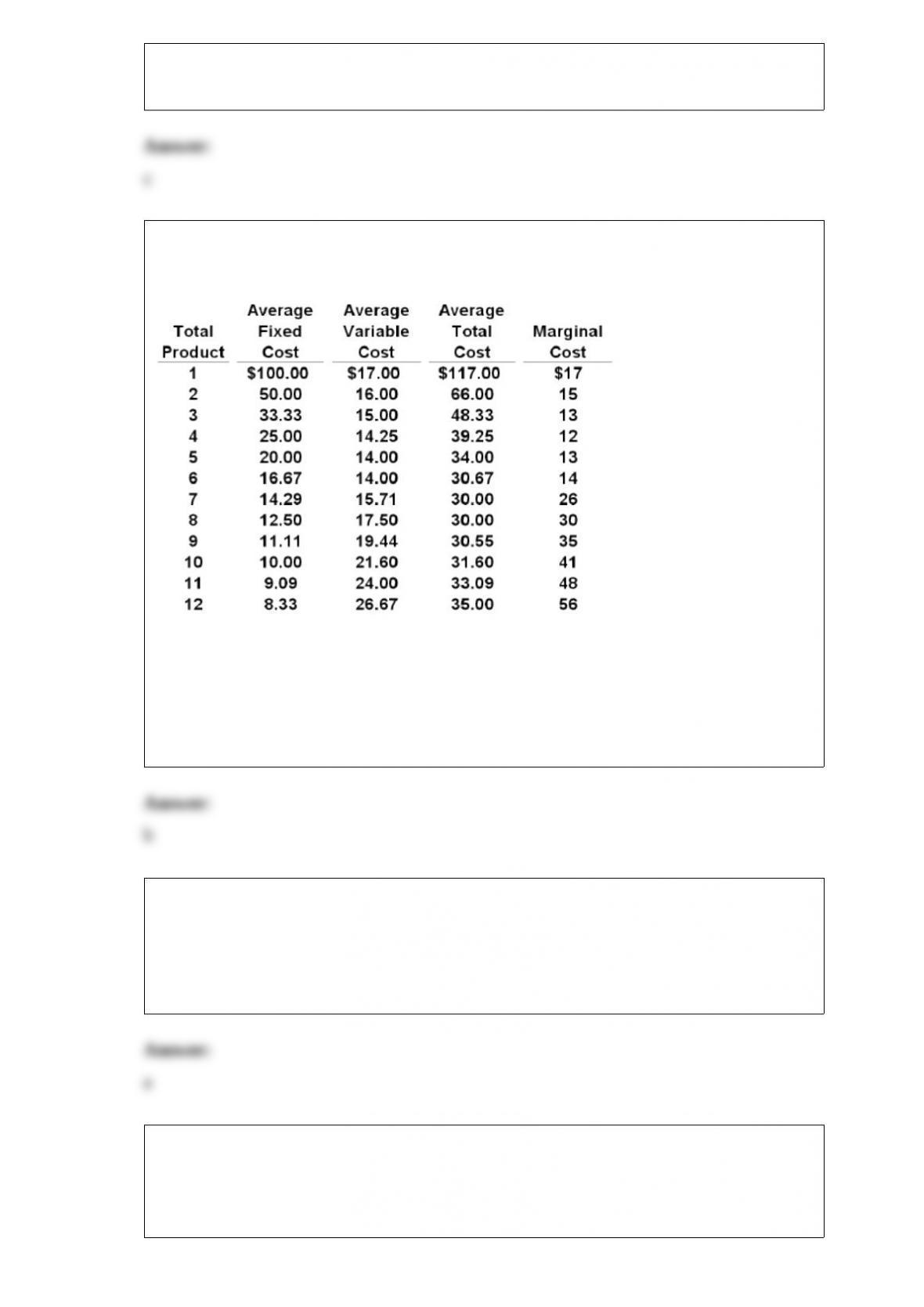
18) the following cost data for a firm that is selling in a purely competitive market:
refer to the above data. if the market price for the firm’s product is $28, the competitive
firm will:
a.produce 4 units at a loss of $17.40.
b.produce 7 units at a loss of $14.00.
c.close down in the short run.
d.produce 6 units at a loss of $23.80.
19) which of the following is an example of a public good?
a.a fireworks display
b.a hotdog
c.a barbeque grill
d.a personal computer
20) answer the next question(s) on the basis of the following five data sets wherein it is
assumed that the variable shown on the left is the independent variable and the one on
the right is the dependent variable. assume in graphing these data that the independent
variable is shown on the horizontal axis and the dependent variable on the vertical axis.
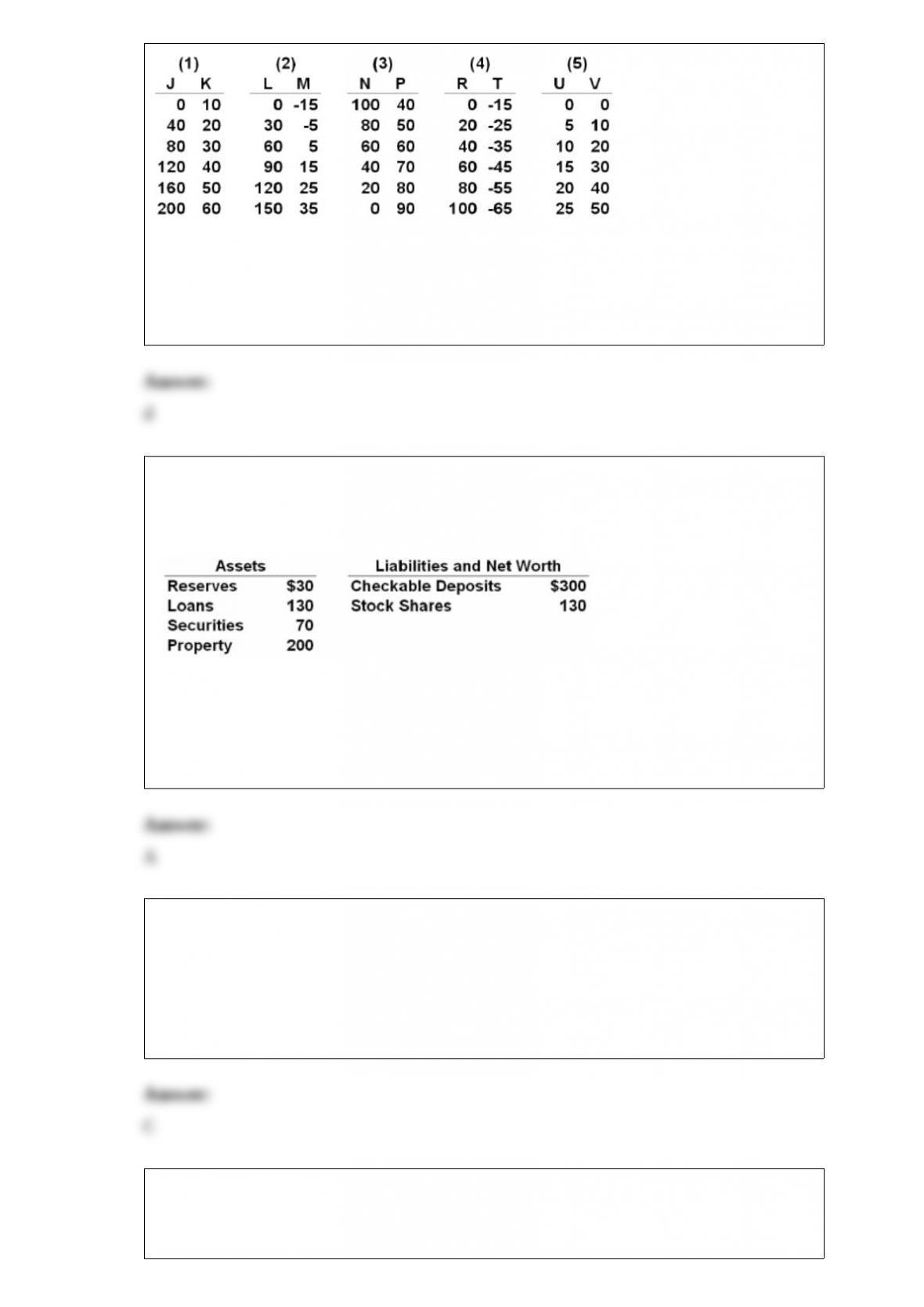
refer to the above data sets. the variables are directly related in:
a.all five data sets.
b.in none of the data sets.
c.in data sets 1, 2, and 3 only.
d.in data sets 1, 2, and 5 only.
21) The following consolidated balance sheet for the commercial banking system.
Assume the required reserve ratio is 10 percent. All figures are in billions.
Refer to the above data. The commercial banking system has excess reserves of:
A.$0 billion.
B.$30 billion.
C.$60 billion.
D.$70 billion.
22) An employer whose discrimination coefficient is zero will:
A.refuse to hire African-Americans at any wage rate.
B.hire only whites if African-American and white wages are the same.
C.randomly hire African-American and white workers if the actual
African-American-white wage differential is also zero.
D.refuse to hire whites at any wage rate.
23) a nation’s stock of capital goods will decline when:
a.gross investment exceeds net investment.
b.net investment is positive, but less than gross investment.
c.depreciation exceeds gross investment.
d.gross investment exceeds depreciation.
24) which of the following is not correct? a typical production possibilities curve:
a.indicates how much of two products a society can produce.
b.reveals how much each additional unit of one product will cost in terms of the other
product.
c.specifies how much of each product society should produce.
d.indicates that to produce more of one product society must forgo larger and larger
amounts of the other product.
25) Suppose government finds it can increase the equilibrium real GDP $45 billion by
increasing government purchases by $18 billion. On the basis of this information we
can say that the:
A.MPS in this economy is .4.
B.MPC in this economy is .4.
C.multiplier does not apply in this economy.
D.multiplier is 3.
26) The Federal income tax is consistent with the __________ principle of taxation,
whereas an excise tax on sporting event tickets is consistent with the ___________
principle of taxation.
A.benefits-received; ability-to-pay
B.benefits-received; pay-as-you go
C.ability-to-pay; benefits received
D.ability-to-pay; pay-as-you-go
27) Below is the information for Manfred’s Shoe Shine Parlor. Assume Manfred hires
labor, its only variable input, under purely competitive conditions. Shoe shines are also
sold competitively.
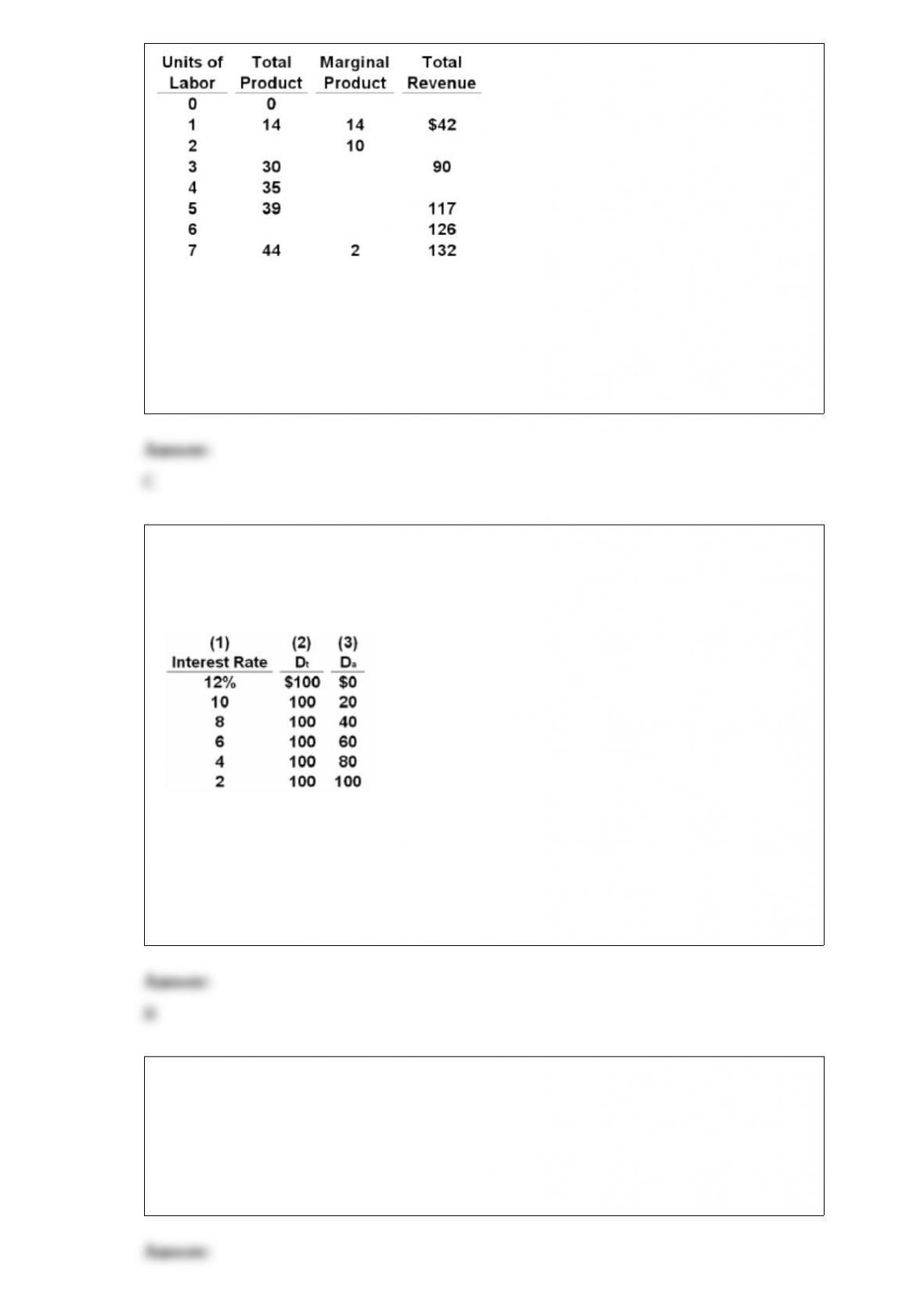
Refer to the above data. How many units of output are produced when 2 workers are
employed?
A.4
B.16
C.24
D.10
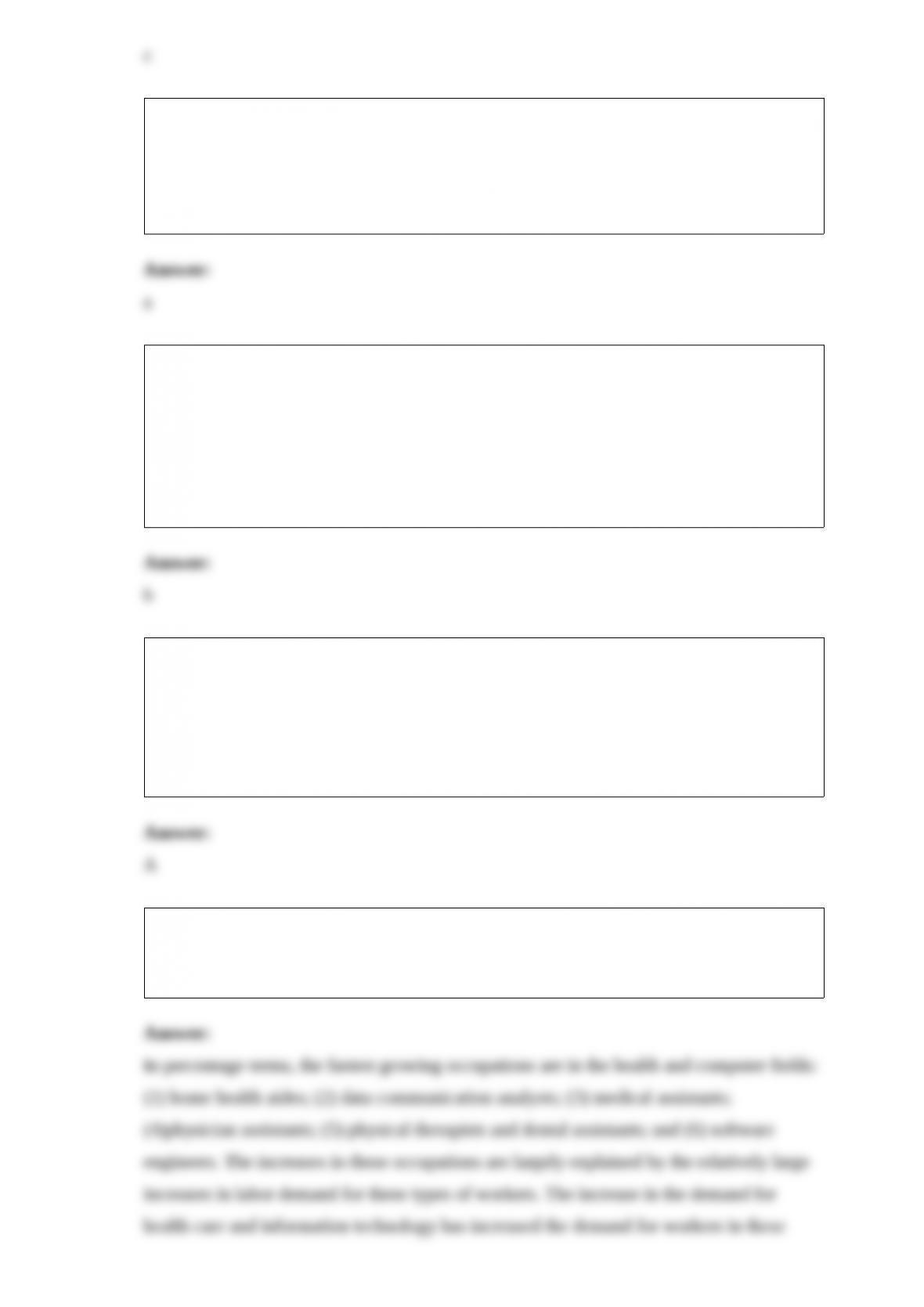
28) The following table in which columns (1) and (2) indicate the transactions demand
(Dt) for money and columns (1) and (3) show the asset demand (Da) for money:
The above data suggest that the amount of money that society wishes to hold as an
asset:
A.varies directly with the interest rate.
B.varies inversely with the interest rate.
C.varies inversely with nominal GDP.
D.is independent of the interest rate.
29) the m&m experiment demonstrated that:
a.the law of diminishing marginal utility is not valid.
b.diminishing marginal utility did not apply because differently colored m&ms taste
different.
c.marginal utility diminishes less rapidly in the presence of variety.
d.marginal utility diminishes more rapidly in the presence of variety.
30) a pure monopolist’s demand curve is:
a.downsloping.
b.upsloping.
c.parallel to the vertical axis.
d.parallel to the horizontal axis.
31) suppose that a university decides to spend $1 million to upgrade personal computers
and scientific equipment for faculty rather than spend $1 million to expand parking for
students. this example illustrates:
a.distorted priorities.
b.opportunity costs.
c.increasing opportunity costs.
d.productive efficiency.
32) A demand curve for a public good is determined by:
A.summing vertically the individual demand curves for the public good.
B.summing horizontally the individual demand curves for the public good.
C.combining the amounts of the public good that the individual members of society
demand at each price.
D.multiplying the per-unit cost of the public good by the quantity made available.
33) What are examples of the fastest growing occupations in percentage terms expected
to be from 20062016? What economic principle of resource pricing best explains these
trends?
34) Define the equilibrium level of output.
35) What is meant by the term business cycle? List the four phases of the business
cycle.
36) Describe the graph for a long-run supply curve in an increasing-cost industry. Why
does it have this slope?
37) Inflation is frequently described as too much money chasing too few goods. Is this
an acceptable definition?
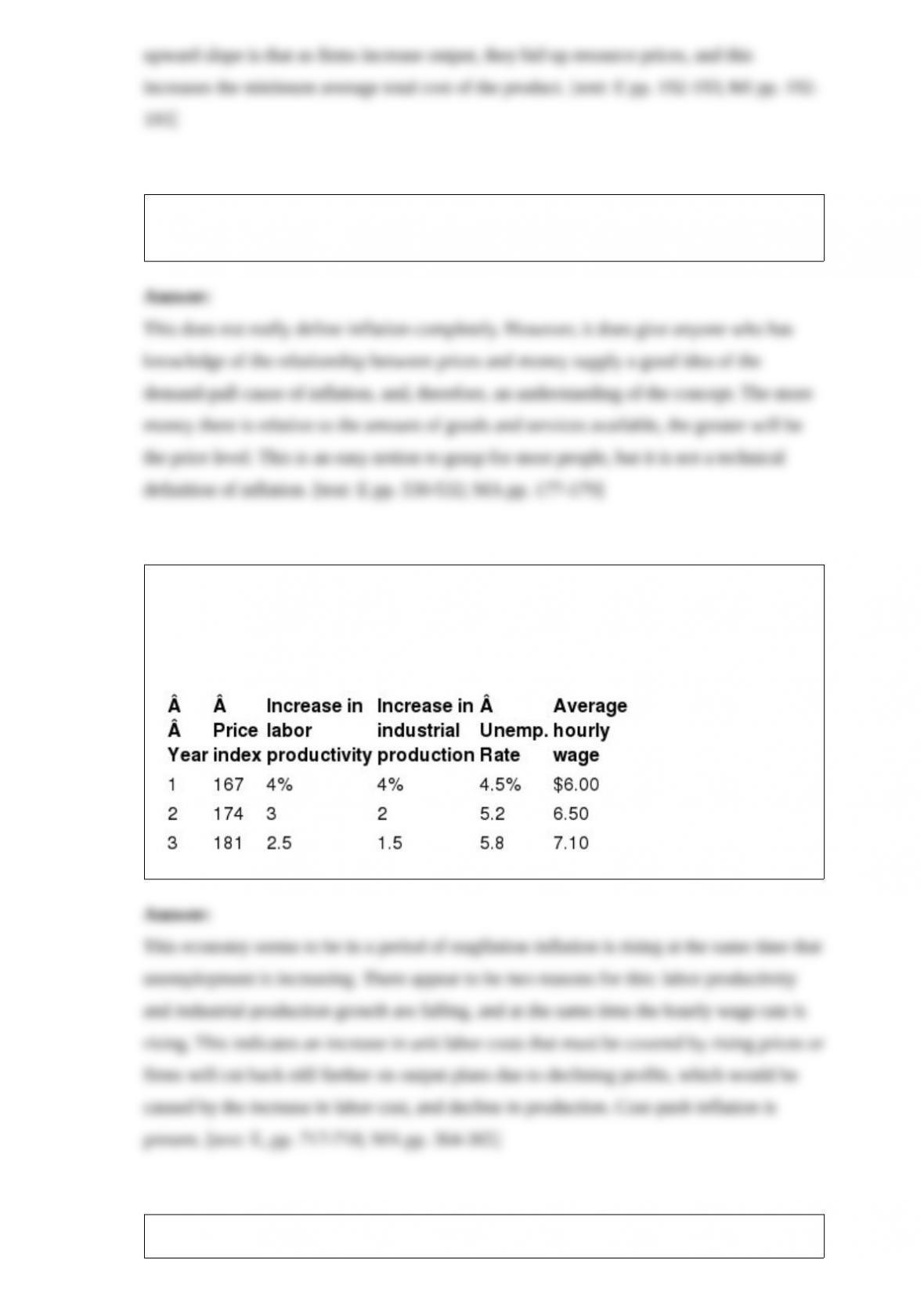
38) Assume the following information is relevant for an advanced economy over a
three-year period. Describe in detail the macroeconomic situation faced by this society.
Is cost-push inflation evident? What corrective policies would you recommend and
why?
39) The international flow of goods helps compensate for the international immobility
of resources. Analyze and explain.
40) What phase of the business cycle is our economy experiencing at the present time?
Justify your answer.