
Dividing the current market price of a stock by the firm’s earnings per share gives the
firm’s
A) price-earnings ratio.
B) year-to-date percentage change.
C) dividend yield.
D) stock coupon maturity yield.
Table 2-10
Table 2-10 shows the output per day of two pet groomers, Tammi and Horace. They can
either devote their time to grooming dogs or bathing cats.
What is tammi’s opportunity cost of bathing a cat?
A) half a groomed dog
B) two groomed dogs
C) two-thirds of a groomed dog
D) one and a half groomed dogs
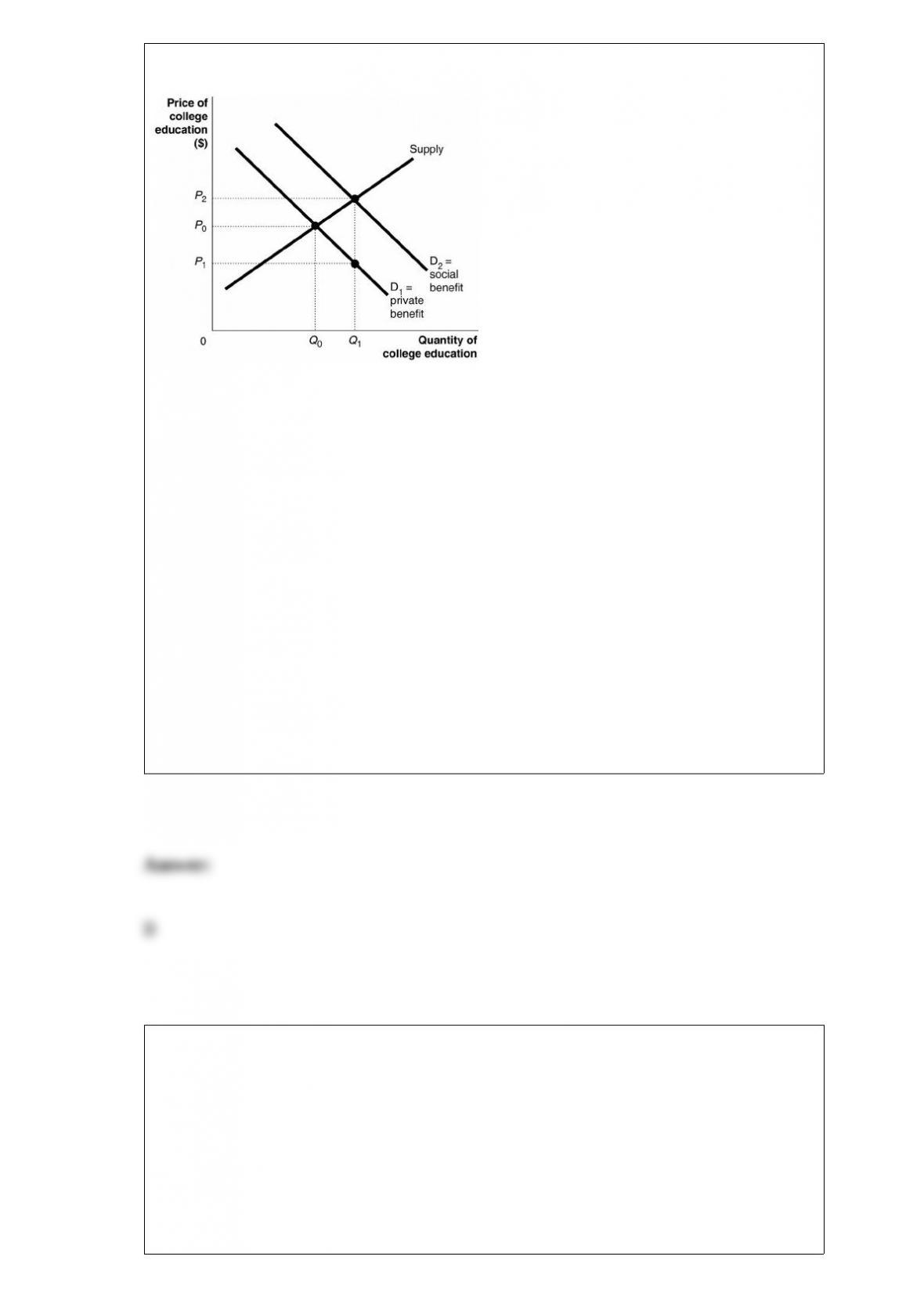
Figure 5-12
College education benefits society by
producing a more employable workforce, reducing crime and creating a better informed
citizenry. Thus, the social benefits of college education exceed the private benefits for
any level of college education. This is illustrated in Figure 5-12. One way to obtain the
economically efficient amount of college education is for governments to subsidize
college education. What is the size of the per-student Pigovian subsidy that the
government must provide to internalize the external benefits? (Note that the subsidy can
be granted to the education institutions or to the students directly or indirectly; for
example, through low-interest student loans.)
A) P2–P0
B) P2–P1
C) P0–P1
D) P1
Which of the following is not a determinant of a good’s price elasticity of demand?
A) the slope of the demand curve
B) the share of the good in the consumer’s total budget
C) whether the good is a luxury or a necessity
D) the passage of time

In 1980, one Zimbabwean dollar was worth 1.47 U.S. dollars. By the end of 2008, the
exchange rate was one U.S. dollar to 2 billion Zimbabwean dollars. When an economy
experiences rapid increases in the price level such as what occurred in Zimbabwe, the
economy is said to experience
A) stagflation.
B) deflation.
C) inflation.
D) hyperinflation.
Two firms would sometimes be better off if they got together and agreed to charge a
high price, rather than to compete and risk having to charge a lower, competitive price.
What is the greatest deterrent to this strategy?
A) The firms may find that the price they charge is greater than the price that would
maximize their profits.
B) An agreement by firms to charge high prices is illegal. The government can fine the
firms and send their managers to jail.
C) Consumers may resent having to pay high prices and not buy from either of the
firms.
D) One of the firms may decide to lower its price and take business away from the firm
that charged the high price.
Which of the following statements is true?
A) As the wage rate rises, the substitution effect decreases the opportunity cost of
leisure and causes a worker to devote more time to working and less time to leisure.
B) As the wage rate rises, the substitution effect increases the opportunity cost of leisure
and causes a worker to devote more time to working and less time to leisure.
C) As the wage rate rises, the income effect increases the opportunity cost of leisure and
causes a worker to devote more time to working and less time to leisure.
D) As the wage rate rises, the income effect causes a worker to devote more time to
work and less time to leisure.
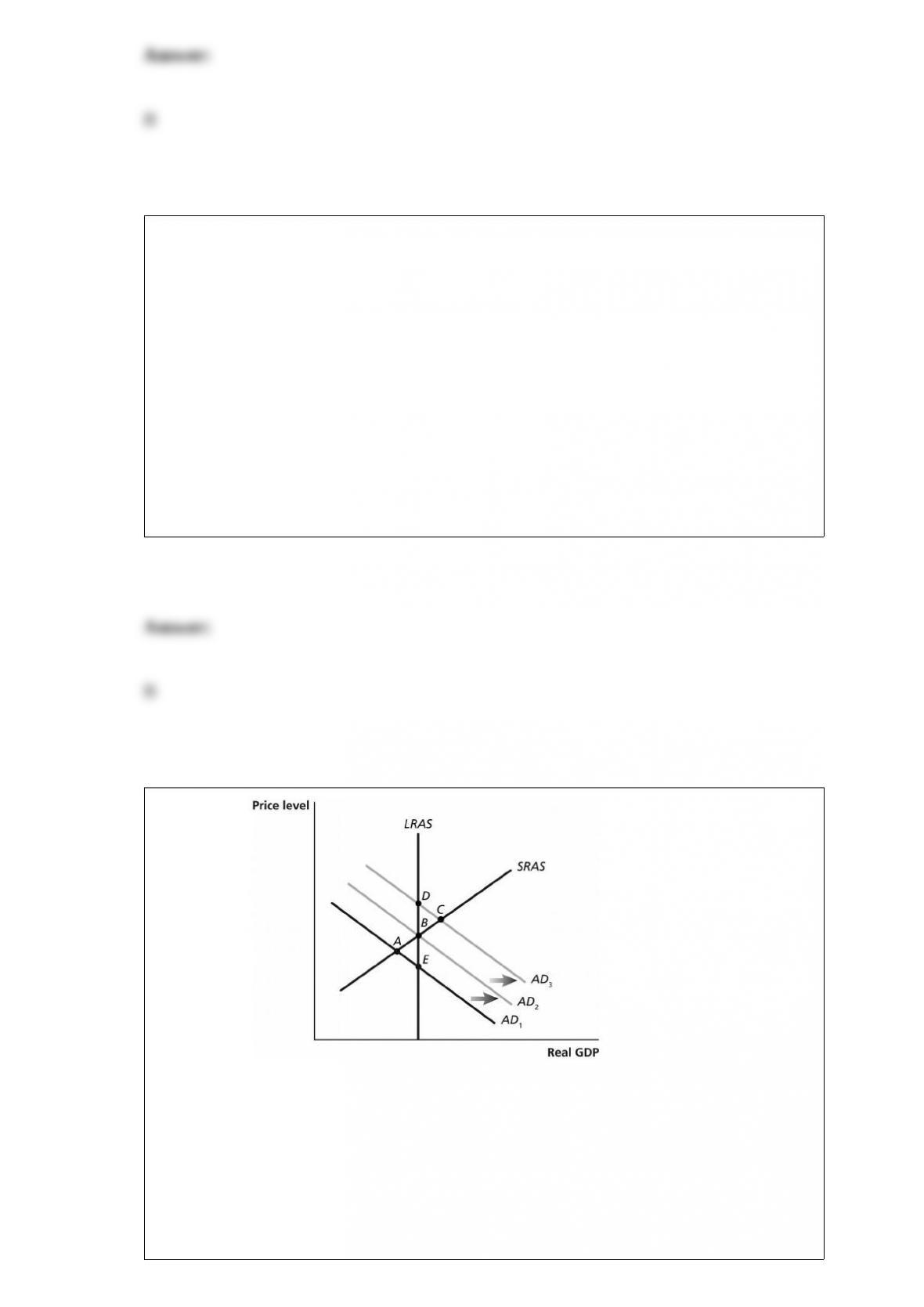
Figure 27-1
Suppose the economy is in a recession and expansionary fiscal policy is pursued. Using
the static AD–AS model in the figure above, this would be depicted as a movement from
A) A to B.
B) B to C.

C) C to B.
D) B to A.
E) A to E.
The monetary growth rule is a plan for increasing the quantity of money
A) at a fixed rate that does not respond to changes in the economic condition.
B) at a rate which increases as the economy grows.
C) at a rate which decreases as the economy declines.
D) at a rate which increases during recessions and decreases during expansions.
If firms are more optimistic that future profits will rise and remain strong for the next
few years, then
A) investment spending will fall.
B) investment spending will rise.
C) investment spending will remain unaffected.
D) investment spending will rise and then fall.
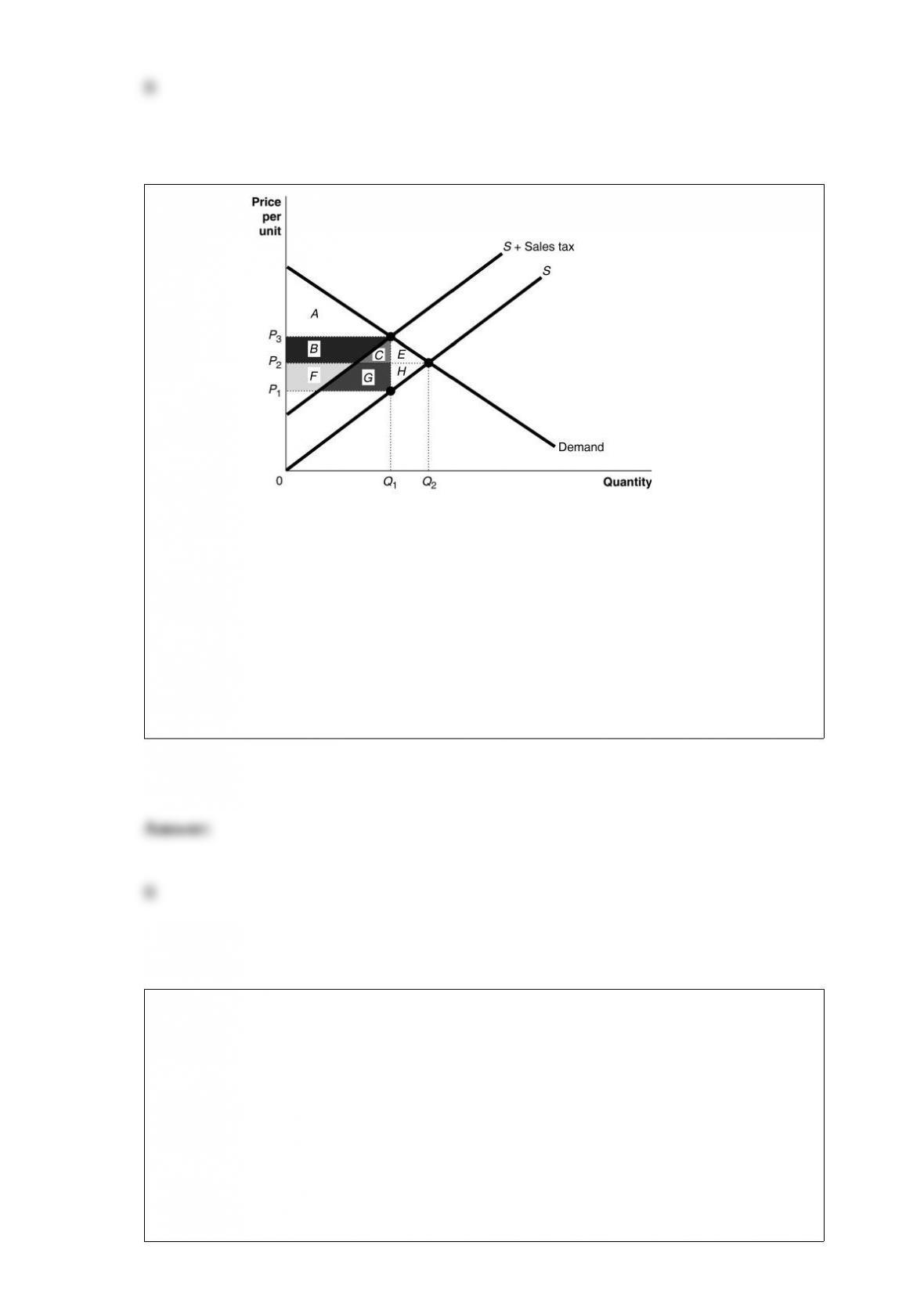
Figure 18-1
Area F + G represents
A) the portion of sales tax revenue borne by consumers.
B) the portion of sales tax revenue borne by producers.
C) the excess burden of the sales tax.
D) sales tax revenue collected by the government.
If a monopolistically competitive firm is producing 50 units of output where marginal
cost equals marginal revenue, total cost is $1,674 and total revenue is $2,000, its
average profit is
A) $326.
B) $40.
C) $6.52.

D) impossible to determine without additional information.
The existence of ________ increases the risk of buying stock in a corporation.
A) the principal-agent problem
B) corporate governance
C) unlimited personal liability
D) employee-owned corporations
When the Federal Reserve increases the money supply, at the previous equilibrium
interest rate households and firms will now have
A) more money than they want to hold.
B) less money than they want to hold.
C) the amount of money that they want to hold.
D) to sell Treasury bills.

A tax imposed by a state or local government on retail sales of most products is
A) an excise tax.
B) a social service tax.
C) a consumption tax.
D) a sales tax.
Which of the following will not shift the demand curve for a good?
A) an increase in population
B) an increase in the price of the good
C) a decrease in the price of a substitute good
D) an increase in consumer incomes
If the best lawyer in town is also the best at operating a word processor, then according
to economic reasoning, this person should
A) split her time evenly between being a lawyer and a word processor.

B) specialize in being a lawyer because its opportunity cost is lower.
C) should pursue the activity she enjoys more.
D) specialize in being a work processor because it is more capital-intensive.
Which of the following would you expect to increase both interest rates and exchange
rates?
A) expansionary monetary policy
B) contractionary monetary policy
C) expansionary fiscal policy
D) Both B and C will increase both interest rates and exchange rates.
When the price of audio books, a normal good, falls, causing your purchasing power to
rise, you buy more of them due to
A) the substitution effect.
B) the income effect.
C) the deadweight loss effect.
D) the elasticity effect.