
What happens in the secondary market?
A) secondary inputs like electricity are sold
B) a corporate financial manager will raise funds for expansion of the firm
C) newly issued claims are sold by the borrowing firm to the initial buyer
D) already issued claims are sold from one investor to another
Jason, a high-school student, mows lawns for families in his neighborhood. The going
rate is $12 for each lawn-mowing service. Jason would like to charge $20 because he
believes he has more experience mowing lawns than the many other teenagers who also
offer the same service. If the market for lawn mowing services is perfectly competitive,
what would happen if Jason raised his price?
A) He would lose some but not all his customers.
B) Initially, his customers might complain but over time they will come to accept the
new rate.
C) If Jason raises his price he would lose all his customers.
D) If Jason raises his price, then all others supplying the same service will also raise
their prices.
A goal of market-based reforms of the health care system is to give patients an incentive
to pay more attention to the prices of medical services. This would tend to ________
economic efficiency by ________ the costs of medical services

A) increase; increasing
B) increase; decreasing
C) decrease; increasing
D) decrease; decreasing
Because the value of the euro is determined by factors that affect the entire euro zone,
during the recession of 2007-2009, individual countries using the euro
A) were unable to have their exchange rates depreciate.
B) were more insulated from unemployment increases than most countries.
C) experienced a greater increase in exports than did most countries.
D) were able to use expansionary monetary policy to lessen the impact of the recession.
The cross-price elasticity of demand between Coca-Cola and Pepsi-Cola is calculated
by dividing
A) the percentage change in quantity demanded of Coca-Cola by the percentage change
in the quantity demanded of Pepsi-Cola.
B) the percentage change in the price of Pepsi-Cola by the percentage change in
quantity demanded of Coca-Cola.
C) the percentage change in the price of Coca-Cola by the percentage change in the
price of Pepsi-Cola.

D) the percentage change in the quantity demanded of Coca-Cola by the percentage
change in the price of Pepsi-Cola.
What is the “reverse causality” problem in determining cause and effect?
A) It is a problem that occurs when one concludes that a change in variable X caused a
change in variable Y when in actual fact, it is a change in variable Z that caused a
change in variable Y.
B) It is a problem that occurs when one observes that a change in variable X caused a
change in variable Y which caused a change in variable Z and concludes that a change
in variable X caused a change in variable Z.
C) It is a problem that occurs when one concludes that a change in variable X caused a
change in variable Y when in actual fact, it is a change in variable Y that caused a
change in variable X.
D) It is a problem that arises when two variables are inter-connected so that a change in
variable X causes a change in variable Y, and a change in variable Y causes a change in
variable X.
When groups of mortgages are bundled together by financial institutions and sold to
investors, these institutions are said to be ________ mortgage loans.
A) securitizing
B) underwriting
C) liquidating
D) harvesting
The narrowest official definition of the money supply is
A) M1.
B) M2.
C) M3.
D) L.
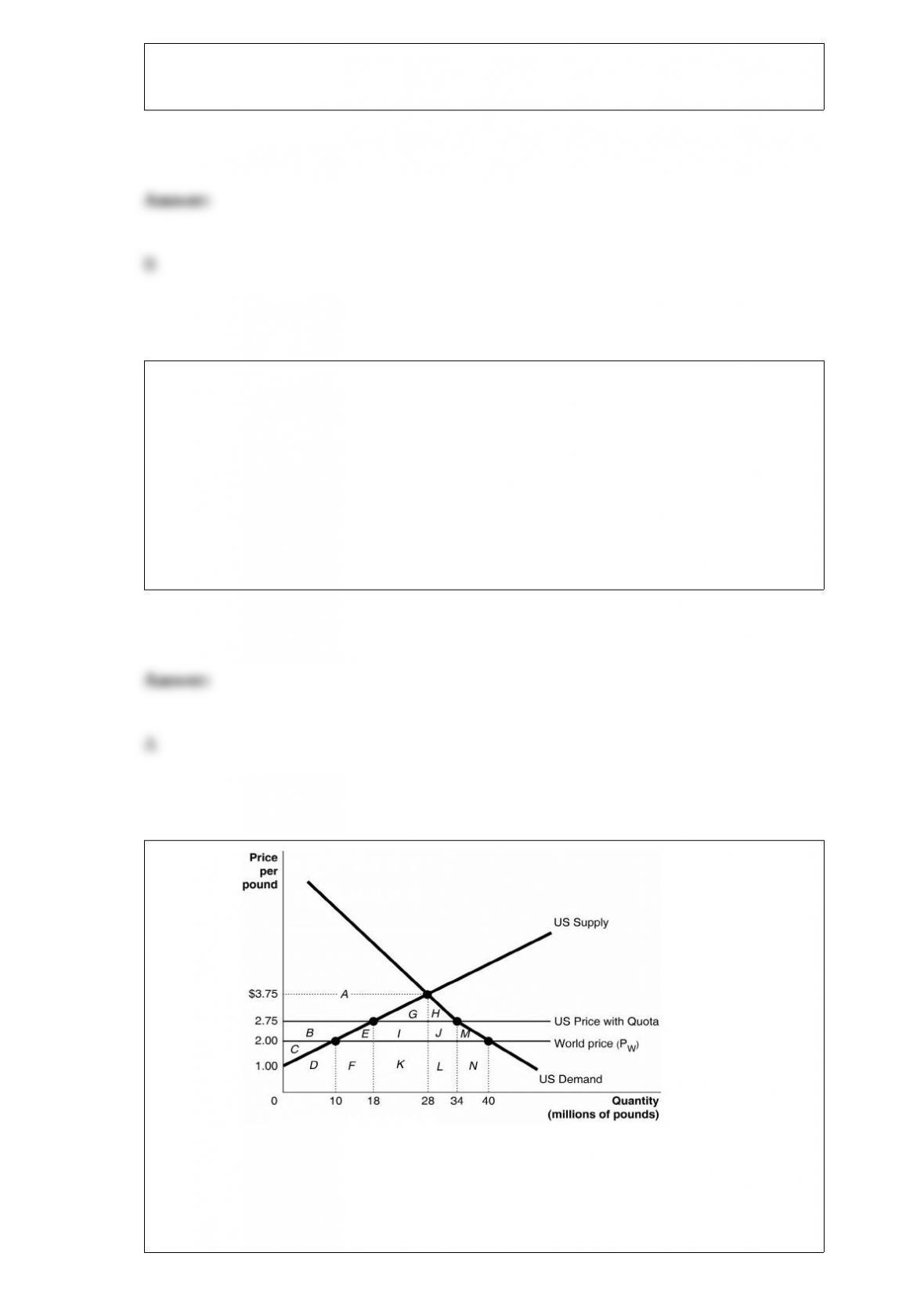
Figure 7-3 Since 1953 the
United States has imposed a quota to limit the imports of peanuts. Figure 7-3 illustrates
the impact of the quota. What is the value of the deadweight loss as a result of the
quota?
A) $5.25 million

B) $8 million
C) $17.25 million
D) $20 million
In 18th century Europe, governments gave guilds legal authority to limit production of
goods. This authority obstructed the market mechanism because the guild’s actions
prevented the forces of ________ from coordinating the self-interested decisions of
producers and consumers.
A) absolute advantage
B) demand and supply
C) opportunity cost
D) nature
If a demand curve shifts to the right, then
A) demand has increased.
B) quantity demanded has increased.
C) demand has decreased.
D) quantity demanded has decreased.

If the growth rate of real GDP rises from 3% to 4% per year, then the number of years
required to double real GDP will decrease from
A) 23.3 years to 17.5 years.
B) 28.0 years to 21.0 years.
C) 11.2 years to 10.8 years.
D) 23.3 years to 20.6 years.
According to the World Bank, GDP per capita ________ in the least corrupt countries
than in the most corrupt countries.
A) is more than 50 percent less
B) is roughly the same
C) is twice as high
D) is more than 10 times higher

If the market price is $40, the average revenue of selling five units is
A) $8.
B) $20.
C) $40.
D) $200.