
The argument advanced by Milton Friedman for adopting a monetary growth rule is
that
A) active monetary policy potentially destabilizes the economy.
B) the Fed can control the money supply, but not the level of interest rates.
C) a constant rate of growth in the money supply would eliminate the booms and
recessions that make up the business cycle.
D) the growth rate of M1 has been unstable.
How will an increase in the government budget surplus as a result of lower government
spending (with no change in net taxes) affect private saving in the economy?
A) Private saving will increase by the amount of increase in the budget surplus.
B) Private saving will decrease by the amount of increase in the budget surplus.
C) Private saving will decrease by less than the amount of increase in the budget
surplus.
D) Private saving will be unaffected by the increase in the budget surplus.
If the dollar appreciates against the Mexican peso,
A) Mexican imports to the U.S. become more expensive.
B) U.S. exports to Mexico become less expensive.
C) U.S. exports to Mexico become more expensive.
D) The value of Mexican imports to the United States does not change.
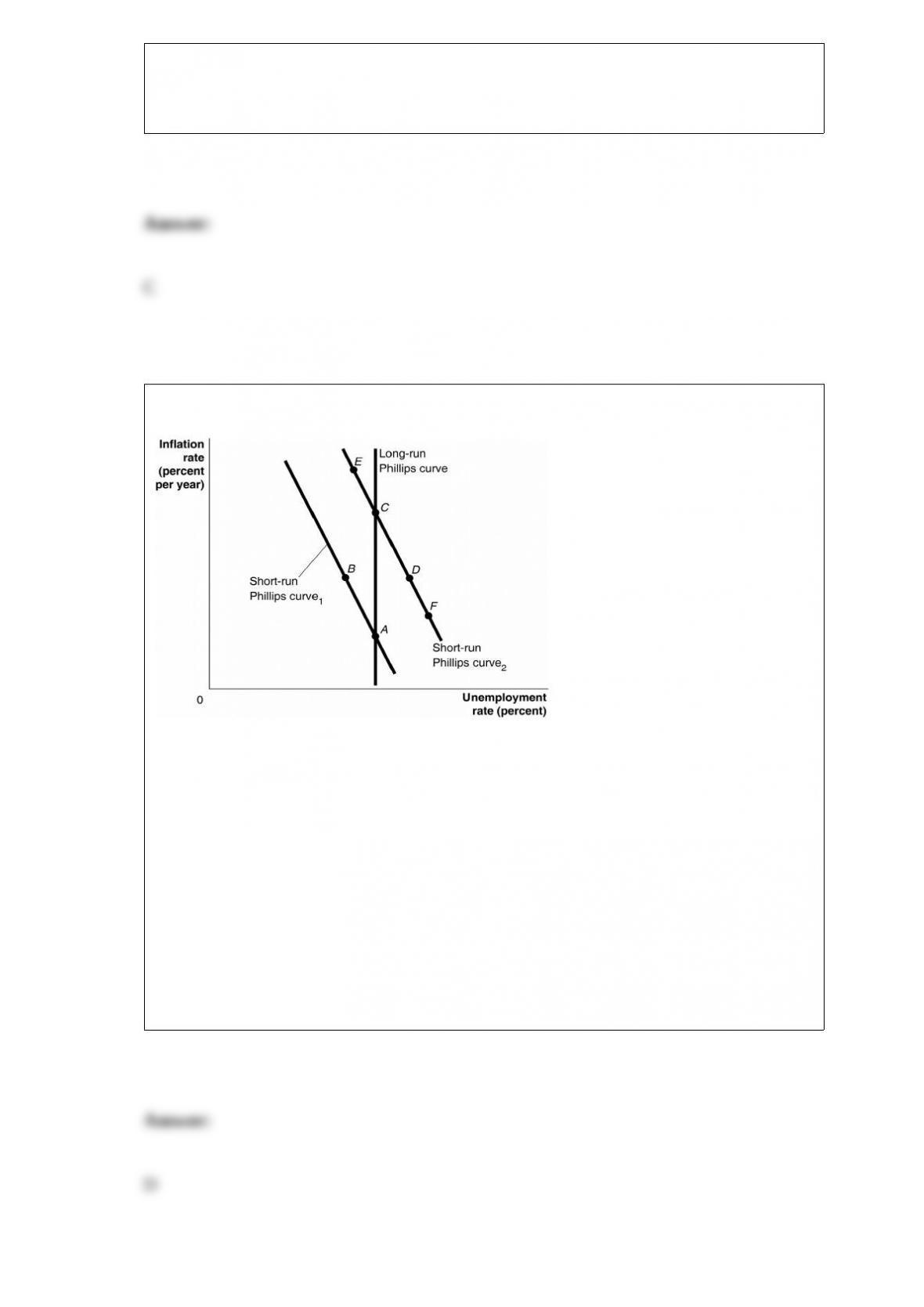
Figure 17-9
Refer to Figure 17-9. A follower of the new classical macroeconomics would argue that
a contractionary monetary policy to lower inflation after a supply shock, like that
pursued by Volcker in 1979, would result in a movement from
A) A to D to C.
B) A to B.
C) C to D to A.
D) C to A.
E) A to C.

In the long run, most economists agree that a permanent increase in government
spending leads to ________ crowding out of private spending.
A) no
B) partial
C) complete
D) more than complete
If the purchasing power of a dollar is less than the purchasing power of the euro,
purchasing power parity would predict that
A) in the short run, exchange rates will move to equalize the purchasing power of the
dollar and the euro.
B) in the long run, exchange rates will move to equalize the purchasing power of the
dollar and the euro.
C) in the long run, interest rates will move to equalize the purchasing power of the
dollar and the euro.
D) in the short run, interest rates will move to equalize the purchasing power of the
dollar and the euro.
If potential GDP is equal to $600 billion, what does the long-run aggregate supply
curve look like?
A) It is a horizontal line at $600 billion of GDP.

B) It is a vertical line at a level of GDP below $600 billion.
C) It is a vertical line at $600 billion of GDP.
D) It is a vertical line at a level of GDP above $600 billion.
Firms in Thailand that had ________ while the baht was pegged to the dollar faced
interest payments that were higher than they had planned once the Thai government
abandoned the peg because the baht had been pegged ________ the equilibrium
exchange rate for the baht.
A) borrowed dollars; above
B) borrowed baht; above
C) borrowed dollars; below
D) borrowed baht; below
Increasing opportunity cost along a bowed out production possibilities frontier occurs
because
A) of inefficient production.
B) of ineffective management by entrepreneurs.
C) some factors of production are not equally suited to producing both goods or
services.
D) of the scarcity of factors of production.
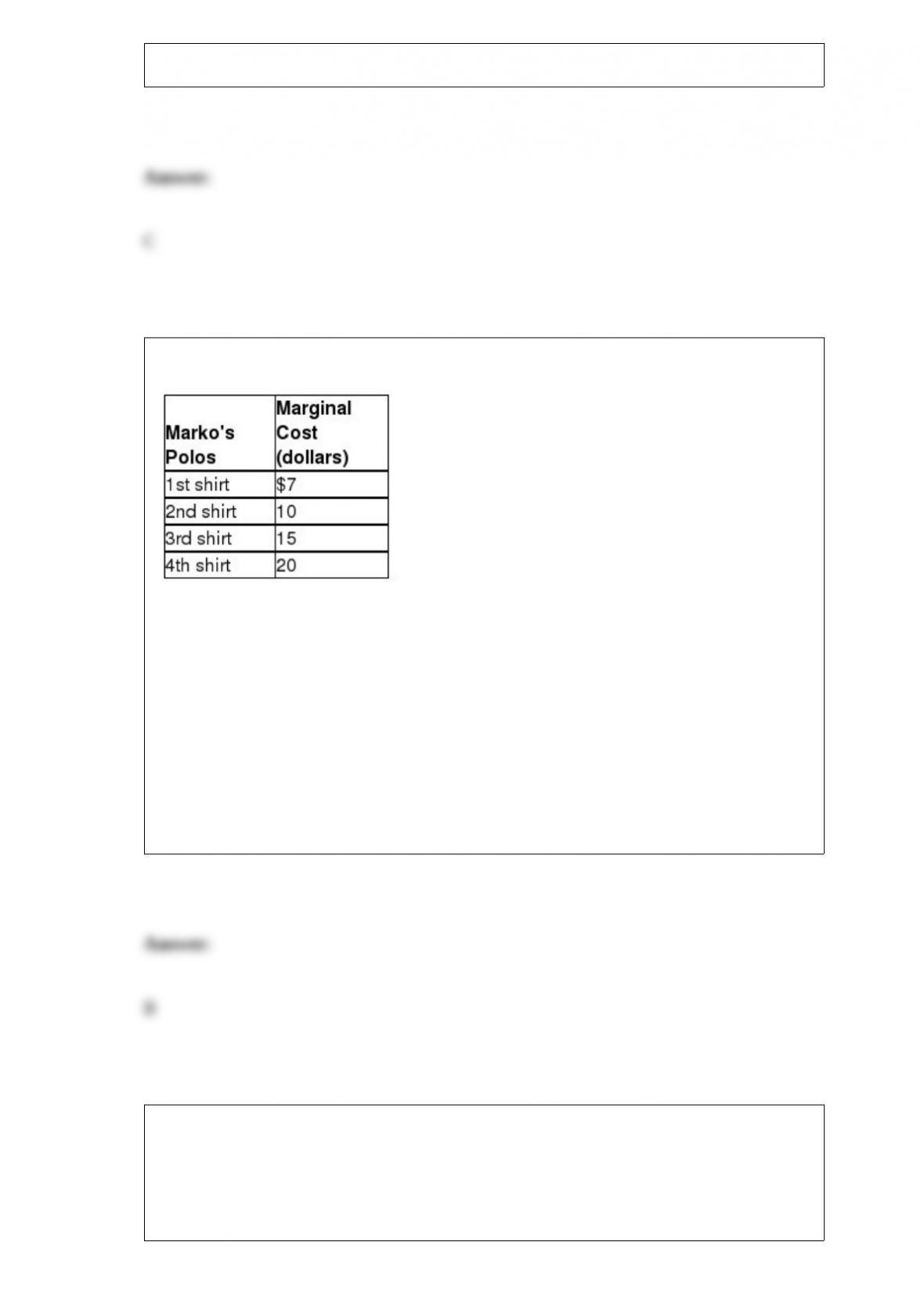
Table 4-3
Refer to Table 4-3. The table above lists the marginal cost of polo shirts by Marko’s, a
firm that specializes in producing men’s clothing. If the market price of Marko’s polo
shirts is $13, Marko’s will produce
A) 1 shirt.
B) 2 shirts.
C) 3 shirts.
D) 4 shirts.
If the GDP deflator is less than 100, then for that year nominal GDP ________ real
GDP.
A) equals

B) is greater than
C) is less than
D) may be greater than or less than