
Which of the following is true about sole proprietorship in the United States?
a. It is the most common form of business organization.
b. It is responsible for a large portion of total production of goods and services.
c. It offers the owner the least personal liability of any form of business organization.
d. There is no opportunity cost to operating the business.
e. Only one individual can work in such a firm.
Wendy’s restaurants must decide whether to grow their own potatoes for French fries or
buy them. If they buy rather than grow, then they have opted to
a. integrate horizontally
b. allow market prices to guide resource allocation
c. integrate vertically
d. allow hierarchical control to guide resource allocation
e. form an authority relation
Along a downward-sloping linear demand curve, total revenue is greatest if demand is

a. inelastic
b. elastic
c. inelastic when prices are high
d. elastic when prices are high
e. unit elastic
The labor market is an example of a
a. government market
b. classified market
c. communication market
d. resource market
e. product market
Exhibit 16-4
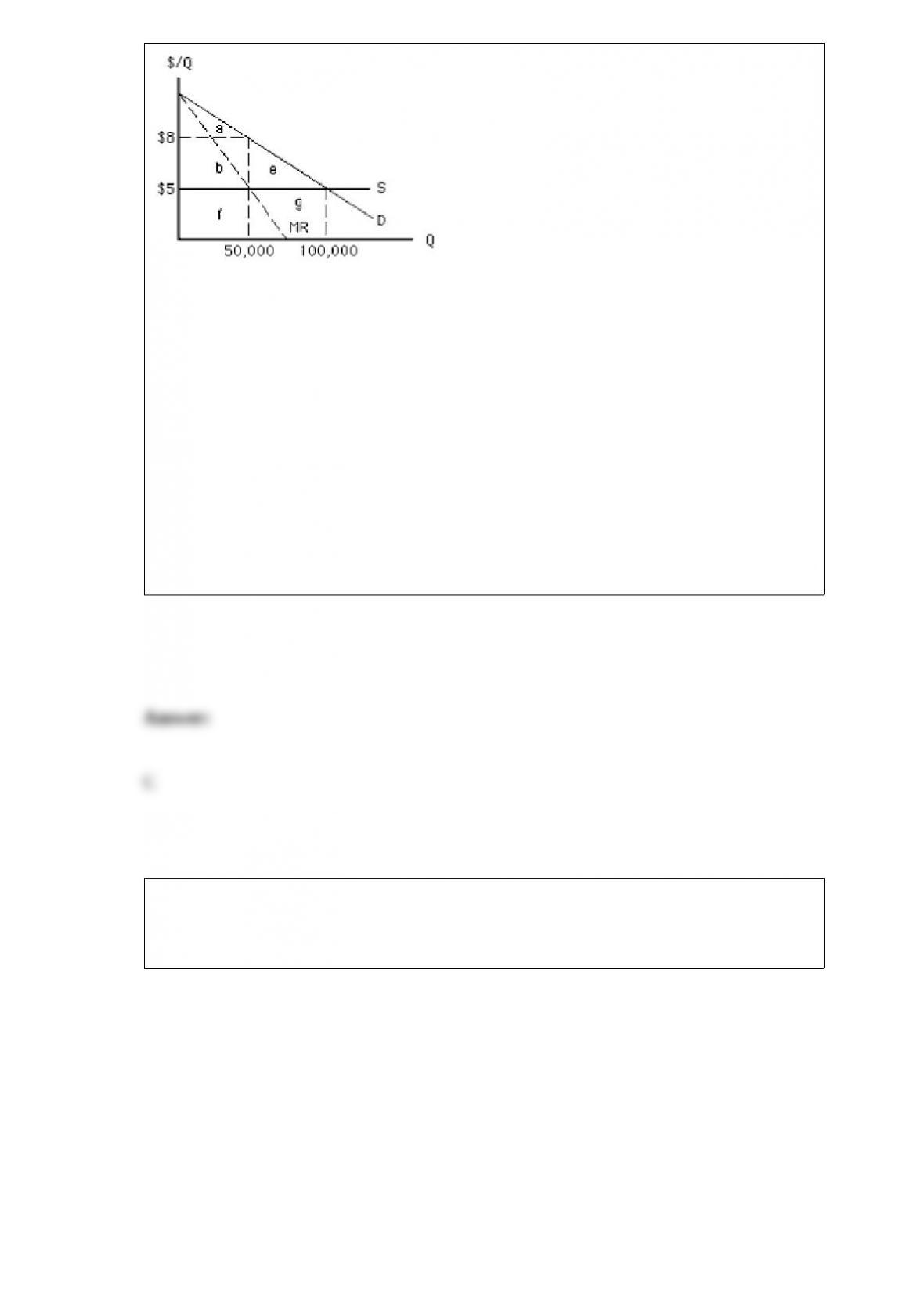
Refer to Exhibit 16-4. Suppose the government announced it would give monopoly
power to one firm in the industry through an exclusive license. If successful, the
welfare l oss due to monopoly would be equl to what?
a. area a
b. area b
c. area e
d. area f
e. area g
Exhibit 8-18
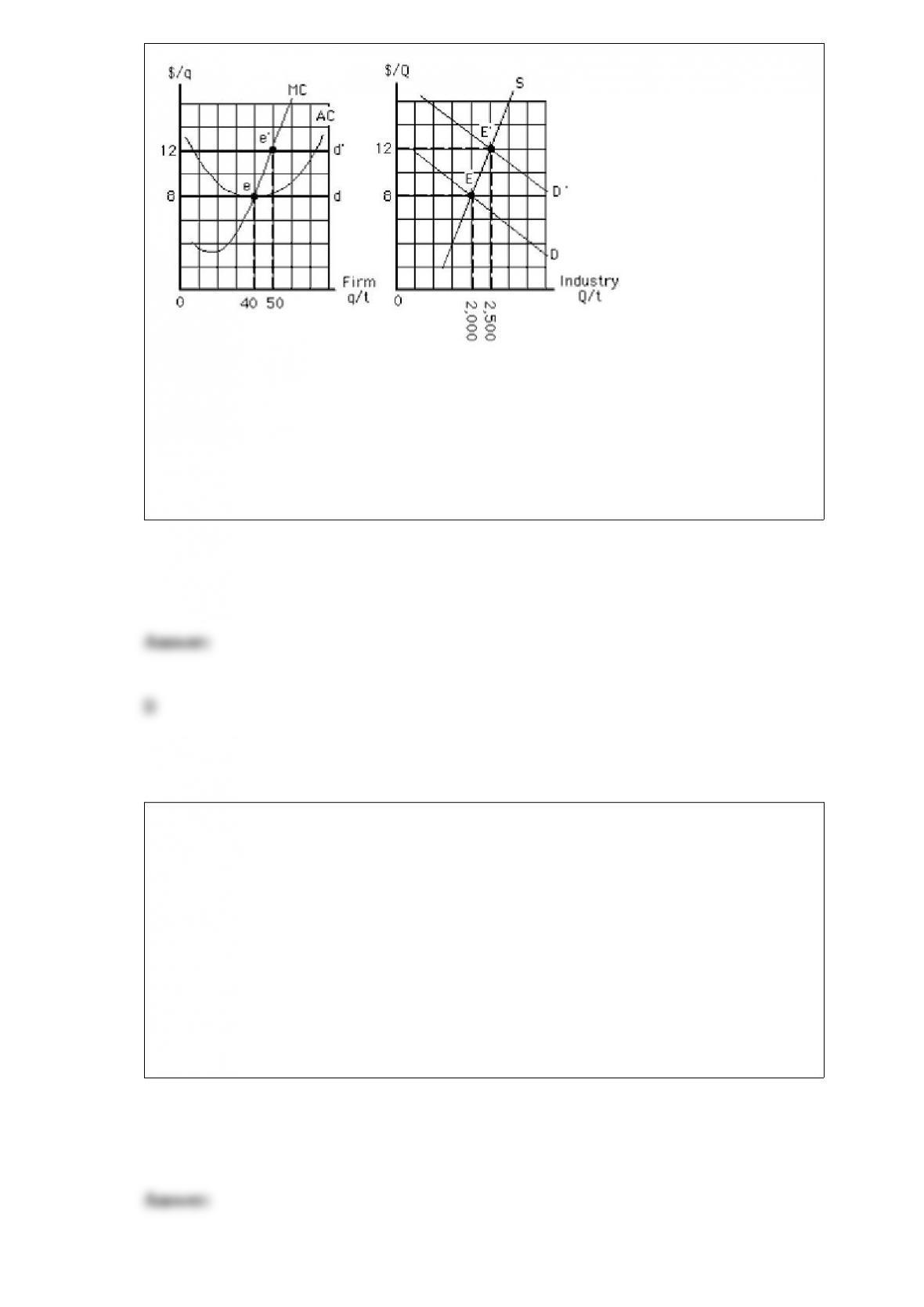
The movement along curve S from E to E’ in the right panel of Exhibit 8-18 represents
a. an increase in the number of firms in the industry only
b. an increase in output by each of a fixed number of firms in the industry
c. both an increase in the number of firms in the industry and an increase in each firm’s
output
d. the response of consumers to an increase in supply that lowers the market price
e. an increase in total revenue from $8 to $12
Unions and employers use collective bargaining to negotiate
a. wages only
b. wages and employee benefits only
c. employee benefits only
d. working conditions only
e. wages, employee benefits, and working conditions
All combinations of goods along the same indifference curve have the same cost to a
consumer.
A profit-maximizing firm will employ a resource up to the point where
a. its marginal resource cost equals its marginal revenue product
b. its marginal resource cost equals its marginal product
c. its marginal resource cost equals the marginal revenue of the output
d. its marginal resource cost equals the price of the resource
e. the price of the resource equals the marginal revenue of the output
If the U.S. demand for British pounds increases,
a. the dollar price of a British pound will increase
b. the dollar price of a British pound will decrease
c. the exchange rate between dollars and pounds will be out of equilibrium
d. the pound will fall in value against the dollar
e. there will be no change in either the value of the dollar or the pound
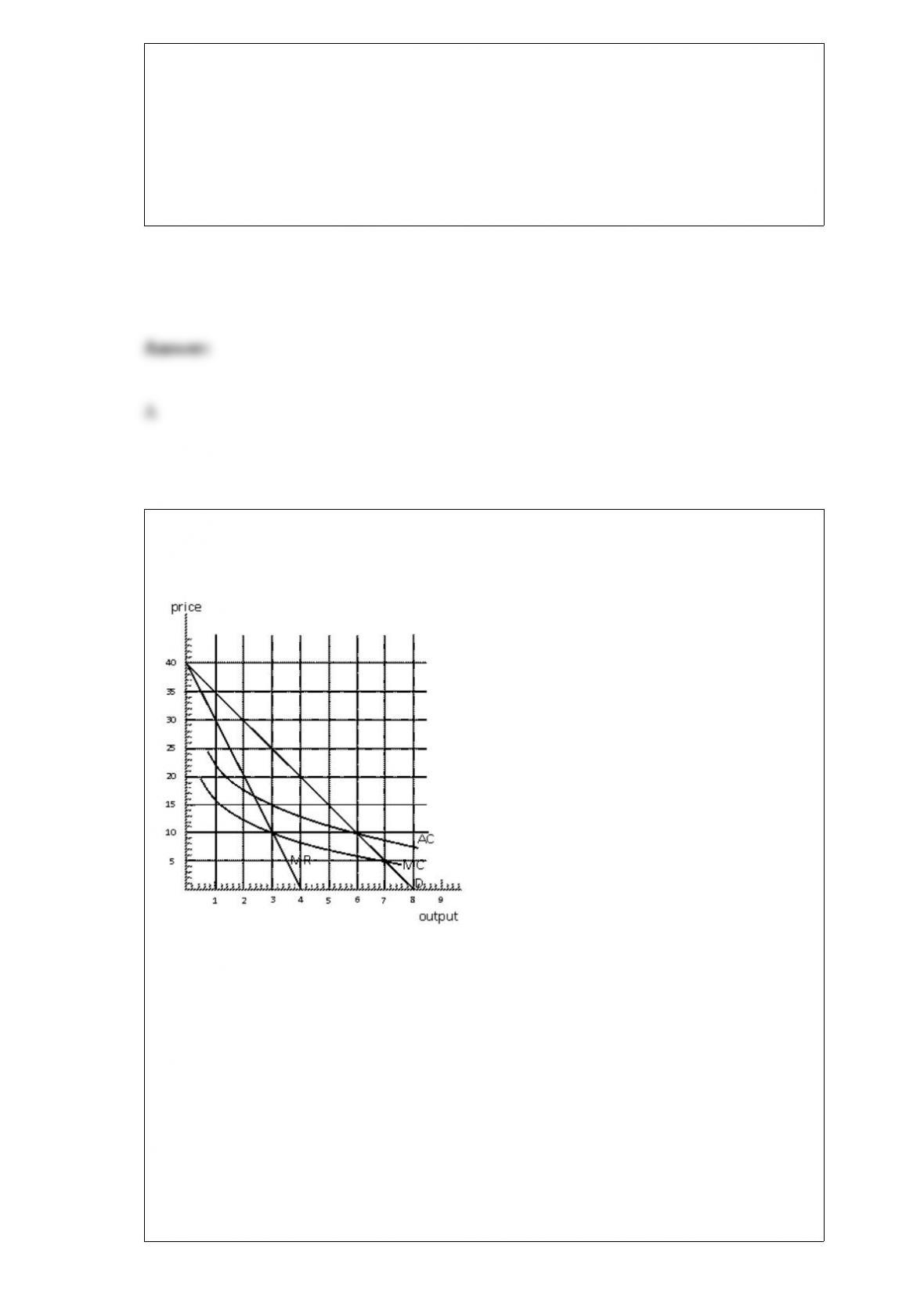
Exhibit 15-5
Consider the natural monopoly depict/ed in exhibit 15-5. What price should regulators
set in order for the natural monopolist to at least break-even?
a. $5
b. $10
c. $15
d. $20
e. $25
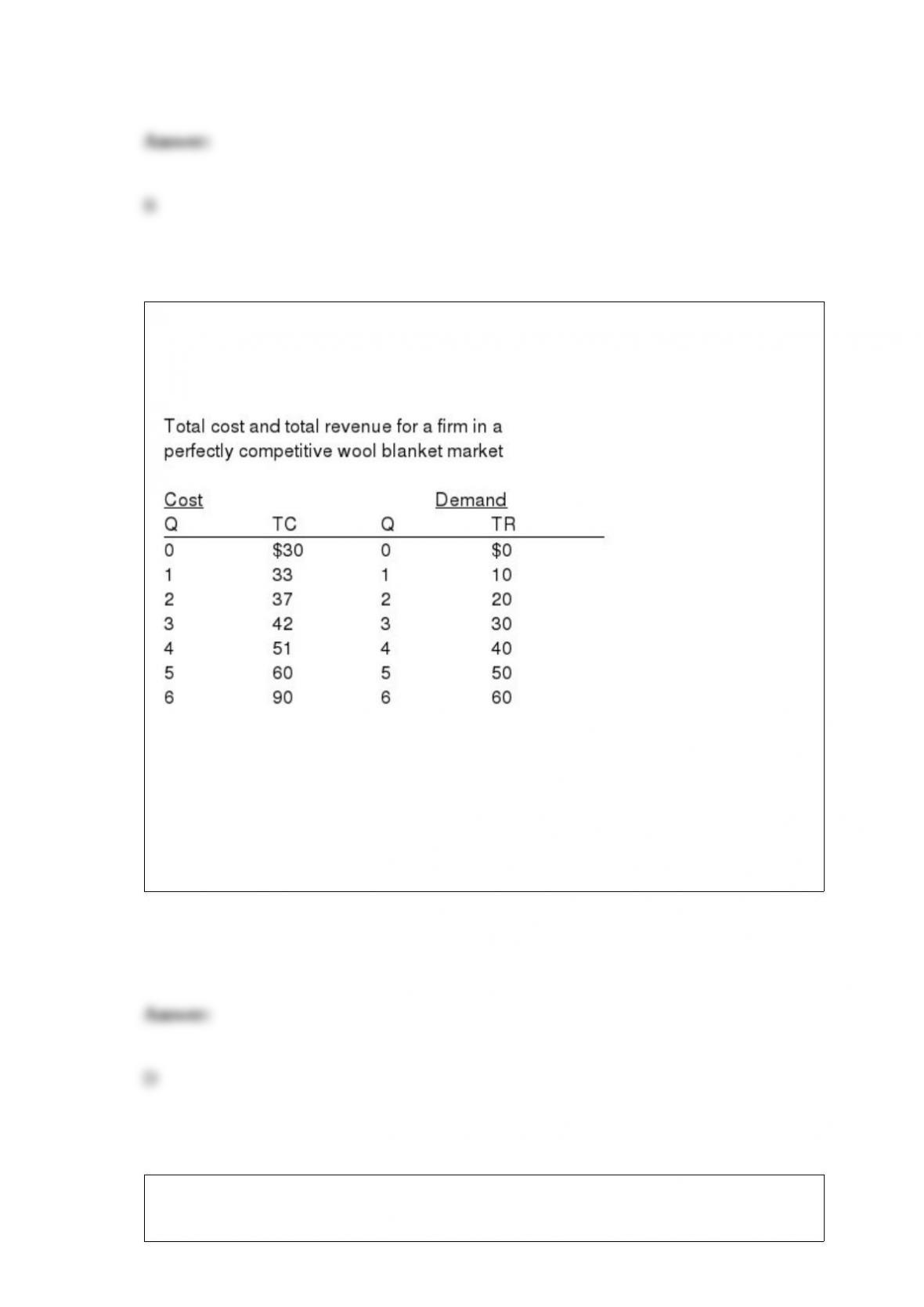
Exhibit 8-2
How much profit is the firm in Exhibit 8-2 earning (or how much of a loss is it
suffering)?
a. -$17
b. $10
c. zero profit or loss
d. -$10
e. $30
Pollution arises because

a. the atmosphere is a nonrenewable resource
b. the atmosphere is a renewable resource
c. of enforceable property rights
d. the atmosphere is an open-access resource
e. there is no supply of pollution curve
Which of the following suggests that people have no control over the number of hours
they work?
a. Most workdays last from 8 a.m. to 5 p.m.
b. People make use of the opportunity for overtime.
c. People make use of the opportunity to moonlight.
d. People make use of early retirement options.
e. Many workers hold more than one job.
If demand increases and supply decreases, quantity will
a. always increase

b. always decrease
c. increase only if supply decreases more than demand increases
d. increase only if supply decreases less than demand increases
e. decrease only if supply decreases less than demand increases
According to the U.S. Supreme Court’s 1945 ruling on Alcoa,
a. all monopolies are illegal
b. price fixing agreements are illegal under the rule of reason
c. small firms can be found to be in violation of the Sherman Antitrust Act
d. “mere size is no offense.”
e. possession of market power is sufficient for a firm to be found in violation of the
Sherman Antitrust Act
Exhibit 6-31
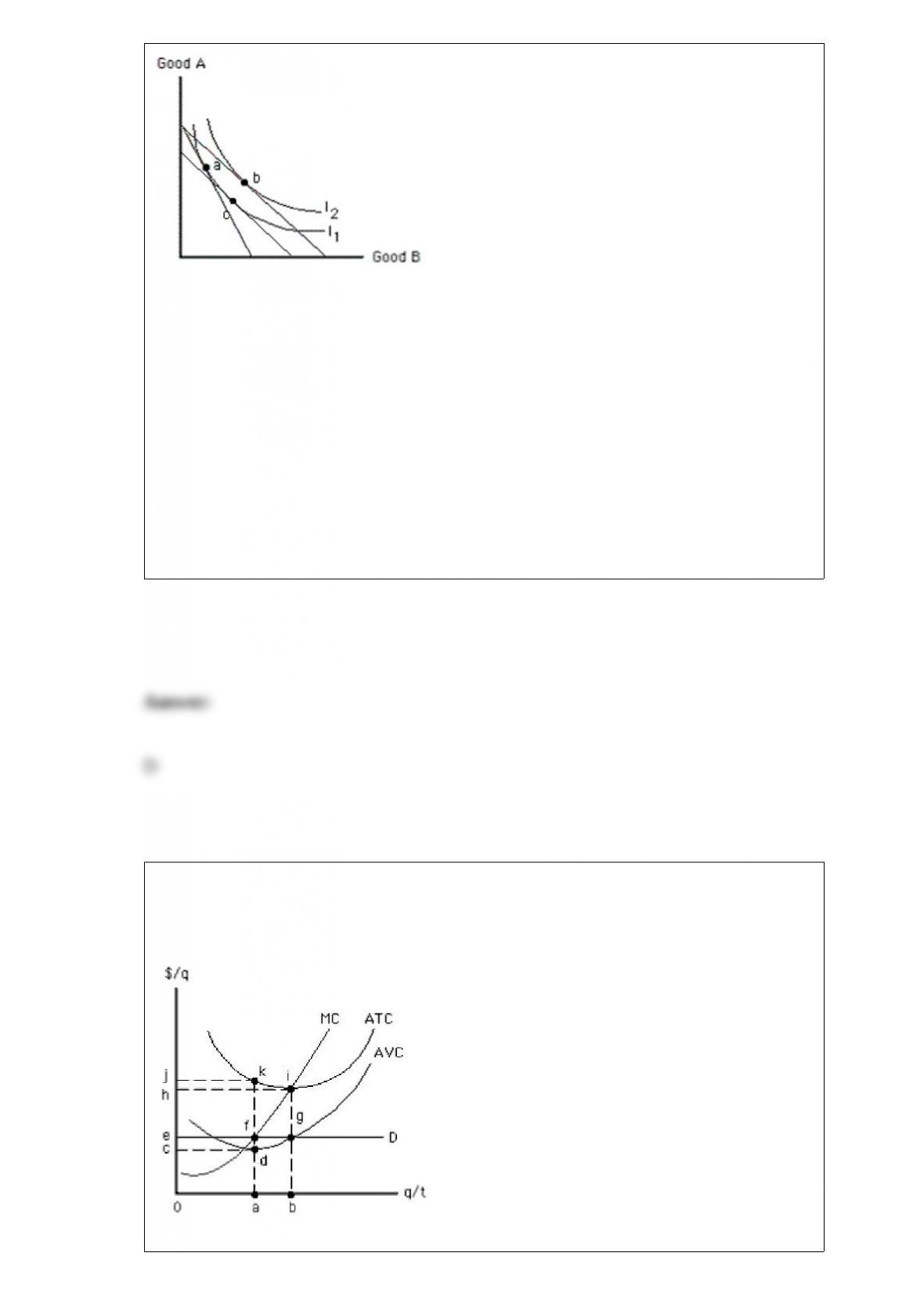
Assume that a consumer is initially in equilibrium at point a in Exhibit 6-31. Then the
price of good B falls. The movement from point a to point b represents
a. the substitution effect
b. the income effect
c. the substitution effect minus the income effect
d. the sum of the substitution and income effects
e. the income effect minus the substitution effect
Exhibit 8-14
In Exhibit 8-14, what area represents totalloss at the loss-minimizing output?
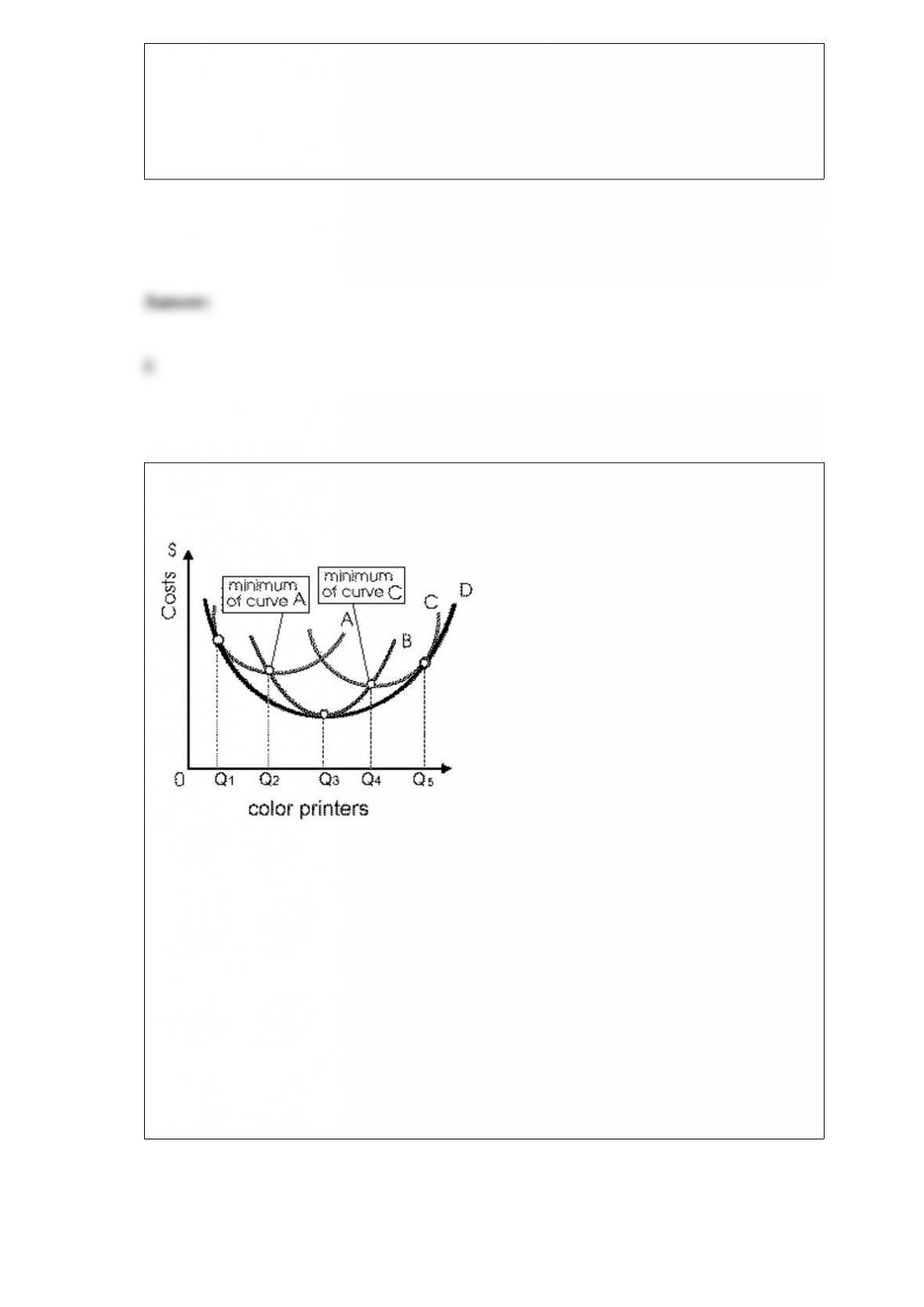
a. 0cda
b. 0jka
c. 0efa
d. cefd
e. ejkf
Exhibit 7-15 Long and Short-Run cost of Producing Color Printers
If the firm represented in Exhibit 7-15 wants to produce output level Q4, then in the
long run it should build a plant size with average total cost curve of
a. A
b. B
c. C
d. B or C
e. the question cannot be answered with the information given

Because of the free-rider problem, it is necessary that public bureaus manufacture
defense weapons.
a. True
b. False
If a teachers’ union negotiates the wage for all college professors, the market supply
curve of college professors
a. is perfectly elastic everywhere
b. is perfectly inelastic everywhere
c. is horizontal and then it slopes upward
d. is vertical and it slopes upward
e. slopes upward and then becomes horizontal

For which of the following products is the consumer’s demand curve most likely to be
vertical?
a. lobster, for a seafood lover
b. cars, for high school students
c. insulin, for a diabetic
d. compact disks, for a music lover
e. beef, for a food lover
A 5 percent increase in income leads to a 10 percent decrease in quantity demanded for
a service. This service is a(n) __________ good and demand is __________.
a. normal; elastic
b. normal; inelastic
c. normal; unit elastic
d. inferior; elastic
e. inferior; inelastic
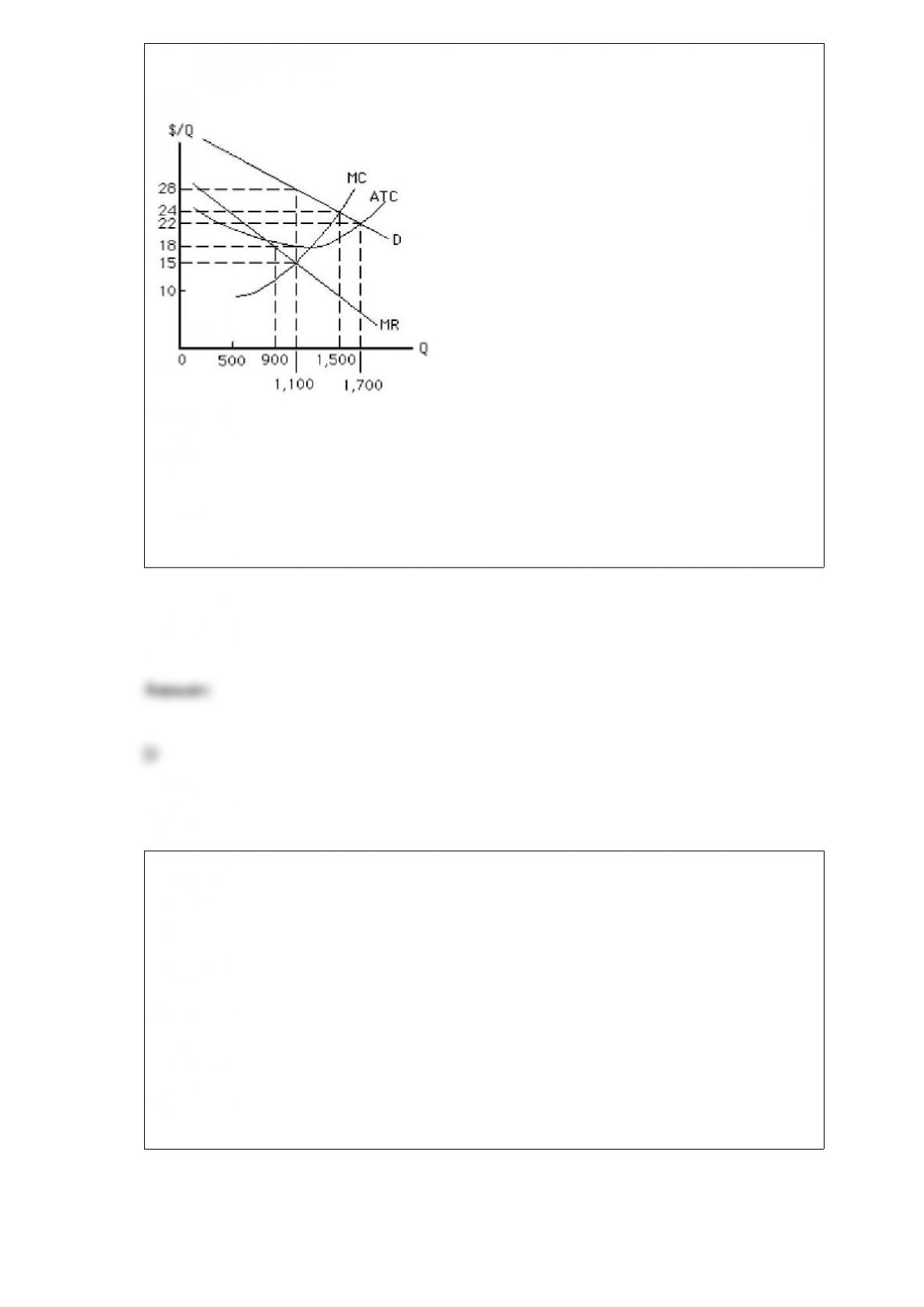
Exhibit 9-5
The total revenue for the nondiscriminating monopolist at its profit-maximizing
quantity in Exhibit 9-5 is
a. $16,200
b. $36,000
c. $39,600
d. $30,800
e. $31,000
Unions sometimes try to ensure that employers hire more union labor than they might
otherwise prefer by
a. collective bargaining
b. featherbedding
c. work enlargement
d. restricting the supply of labor
e. increasing the demand for union-made products

Which of following is true of monopoly and not of perfect competition?
a. Profit is maximized where marginal cost equals marginal revenue
b. The industry demand curve is also the firm’s demand curve
c. Normal profits are made only if average total cost equals average revenue
d. Profit is maximized in the elastic portion of the demand curve
e. the firm has no control over the market price
A worker’s labor supply depends on, among other things, his ability, his preference for
the task, and the opportunity cost of his time.
a. True
b. False
What is true along the demand curve for a resource?
a. Prices of other resources are assumed constant.
b. The marginal product of that resource remains constant.

c. Total cost of production is assumed constant.
d. The price of that particular resource is assumed constant.
e. The quantity of that particular resource is assumed constant.
As a scientist, an economist’s main professional objective is to become wealthy.
a. True
b. False
The threat of a strike
a. can serve as an incentive for labor and management to reach an agreement
b. destroys incentives for labor and management to reach an agreement
c. is usually not taken seriously because employers know the workers will suffer during
a strike
d. is not taken seriously unless management expects to suffer
e. is not taken seriously if public safety is at risk

Mutually beneficial trade will occur between two countries for all of the following
reasons except one. Which is the exception?
a. The opportunity costs of producing two goods differs between the two trading
partners.
b. One country is more productive than the other.
c. One country is more efficient than the other.
d. One country has an absolute advantage over the other.
e. Each country has a comparative advantage in producing some good.
Cross-price elasticity measures the responsiveness of the price of good A to a change in
the price of good B.
a. True
b. False

Which of the following did not occur during the Industrial Revolution?
a. worker productivity increased
b. factories became larger
c. direct supervision of labor decreased
d. division of labor increased
e. fewer stages of production were organized in the household