1) The antitrust laws are enforced by the:
A.Federal Bureau of Investigation.
B.Antimonopoly Court of Appeals.
C.Federal Justice Department and the Federal Trade Commission.
D.Department of Commerce.
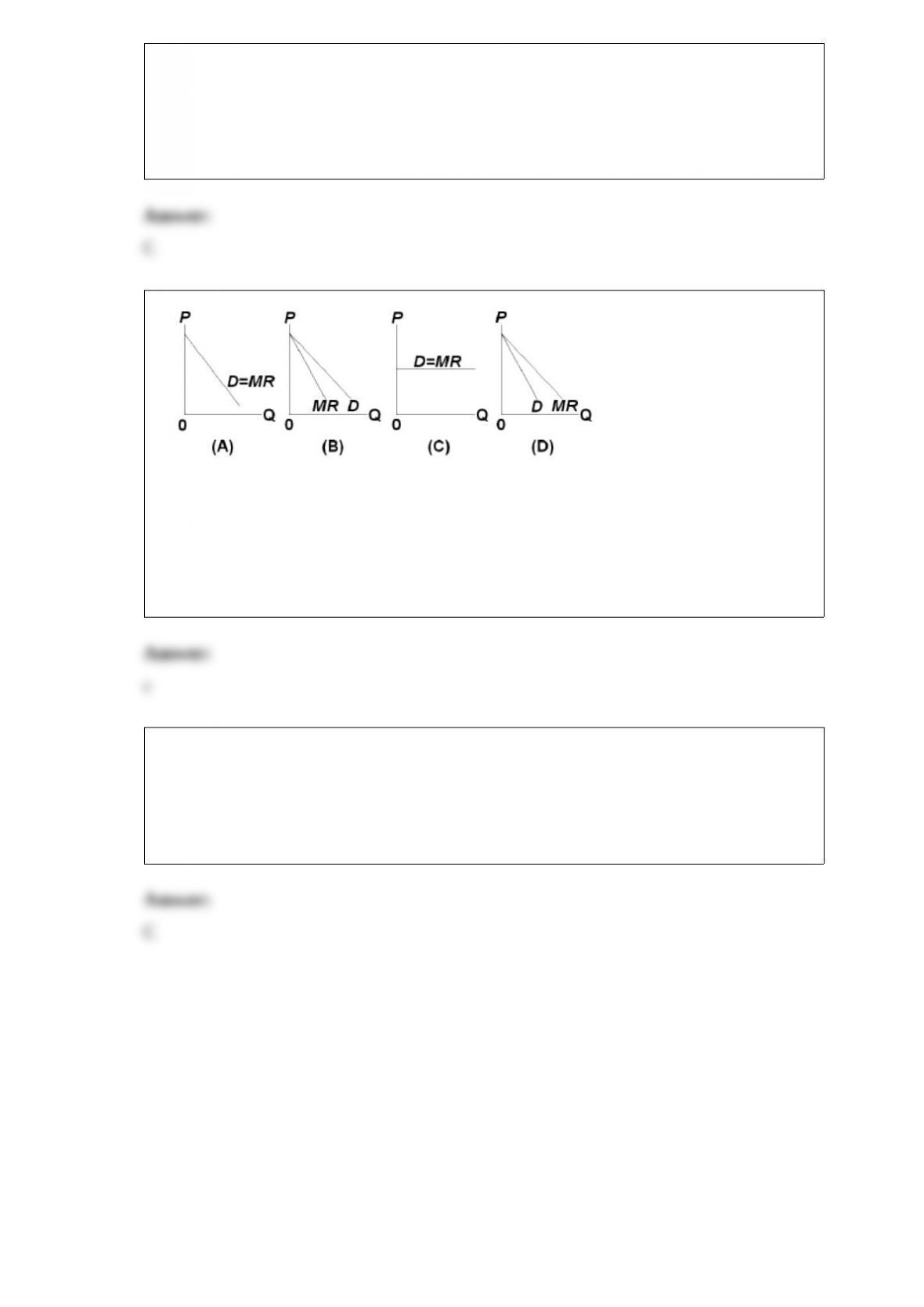
2)
which of the above diagrams correctly portray the demand (d) and marginal revenue
(mr) curves of a purely competitive seller?
a.a
b.b
c.c
d.d
3) Farm share of U.S. GDP has:
A.declined from about 14 percent in 1950 to 1 percent today.
B.declined from about 14 percent in 1950 to 7 percent today.
C.declined from about 7 percent in 1950 to 1 percent today.
D.remained relatively stable over the past fifty years.
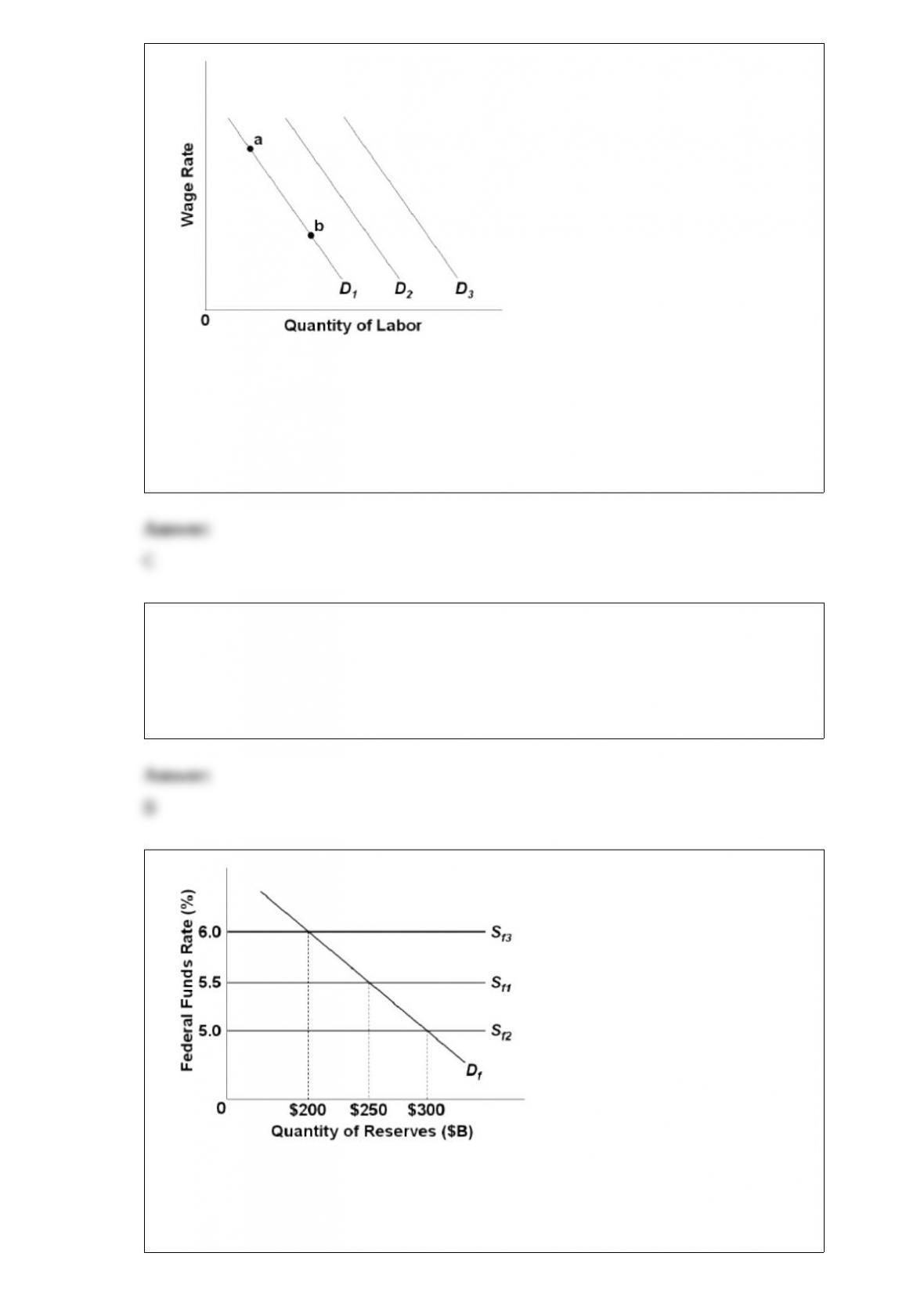
4)
Refer to the above graph. Other things equal, an increase in the price of a
complementary resource would cause a(n):
A.move from a to b on D1.
B.shift from D2 to D3.
C.shift from D3 to D2.
D.move from b to a on D1.
5) Restructuring of a major industry resulted from the:
A.U.S. Steel case.
B.AT&T case.
C.IBM case.
D.DuPont cellophane case.
6)
Refer to the above diagram for the Federal funds market. If the Fed supplies $300
billion in reserves, the equilibrium Federal funds rate is:
A.6.0 percent.
B.5.5 percent.

C.5.0 percent.
D.undeterminable with the information given.
7) debeers consolidated mines markets about:
a.55 percent of the world’s rough-cut diamonds.
b.80 percent of the world’s rough-cut diamonds.
c.45 percent of the world’s rough-cut diamonds.
d.33 percent of the world’s rough-cut diamonds.
8) the dollar votes of consumers ultimately determine the composition of output and the
allocation of resources in a market economy. this statement best describes the concept
of:
a.derived demand.
b.consumer sovereignty.
c.the invisible hand.
d.market failure.
9) the amount of calendar time associated with the long run:
a.is less than that associated with the immediate market period.
b.varies from industry to industry.
c.is the same for all firms.
d.is one year by definition.
10) (last word) which of the following has to do with the idea that generalizations that
apply to individuals are also always valid for a group?
a.the law of large numbers.
b.the law of averages.
c.the fallacy of composition.
d.the post hoc, ergo propter hoc fallacy.
11) The crowding-out effect refers to the possibility that:
A.when used simultaneously, expansionary fiscal and monetary policies are
counterproductive.
B.the asset demand for money varies inversely with the interest rate.
C.deficit financing will increase the interest rate and reduce investment.
D.an increase in the supply of money will result in a decline in velocity.
12) If the MPC in an economy is .75, government could shift the aggregate demand
curve leftward by $60 billion by:
A.reducing government expenditures by $12 billion.
B.reducing government expenditures by $60 billion.
C.increasing taxes by $15 billion.
D.increasing taxes by $20 billion.
13) the basic tax rate on taxable corporate income is:
a.15 percent.
b.22 percent.
c.35 percent.
d.52 percent.
14) Since 2002, the United States has had:
A.large Federal budget surpluses.
B.large Federal budget deficits.
C.modest trade surpluses.
D.a rising natural rate of unemployment.
15) The basis of the following table shows market shares of firms in hypothetical
industries. Assume these are distinct industries with no buyer-seller relationships or
competition among them.
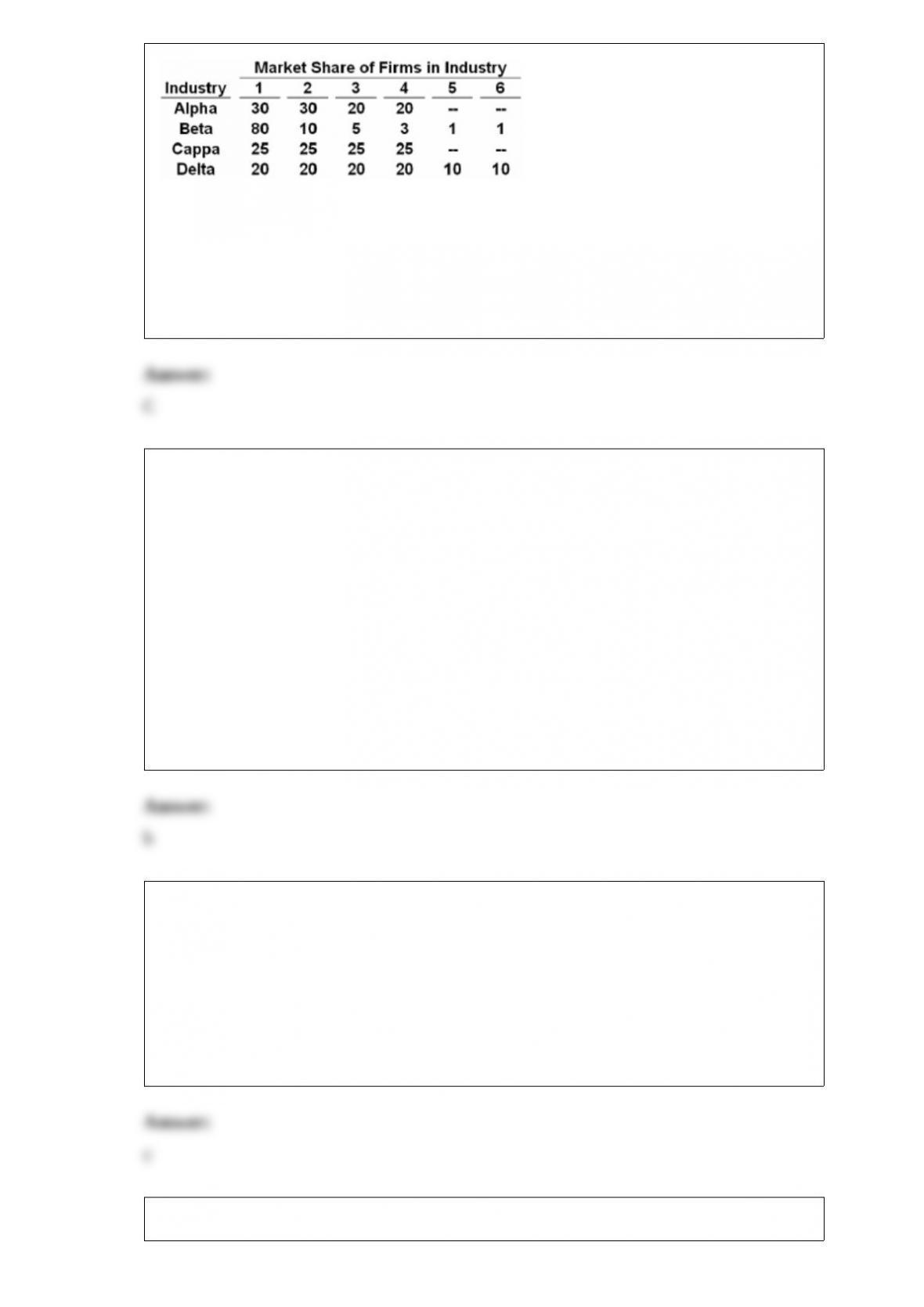
Refer to the above table. A merger between Firm 1 in Alpha and Firm 2 in Delta would
be a:
A.vertical merger.
B.horizontal merger.
C.conglomerate merger.
D.diagonal merger.
16) the following is cost information for the creamy crisp donut company:
entrepreneur’s potential earnings as a salaried worker = $50,000
annual lease on building = $22,000
annual revenue from operations = $380,000
payments to workers = $120,000
utilities (electricity, water, disposal) costs = $8,000
value of entrepreneur’s talent in the next best entrepreneurial activity = $80,000
entrepreneur’s forgone interest on personal funds used to finance the business = $6,000
refer to the above data. if, other things equal, creamy crisp’s revenue fell to $286,000:
a.its implicit costs, including a normal profit, would exceed its explicit costs.
b.it would earn a normal profit but not an economic profit.
c.it would suffer an economic loss.
d.its accounting profit would fall to zero.
17) the “most-favored-nation” clause of reciprocal trade agreements:
a.outlaws tariffs on products for which an exporting nation has a comparative
advantage.
b.singles out a particular nation for exemption from an import quota.
c.means that any tariff reductions the united states negotiates with a specific nation will
automatically apply to many other nations.
d.confers special trade privileges to nations in which the united states has military
bases.
18) Describe the three major units of the Federal Reserve System and their functions.
19) Why does the marginal resource cost exceed the wage rate in the case of a
monopsonistic firm? Explain and illustrate with an example.
20) What are some of the theories that economists have developed as to why business
cycles occur?
21) At the present time Social Security beneficiaries are limited in the amount of
income they can earn and still receive full benefits. Should this limitation be abolished?
Justify your answer.
22) How does the fact that asset prices and expected rates of return are inversely related
cause asset risk and expected rates of return to be positively related?
23) What are some examples of the four different market structures?
24) Why cant the substitution and income effects be used to explain the downward
slope of the aggregate demand curve?