1) The crowding-out effect of expansionary fiscal policy suggests that:
A.tax increases are paid primarily out of saving and therefore are not an effective fiscal
device.
B.increases in government spending financed through borrowing will increase the
interest rate and thereby reduce investment.
C.it is very difficult to have excessive aggregate spending in the U.S. economy.
D.consumer and investment spending always vary inversely.
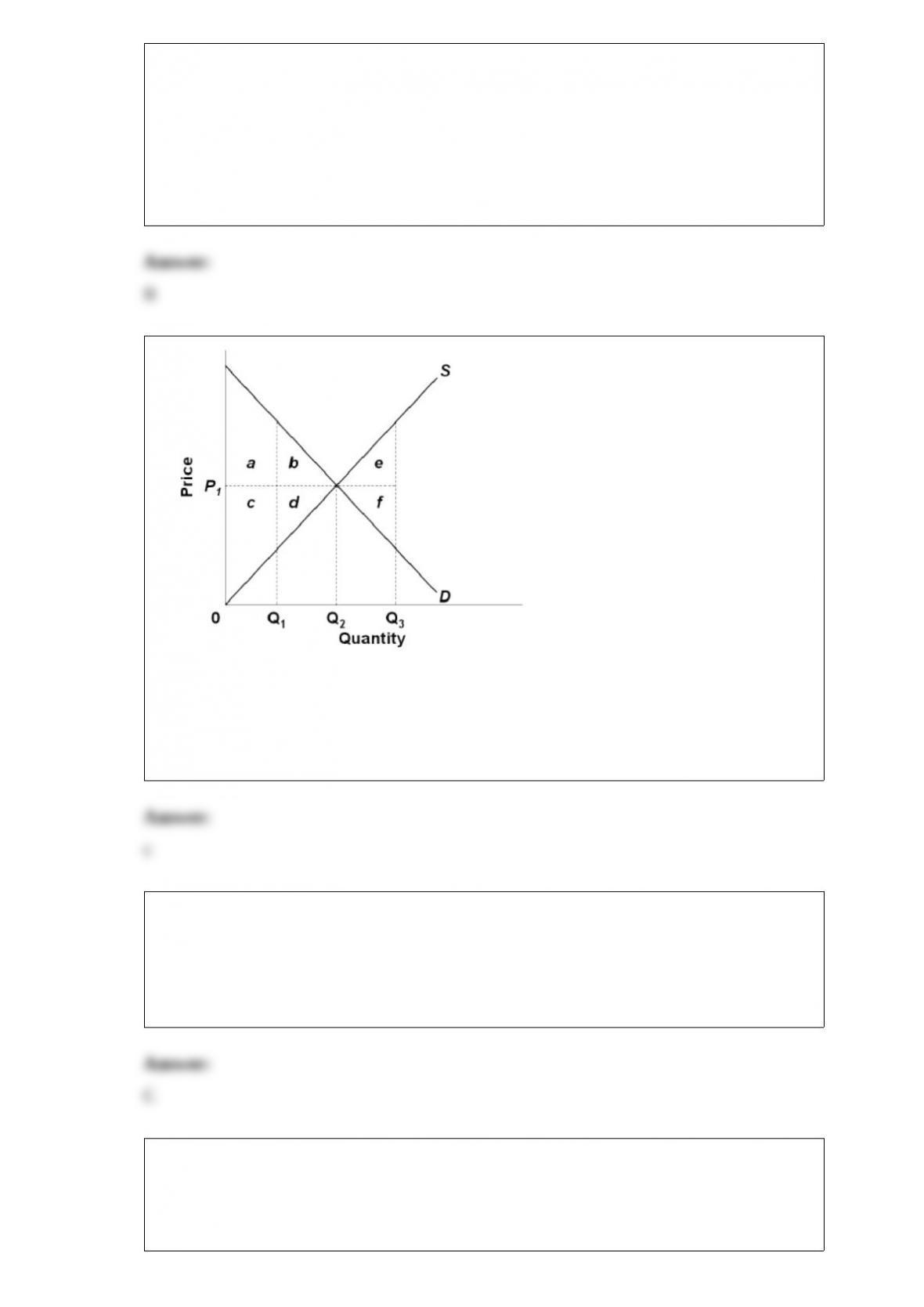
2)
refer to the above diagram. if actual production and consumption occur at q1:
a.efficiency is achieved.
b.consumer surplus is maximized.
c.an efficiency loss (or deadweight loss) of b + d occurs.
d.an efficiency loss (or deadweight loss) of e + d occurs.
3) The “brain drain” problem in the DVCs refers to the fact the best-educated workers:
A.are reluctant to become entrepreneurs.
B.are concentrated in rural areas where their skills are underutilized.
C.often emigrate to industrialized countries.
D.are reluctant to work in the public sector.
4) there is some evidence to suggest that x-inefficiency is:
a.absent whenever two or more producers are competing with one another.
b.not encountered in either competitive or monopolistic firms.
c.more likely to occur in monopolistic firms than in competitive firms.

d.more likely to occur in competitive firms than in monopolistic firms.
5) with respect to local finance:
a.death and gift taxes are the major source of revenue and most expenditures are for
hospitals and health services.
b.the corporate income tax is the major source of revenue and natural resource
development the major type of expenditure.
c.property taxes are the basic source of revenue and education is the major type of
expenditure.
d.sales and excise taxes are the major source of revenue and highway construction and
maintenance is the major type of expenditure.
6) as a percentage of gdp, health care spending in the united states has:
a.decreased substantially since 1960.
b.increased slightly since 1960.
c.increased substantially since 1960.
d.remained relatively constant since 1960.
7) Complete the following table assuming that (a) MPS = 1/5, (b) there is no
government and all saving is personal saving.
8) if real gdp rises and the gdp price index has increased:
a.the percentage increase in nominal gdp must have been less than the percentage
increase in the price level.
b.nominal gdp may have either increased or decreased.
c.nominal gdp must have increased.
d. nominal gdp must have fallen.

9) An increase in taxes will have a greater effect on the equilibrium GDP:
A.if the tax revenues are redistributed through transfer payments.
B.the larger the MPS.
C.the smaller the MPC.
D.the larger the MPC.
10) allocative efficiency involves determining:
a.which output-mix will result in the most rapid rate of economic growth.
b.which production possibilities curve reflects the lowest opportunity costs.
c.the mix of output that will maximize society’s satisfaction.
d.the optimal rate of technological progress.
11) United States exports of goods and services (on a national income account basis)
are about:
A.20 percent of U.S. GDP.
B.4 percent of U.S. GDP.
C.28 percent of U.S. GDP.
D.12 percent of U.S. GDP.
12) in an economy experiencing a declining production capacity:
a.the nation’s stock of capital goods is expanding.
b.net exports are necessarily zero.
c.depreciation exceeds gross investment.
d.ndp exceeds gdp.
13) Which of the following is characteristic of a regulated natural monopoly?
A.extensive economies of scale
B.the wasteful duplication of capital facilities in the event of competition
C.the provision of an essential service
D.all of these
14) Which attitude or custom is the most conducive to long-term economic growth?
A.focus on group contentment rather than individual achievement
B.the belief there is little or no correlation between an individual’s economic actions
and her or his economic fortunes
C.direct connections between individual efforts (including educational efforts) and
economic rewards
D.use of the majority of resources for religious structures and ceremonies
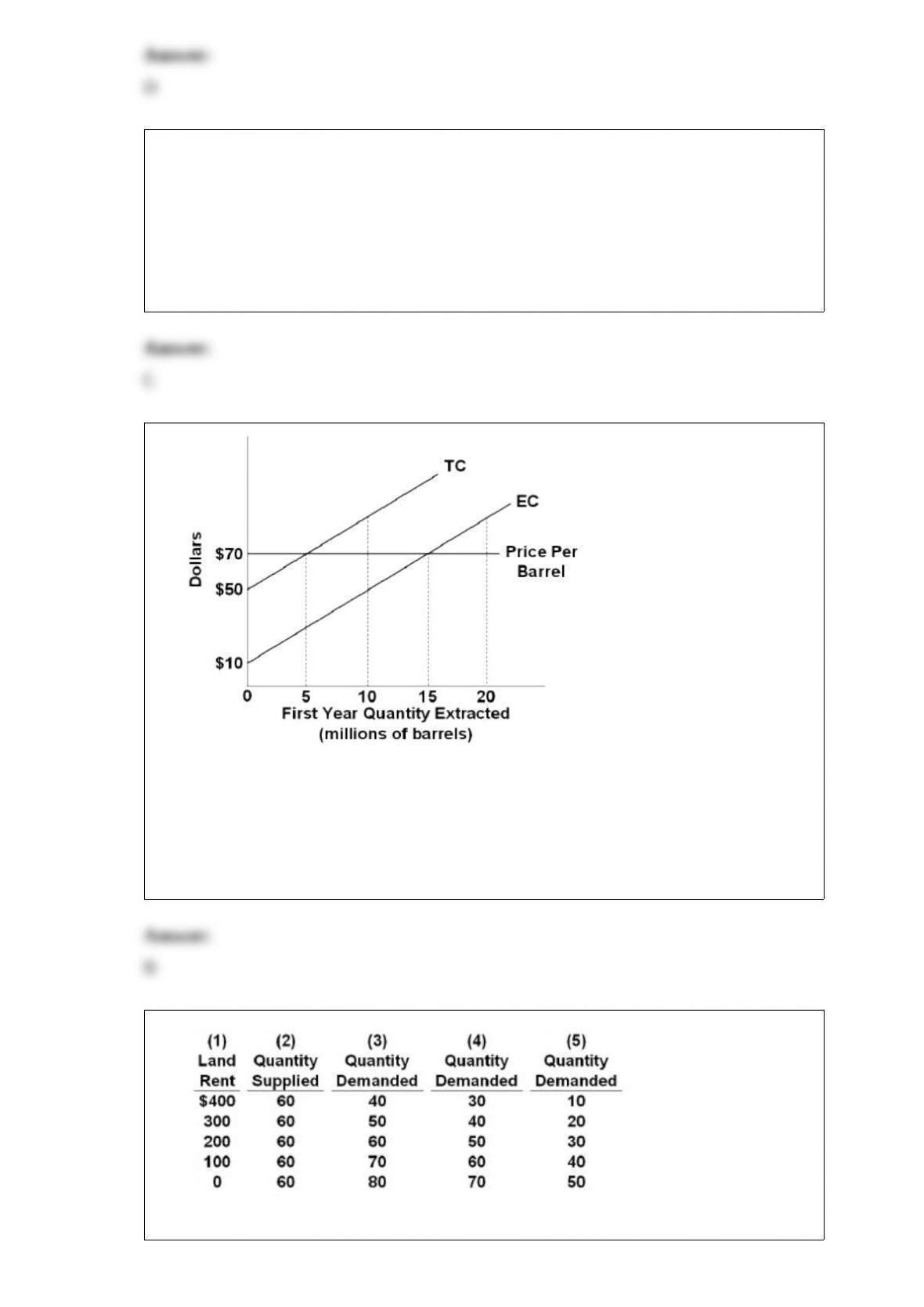
15)
Refer to the diagram above, representing Slippery Slope Oil Company. What is the user
cost of extracting a barrel of oil this year?
A.$20.
B.$40.
C.$50.
D.$70.
16)
Refer to the above table, in which the values for columns (2) through (5) are in acres. If

the relevant columns are (1), (2), and (5), land rent will be:
A.$0 per acre.
B.$100 per acre.
C.$200 per acre.
D.$300 per acre.
17) The productivity and real wages of workers in the industrially advanced economies
have risen historically partly because:
A.workers have acquired less education and training over time.
B.workers have been able to use larger quantities of capital equipment.
C.over time the capital equipment used by workers has deteriorated in quality.
D.the supply of labor has increased.
18) In 1994, the world’s trading nations agreed to:
A.increase export subsidies to reduce world surpluses of farm products.
B.reduce agricultural subsidies and tariffs on agricultural imports.
C.eliminate all price supports for farm products.
D.create an international farm price support system to replace the price support systems
of individual countries.
19) Which of the following is a feature of farm policy present in the Food,
Conservation, and Energy Act of 2008, that was not part of the Freedom to Farm Act of
1996?
A.direct payments (direct subsidies) based on crops currently grown
B.countercyclical payments
C.farm buyouts by government
D.acreage allotments (restrictions on planting)