1) Changes in the discount rate are:
A.the most powerful and useful tool of monetary policy.
B.less frequent than changes in the reserve requirement.
C.more important than open-market operations.
D.less important than open-market operations in implementing monetary policy.
2) a one-firm industry is known as:
a.monopolistic competition.
b.oligopoly.
c.pure monopoly.
d.pure competition.
3) Over recent years, economists holding monetarist views have replaced their call for a
monetary rule with a call for:
A.artful Fed management of interest rates.
B.inflation targeting.
C.nominal GDP targeting.
D.inflationary and recessionary gap analysis.
4) Consider the following situations and determine whether they exhibit simultaneous
consumption, network effects, x-inefficiency or rent-seeking behavior. Assume the
businesses referenced function as monopolies.
(a)A pharmaceutical company discovers a vaccine for the common cold. The company
puts a significant effort into tests to get it FDA-approved and into hiring lawyers to
obtain a patent.
(b)An Internet service provider adds thousands of new customers.
(c)The head of a family-owned, major hotel chain decides to hire his wild, socialite
niece to work as an executive of the company after her reality TV career ends.
(d)An online profile company helps college and high school students from across the
country to connect with each other.
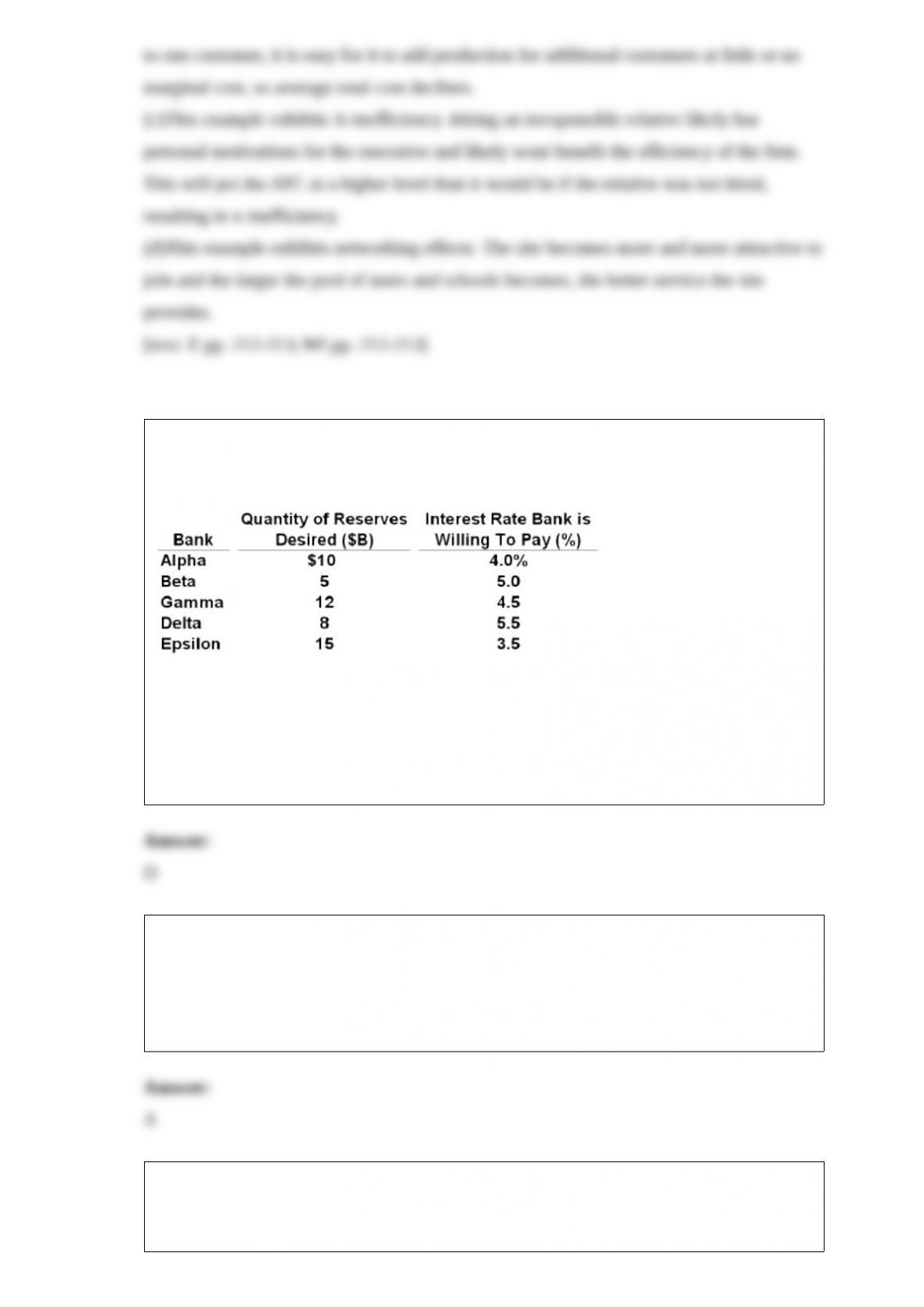
5) The following information: The Fed is going to auction $30 billion in reserves using
the term auction facility. It receives the following bids:
Refer to the above information. As a result of the auction, how much and at what
interest rate will Gamma bank borrow?
A.$7 billion; 4.5 percent
B.$5 billion; 4.5 percent
C.$12 billion; 4.5 percent
D.$12 billion; 4 percent
6) Which of the following is not a social insurance program?
A.TANF
B.Medicaid
C.Supplemental Security Income
D.unemployment compensation
7) a college graduate using the summer following graduation to search for a job would
best be classified as:
a.not officially a member of the labor force.
b.a part of structural unemployment.
c.a part of cyclical unemployment.
d.a part of frictional unemployment.
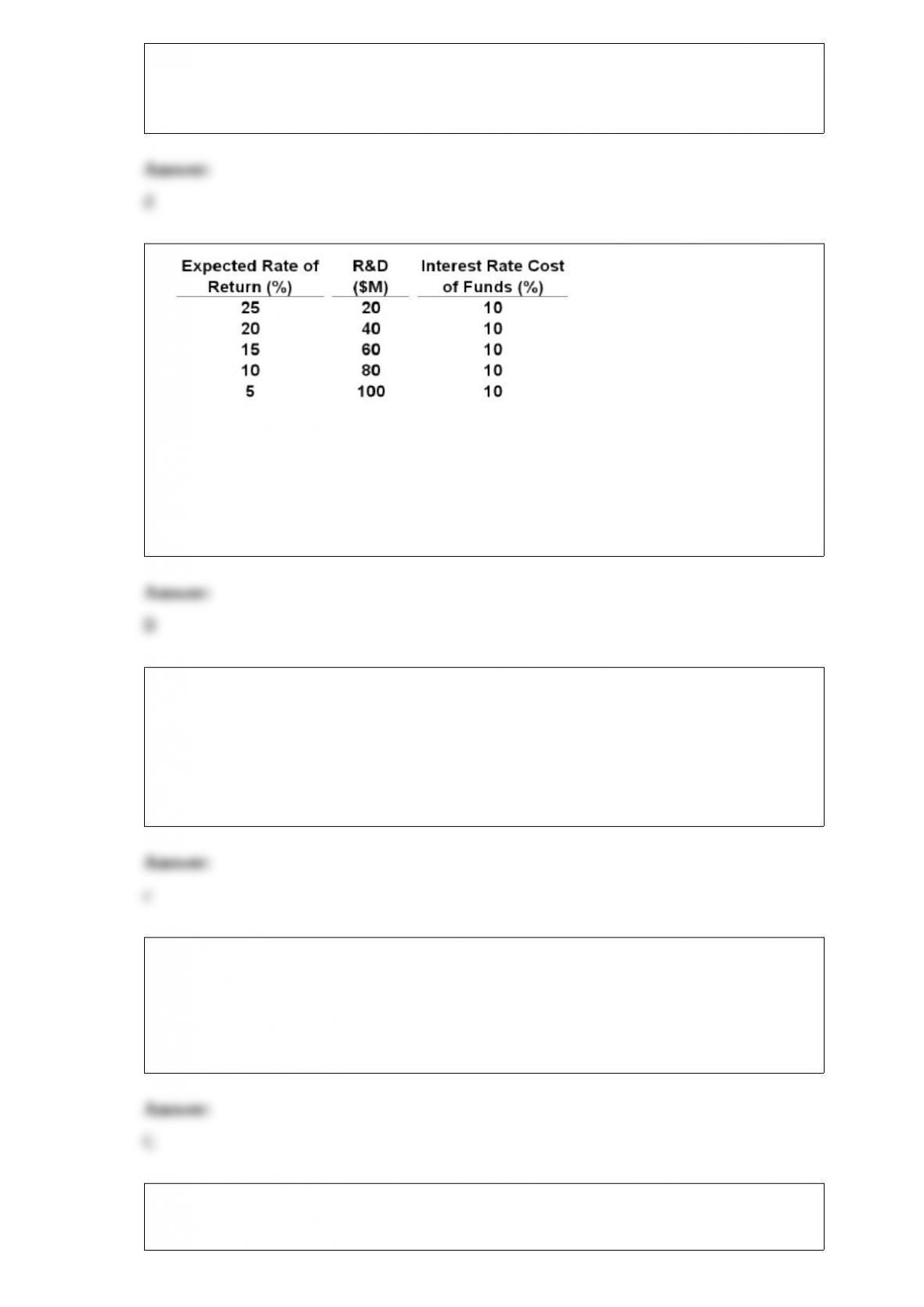
8)
If we plotted the above data on a graph with R&D expenditures on the horizontal axis,
the:
A.interest-rate-cost-of-funds-curve would be a vertical line.
B.interest-rate-cost-of-funds-curve would be horizontal line.
C.expected-rate-of-return-curve would slope upward.
D.expected-rate-of-return-curve would be a horizontal line.
9) mary says, “you would have to pay me $50 to attend that pro wrestling event.” for
mary, the marginal utility of the event is:
a.zero.
b.positive, but declines rapidly.
c.negative.
d.positive, but less than the ticket price.
10) All but which one of the following are cash transfer programs?
A.TANF
B.Supplemental Security Income (SSI)
C.low-rent public housing
D.Social Security
11) In a sporting good store, you can buy the equipment you want and forgo the rest.
But in an election you “buy” the entire range of the candidate’s positions, including

some you may not agree with. This difference:
A.reflects limited and bundled choices in the public sector.
B.describes the paradox of voting.
C.describes the principal-agent problem in the public sector.
D.creates bureaucratic inefficiency in the public sector.