1) Commercial banks increase the supply of money when they purchase either personal
IOU’s or government bonds from businesses and households.
2) Because families can afford to have more children, population growth is greater in
the IACs than in the DVCs.
3) the wants of consumers are expressed in the product market with “dollar votes”.
4) an increase in demand accompanied by an increase in supply will increase the
equilibrium quantity but the effect on equilibrium price will be indeterminate.
5) growth of real gdp in the united states has averaged slightly more than 5 percent
annually since 1950.
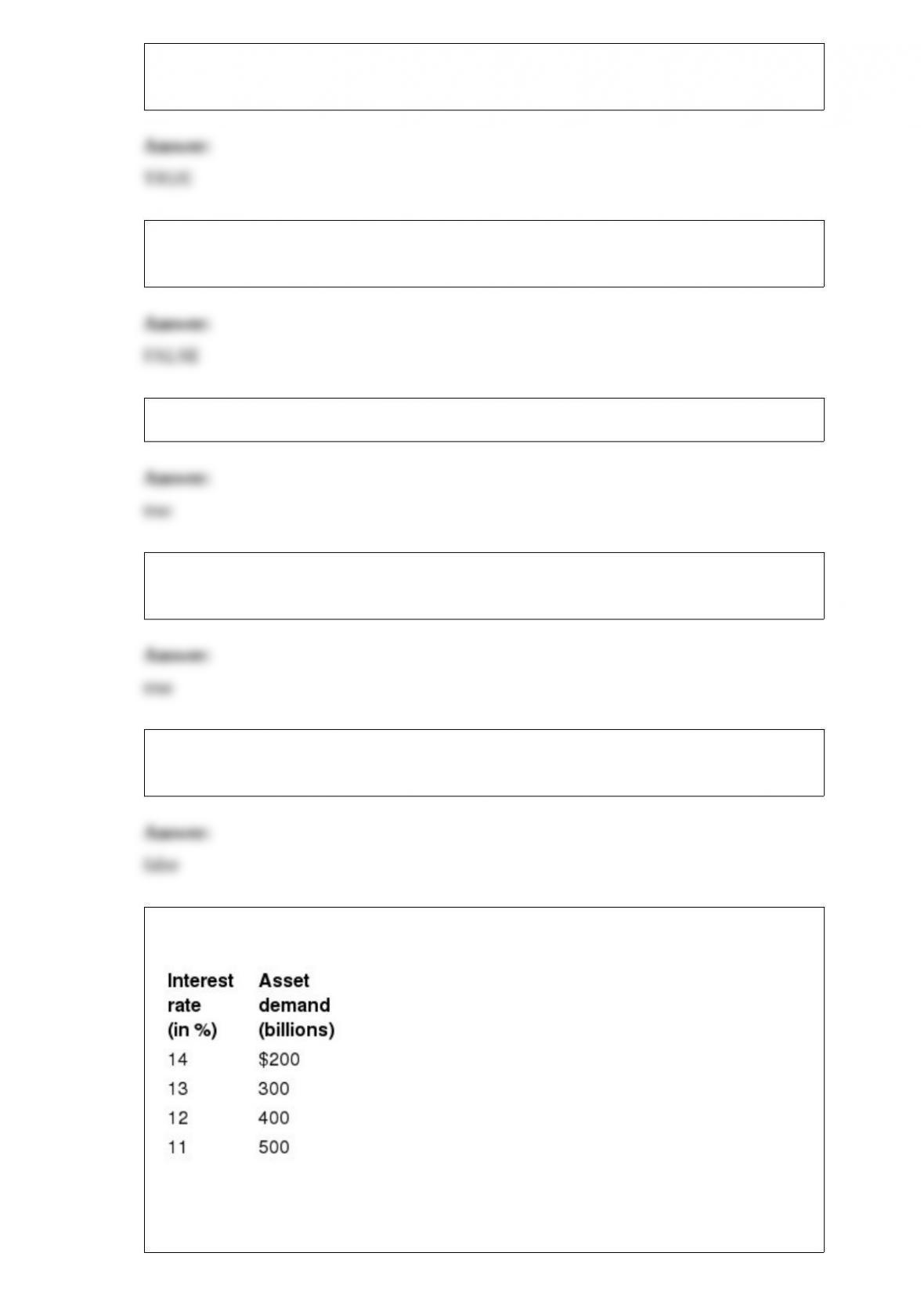
6) Use the table below to answer the questions:
(a)If the transactions demand for money equals 10% of nominal GDP, the nominal GDP
is $5000 billion, and the supply of money is $900 billion, what is the equilibrium
interest rate?
(b)If nominal GDP remains constant, and the money supply is decreased from $900 to
$800 billion, what will the equilibrium rate of interest be?
7) Which of the following is considered a non-renewable natural resource?
A.wind.
B.timber.
C.oceans.
D.tin.
8) A firm that is hiring labor in a purely competitive labor market and selling its product
in a purely competitive product market will maximize its profit by hiring labor until:
A.marginal revenue product is zero.
B.marginal revenue product exceeds marginal resource (labor) cost by the greatest
amount.
C.marginal resource cost is zero.
D.marginal revenue product equals marginal resource (labor) cost.
9) Under a gold standard a balance of payments disequilibrium would be corrected
automatically by:
A.the depreciation of that country’s currency.
B.an increase in the gold content of that nation’s monetary unit.
C.the appreciation of that country’s currency.
D.an outflow or inflow of gold.
10) answer the next question(s) on the basis of the following information: only three
goods are produced in an economy in the following amounts: a = 10, b = 30, c = 5. the
current year per unit prices of these three goods are a = $2, b = $3, and c = $1.
refer to the above information. nominal gdp in the current year is:
a.$110.
b.$115.
c.$45.
d.$90.
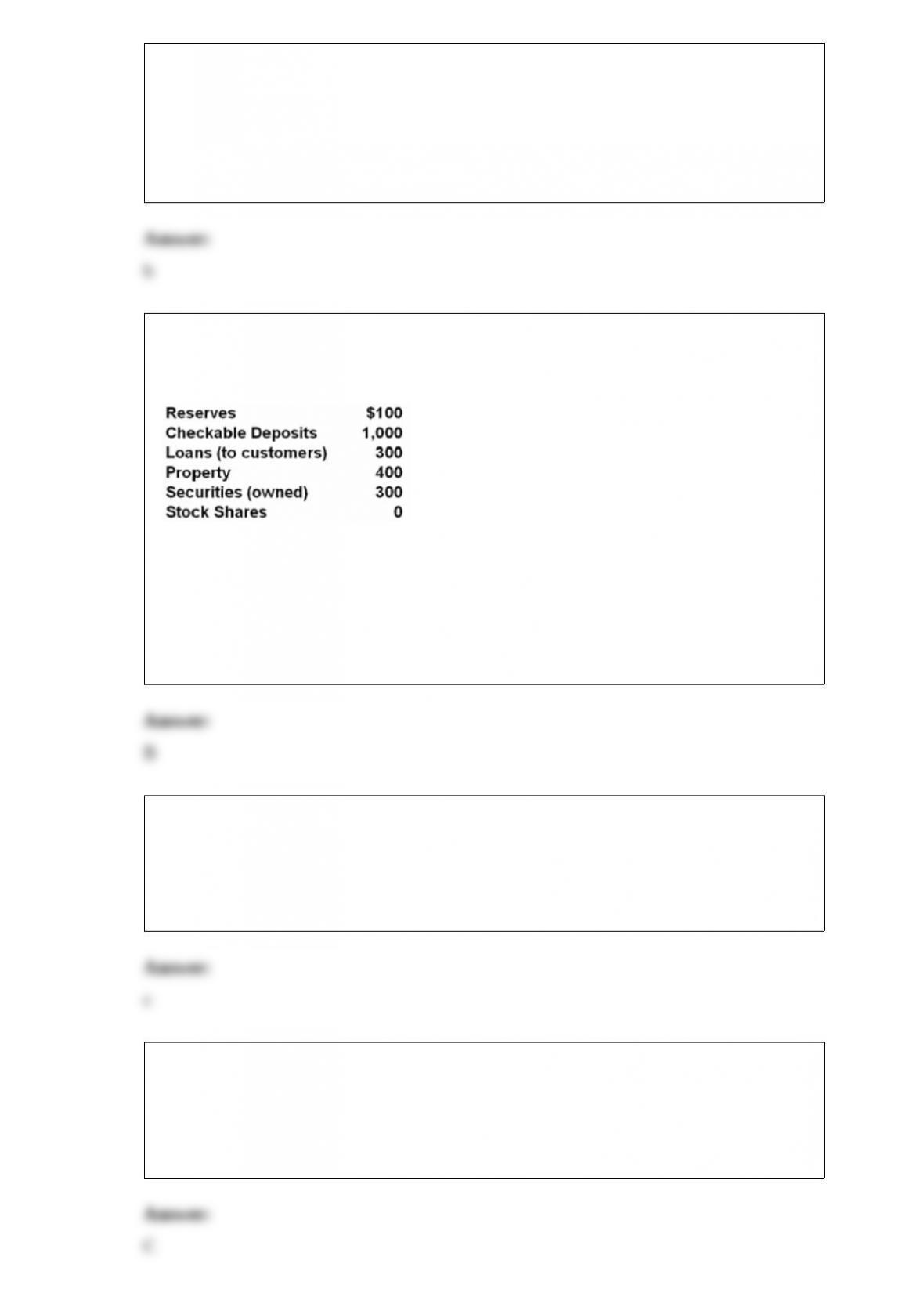
11) The following information for the Moolah Bank.
Refer to the above information and assumed that Moolah bank is “loaned up.” If it
receives a $100 deposit of currency, it could safely expand its loans by:
A.$100.
B.$90.
C.$900.
D.$1000.
12) in national income accounting, consumption expenditures include:
a.purchases of both new and used consumer goods.
b.consumer durable goods and consumer nondurable goods, but not services.
c.consumer durable goods, consumer nondurable goods, and services.
d.changes in business inventories.
13) A firm is likely to be a natural monopoly:
A.when the demand for its product or service is inelastic.
B.if it is producing an inferior good.
C.if economies of scale are experienced over the full range of output.
D.because government grants it an exclusive franchise.
14)
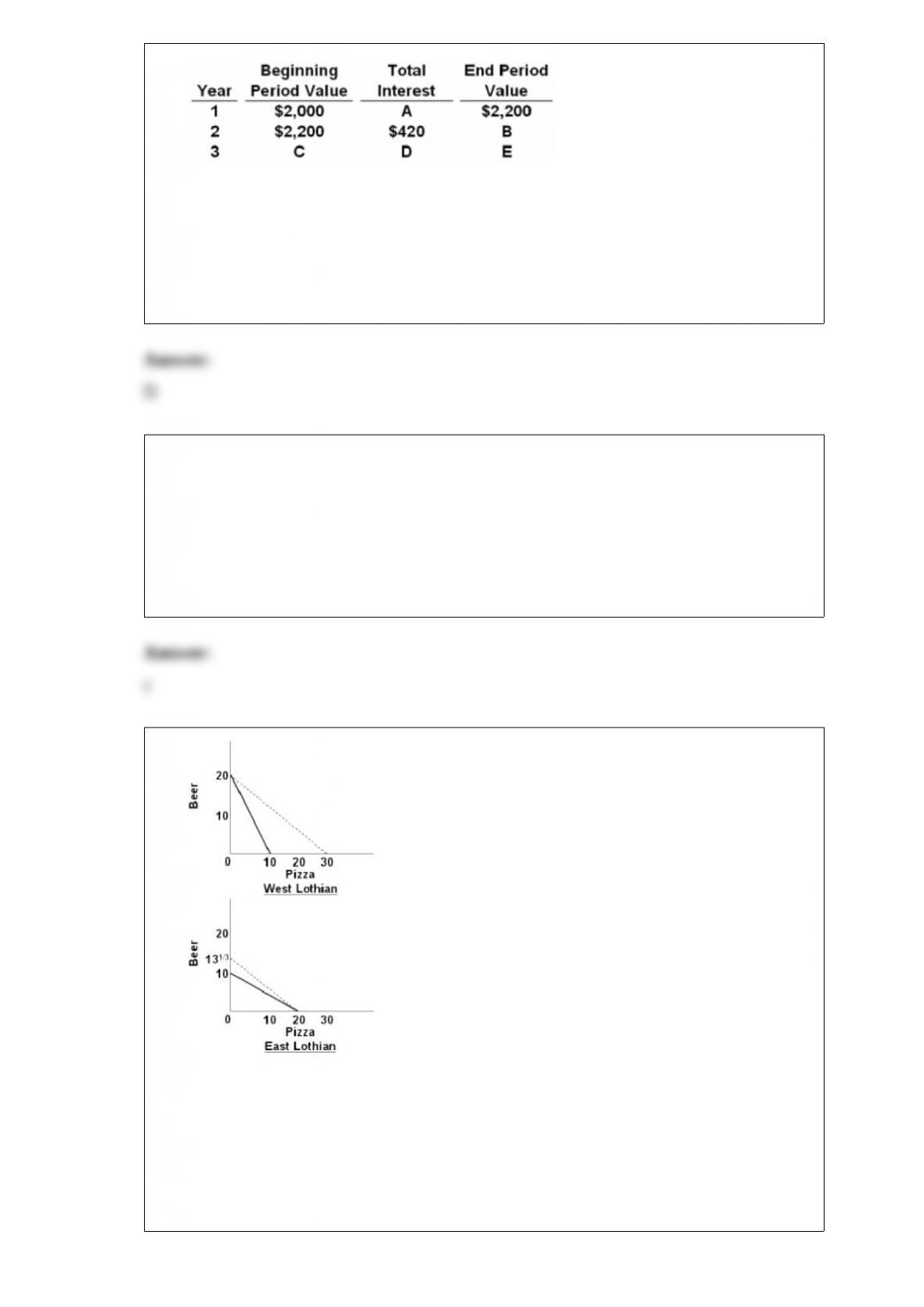
Refer to the above table representing Kara’s bank account. Assuming that $2000 was
deposited into her account at the beginning of year 1, the value for cell A is:
A.$10.
B.$20.
C.$100.
D.$200.
15) suppose the total monetary value of all final goods and services produced in a
particular country in 2008 is $500 billion and the total monetary value of final goods
and services sold is $450 billion. we can conclude that:
a.gdp in 2008 is $450 billion.
b.ndp in 2008 is $450 billion.
c.gdp in 2008 is $500 billion.
d.inventories in 2008 fell by $50 billion.
16)
Refer to the above diagrams. The solid lines are production possibilities curves; the
dashed lines are trading possibilities curves. The data contained in the production
possibilities curves are based on the assumption of:
A.imperfect shiftability of resources between beer and pizza production.
B.constant costs.
C.decreasing costs.
D.increasing costs.
17) fixed costs are associated with:
a.highly adjustable inputs such as labor.
b.both the short run and the long run.
c.the short run only.
d.the long run only.
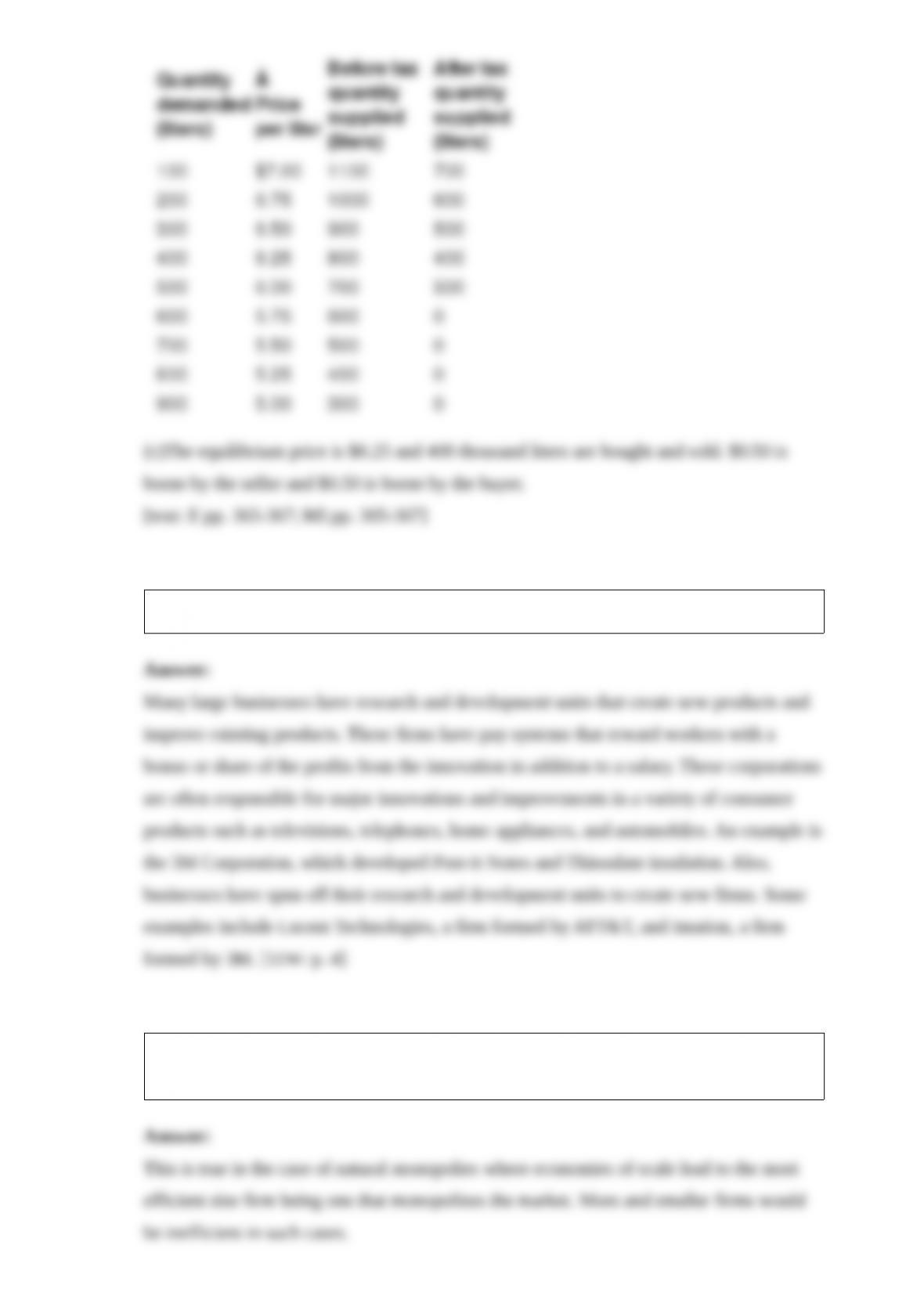
18) In the table below are the demand and supply schedules for rum in thousands of
liters in a state.
(a)What is the equilibrium price and quantity before a tax is imposed?
(b)If state government now imposes an excise tax of $1.00 per liter of rum, what is the
after-tax supply schedule?
(c)What is the equilibrium price of rum after the tax is imposed? How much of the
$1.00 is borne by the buyer and how much by the seller?
19) Is innovation within existing firms important? Explain and give examples.
20) Monopoly has developed in both product and resource markets because of the
shortcomings and inefficiencies of competitive markets. Do you agree? Explain.
21) Explain the reasoning behind why employment could increase for domestic-born
workers if immigrant workers become complementary resources rather than substitute
resources.
22) Evaluate the statement: Tariffs and quotas are needed to protect American products
from dumping.
23) How is a commercial bank different from a savings and loan association?
24) Explain what is needed for optimal harvesting of a forest. How do changes in
economic incentives and structures affect present and future decisions?
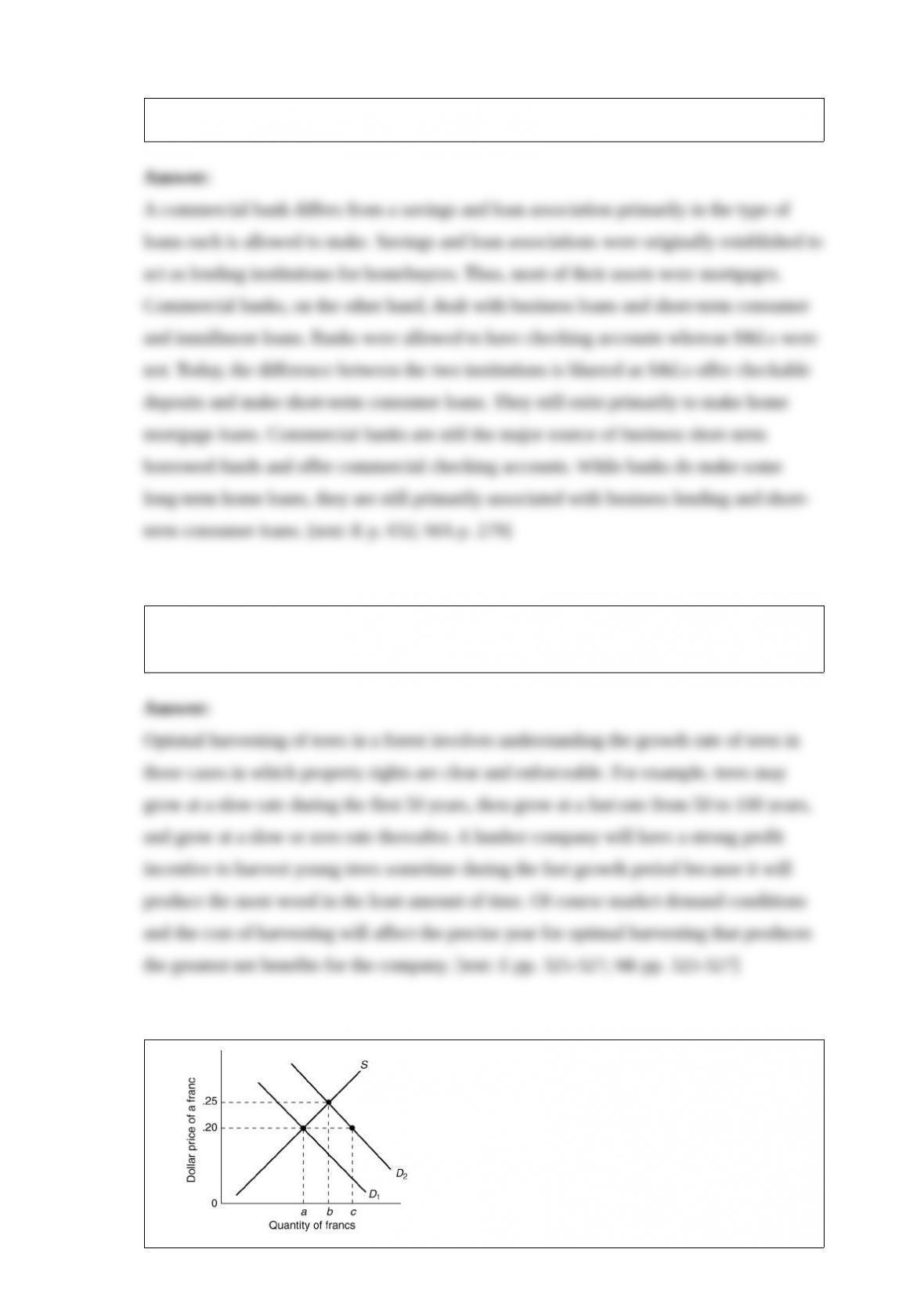
25)

The graph below shows a change in the demand for Swiss francs from D1 to D2. What
would happen when D1 shifted to D2 under a flexible exchange rate system compared
to a fixed exchange rate system?