
Using monetary policy to help eliminate an inflationary gap
a. shifts the aggregate supply curve to the right.
b. is ineffective if the short-run aggregate supply curve is very steep.
c. leads to an increase in unemployment, at least temporarily.
d. produces a permanent increase in the price level.
e. is futile unless fiscal policy simultaneously creates a budget surplus.
The idea that when citizens vote for an elected official they vote for a bundle of
inseparable political programs is known as
a. the benefit principle.
b. bureaucratic inefficiency.
c. the equity principle.
d. nonselectivity.
e. patronage.
The greatest source of federal government tax receipts is the ________ tax.

a. personal income
b. corporate income
c. estate and gift
d. general sales
e. property
The Council of Economic Advisers
a. was established to help the president carry out the objectives of the Employment Act
of 1946.
b. was established by President Kennedy to promote fiscal policy.
c. is directly responsible to the House Ways and Means Committee.
d. was made an integral part of the policy-making process under the leadership of John
Maynard Keynes.
e. has consistently urged balanced budgets.
Two important determinants of the rate of interest charged to borrowers are the
riskiness of the loan and the

a. capital budget.
b. liquidity index.
c. cost of bookkeeping and collection.
d. level of roundaboutness.
e. profit share.
Fiat money is any money that
a. exists in the form of coin or currency.
b. is issued by the Federal Reserve.
c. has a greater face value than its purchasing power.
d. is money because the government says so and the people accept it.
e. earns interest when deposited in banks.
According to the new classical macroeconomists, the gap between actual and potential
output is a result of
a. perfectly inflexible wages and prices.

b. a horizontal short-run aggregate supply curve.
c. the inability to accurately estimate depreciation when measuring national output.
d. anticipated changes in the money supply.
e. random forecasting errors.
According to the video, which of the following is the best assessment of the overall
value of GNP measure?
a. Despite its statistical base, GNP is now considered an outmoded measure of
productivity.
b. GNP is a highly accurate, remarkably precise measure of human welfare.
c. GNP is of interest to economists but offers no useful information to consumers or
business people.
d. GNP is a universally useful estimate of our nation’s productivity.
e. GNP is useful as a measure of annual output but not helpful in measuring economic
growth over an extended period of time.
Milton Friedman and his followers propose that the
a. Fed be given powers over tax rates.

b. functions of the Fed be taken over by the Council of Economic Advisers.
c. Fed conform to a rule specifying a fixed, agreed-upon rate of growth in the money
supply.
d. Fed be directly responsible to the Joint Economic Committee of Congress.
e. Fed be given powers to control wages and prices.
For a market to exist, there must be
a. buyers and sellers.
b. a building such as a retail store.
c. third parties such as brokers and agents.
d. perfect information.
e. government oversight.
Say’s law
a. states that the total amount paid out for resources must equal the value of the goods
produced.
b. states that all income spent must have been earned.
c. is the intellectual basis for the Keynesian model of income and employment.
d. is an integral part of the Marxian analysis of capitalism.
e. requires the assumption of wage and price rigidity.
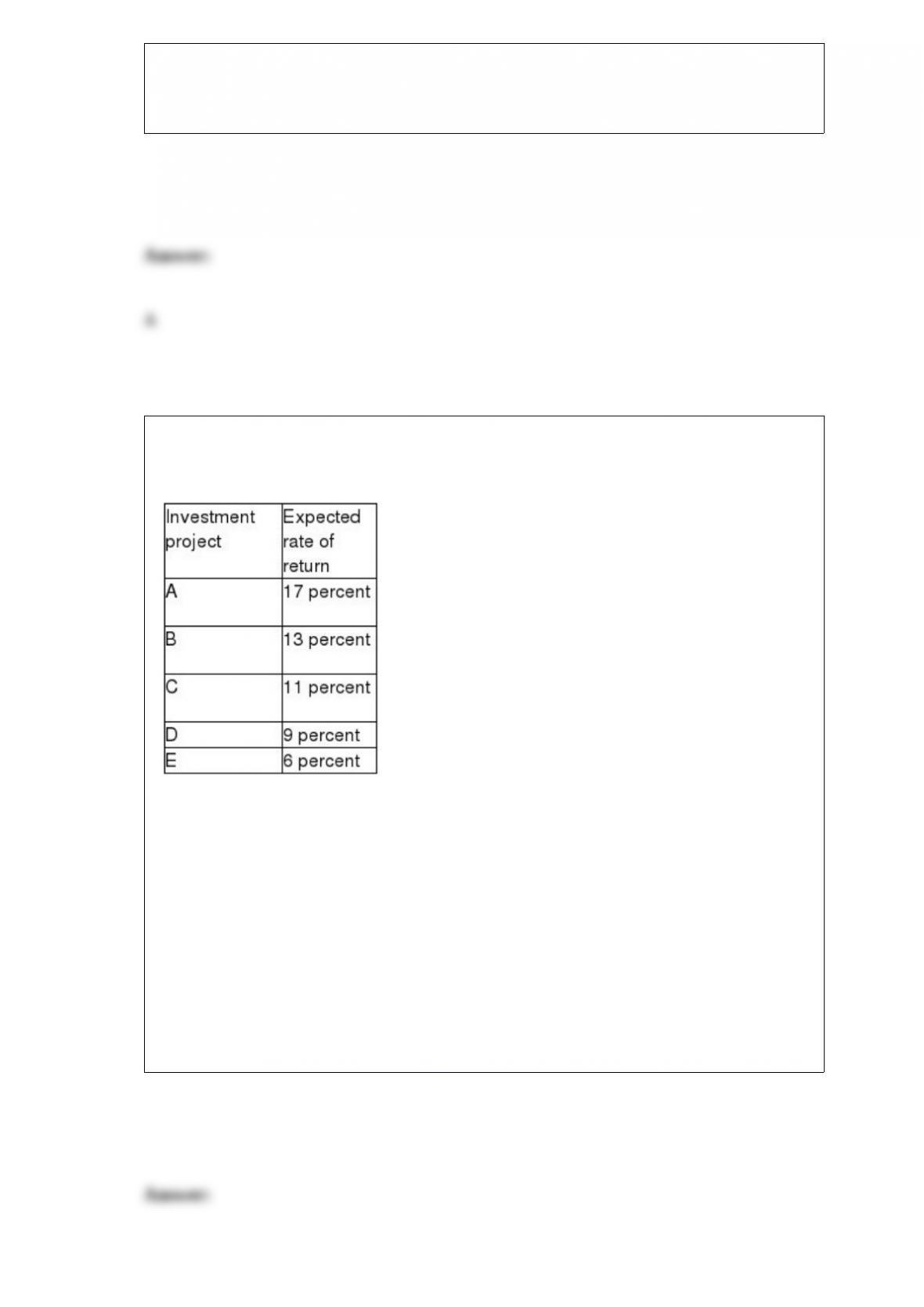
The following questions are based on the following rates-of-return table for five
independent investment projects:
If the interest rate is 7 percent, the number of projects undertaken would be
a. 1.
b. 2.
c. 3.
d. 4.
e. 5.
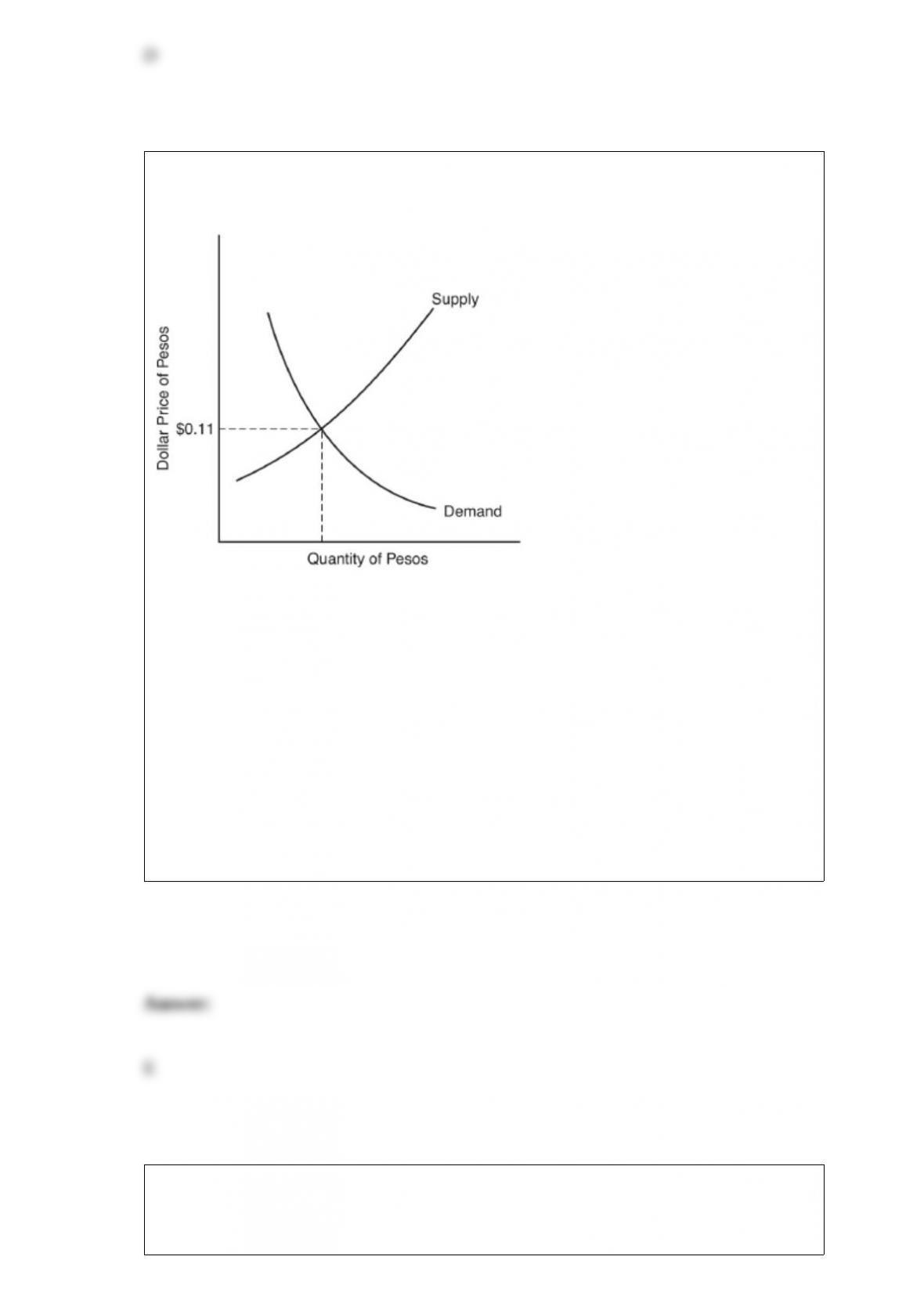
The following questions are based on the following graph, showing the market for
pesos. Mexico and the United States are engaged in a system of flexible exchange rates.
If people in Mexico decide to purchase shares of stock on the U.S. stock exchange, the
exchange rate (in terms of the dollar to the peso)
a. rises because demand increases.
b. falls because demand increases.
c. falls because demand decreases.
d. rises because demand decreases.
e. falls because supply increases.
The next question is based on the following table:
Wage Increases in First, Second, and Third Years of Union Contracts, United States,
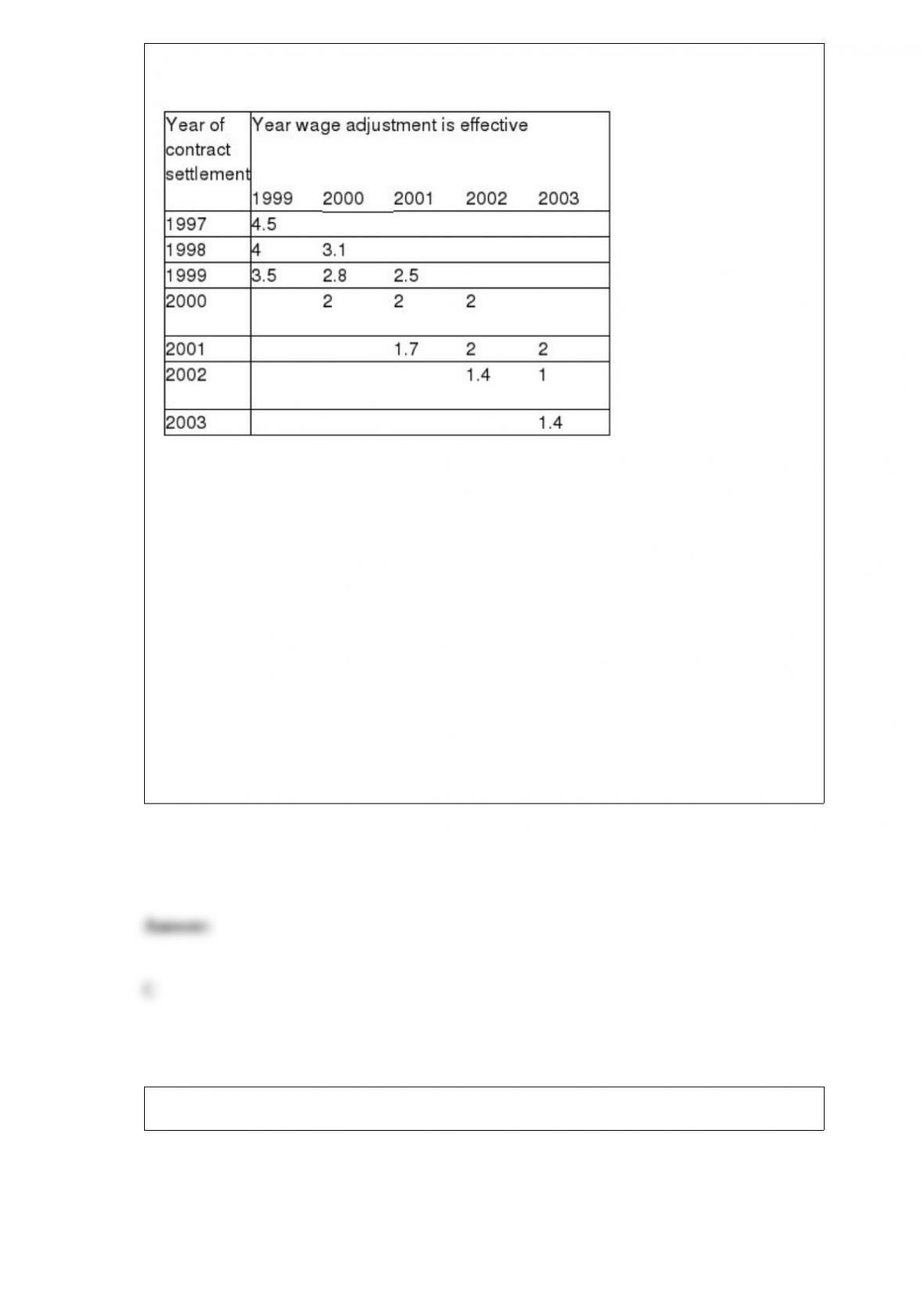
1997″2003
What can be said on the basis of the union contract settlement data shown?
a. Unions are becoming much more powerful in their ability to negotiate wage
increases.
b. Price levels in the country are rising rapidly.
c. The most recently negotiated wage increase for a given year is below the average
increase prevailing under continuing contracts for that year.
d. Wage rates adjust immediately throughout the economy in response to changing labor
market conditions.
e. Labor markets are tight, so firms are increasing employment.
Refer to the following graphs for the following questions.
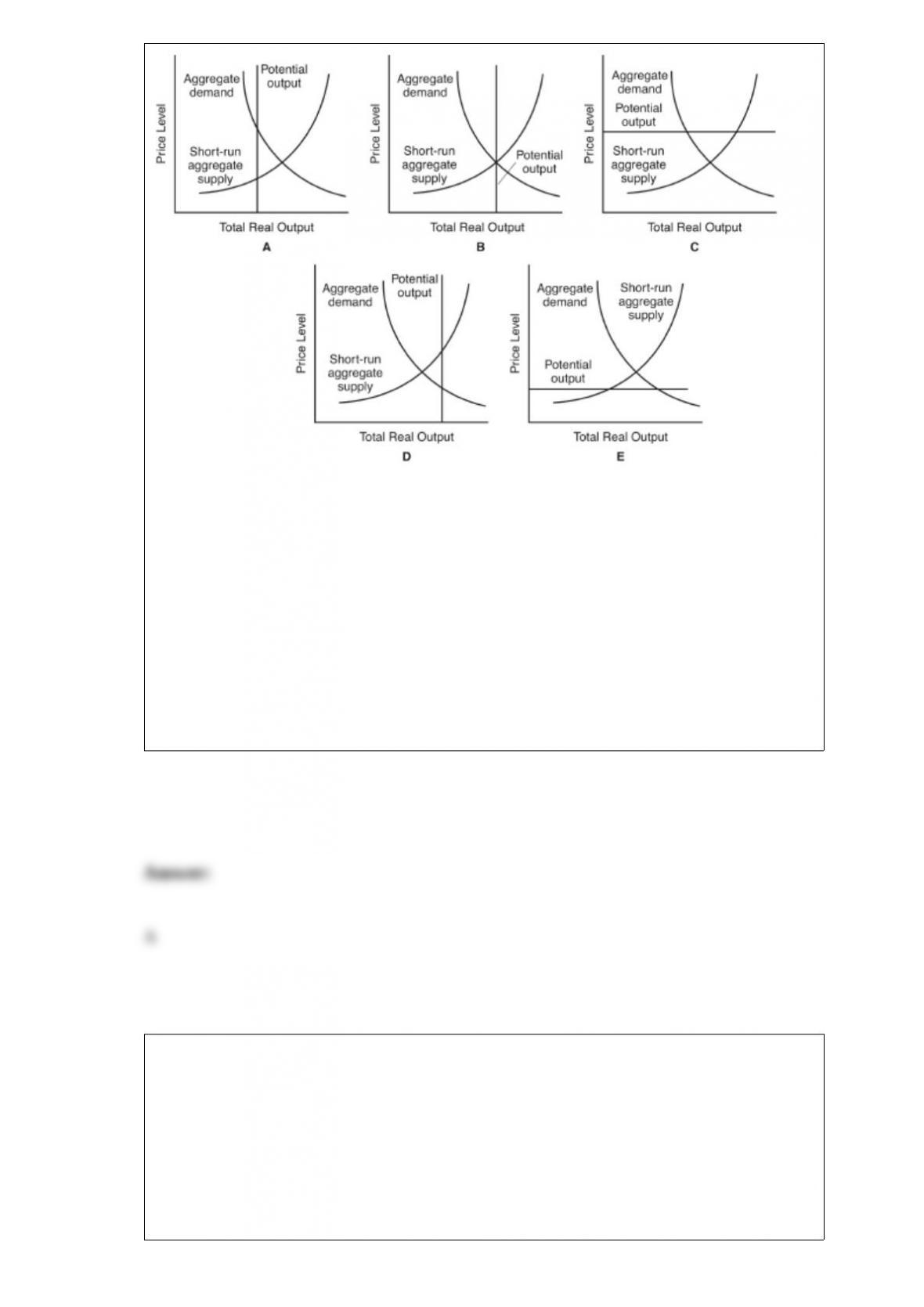
Which of the diagrams best reflects the existence of an inflationary gap?
a. A
b. B
c. C
d. D
e. E
The law of diminishing marginal returns
a. requires that all inputs be varied proportionately.
b. states that as an input is increased (all other inputs held constant), total output falls
after some point.
c. is relevant only when there is significant unemployment in the economy.

d. states that if more and more of a resource is used (the quantities of other resources
being held constant), after some point, the average, marginal, and total products all
become equal.
e. states that as a variable input is increased (with other inputs remaining constant),
beyond some point the marginal product of the variable input falls.
In an open economy, if government expenditures, tax receipts, and exports are the same
at all levels of GDP, the multiplier effect of a $1 increase in intended spending on net
exports raises the equilibrium GDP by ________, where MPI = marginal propensity to
import.
a. 1/MPI
b. 1/(MPS + MPI)
c. 1/(MPS ” MPI)
d. 1/(1 ” MPI )
e. 1/(MPC + MPI )
If actual price is above equilibrium price
a. demand falls.

b. supply rises.
c. shortages will emerge.
d. the quantity supplied exceeds the quantity demanded.
e. the equilibrium price rises.
One of the four basic tasks any economic system must perform is
a. measuring the size of its production possibilities curve.
b. conducting a population census.
c. eliminating free resources.
d. classifying economic resources.
e. determining the kinds of goods to be produced and the amount of each.
Higher than expected rates of inflation cause the short-run Phillips curve to
a. equal the aggregate demand curve.
b. become horizontal.
c. remain stable.

d. shift further upward and out from the origin.
e. reflect the fact that, in the long run, the actual rate of unemployment remains below
the natural rate of unemployment.
Which of the following was an important factor in boosting sales of Japanese cars
during the 1970s?
a. the United States’ comparative advantage in auto production
b. a shortage of U.S. cars at dealerships
c. the higher prices of Japanese cars compared to U.S. autos
d. the U.S. manufacturers’ slow response to pressures to produce smaller cars
e. Japanese agreements to voluntary restrictions rather than quotas on their auto exports
to the United States
The following questions are based on the following information about a hypothetical
economy:
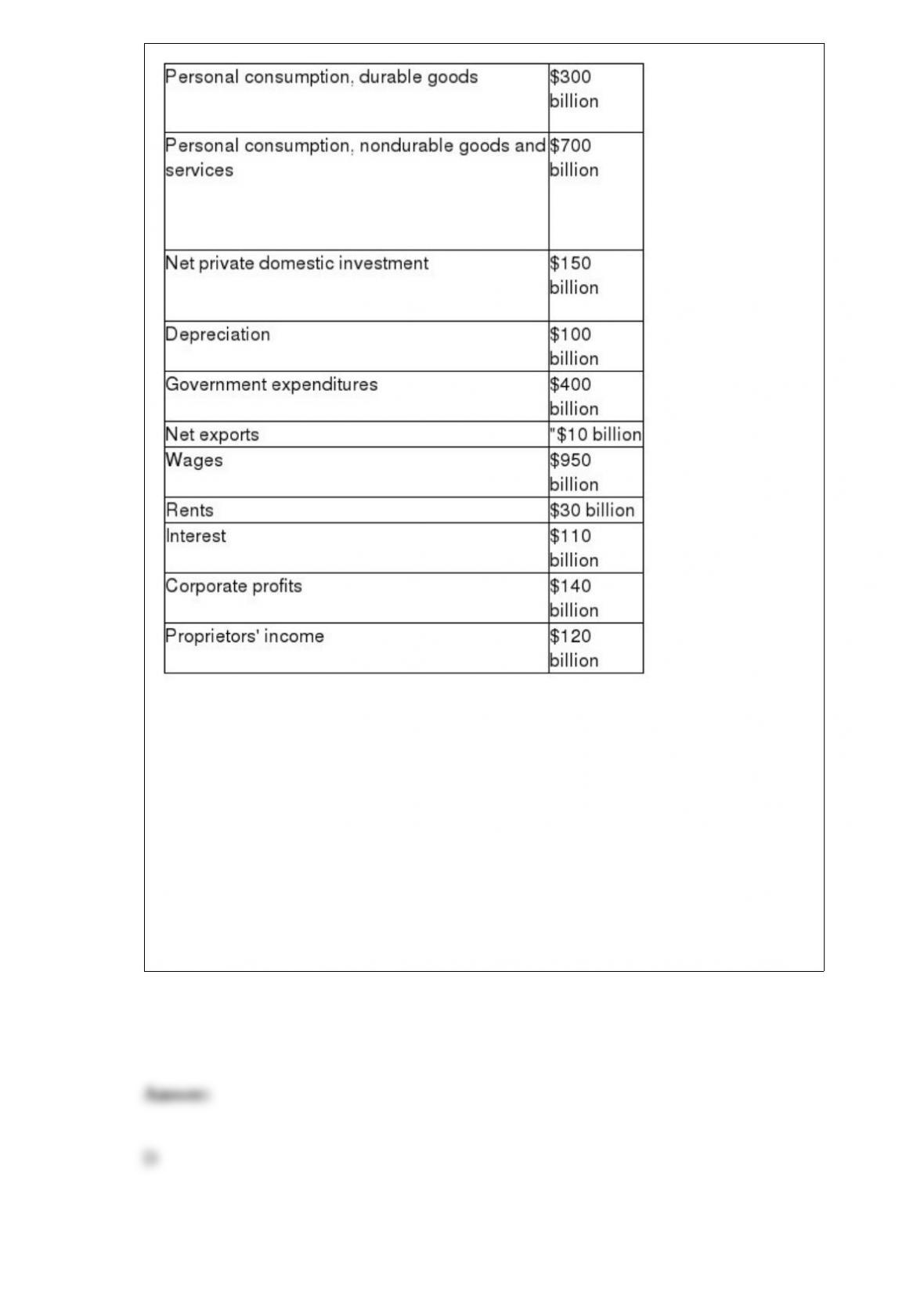
GDP is ________ billion.
a. $1,240
b. $1,250
c. $1,340
d. $1,640
e. $2,590

The level of real national output purchased at each price level is called a(n)
a. market basket.
b. market demand curve.
c. aggregate demand curve.
d. derived demand curve.
e. consumption possibilities curve.
A significant problem with U.S. unemployment figures is that they
a. exclude people who are under 16 and actively looking for work.
b. change monthly, making measurement of the unemployment rate impossible.
c. exclude those who are self-employed.
d. are based on a selected sample of the population and miss counting large numbers of
employed people.
e. do not indicate those who are underemployed or who have given up looking for
work.
Amarginal propensity to save of 0.32 implies that the marginal propensity to consumeis
a. 1.32.
b. 0.74.
c. 0.68.
d. 0.36.

e. impossible to calculate unless the change in income is specified.
The 2011 U.S. per capita income was about
a. $25,000.
b. $33,000.
c. $40,000.
d. $48,000.
e. $55,000.
The executive director of New Jersey Transit was quoted as saying, “We have a rule of
thumbfor each 1 percent fare hike, we lose 0.2 percent of our ridership.” From his
statement we could assume that
a. fare increases will increase New Jersey Transit’s operating revenue.
b. demand for transit service will go up as fares increase.
c. demand is price elastic.
d. a 10 percent fare hike will produce a 20 percent reduction in ridership.

e. the price elasticity coefficient is 5.
Evidence clearly shows that the process of globalization leads to
a. fewer jobs.
b. reduced living standards.
c. a greater international division of labor.
d. more disparity in the international distribution of labor.
e. slower worldwide economic growth.
The purpose of the Landrum-Griffin Act is to
a. outlaw the closed shop.
b. eliminate the checkoff system.
c. ban yellow dog contracts.
d. make it an unfair labor practice for employers to refuse to bargain collectively with
unions representing a majority of their workers.
e. protect the rights of individual union members from abuse by union leaders.
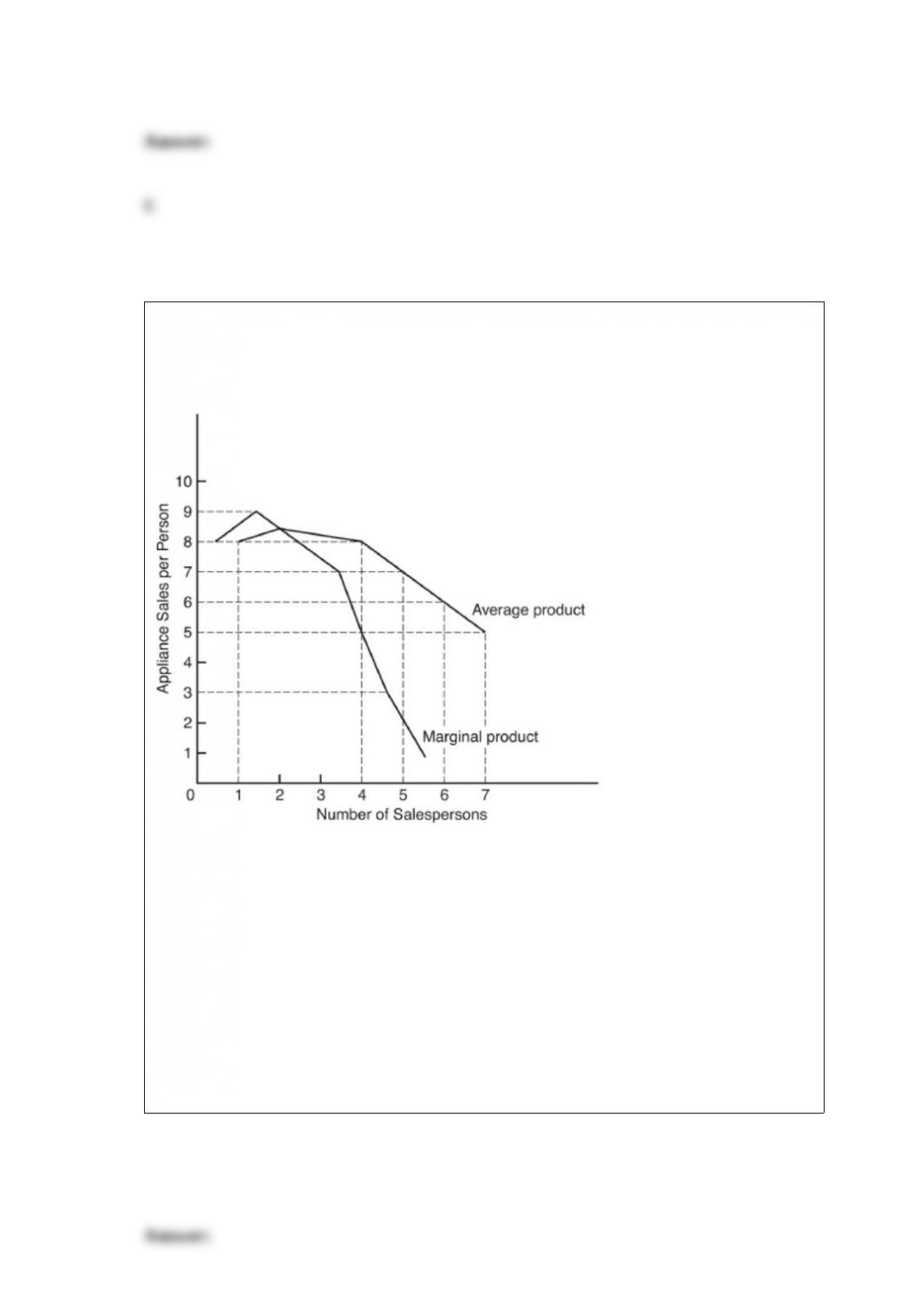
The following questions are based on the following diagram illustrating the weekly
average and marginal products for salespersons in the appliance department of a large
department store:
Diminishing marginal returns set in when adding the ________ salesperson.
a. first
b. second
c. third
d. fourth
e. fifth

Which of the following best describes the relationship between unemployment and
inflation as we understand it today?
a. In the short run, one tends to go up as the other goes down; in the long run, there may
be little relationship.
b. In the short run, there is little relationship; in the long run, one tends to go up as the
other falls.
c. One tends to go up as the other falls in both the short and long runs.
d. There is no discernible relationship in either the short or the long run.
e. Unemployment and inflation tend to rise and fall together in both the short and the
long runs.
If the economy is operating on the positively sloped range of the short-run aggregate
supply curve, fiscal policy that increases total spending
a. lowers total real output and raises the price level.
b. promotes increased employment with higher price levels.
c. shifts the aggregate supply curve to the right, increasing the price level.
d. raises total real output and lowers the price level.
e. shifts the aggregate demand curve to the left.

If under freely fluctuating exchange rates, 1 U.S. dollar exchanges for either 9 Swedish
krona or 1.7 Swiss francs, 1 Swedish krona exchanges for how many Swiss francs?
a. 0.111
b. 0.189
c. 0.588
d. 1.000
e. 5.294
The major asset of the Federal Reserve System is
a. gold certificates.
b. government securities.
c. loans to commercial banks.
d. Federal Reserve notes.
e. treasury deposits.