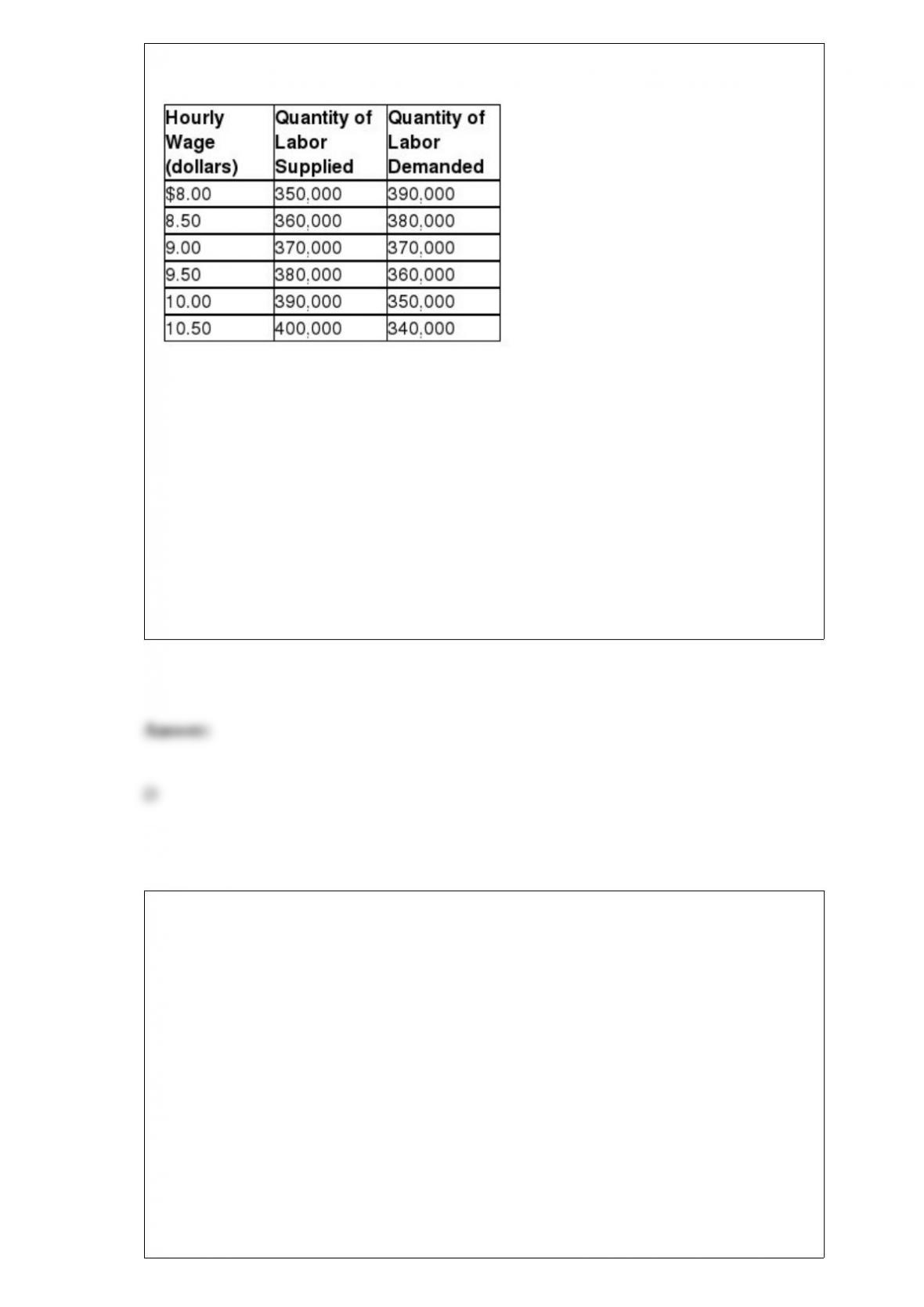
Table 4-4
Table 4-4 shows the demand and supply schedules for the low-skilled labor market in
the city of Westover.
If a minimum wage of $9.50 is mandated there will be a
A) shortage of 10,000 units of labor.
B) surplus of 10,000 units of labor.
C) shortage of 20,000 units of labor.
D) surplus of 20,000 units of labor.
The first example of comparative advantage appeared in a book that was published in
1817. This example showed that mutually beneficial trade between two countries
(England and Portugal) was possible. The example assumed that two goods (wine and
cloth) could be produced by both countries. Which of the following describes the
conclusion of this example?
A) Portugal had a comparative advantage in wine and England had a comparative
advantage in cloth.
B) Portugal had a comparative advantage in both wine and cloth, but its advantage in
cloth was greater.
C) England had a comparative advantage in both wine and cloth, but its advantage in
cloth was greater.

D) England had an absolute advantage in both wine and cloth, but a comparative
advantage in wine.
Labor unions cause unemployment because the union contract wage is set
A) below the market wage, causing a shortage of labor.
B) below the market wage, causing a surplus of labor.
C) above the market wage, causing a surplus of labor.
D) above the market wage, causing a shortage of labor.
Let MP = marginal product, P = output price, and W = wage, then the equation that
represents the condition where a competitive firm would hire another worker is
A) P MP = W.
B) P MP < W.
C) P MP > W.
D) P W > MP.
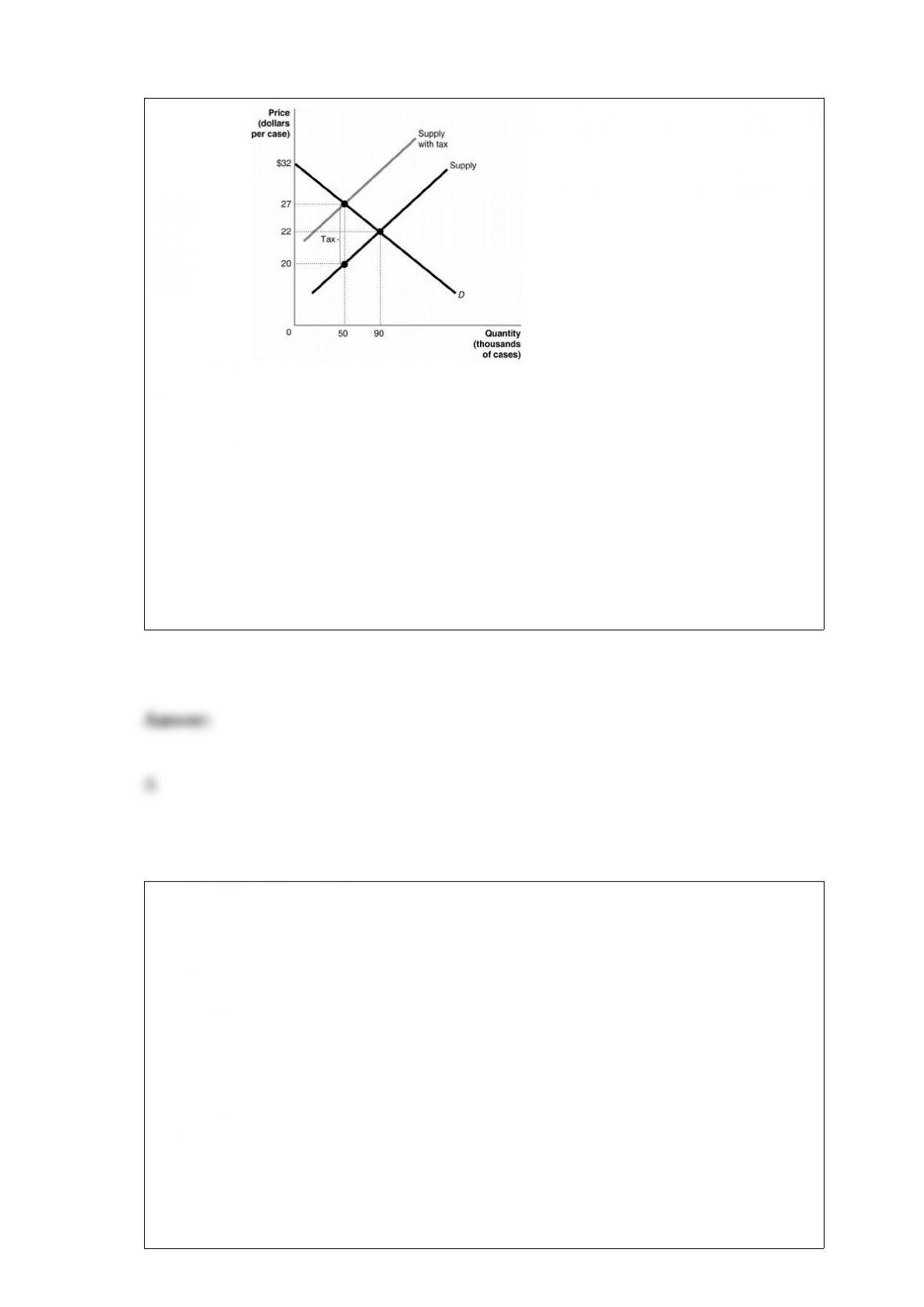
Figure 4-15 Figure 4-15 shows the market for
beer. The government plans to impose a unit tax in this market.
For each unit sold, the price sellers receive after the tax (net of tax) is
A) $20.
B) $22.
C) $27.
D) $32.
Which of the following statements best represents the opinion of many economists
regarding the impact that changes in tax laws have had on recent changes in income
inequality in the United States?
A) Reductions in income tax rates have favored high-income individuals more than
low-income individuals. As a result, reductions in federal income tax rates have led to
more income inequality.
B) Reductions in income tax rates have created greater incentives for low-income
individuals to work, save and invest. As a result, reductions in federal income tax rates
have led to less income inequality.
C) Reductions in income tax rates probably have had little impact on the distribution of
income.
D) Reductions in income tax rates have been offset by increases in corporate income tax
rates and payroll taxes. As a result, greater income inequality in the 1990s has been
followed by a more equal distribution of income since 2001.
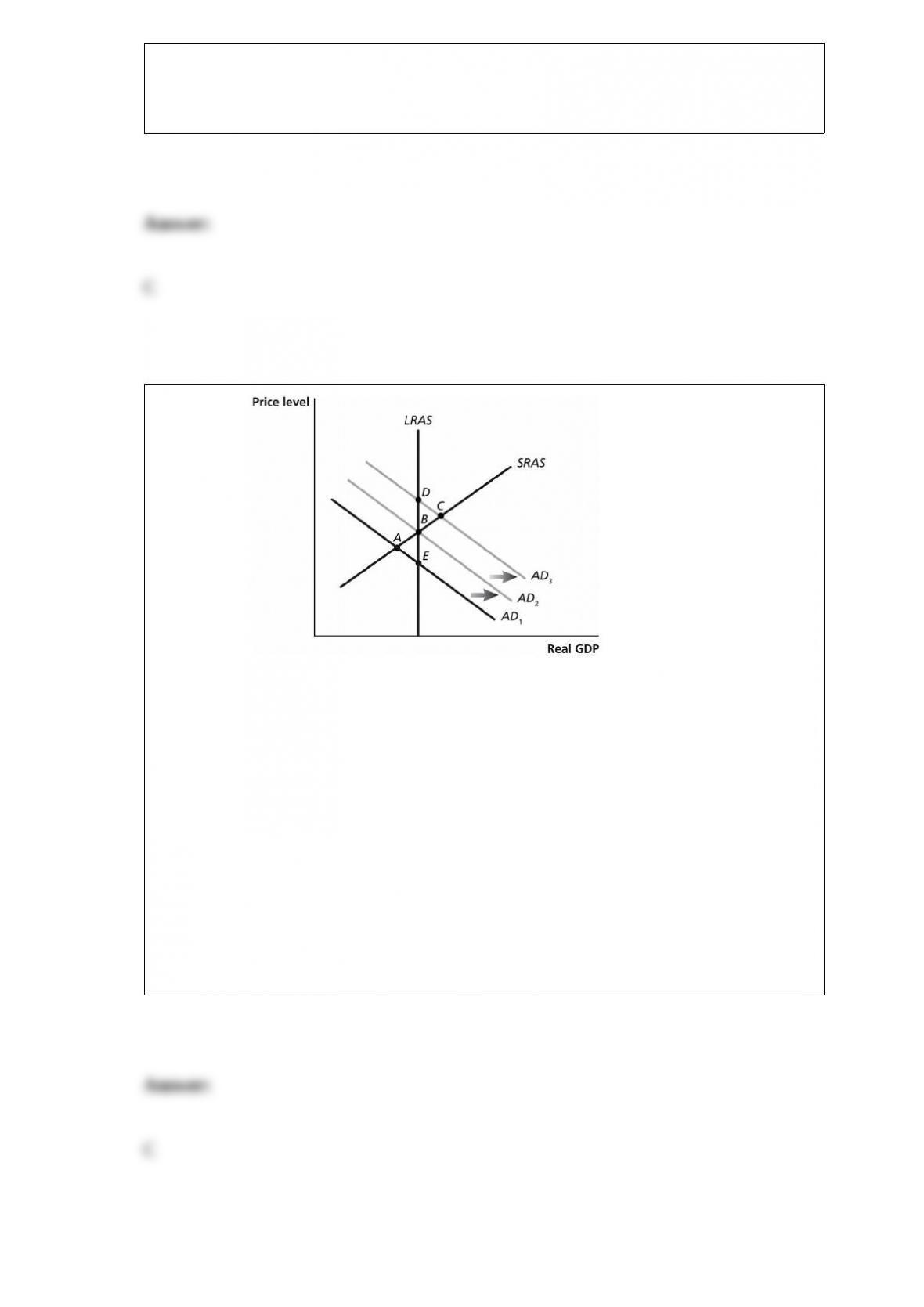
Figure 27-1
Suppose the economy is in short-run equilibrium above potential GDP and automatic
stabilizers move the economy back to long-run equilibrium. Using the static AD–AS
model in the figure above, this would be depicted as a movement from
A) D to C.
B) A to E.
C) C to B.
D) B to A.
E) E to A.

A monopoly firm is the only seller of a good or service that
A) has a perfectly elastic demand.
B) has no close complements.
C) does not need to be advertised.
D) does not have a close substitute.
Which of the following is most likely to be able to sustain economic growth in an
economy?
A) sustained increases in the labor force participation rate
B) technological change
C) increases in capital per hour worked
D) accumulations of economic resources
Marty’s Bird House suffers a short-run loss. Marty can reduce his loss below the
amount of his total fixed costs by continuing to produce if his revenue
A) exceeds his implicit costs.
B) exceeds his nonmonetary opportunity costs.
C) exceeds his variable costs.

D) exceeds his marginal costs.
If the price of gasoline decreases, what will be the impact in the market for public
transportation?
A) The demand curve for public transportation shifts to the right.
B) The quantity of public transportation demanded increases.
C) The demand curve for public transportation shifts to the left.
D) The quantity of public transportation demanded decreases.
Which of the following is an example of spending on factors of production in the
circular flow model?
A) Carolina has her nails done before her 20th high school class reunion.
B) Giorgio buys snow cones for his youth soccer team after each game.
C) Stevie trades in his old cell phone for a newer model.
D) Arlisha purchases a cotton candy machine for her concession stand at the state fair.
When a monopolistically competitive firm cuts its price to increase its sales, it
experiences a loss in revenue due to the
A) substitution effect.
B) income effect.
C) price effect.
D) output effect.
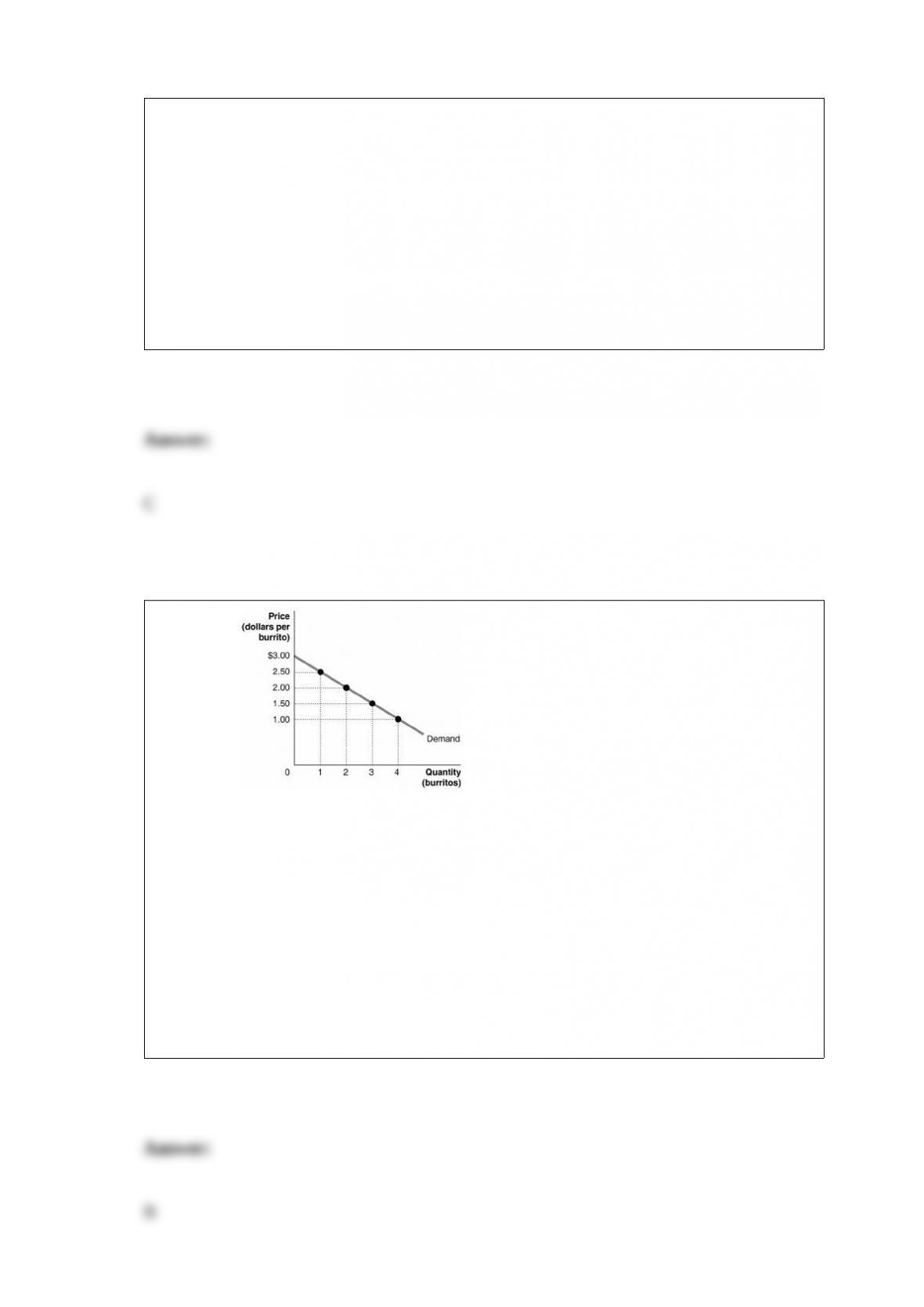
Figure 4-1 Figure 4-1 shows Arnold’s demand curve for
burritos.
What is the total amount that Arnold is willing to pay for 3 burritos?
A) $1.50
B) $6.00
C) $7.00
D) $10.00
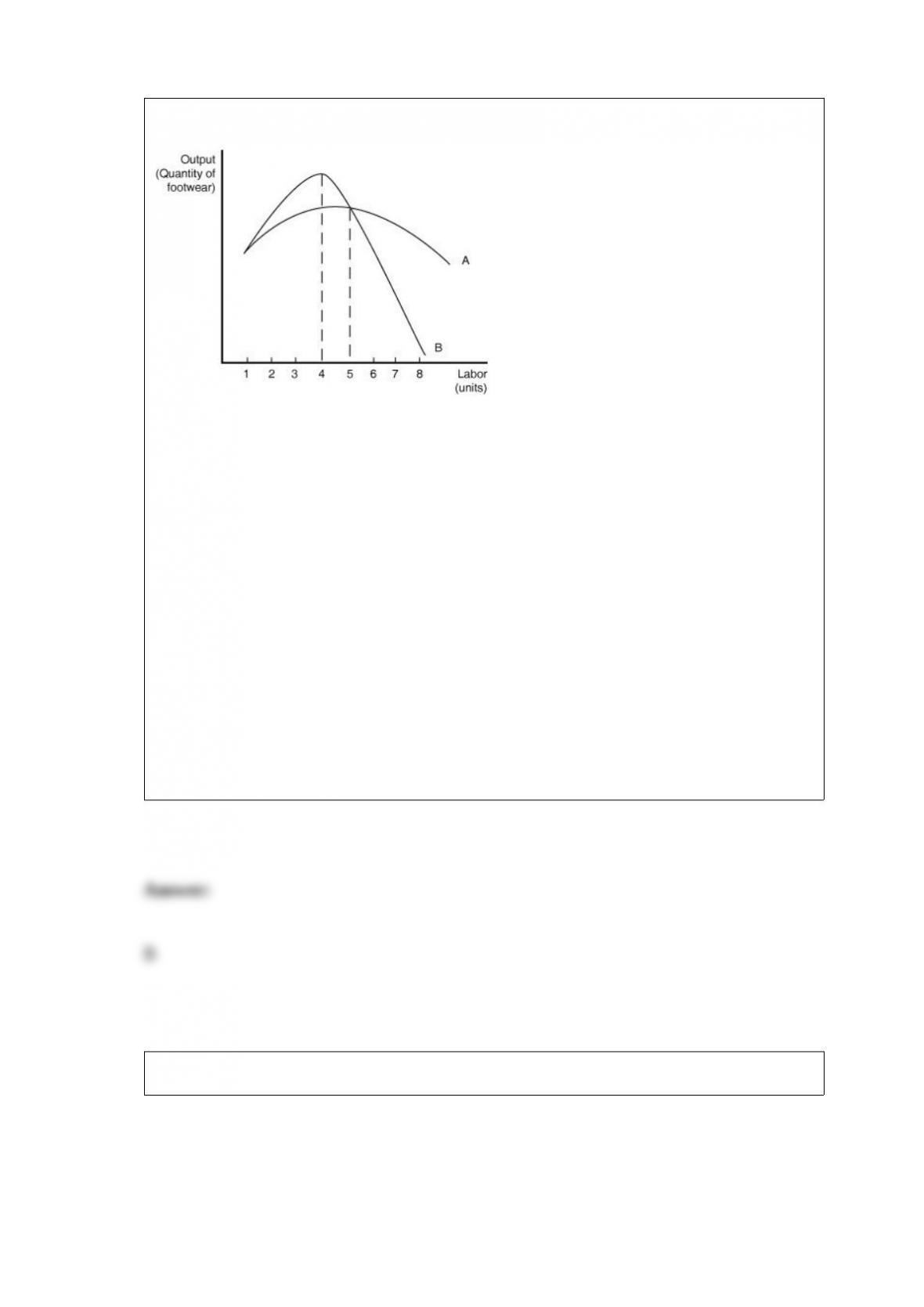
Figure 11-3
Fancy Footwear manufactures shoes. Figure 11-3 shows Fancy Footwear’s marginal
product of labor and average product of labor curves in the short run.
Which of the following statements correctly describes the curves in the figure?
A) The marginal product of labor curve is represented by curve A and the average
product of labor curve is represented by curve B.
B) The marginal product of labor curve is represented by curve B and the average
product of labor curve is represented by curve A.
C) Curve A could represent either the average product curve or the marginal product
and curve. Curve B represents the total product curve.
D) Curve B could represent either the average product curve or the marginal product
curve. Curve A represents the total product curve.
Figure 4-5
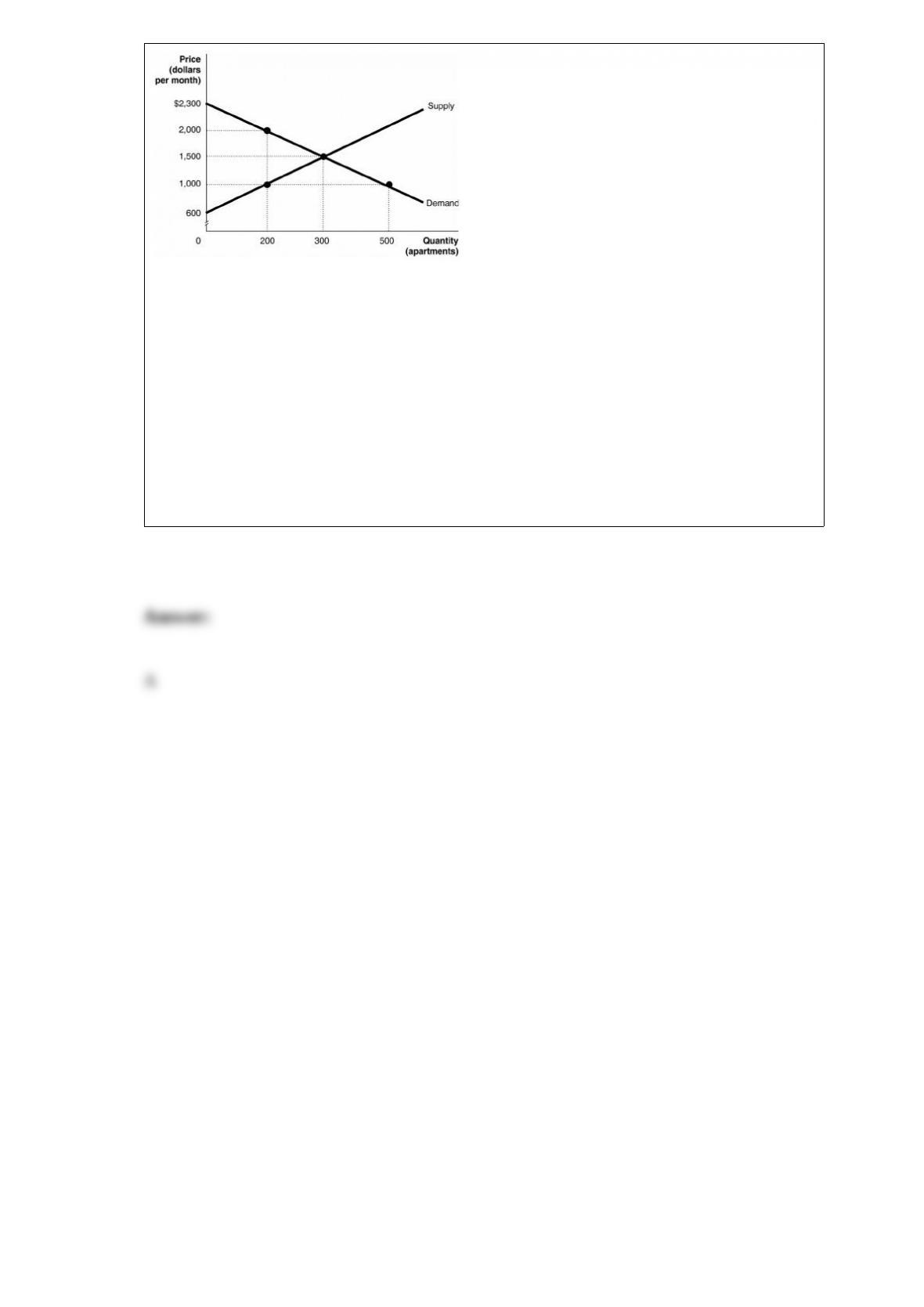
Figure 4-5 shows the market for apartments in
Springfield. Recently, the government imposed a rent ceiling of $1,000 per month.
What is the value of producer surplus after the imposition of the ceiling?
A) $40,000
B) $100,000
C) $300,000
D) $430,000