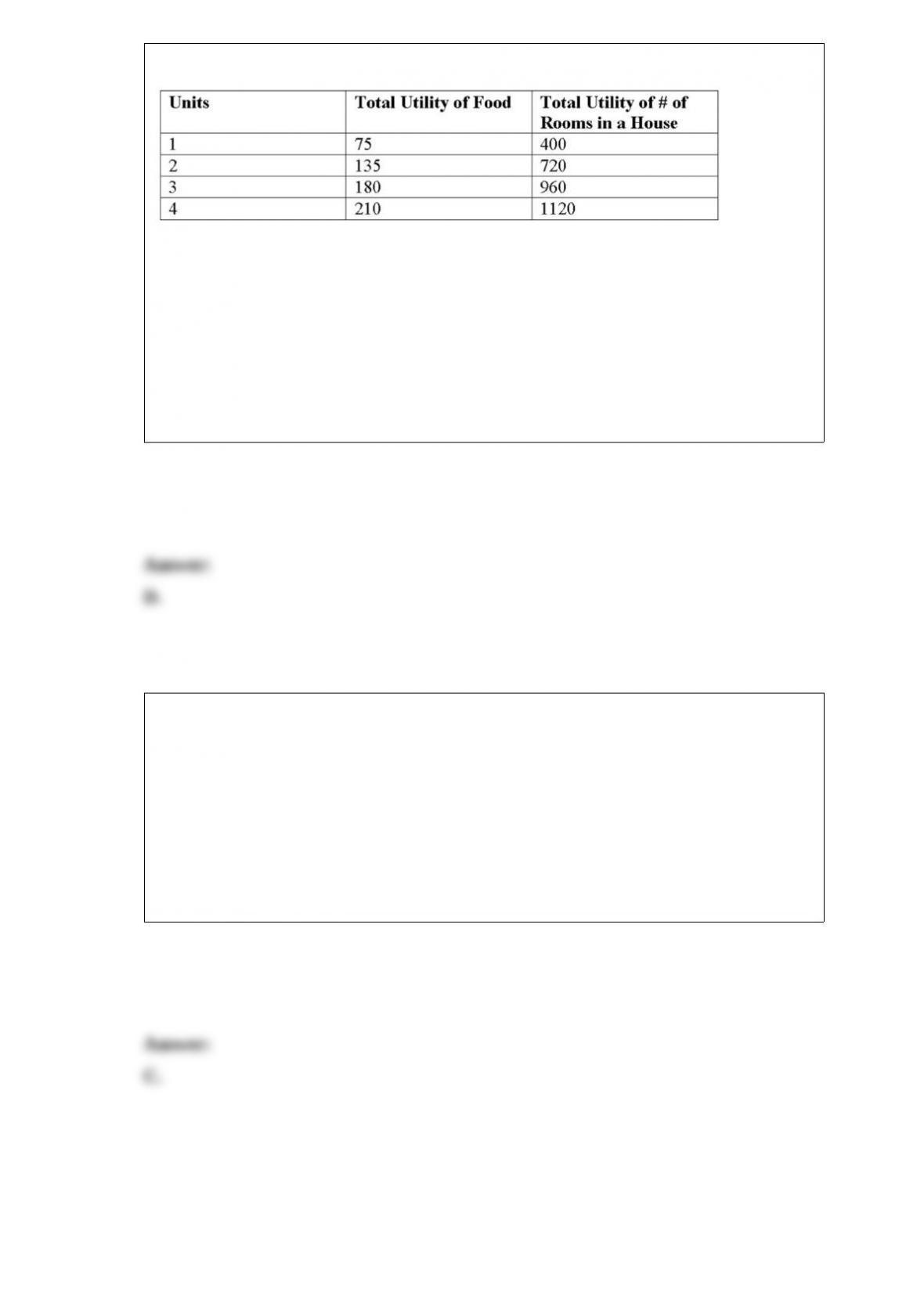
Refer to the figure above. The law of diminishing marginal utility
A. applies to Food but not Rooms.
B. does not apply to either Food or Rooms.
C. applies to Rooms but not Food.
D. applies to both Food and Rooms.
If a pizza maker pays $1 for tomatoes, $1 for cheese, $2 for sausage, and sells the pizza
made with these ingredients for $7, then each pizza sold contributes how much to GDP?
A. $3
B. $4
C. $7
D. $11

Bob’s Barber Shop cut 3,000 heads of hair in 2009 and 3,100 in 2010. The price of a
haircut was $7 in 2009 and $8 in 2010. If 2009 is the base year, what was Bob’s
contribution to nominal GDP in the year 2009?
A. $21,000
B. $21,700
C. $24,000
D. $24,800
An increase in the demand for workers producing computers for export versus
producing agricultural products that can be imported more cheaply from abroad is an
example of how increasing wage inequality can result from:
A. the diminishing marginal product of labor.
B. the diminishing marginal product of capital.
C. increasing reservation prices.
D. globalization.
Financial intermediaries, such as commercial banks, help borrowers, particularly small
borrowers, by:

A. providing information to evaluate potential lenders.
B. offering tax-preferred borrowing opportunities.
C. eliminating the risk of borrowing.
D. providing credit that might otherwise not be available.
Which of the following would increase the consumption component of U.S. GDP?
A. You purchase a vacation at Disney World in Florida.
B. A business purchases Disney World vacations as rewards for the firm’s best
salespeople.
C. Disney World purchases tires for the monorail from a firm in Ohio.
D. A French man purchases a vacation at a Disney theme park in France.
Refer to the figure above. With the subsidy, what is the producer surplus?
A. $0
B. $6,000
C. $7,500
D. $17,000
The three elements of a game are:
A. the firm, the consumers, and the profit.
B. the players, the strategies, and the payoffs.
C. the model, the graph, and the costs.
D. the costs, the revenue, and the profit.
You own a pizza shop called “Pizzas’R’ Us”. Currently you are paying your cooks an
hourly wage of $20. You sell a medium pizza for $10. By hiring more cooks, you can
increase your pizza production as shown in the following table.

What is the average labor cost per pizza if you hire 4 cooks?
A. $6
B. $8
C. $10
D. $12
Suppose you want to make rational dining choices at an all-you-can-eat buffet. How do
you apply the rational spending rule?
A. you can’t because the fixed price is a sunk cost that should not be taken into
consideration.
B. you can’t because once you have paid the sunk cost the price of each serving is zero,
and since you can’t divide by zero you cannot apply the rational choice formula.
C. you should continue to eat every item until your marginal utility from consuming
each item equals the fixed price of the buffet.
D. you should continue to eat until your marginal utility from consuming each item
exactly equals zero plus your non-monetary costs of staying at the buffet.
Why are you more likely to see a poor person picking up aluminum cans than a wealthy
person?
A. Wealthy people care less about the environment.
B. Wealthy people have higher opportunity costs for their time.
C. Wealthy people are more concerned about their public image.
D. Wealthy people are more likely to be aware of diseases that are transmitted through
litter.
In the market for office workers:
A. there are no substitutes because each human is unique.
B. computers are complements.
C. an increase in wages will increase the number of workers demanded.
D. a decrease in wages will shift the demand for workers to the left.

The four components of aggregate expenditures are:
A. consumption, imports, government spending, and net exports.
B. consumption, interest payments, government spending, and net exports.
C. consumer durables, investment, government spending, and net exports.
D. consumption, investment, government spending, and net exports.
A fiscal policy action to close an expansionary gap is to:
A. decrease taxes.
B. increase transfer payments.
C. decrease government purchases.
D. increase the marginal propensity to consume.
If the demand for salad dressing increased when the price of lettuce decreased, cross
price elasticity would be ________, and we would say these two goods are _______.
A. unitary; inelastic

B. zero; inferior
C. negative; substitutes
D. negative; complements
Double coincidence of wants is avoided if money is used as a:
A. medium of exchange.
B. measure of value.
C. standard of deferred payment.
D. store of value.
Pat pays $10,000 for a newly issued two-year government bond with a $10,000 face
value and a 6 percent coupon rate. One year later, after receiving the first coupon
payment, Pat sells the bond. If the current one-year interest rate on government bonds is
5 percent, then the price Pat receives is:
A. $10,000.

B. $500.
C. greater than $10,000.
D. less than $10,000.
The PPP theory would be most useful in predicting:
A. short-run changes in the exchange rate for a country that mainly produces
heavily-traded standardized goods.
B. long-run changes in the exchange rate for a country that mainly produces
heavily-traded standardized goods.
C. short-run changes in the exchange rate for a country that mainly produces
lightly-traded standardized goods.
D. long-run changes in the exchange rate for a country that mainly produces
lightly-traded non-standardized goods.
“Smart” vending machines, which adjust prices automatically according to changes in
demand factors (like time of day or outside temperature), are examples of:
A. meeting demand at preset prices.

B. skill-biased technological change.
C. flexible price setting.
D. capital equipment that is less expensive than standard equipment.
If voters A, B, and C have the following demand curves for a public library Pa = 5 – 2Q,
Pb = 7 – .5Q, and Pc = 2 – 4Q, then social demand for a public library is
A. P = 6 – 12Q.
B. P = 15 – 6Q.
C. P = 21 – 1.5Q.
D. P = 14 – 6.5Q.
According to the textbook, union membership has
A. remained constant since the 1950’s.
B. expanded into white collar professions.
C. declined by approximately 50% since the 1950’s.
D. become common in the South.

Refer to the figure above. At the point of monopoly profit maximization, consumer
surplus is _______. If this graph depicted a perfectly competitive industry, consumer
surplus would be _____.
A. $333.33; $355.51
B. $222.14; $500
C. $500.00; $222.14
D. $266.67; $355.51
Antony’s Pizza uses the same dough, sauce, and cheese for pizza and calzones. When
the price of pizza is low Antony produces more calzones. For Antony, with respect to
price, supply of pizza is ________ compared to supply at a pizza restaurant that does
not serve calzones.
A. more inelastic
B. more elastic
C. unitary elastic

D. more unpredictable
In a small town of 100 people, there are 10 children under 16, 10 retired people, 60
people with full-time jobs, 3 people with part-time jobs, 3 full-time students over 16,
and 4 full-time homemakers. The remaining people did not have jobs, but wanted jobs.
All but one of these had actively looked for a job in the previous four weeks. What is
the unemployment rate in this town?
A. 10.0%
B. 11.0%
C. 12.5 %
D. 14.3%
The following data give the dates of successive turning points in U.S. economic activity
and the corresponding levels of real GDP at the time.
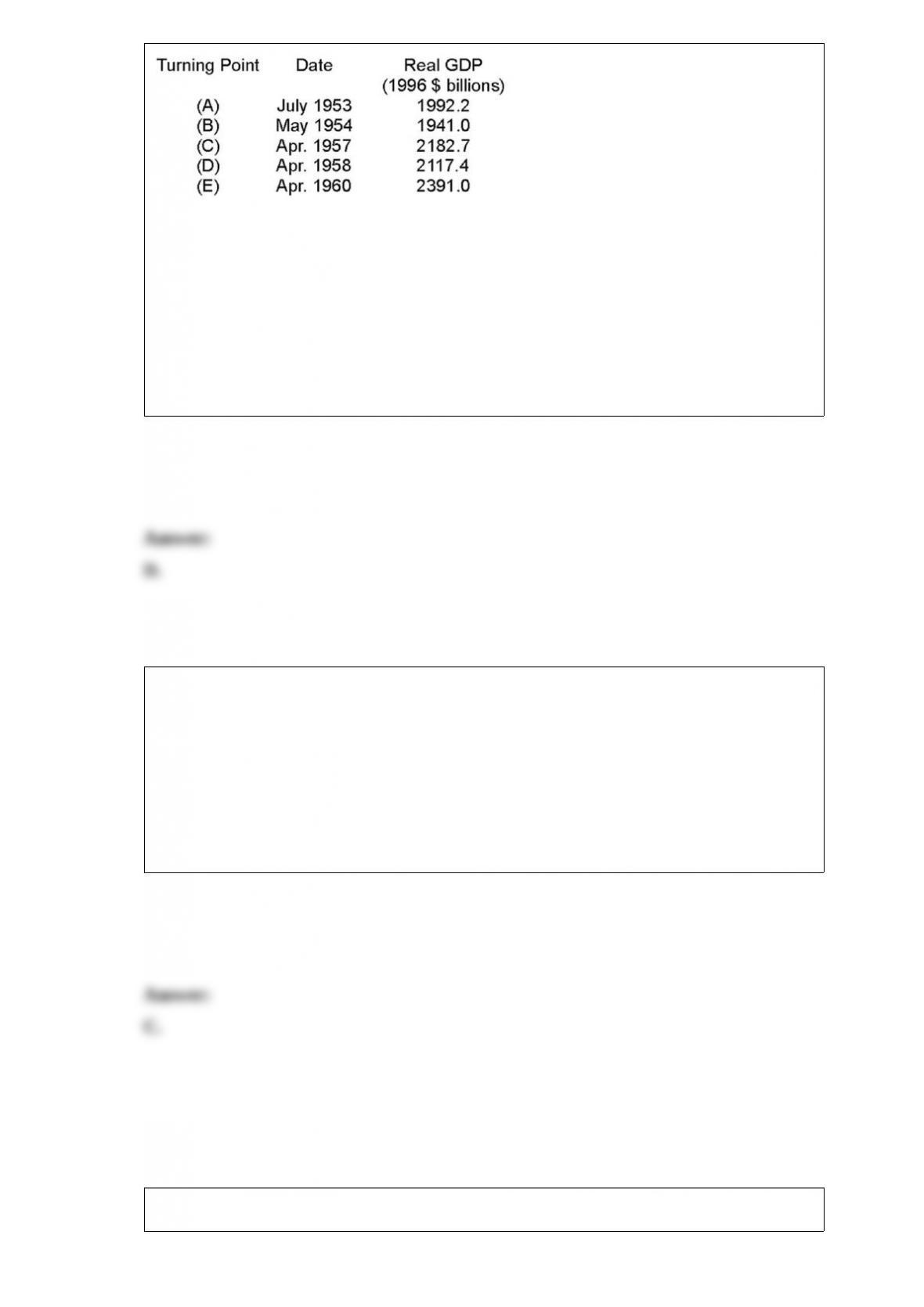
Which of the turning points are troughs?
A. (A), (B), and (C)
B. (C), (D), and (E)
C. (A), (C), and (E)
D. (B) and (D)
An increase in the price of the output produced by labor will:
A. increase the supply of labor.
B. decrease the supply of labor.
C. increase the demand for labor.
D. decrease the demand for labor.

Refer to the table above. According to the data, Corey has an absolute advantage in:
A. the production of pizza.
B. neither the production of pizza nor the delivery of pizza.
C. delivering pizza.
D. both the production of pizza and the delivery of pizza.
It is spring, and several graduates of State U are seeking employment. State U graduates
have evenly distributed GPAs, from 2.0 to 4.0, with an average GPA of 3.0. The largest
employer in town, Acme Dynamite, is interviewing candidates, hoping to hire a few
hard workers. While Acme does not require students to submit a transcript with their
applications, the hiring officer believes that high GPAs signal a willingness to work
hard.
Suppose that all State U students take the same courses and have the same academic
abilities on entering college. They differ only by their tolerance for intensive study. If
this is the case, a high GPA
A. does not provide useful information to Acme, since all applicants are of equal ability.
B. does not provide useful information to Acme, since all applicants took the same
classes.
C. identifies students who don’t mind studying, so is not costly information to convey
and therefore not credible.
D. is a costly-to-fake indication that the high-GPA student is a hard worker.

If a country pegs its currency to a foreign currency, it no longer has the ability to use
monetary policy to stabilize the economy because:
A. it no longer has a central bank.
B. monetary policy must be used to keep the exchange rate’s market equilibrium value
at its official value.
C. banks will begin to hold 100% of their deposits in reserves.
D. it must eliminate its currency from circulation and replace it with the foreign
currency.
Which of the following is NOT classified as a final good?
A. New clothing purchased by a college student
B. Fresh vegetables purchased by a restaurant
C. A new house purchased by a family
D. A new machine purchased by a business