
Diseconomies of scale can occur for:
A) coordination problems.
B) minimum efficient scale problems.
C) increasing input costs.
D) A and C are correct.
What was the mistake that the governments the U.K. and France make when they
subsidized the Concorde, a supersonic aircraft manufacturer?
A) The market was not worth capturing.
B) The market was too big to capture alone.
C) They should have invited the United States in their partnership.
D) The governments of each country tried to take the whole company for themselves.
Recall the Application about the decrease in the price of wool in the 1990s to
answer the following question(s). In the 1990s, the world price of wool decreased
by about 30 percent and prices have remained relatively low since then. In 2012,
an organization in New Zealand proposed that sheep shearing be added to the
Commonwealth Games and the Olympics as a spectator sport in an effort to

increase the awareness and the demand for wool.
Recall the Application. The decrease in the price of wool would be reflected by a
movement ________ on the market supply curve for wool.
A) down and to the right
B) down and to the left
C) up and to the right
D) up and to the left
Deciding if a college uses more PhDs to teach introductory classes answers the
economic question of:
A) Who consumes the products produced?
B) What will be produced?
C) Where will the products produced be consumed?
D) How will we produce it?
Under a Coase bargaining solution, deal making between the two parties continues until
the marginal ________ to the harmed party equals the marginal ________ to the other
party.
A) benefit; benefit
B) benefit; cost
C) cost; benefit
D) cost; cost
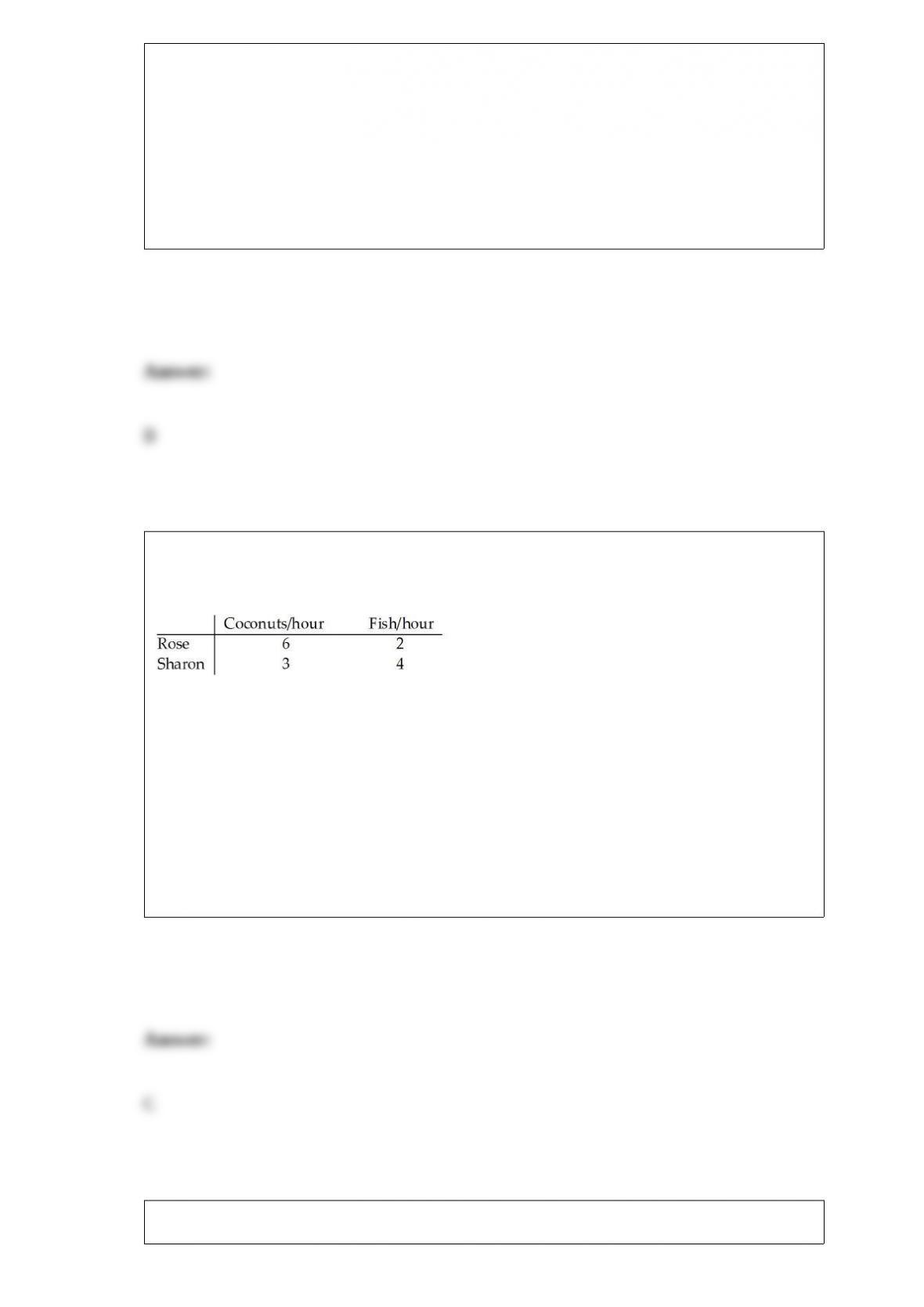
Consider two individuals, Rose and Sharon, who produce fish and coconuts. Rose and
Sharon’s hourly productivity are shown in Table 3.2. Rose’s opportunity cost of
producing 1 fish is:
Table 3.2
A) 1/3 coconut.
B) 1 1/2 coconuts.
C) 3 coconuts.
D) 6 coconuts.
When moving upward the along a liner demand curve, what happens to the price

elasticity of the demand?
A) decreases
B) increases
C) stays the same
D) none of the above
In a market system, what provides individuals the information needed to make
decisions?
A) insurance
B) prices
C) patents
D) government
Recall the Application. Rent control ________ the quantity of apartments supplied and
________ the total value of the apartment market.
A) increases; increases
B) increases; decreases

C) decreases; increases
D) decreases; decreases
In which of the following market structures do you find many sellers?
A) monopoly
B) perfect competition
C) monopolistic competition
D) monopolistic competition and perfect competition
Additional Application
PAYING LANDOWNERS TO HOST WOLVES
We can apply the concepts of public goods and free riding to the issue of preserving
wildlife. There are some tradeoffs associated with preserving wolves and other wildlife
in Yellowstone Park. To environmentalists, wolves are a part of the natural ecosystem.
To ranchers, wolves are predators that eat livestock. In other words, there are costs as
well as benefits associated with the preservation of wolves, just as there are costs and
benefits associated with other public goods such as dams, fireworks, national defense,
and space exploration.

One response to the wolf-preservation problem comes from Defenders of Wildlife, an
environmental group in Montana. The organization collects money from its members
and uses the money to reward landowners who allow wolves to live on their properties.
The host landowner receives a payment of $5,000 for each litter of wolf pups reared on
the property. In addition, the organization compensates ranchers for livestock killed by
wolves.
As a result of these programs, ranchers in the Yellowstone area are more likely to
support efforts to maintain the wolves as part of Yellowstone Park’s ecosystem. The
programs treat preservation as a public good, one that is supported by money
contributed by people who benefit from preservation. The organization has collected
contributions from thousands of people despite the free-rider problem. The success of
Defenders of Wildlife illustrates one of the key principles of economics.
SOURCE: Terry L. Anderson, “A Carrot to Save the Wolf,” The Margin, Spring 1992,
p. 28.
Recall the application on “Paying Landowners to Host Wolves.” Landowners let wolves
live on their property because:
A) a private group pays them for each litter of wolf pups reared on it property.
B) the government orders them too.
C) wolves are good for livestock.
D) all of the above
ABC company will choose to shut down rather than operate as long as:
A) it earns the same amount as its expenses.
B) average fixed cost is less than average variable cost.
C) total revenue is less than or equal to fixed cost.
D) total revenue is less than or equal to variable cost.

Recall the application about laws against predatory pricing, who is responsible for
enforcing these types of laws?
A) the Federal Reserve Bank
B) the Federal Trade Commission
C) the Federal Deposit Insurance
D) the Federal Antitrust Agency
Which of the following is the most likely complement for hamburgers?
A) soda
B) beef
C) hamburger buns
D) All of the above are complements.

Refer to Figure 5.4. The demand for tickets is:
A) perfectly elastic.
B) perfectly inelastic.
C) elastic.
D) inelastic.
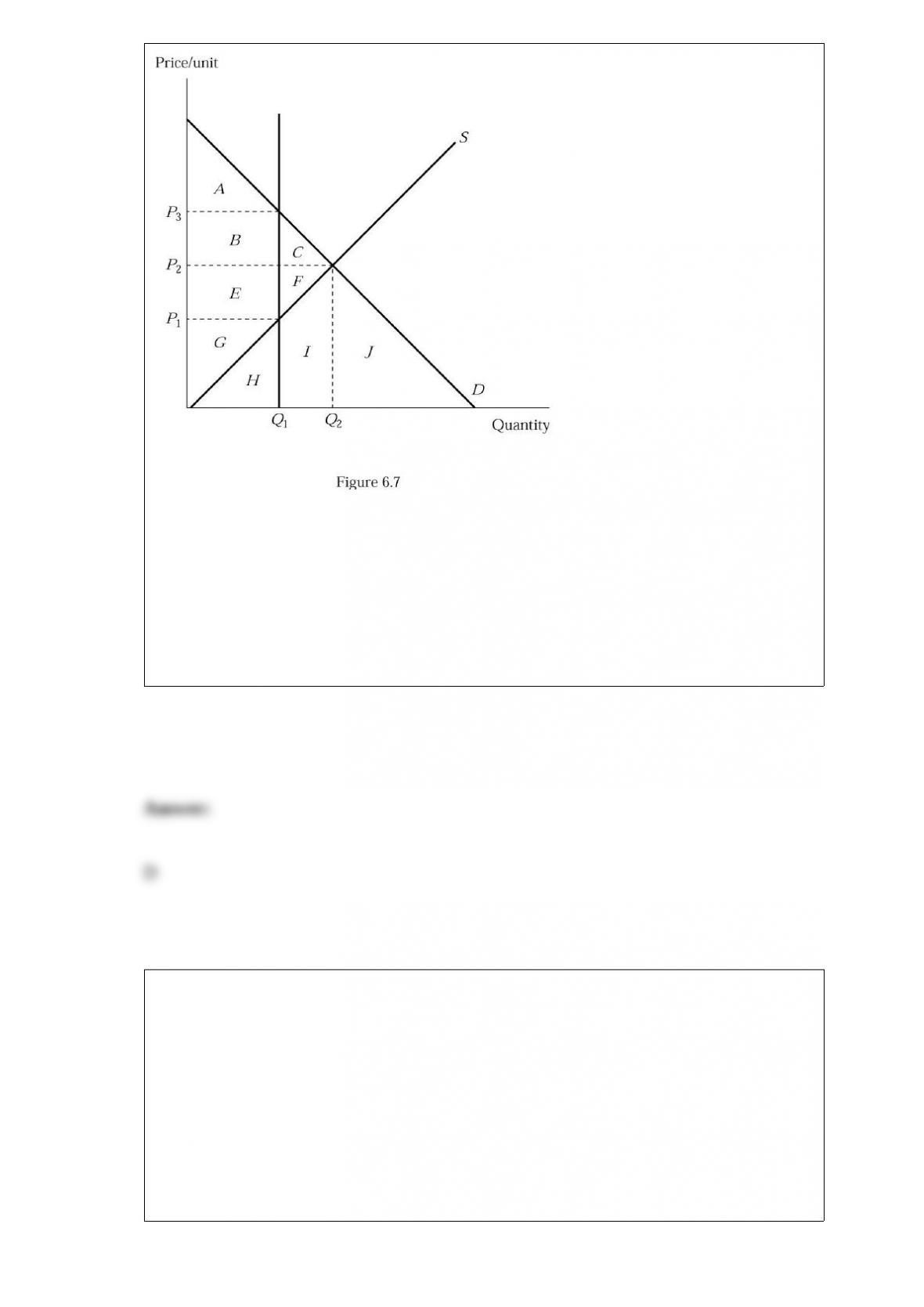
In Figure 6.7 with a quantity constraint of Q1, producer surplus is area:
A) A.
B) A + B + C.
C) E + F + G.
D) G.
Because people can enjoy the benefits of public goods whether they pay for them or
not, they are usually unwilling to pay for them. This is known as the:
A) drop-in-the-bucket problem.
B) nonexcludable problem.
C) nonrival problem.
D) free-rider problem.

The firm’s short-run supply curve shows the relationship between the price of a good
and the:
A) quantity demanded of that good.
B) quantity supplied of that good.
C) willingness of consumers to purchase the good.
D) firm’s capacity output.
A group of people has formed a house cleaning and yard maintenance business. The
number of houses or yards that they can clean or maintain in any given day is depicted
in Table 2.1. As the group cleans more houses, the opportunity cost of cleaning houses:
Table 2.1
A) falls.
B) rises.

C) stays the same.
D) is the sum of the opportunity costs of cleaning all the houses prior to that one.
An example of moral hazard is:
A) a situation where high-quality loan applicants drive low-quality loan applicants out
of the market for bank loans.
B) a situation where equally qualified men and women do not earn the same wages in
the same occupation.
C) a situation where individuals are not willing to pay top dollar for a used car because
they assume it is a lemon.
D) a situation where a person purchases life insurance and then lives recklessly.
If an increase in income results in an increase in the demand for Honda Civics, then
Honda Civics are considered:
A) normal goods.
B) inferior goods.
C) substitute goods.
D) complementary goods.
Relative to people who are eligible for group health insurance, individuals who are not
covered by a group health insurance plan tend to pay:
A) more for health insurance regardless of their health condition.
B) more for health insurance if they are unhealthy and less for health insurance if they
are healthy.
C) less for health insurance regardless of their health condition.
D) less for health insurance if they are unhealthy and more for health insurance if they
are healthy.
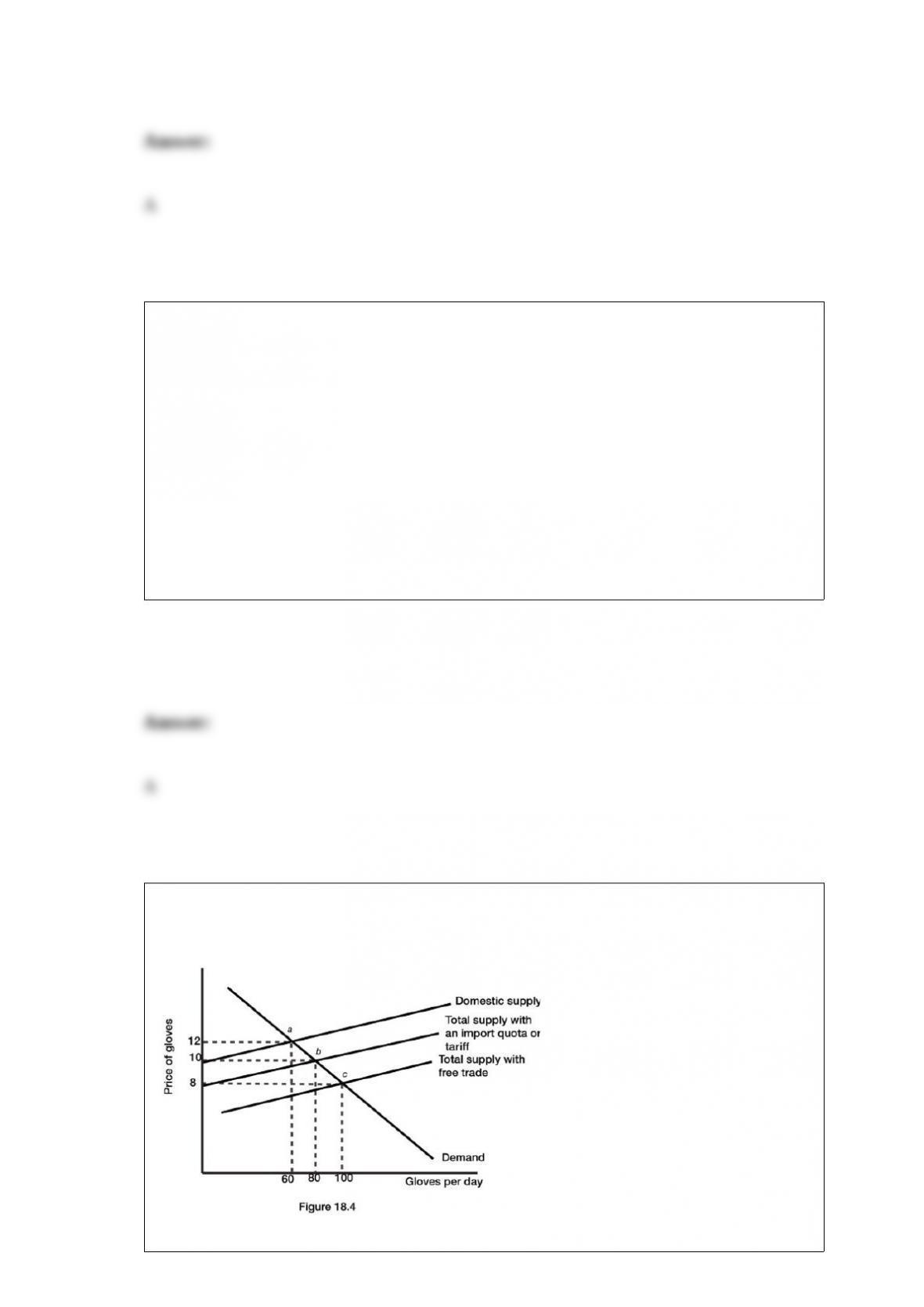
Refer to Figure 18.4. With free trade, what is the equilibrium quantity of gloves in
Duckland?

A) 100
B) 80
C) 60
D) 40
The benefit valuations for a product are gut feelings that occur:
A) after marginal thought.
B) instantaneously.
C) after careful thought.
D) after conscious weight is given to the cost of the product.
Which of the following would be classified as an external cost?
A) As more firms began hiring computer programmers, the salaries of computer
programmers increased and therefore the firm’s cost of production increased.
B) You eat too much pizza and end up with a stomachache.
C) You are not able to study at night because there is so much noise coming from the
dorm room next to yours.

D) When you purchase a prescription drug you are not made fully aware of all the
possible side effects that may result from taking the drug.
Which of the following is NOT a market?
A) a group of children trading Pokemon cards
B) a cattle auction
C) your college bookstore
D) All of the above are markets.
Figure 11.4 depicts demand and costs for a monopolistically competitive firm. At the
profit maximizing output level:
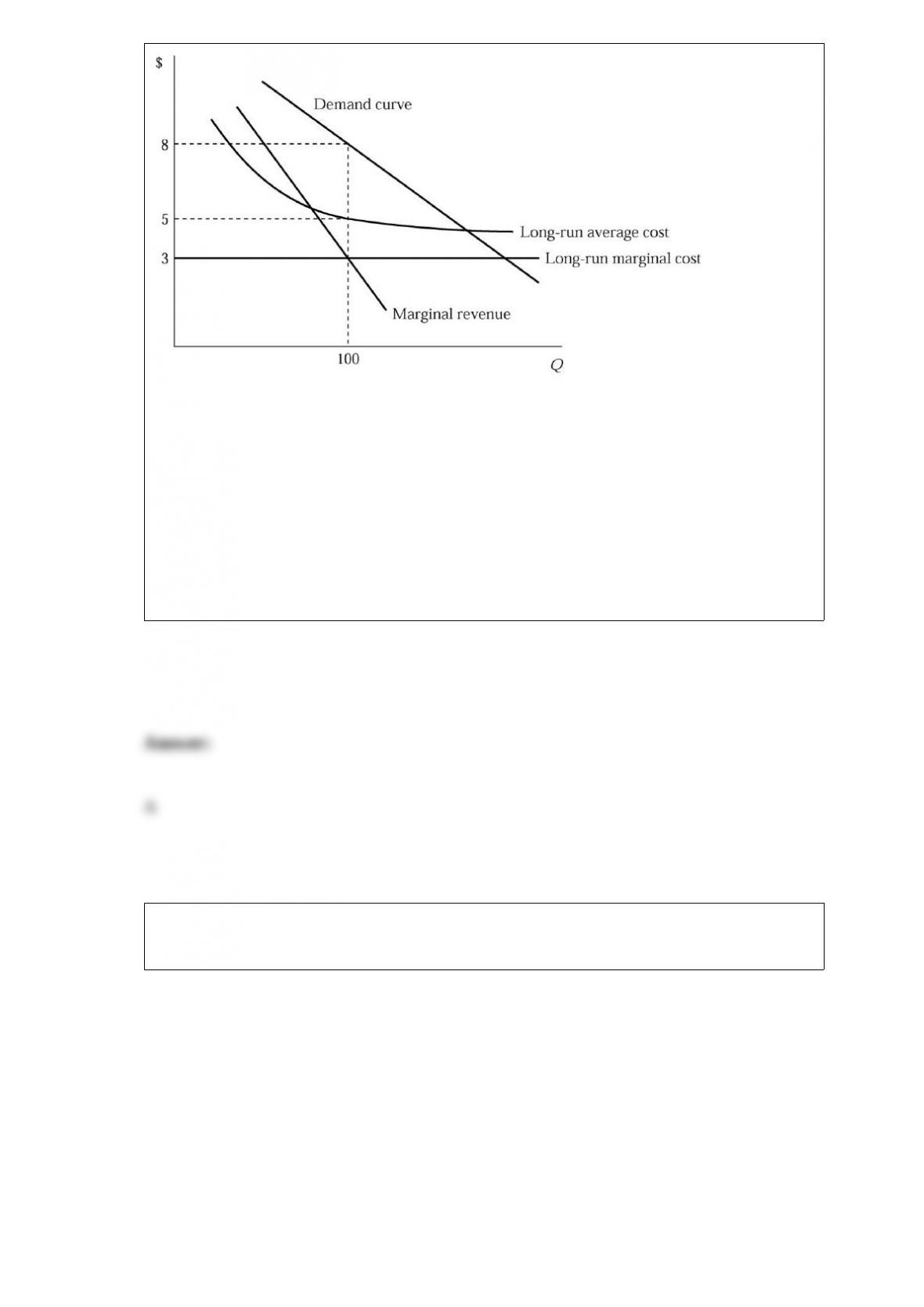
Figure 11.4
A) the firm is making a positive economic profit.
B) the firm is earning a zero economic profit.
C) the firm is earning a negative economic profit.
D) There is not sufficient information.
Figure 10.2 shows a monopolist’s demand curve. Suppose that the marginal cost is $6
for all units and the current output level is 4 units. Then which of the following is true?
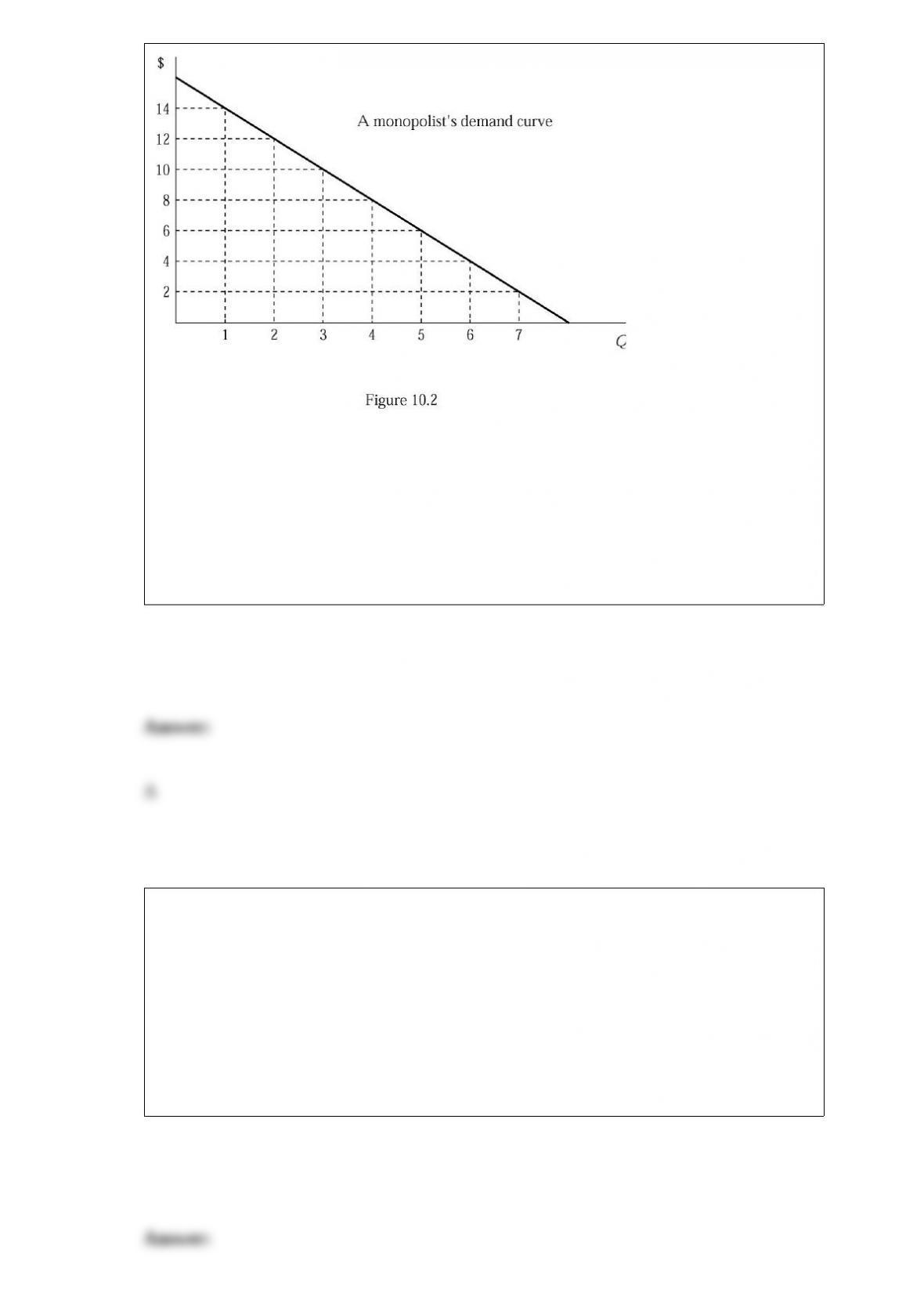
A) The marginal revenue is less than the marginal cost.
B) The price is greater than the average total cost.
C) The firm is producing the profit maximizing level of output.
D) all of the above
Assume that chicken and beef are substitutes. When the price of beef increases:
A) the demand for chicken decreases.
B) the demand for chicken increases.
C) the supply of chicken increases.
D) the supply of chicken decreases.
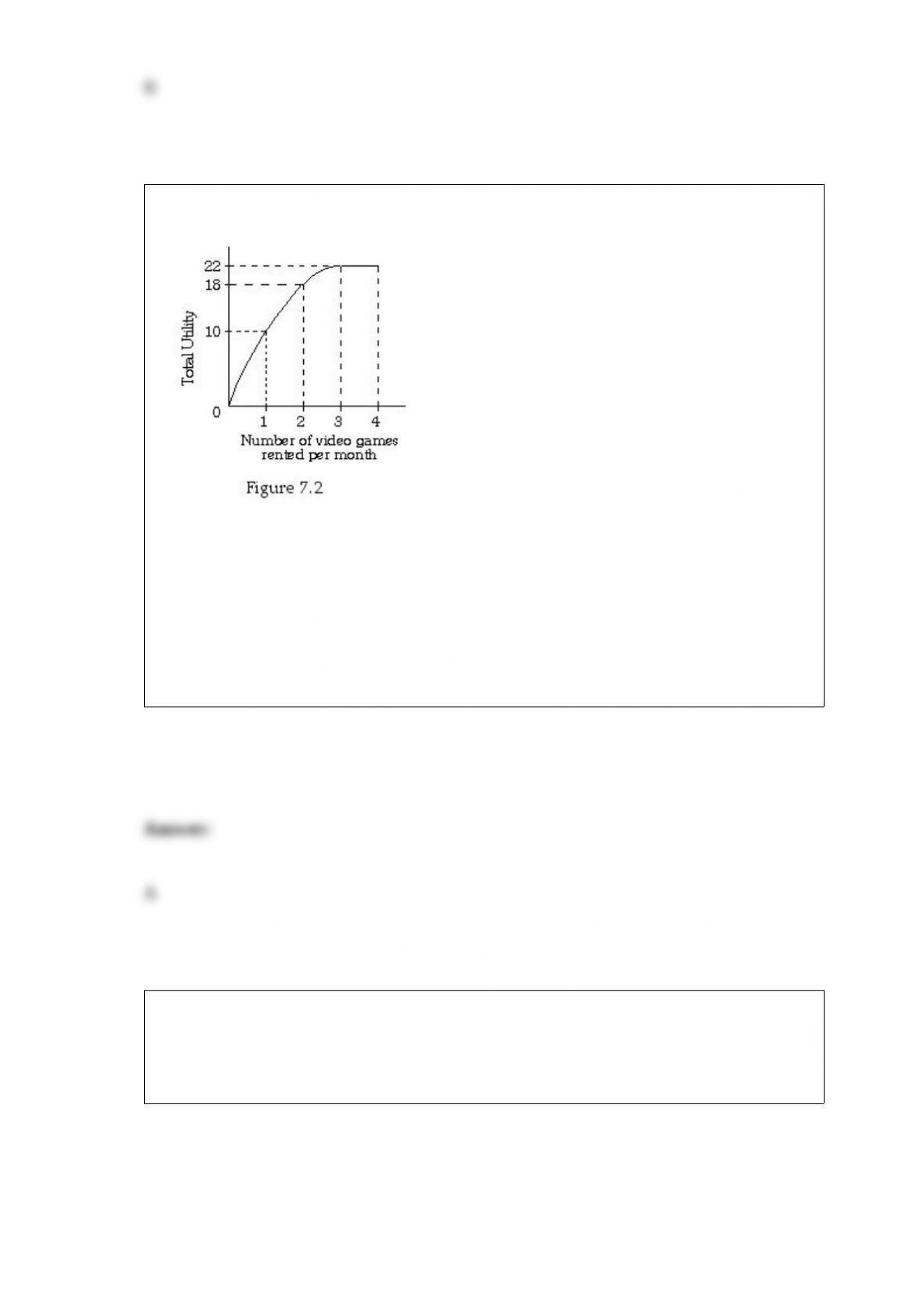
Refer to Figure 7.2. The marginal utility of the first video game rental is:
A) 10.
B) 8.
C) 25.
D) 40.
Refer to Figure 7.4. If Sophia bases her choice on cognition , she will maximize utility
at a marginal utility per dollar of ________ utils for candy bars and ________ utils for
oranges.
Figure 7.4
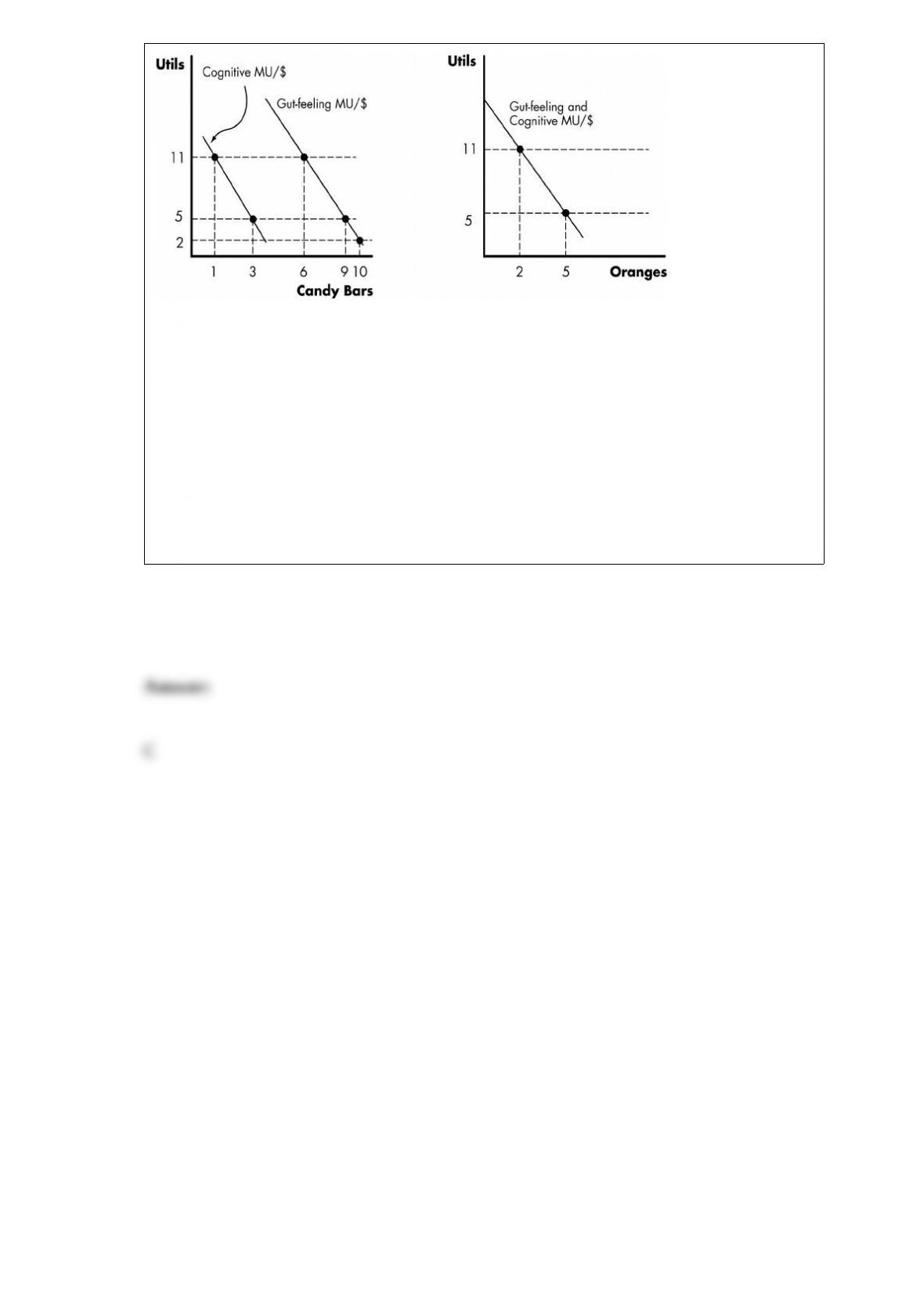
The above figure represents the marginal utility per dollar for candy bars and
oranges for Sophia. The price of each product is $0.50, and Sophia has a budget of
$4.
A) 5; 11
B) 11; 5
C) 5; 5
D) 11; 11