
When Toyota introduced its 2010 Prius, it announced that the average retail price of the
2010 model would be lower than the average retail price was for the equivalent 2009
model. Which of the following would explain the price Differential?
A) The demand for the Prius had increased, and the supply of the Prius remained
unchanged.
B) The supply of the Prius had decreased, and the demand for the Prius remained
unchanged.
C) The demand for the Prius had decreased, and the supply of the Prius had increased.
D) The demand for the Prius had increased, and the supply of the Prius had decreased.
Which of the following is not an argument against inflation targeting?
A) Inflation targeting reduces the flexibility of the Fed to pursue other policy goals.
B) Inflation targeting assumes that the Fed can accurately forecast future inflation rates.
C) Inflation targeting makes monetary policy ineffective because the targets are
publicly announced.
D) Inflation targeting holds the Fed accountable for an inflation goal, but may make it
less likely the Fed will achieve other goals.
If price discrimination occurs in a market
A) the law of one price does not hold.

B) the firm earns arbitrage profits.
C) consumers whose demand for the product sold is more elastic pay higher prices than
consumers whose demand is less elastic.
D) the marginal cost of production is constant.
Suppose you have just opened a store to sell espresso machines. Both you and a
competing store buy this machine from a manufacturer for $130 each. Your competitor
who has a store of the same size as yours is currently selling about 10 machines a
month at a price of $200 per machine. You expect to sell about 6 machines a month at a
price of $220 per machine. If you lower your price, you expect to make a loss. Which of
the following could explain why your competitor is able to profitably sell the machine
at a lower price although the cost of purchasing the machine is the same for the both of
you?
A) The competing store probably has a lower marginal cost of production.
B) The competing store probably has a lower average variable cost of production.
C) The competing store’s goal is to maximize revenue and not profit.
D) The competing store probably has a lower average cost because average fixed cost
falls as output increases.
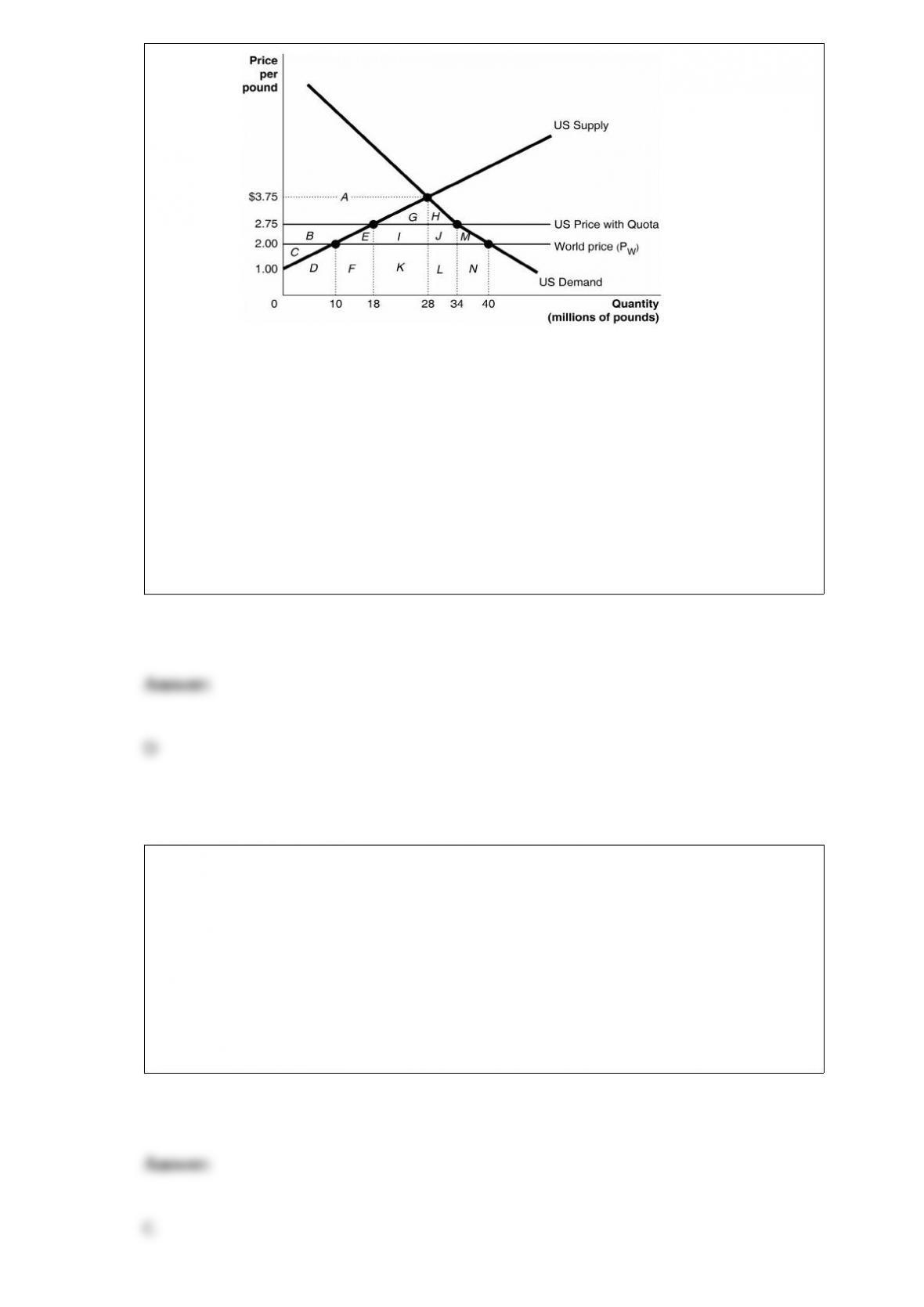
Figure 7-3 Since 1953 the
United States has imposed a quota to limit the imports of peanuts. Figure 7-3 illustrates
the impact of the quota. What is the value of revenue to foreign producers who are
granted permission to sell in the U.S. market when there is a quota?
A) $12 million
B) $17.25 million
C) $20 million
D) $44 million
Income elasticity measures
A) how a good’s quantity demanded responds to change in the goods price.
B) how a good’s quantity demanded responds to change in the price of another good.
C) how a good’s quantity demanded responds to change in buyers’ incomes.
D) how a good’s quantity demanded responds to producers’ incomes.

Under what circumstances would the GDP deflator be less than 100 after the base year?
A) The GDP deflator will be less than 100 if there has been inflation relative to the base
year.
B) The GDP deflator will be less than 100 if there has been inflation of less than 2% per
year relative to the base year.
C) The GDP deflator will be less than 100 if there has been deflation relative to the base
year.
D) There are no circumstances under which the GDP deflator could be less than 100.
The United States is called a debtor nation because
A) it has a large current account deficit and is simultaneously funded by foreign
investment.
B) it has a large financial account deficit that is used to fund the current account deficit.
C) it has a large balance of payments deficit that is used to fund the current account
deficit.
D) U.S. capital outflows are much greater than U.S. capital inflows.
Economic models
A) make no assumptions in order to remain as accurate as possible.
B) are simplified versions of reality.
C) cannot be used to analyze real-world issues.
D) magnify the complexity of economic issues in order to provide useful data.
Which of the following is an example of implicit collusion?
A) product differentiation
B) a retaliation strategy
C) a second-price auction
D) price leadership