
1) “The government should punish crimes and enforce voluntary agreements but not
redistribute income.” This statement is most closely associated with which political
philosophy?
a.liberalism
b.utilitarianism
c.libertarianism
d.welfarism
2) Scenario 13-8
Wanda owns a lemonade stand. She produces lemonade using five inputs: water, sugar,
lemons, paper cups, and labor. Her costs per glass are as follows: $0.01 for water, $0.02
for sugar, $0.03 for lemons, $0.02 for cups, and $0.10 for the opportunity cost of her
labor. She can sell 300 glasses for $0.50 each.
What are Wanda’s total economic costs per glass?
a. $0.18
b. $0.10
c. $0.08
d. $0.02
3) Figure 21-25
The figure pertains to a particular consumer. On the axes, X represents the quantity of
good X and Y represents the quantity of good Y.
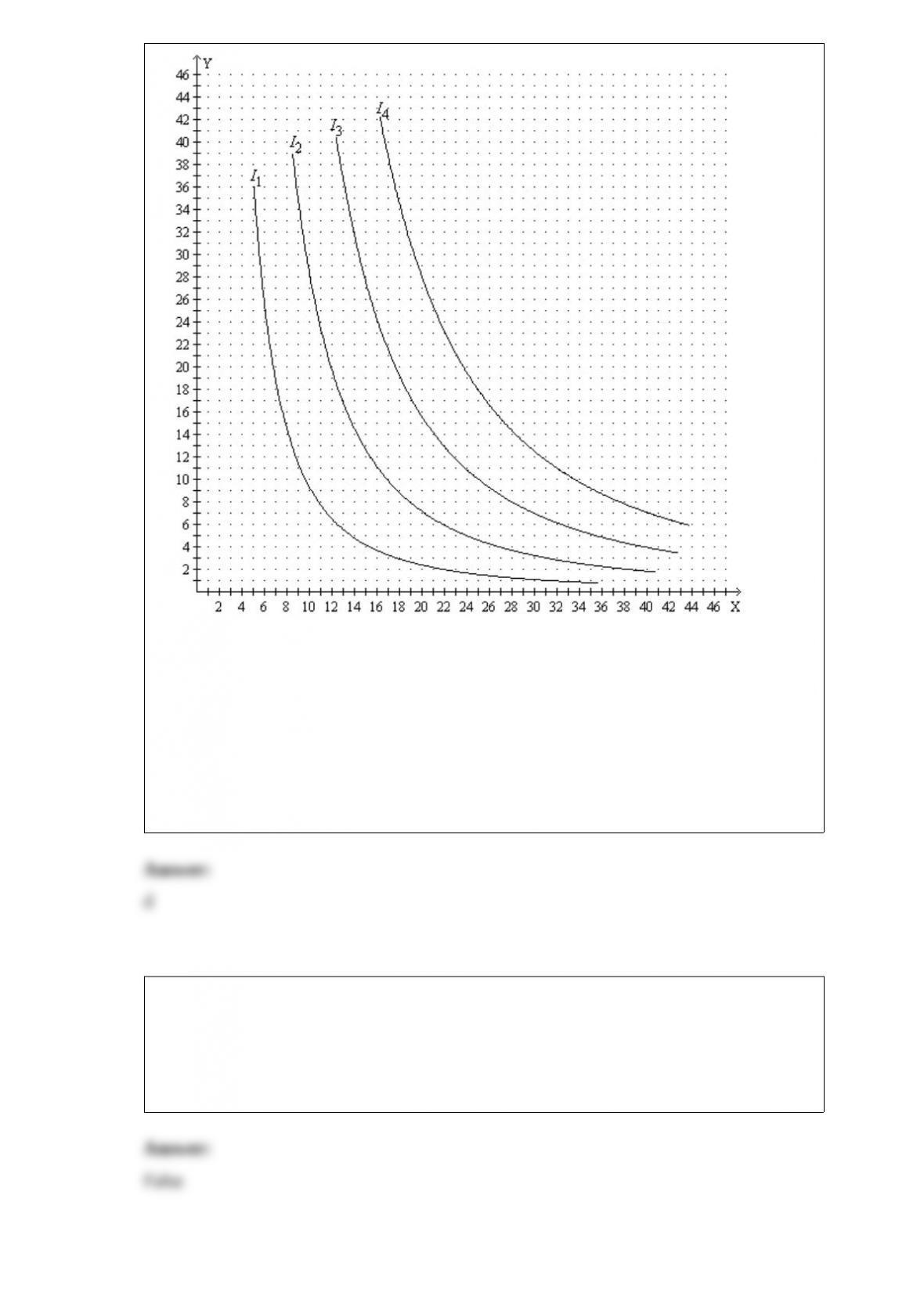
Refer to Figure 21-25. Suppose the price of good X is $8, the price of good Y is $10,
and the consumer’s income is $360. Then the consumer’s optimal choice is represented
by a point on which curve?
a.I1
b.I2
c.I3
d.I4
4) The market supply curve shows how the total quantity supplied of a good varies as
input prices vary, holding constant all the other factors that influence producers’
decisions about how much to sell.
a.True
b.False
5) Suppose a certain good provides an external benefit. If the private cost of the last unit
of the good that was produced is equal to the social value of that unit, then the sum of
producer and consumer surplus is maximized.
a.True
b.False
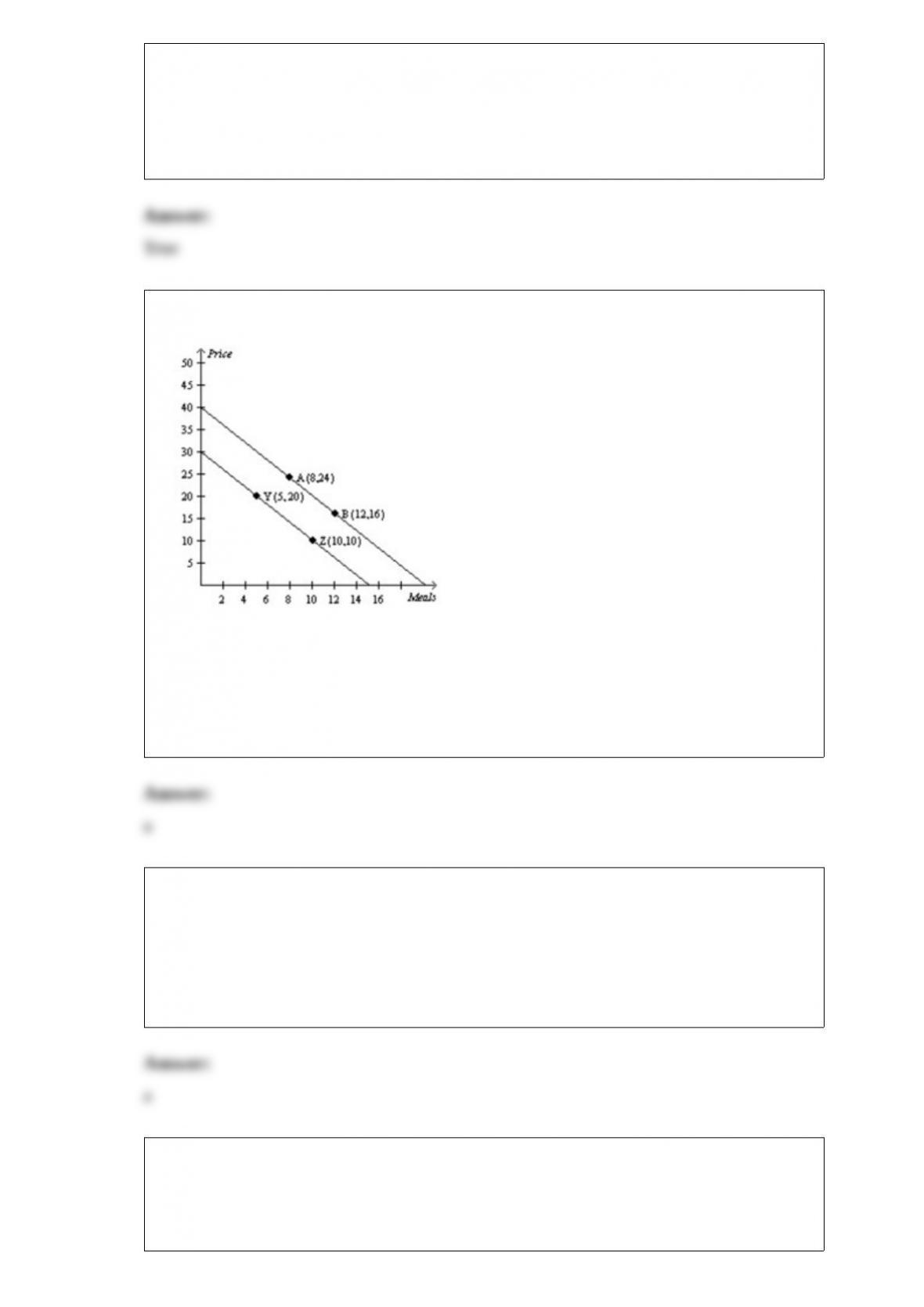
6) Relationship between Price and Restaurant Meals
In the ordered pair (8, 24)
a.the x-coordinate is 8 and the y-coordinate is 24.
b.the x-coordinate is 24 and the y-coordinate is 8.
c.the numbers tell the location of the origin.
d.the 8 represents the price and the 24 represents the number of restaurant meals.
7) If the world price of coffee is lower than Colombia’s domestic price of coffee without
trade, then Colombia
a.should import coffee.
b.has a comparative advantage in coffee.
c.should produce just enough coffee to satisfy domestic demand.
d.should produce no coffee domestically.
8) The breakfast cereal industry, with its concentration ratio of 80%, would best be
described as a(n)
a.perfectly competitive market.
b.monopolistically competitive market.
c.oligopoly.
d.monopoly.
9) When discrimination occurs as a result of employer prejudice, discriminating firms
do not maximize profits.
a.True
b.False
10) In 2009, the top 1 percent of income earners made about
a.1 percent of all income and paid about 1 percent of all taxes.
b.13 percent of all income and paid about 22 percent of all taxes.
c.22 percent of all income and paid about 13 percent of all taxes.
d.50 percent of all income and paid about 50 percent of all taxes.
11) The law of supply states that, other things equal, when the price of a good
a.falls, the supply of the good rises.
b.rises, the quantity supplied of the good rises.
c.rises, the supply of the good falls.
d.falls, the quantity supplied of the good rises.
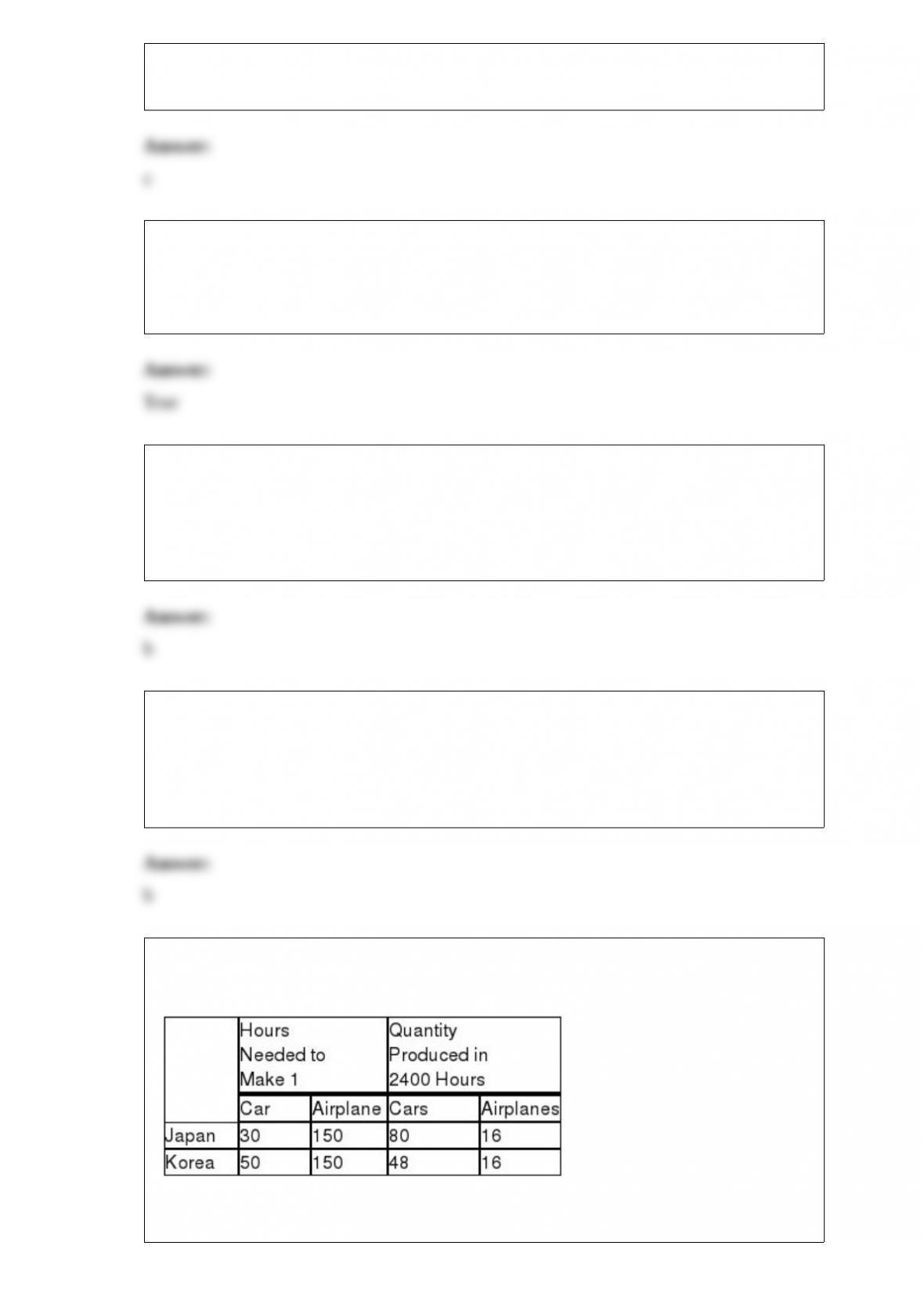
12) Assume that Japan and Korea can switch between producing cars and producing
airplanes at a constant rate.
Assume that Japan and Korea each has 2400 hours available. If each country spends all
its time producing the good in which it has a comparative advantage and trade takes

place at a price of 12 cars for 6 airplanes, then
a.Japan and Korea will both gain from this trade.
b.Japan will gain from this trade, but Korea will not.
c.Korea will gain from this trade, but Japan will not.
d.neither Japan nor Korea will gain from this trade.
13) Milk has an inelastic demand, and beef has an elastic demand. Suppose that a
mysterious increase in bovine infertility decreases both the population of dairy cows
and the population of beef cattle by 50 percent.
Total consumer spending on milk will
a.increase, and total consumer spending on beef will increase.
b.increase, and total consumer spending on beef will decrease.
c.decrease, and total consumer spending on beef will increase.
d.decrease, and total consumer spending on beef will decrease.
14) Firms operating in perfectly competitive markets try to maximize profits.
a.True
b.False