
Consider the following actions undertaken by a firm:
a. charging the same price for products of different quality
b. charging different prices to different consumers for the same product when the
variation cannot be explained by cost differences
c. charging different prices for products of different qualities
d. charging a lower price to match a competitor’s price Which of the above will be
considered price discrimination?
A) a, b, c, and d
B) a, b, and d only
C) b and d only
D) a and b only
Which of the following is the best example of a tariff?
A) a subsidy from the U.S. government to domestic manufacturers of residential air
conditioners to enable them to compete more effectively with foreign producers
B) a limit on the quantity of residential air conditioners that can be imported from a
foreign country
C) a $150 fee imposed on all imported residential air conditioners
D) a tax placed on all residential air conditioners sold in the domestic market to help
offset the impact of emissions on the environment

Fiscal policy is determined by
A) the Federal Reserve.
B) the president and the Federal Reserve.
C) Congress and the Federal Reserve.
D) Congress and the president.
Persistent current account deficits in the United States
A) can be seen as a vote of confidence in the strength of the U.S. economy.
B) cause persistent declines in investment in the United States.
C) cause U.S. investors to accumulate more foreign assets than foreign investors
accumulate U.S. assets.
D) will eventually cause the value of the dollar to rise.
If the Fed does not take into account the additional policy channels available in an open
economy, then ________ when conducting contractionary monetary policy,
A) it is likely to decrease GDP too much and cause a recession
B) it is likely to decrease GDP too little and inflation will persist

C) it is likely to increase GDP too much and inflation will persist
D) it is likely to increase GDP too little and cause a recession
In the United States in 2012, of those companies employing more than 200 workers that
offer health care to those workers, about ________ percent of employees accept the
coverage.
A) 10
B) 36
C) 62
D) 98
If, for a perfectly competitive firm, price exceeds the marginal cost of production, the
firm should
A) increase its output.
B) reduce its output.
C) keep output constant and enjoy the above normal profit.
D) lower the price.
An expansion path shows
A) the level of sales necessary for a firm if it wants to expand.
B) the level of long-run average cost at different scales of operation.
C) the least-cost combination of inputs for each level of output.
D) the returns to scale at each level of output.
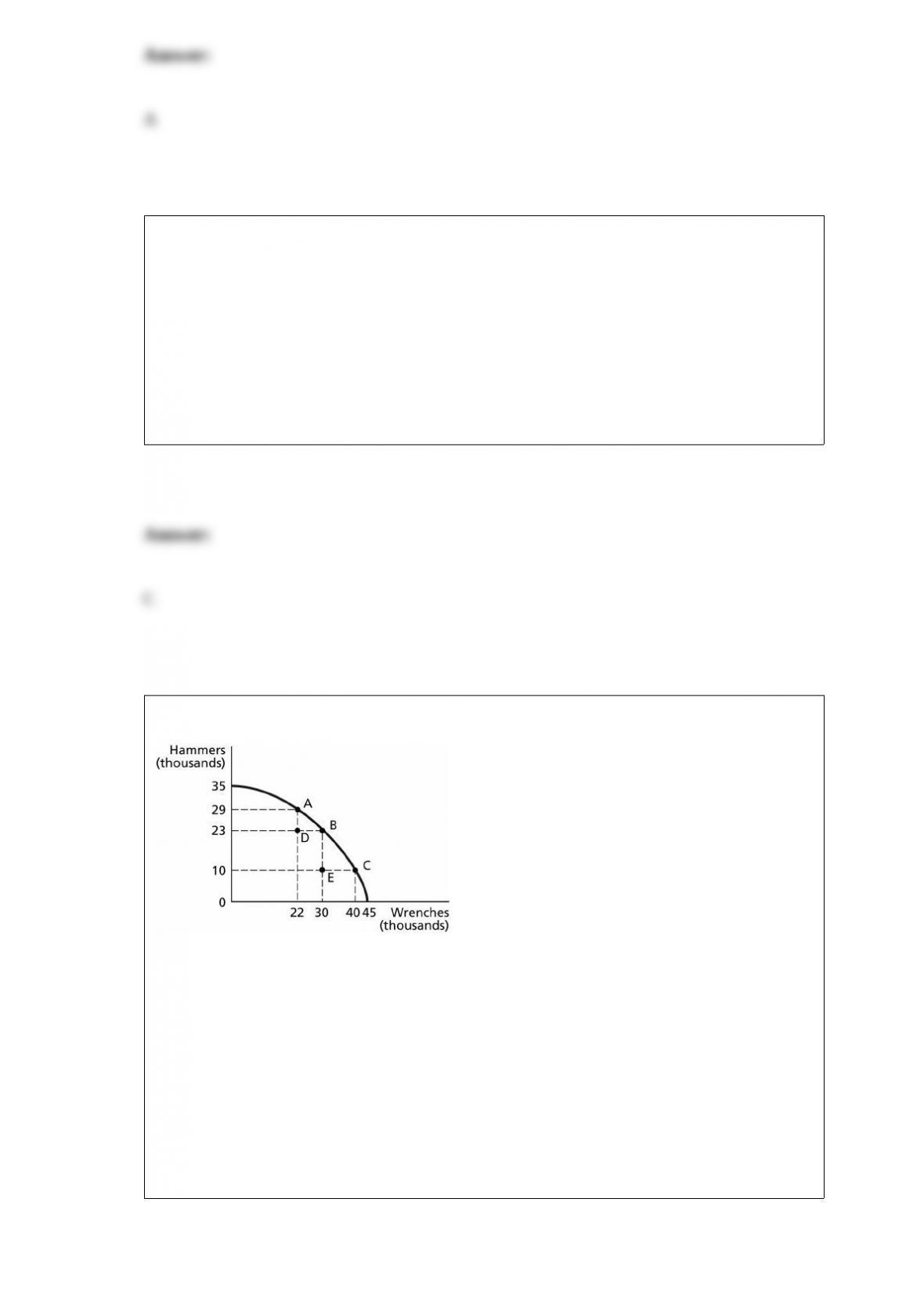
Figure 2-6
If the economy is currently producing at point E, what is the opportunity cost of moving
to point D?
A) 13 thousand hammers
B) 10 thousand hammers
C) 8 thousand wrenches
D) 0 wrenches
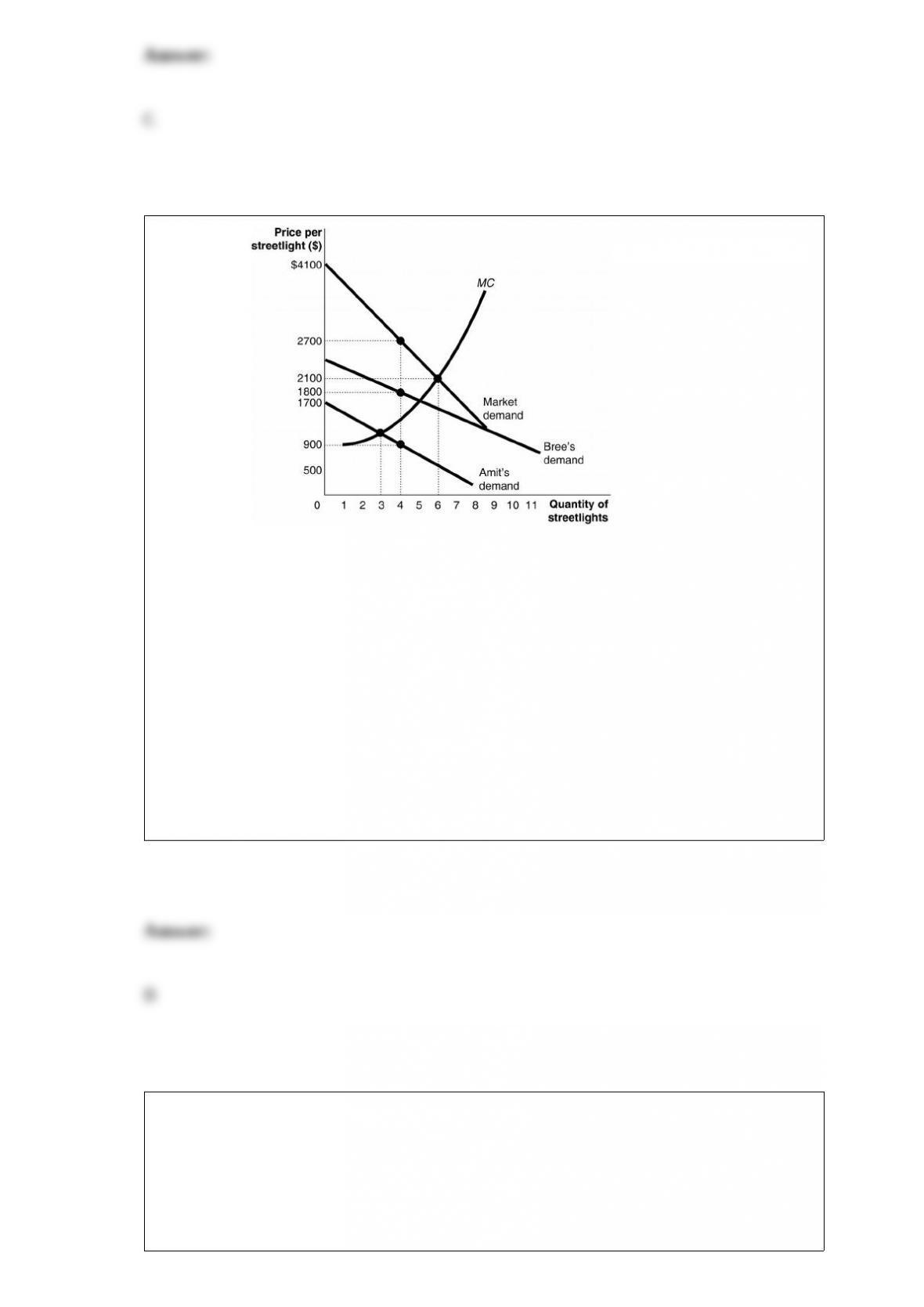
Figure 5-16 Amit and Bree are the
only two homeowners on an isolated private road. Both agree that installing street lights
along the road would be beneficial and want to do so. Figure 5-16 shows their
willingness to pay for Different quantities of street lights, the market demand for street
lights and the marginal cost of installing the street lights. How much is Bree willing to
pay to have 4 street lights installed?
A) $1,500
B) $1,800
C) $2,700
D) $7,200
Which of the following is the best example of a firm that competes in a
monopolistically competitive market?
A) the U.S. Postal Service
B) Microsoft

C) a movie theater
D) an automobile manufacturer
Which of the following correctly describes how an increase in the price level affects
consumption spending?
A) An increase in the price level raises real wealth, which causes consumption to
increase.
B) An increase in the price level decreases the amount of money a household needs to
buy goods and raises the interest rate, which causes consumption to increase.
C) An increase in the price level increases the amount of money a household needs to
buy goods and raises the interest rate, which causes consumption to increase.
D) An increase in the price level lowers real wealth, which causes consumption to
decrease.