1) pure monopolists always earn economic profits.
2) The short-run aggregate supply curve shifts to the left when nominal wages rise in
response to price level increases.
3) monopolistic competition is more like monopoly than pure competition because
sellers have considerable control over price.
4) in economics, a firm earns a normal profit when its total revenue equals its total
economic costs.
5) The closer the Lorenz curve is to the diagonal, the greater is the degree of income
inequality.
6) The Laffer Curve underlies the contention that lower tax rates need not reduce tax
revenues.
7) because economic generalizations are simplifications from reality, they are
impractical and useless.
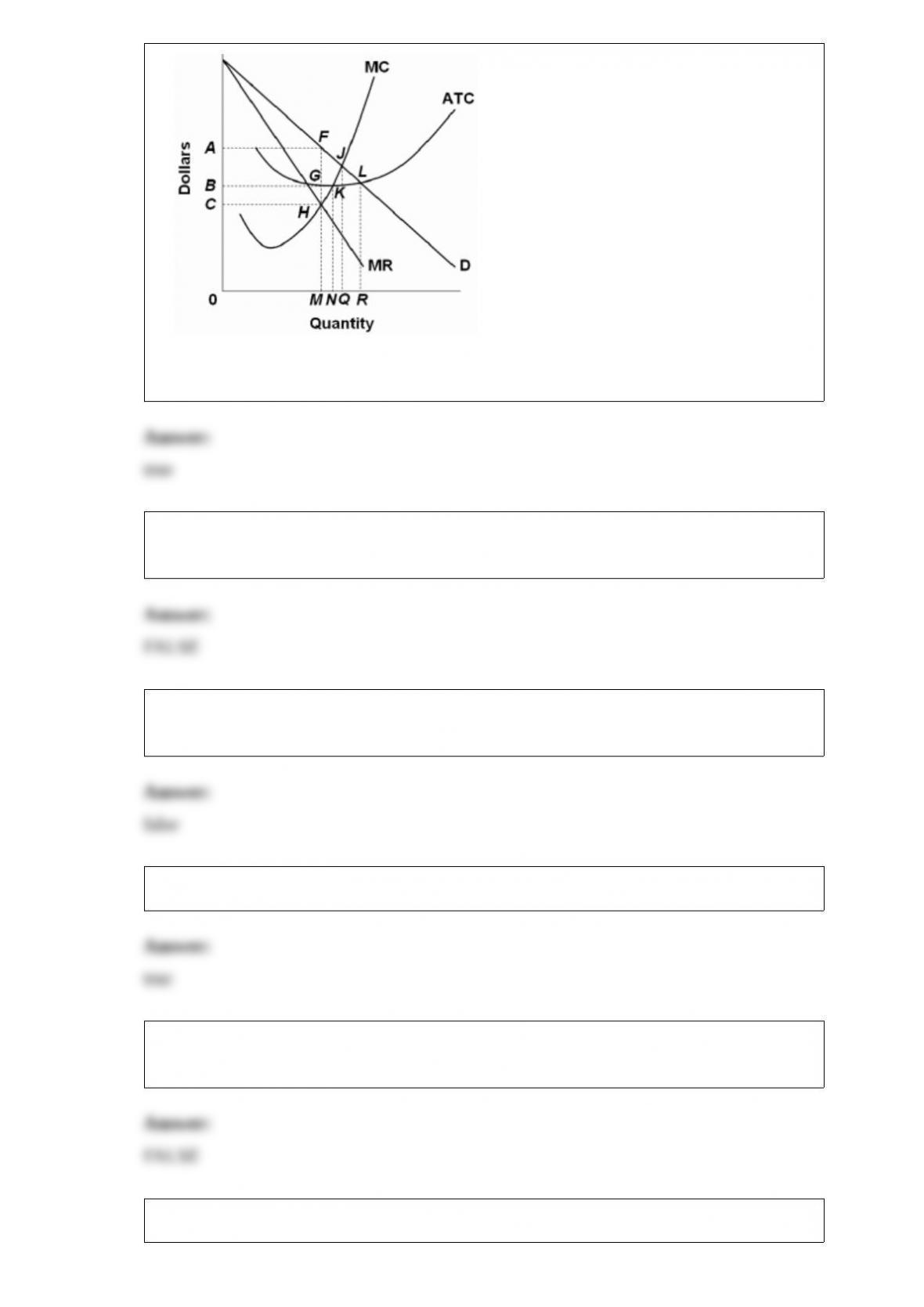
8)
refer to the above diagram for a nondiscriminating monopolist. at the profit-maximizing
output the firm’s economic profit will be bafg.
9) In the theory of coordination failures, shifts of the nation’s long-run aggregate supply
curve are the main cause of business cycles.
10) improvements in education and training explain about 80 percent of the historical
growth of u.s. labor productivity.
11) strong patent laws encourage innovation and promote economic growth.
12) The benefits-received principle of taxation is used to support corporate and personal
income taxes.
13) Higher user costs imply that a resource should be extracted more quickly.
14) a rational consumer will try to achieve the highest indifference curve that his or her
income will allow.
15) Under the Food, Conservation, and Energy Act of 2008, subsidies to farmers based
on gaps between actual prices of crops and targeted prices are called:
A.direct payments.
B.price supports.
C.countercyclical payments.
D.price gap set-asides.
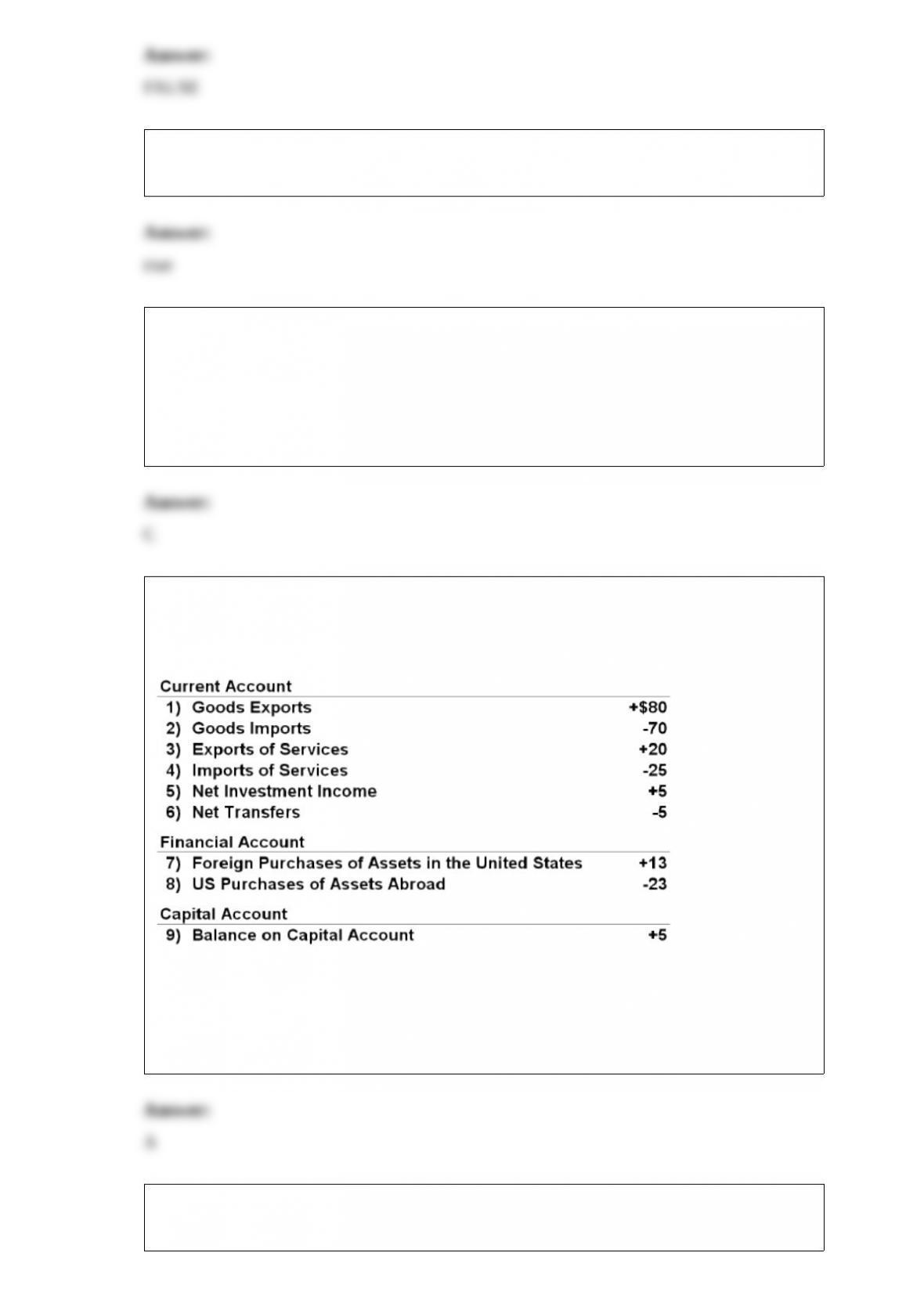
16) The following 2006 balance of payments data (+ and -) for the hypothetical nation
of Zabella. All figures are in billions of dollars.
Refer to the above data. Zabella’s balance on capital and financial account shows a:
A.deficit of $5 billion.
B.surplus of $10 billion.
C.deficit of $10 billion.
D.surplus of $5 billion.
17) which of the following activities is excluded from gdp, causing gdp to understate a
nation’s well-being?
a.the services of health care workers
b.the services of military personnel
c.the construction of new buildings
d.goods and services produced in the underground economy
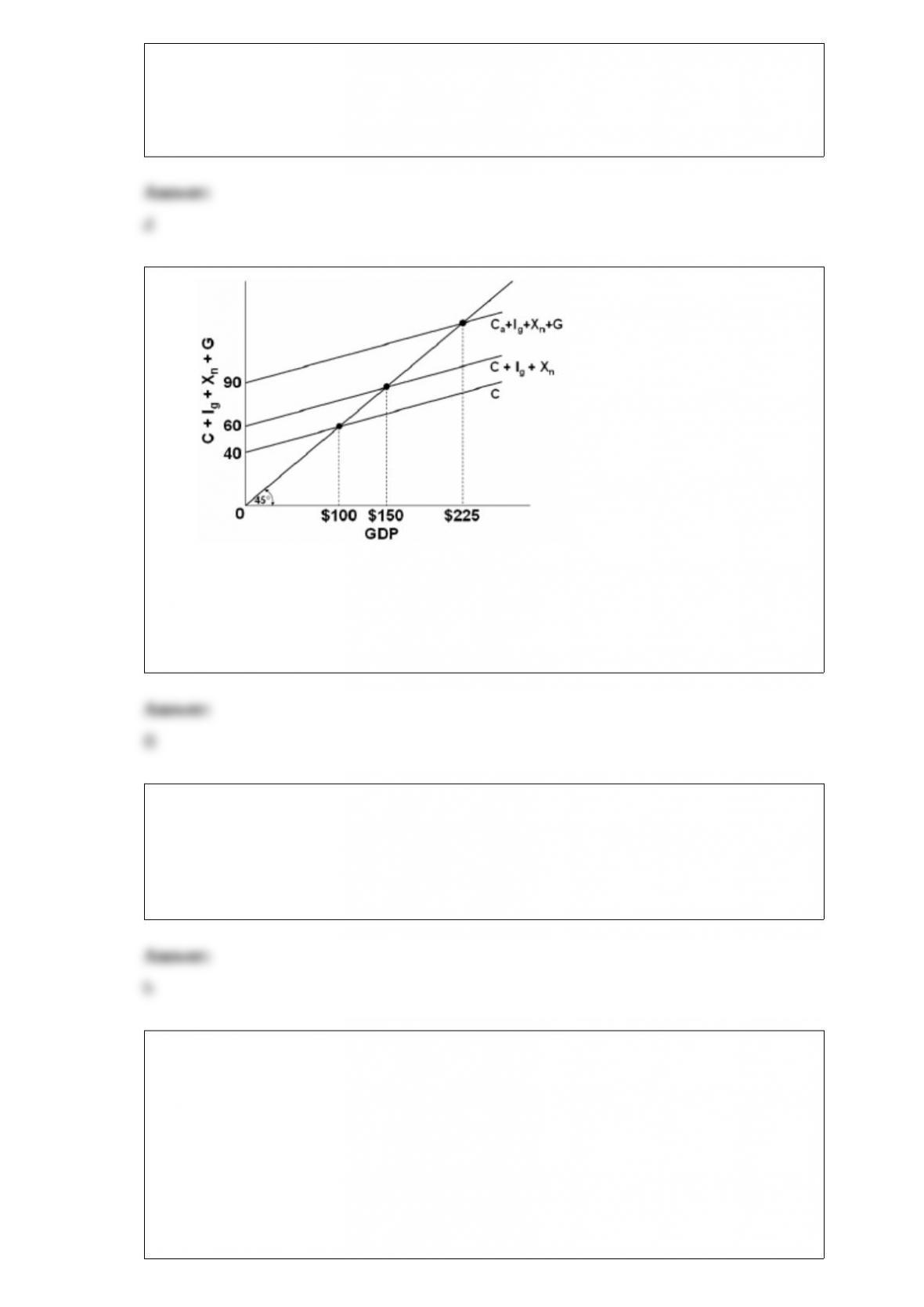
18)
Refer to the above diagram. The level of government spending:
A.is equal to tax collections at each level of GDP.
B.is the same at all levels of GDP.
C.varies inversely with the level of GDP.
D.varies directly with the level of GDP.
19) increases in product prices shift the consumer’s:
a.budget line to the right.
b.budget line to the left.
c.indifference curves to the left.
d.indifference curves to the right.
20) alejandro scoobertini owns a store specializing in soccer jerseys. in 2008, he
purchased $150,000 worth of jerseys from manufacturers, employed one worker for
$40,000, purchased $20,000 worth of supplies from an office supply store, and sold
jerseys for $280,000. based on this information, what was the value added at alejandro’s
store in 2008?
a.$70,000
b.$110,000
c.$280,000
d.$490,000
21) To achieve economic efficiency in energy use, an economy:
A.often uses a variety of energy sources.
B.must use the single energy source in which it can achieve economies of scale.
C.should use all energy sources in equal proportion.
D.should only use domestically produced energy.
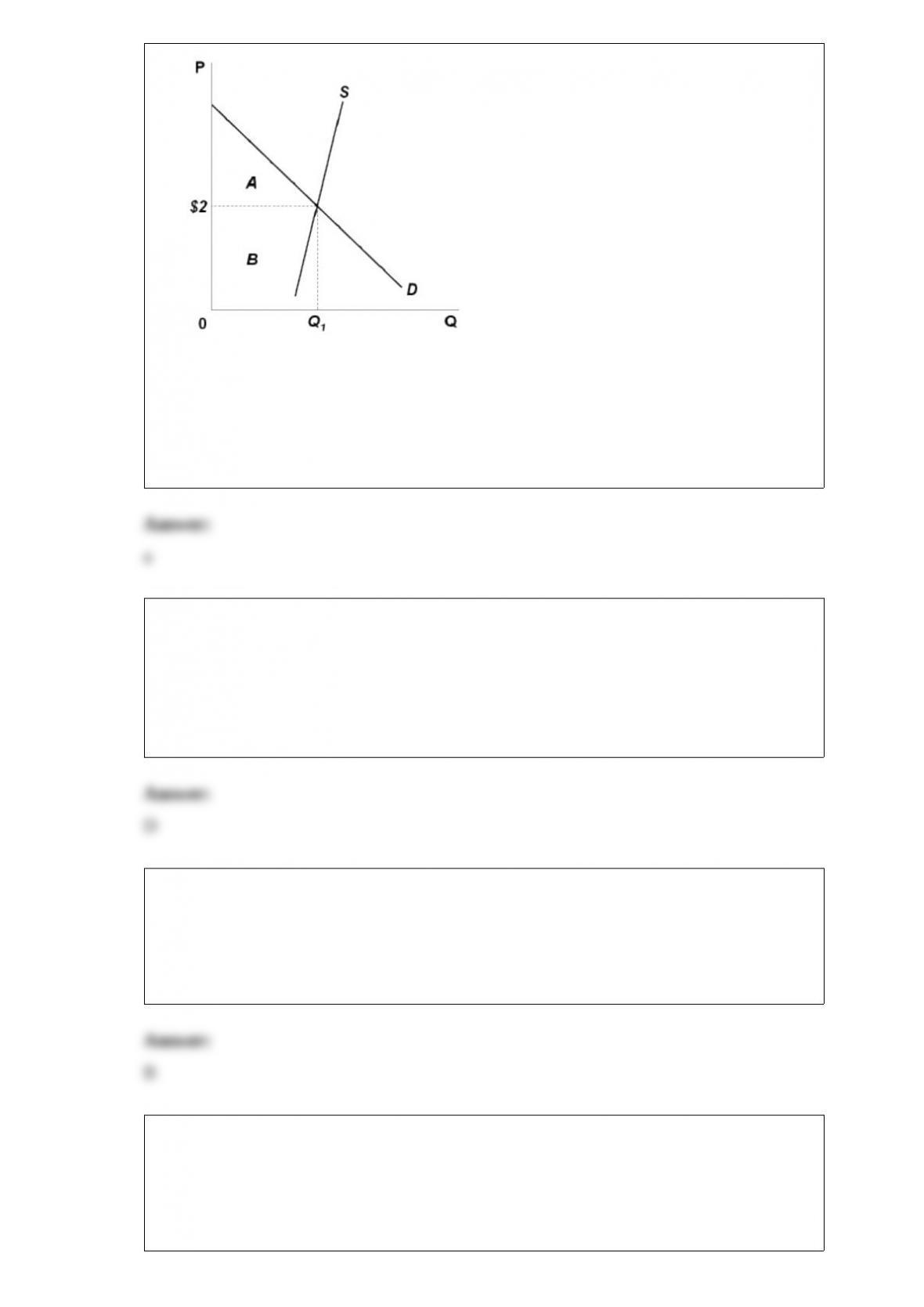
22)
Refer to the above diagrams. The numbers in parentheses after the AD1, AD2, and AD3
labels indicate the levels of investment spending associated with each curve. All figures
are in billions. If aggregate demand is AD3 and the monetary authorities desire to
reduce it to AD2, they should:
A.increase the interest rate from 3 percent to 9 percent.
B.increase the money supply from $100 to $120.
C.decrease the money supply from $120 to $100.
D.decrease the interest rate from 3 percent to 9 percent.
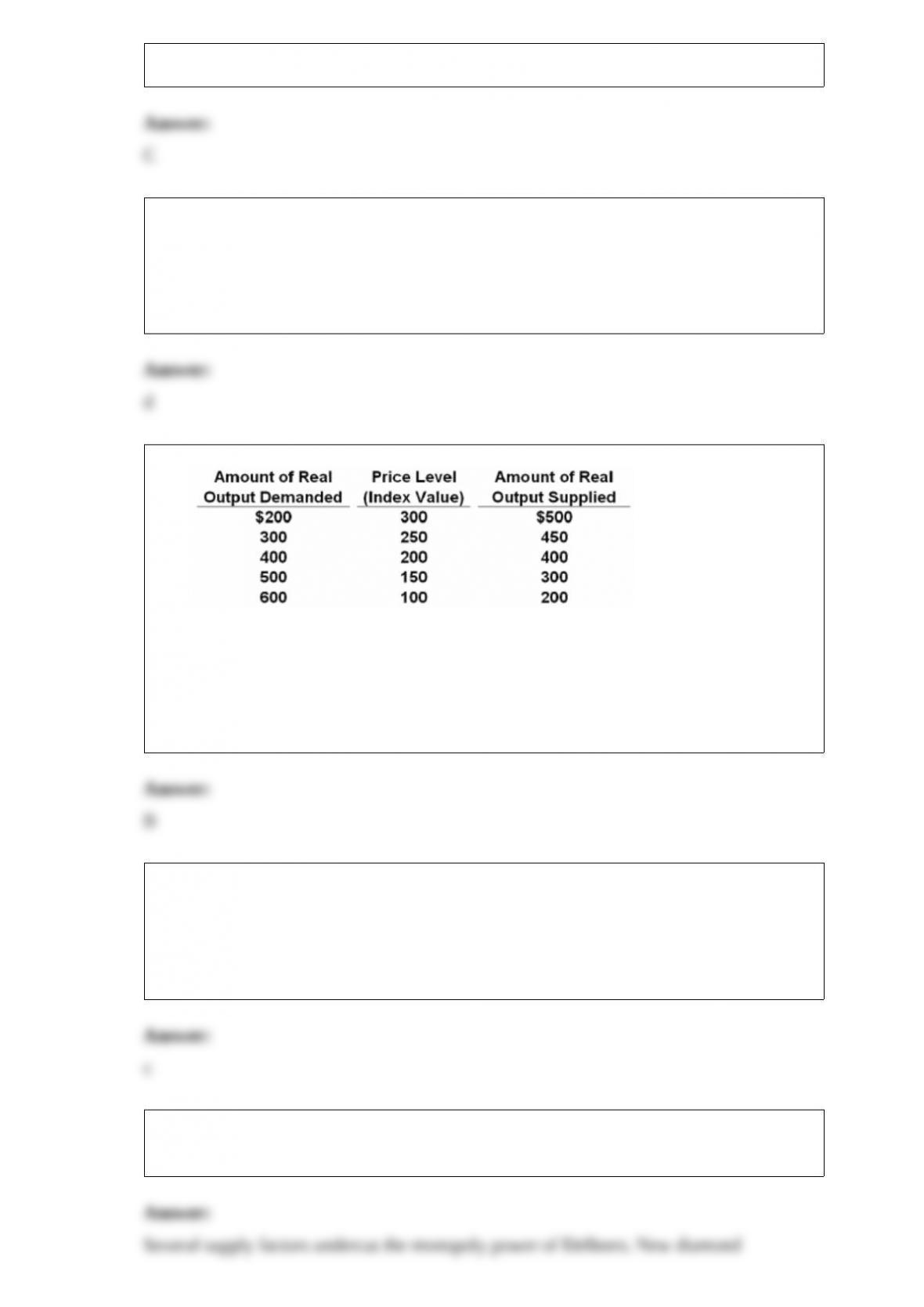
23)
refer to the above graph of the market for asparagus. at the market price of $2, area a +
b represents:
a.total consumer utility.
b.total revenue to sellers.
c.consumer surplus.
d.returns to capital and to labor.
24) The market for immediately available reserve balances at the Federal Reserve is
known as the:
A.money market.
B.long-term bond market.
C.short-term bond market.
D.Federal funds market.
25) The spread of innovation through imitation refers to:
A.invention.
B.diffusion.
C.duplication.
D.diversification.
26) Assume that a firm’s production technique is such that varying combinations of
labor and capital can be used to produce output. If the price of labor falls relative to the
price of capital and the firm decides to use more labor in the production process, this
decision is:
A.solely the result of the substitution effect.

B.solely the result of the output effect.
C.probably the result of both the substitution and output effects.
D.the result of neither the substitution nor the output effect.
27) Suppose population A, consisting of Al, Bob, Curt, Doris, and Ellie, receive annual
incomes of $5,000, $2,500, $1,250, $750, and $500, respectively.
Refer to the above information. What percentage of total income is received by the
lowest 60 percent of the income receivers in population A?
A.60
B.50
C.25
D.18
28) At equilibrium real GDP in a private closed economy:
A.the MPC must equal the APC.
B.the slope of the aggregate expenditures schedule equals the MPS.
C.aggregate expenditures and real GDP are equal.
D.planned saving and consumption are equal.
29) if mua/pa= 100/$35 = mub/pb= 300/? = muc/pc= 400/?, the prices of products b and
c in consumer equilibrium:
a.cannot be determined from the information given.
b.are $105 and $140 respectively.
c.are $105 and $175 respectively.
d.are $100 and $200 respectively.
30) Which of the following statements is true?
A.The Federal Reserve sets the Federal funds rate.
B.The Federal Reserve sets the target for the Federal funds rate, and then uses the
reserve ratio to push banks toward that target.
C.The Federal Reserve does not set the Federal funds rate, but it influences it through
the use of open market operations.
D.The Federal Reserve will set a higher target for the Federal funds rate if pursuing an
expansionary monetary policy.
31) price discrimination is:
a.always legal.
b.always illegal.
c.only illegal if it hurts consumers more than non-discrimination.
d.only illegal if used to lessen or eliminate competition.
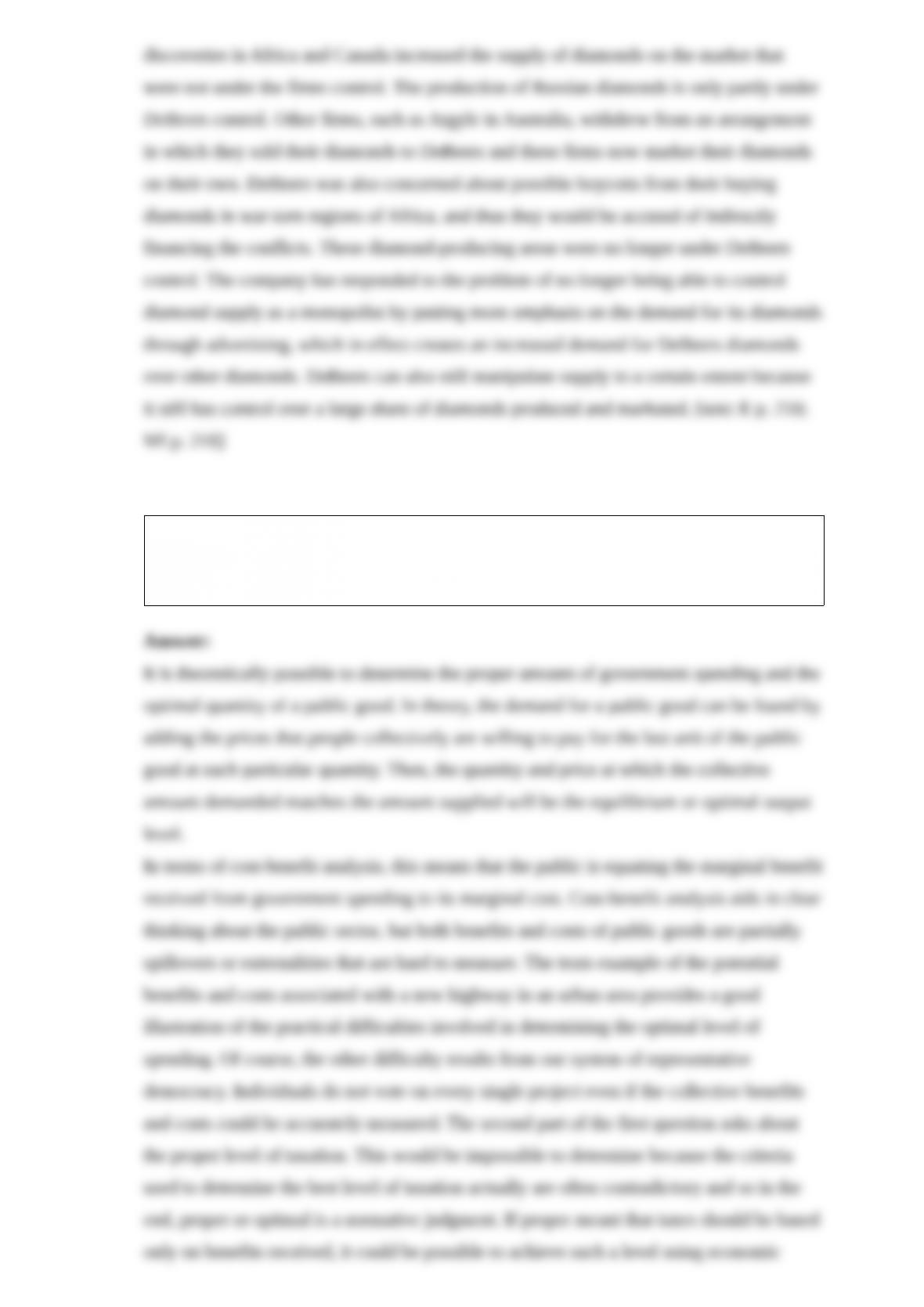
32)
Refer to the above data. The equilibrium price level will be:
A.150.
B.200.
C.250.
D.300.
33) a nation’s stock of capital goods will decline when:
a.gross investment exceeds net investment.
b.net investment is positive, but less than gross investment.
c.depreciation exceeds gross investment.
d.gross investment exceeds depreciation.
34) What market forces made DeBeers change its monopoly behavior and end its
attempts to control the diamond market?
35) Can economic analysis precisely determine the proper levels of government
spending and taxation? In your answer explain the problems in using cost-benefit
analysis.
36) The following data show nominal GDP and the appropriate price index for several
years. Compute real GDP for each year and indicate whether you have inflated or
deflated nominal GDP in finding real GDP. All GDP are in billions.
37) (Consider This) How did economist Irving Fischer explain interest to a masseur?
38) Explain what critics see as the problem with social regulation.
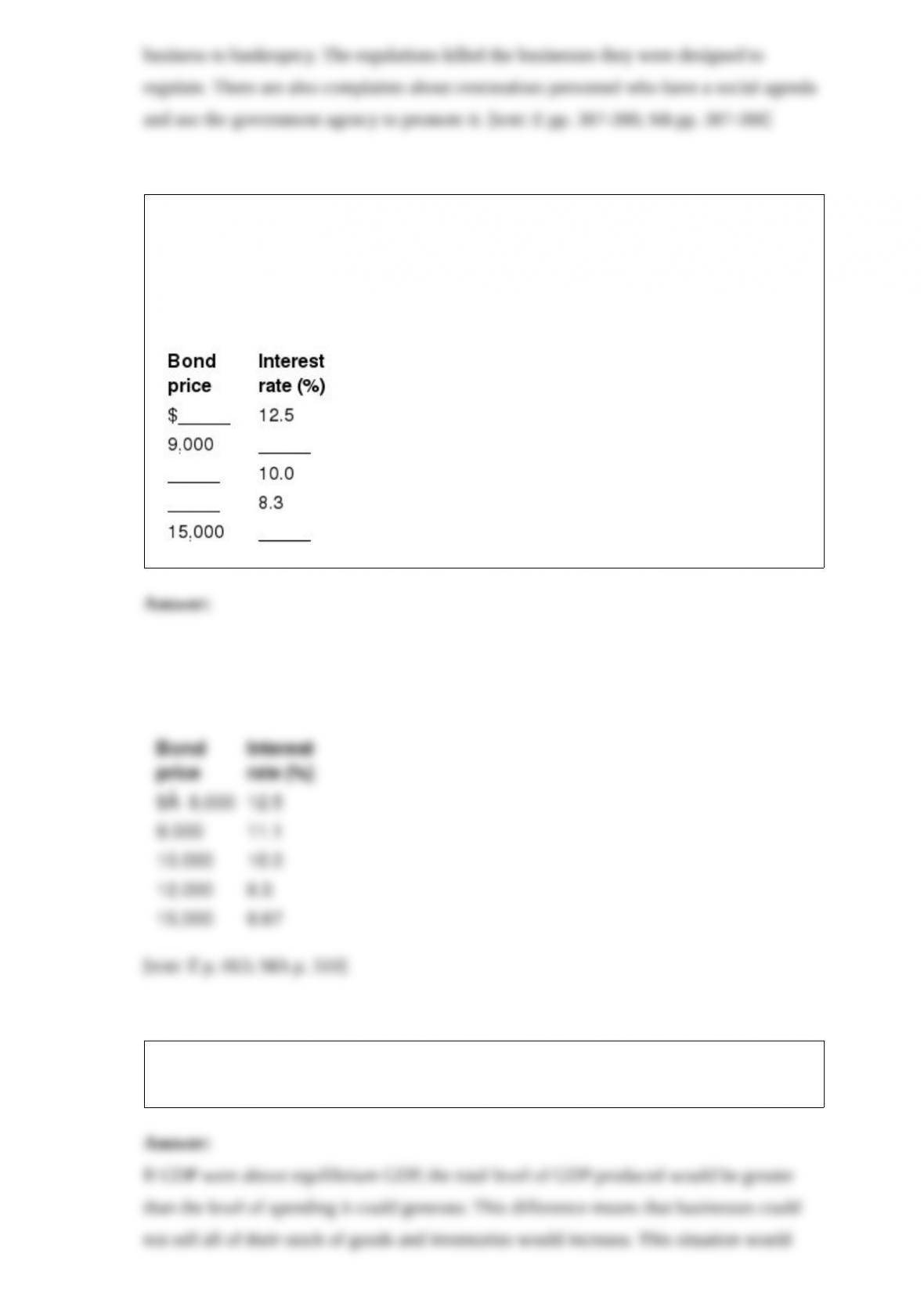
39) Suppose that a bond having no expiration date has a face value of $10,000 and pays
a fixed amount of interest of $1000 annually. Compute and enter in the spaces provided
either the effective interest rate which a bond buyer could receive at the new price or
the bond price (rounded to the nearest $1000) required to receive the interest rate
shown.
40) Explain how GDP would return to equilibrium if it was above or below equilibrium
GDP.
41) Monopoly has developed in both product and resource markets because of the
shortcomings and inefficiencies of competitive markets. Do you agree? Explain.
42) Can you imagine graphically a case where the efficiency loss from a tax would
equal zero? Explain.