1) immigration of workers is an example of a goods and services flow:
2) Advocates of the minimum wage argue that its effects should be analyzed within the
context of a dynamic and imperfectly competitive labor market.
3) disposable income measures the before-tax income received by resource suppliers.
4) After the implementation of TANF, the U.S. welfare rolls fell by more than one-half
between 1996 and 2007.
5)
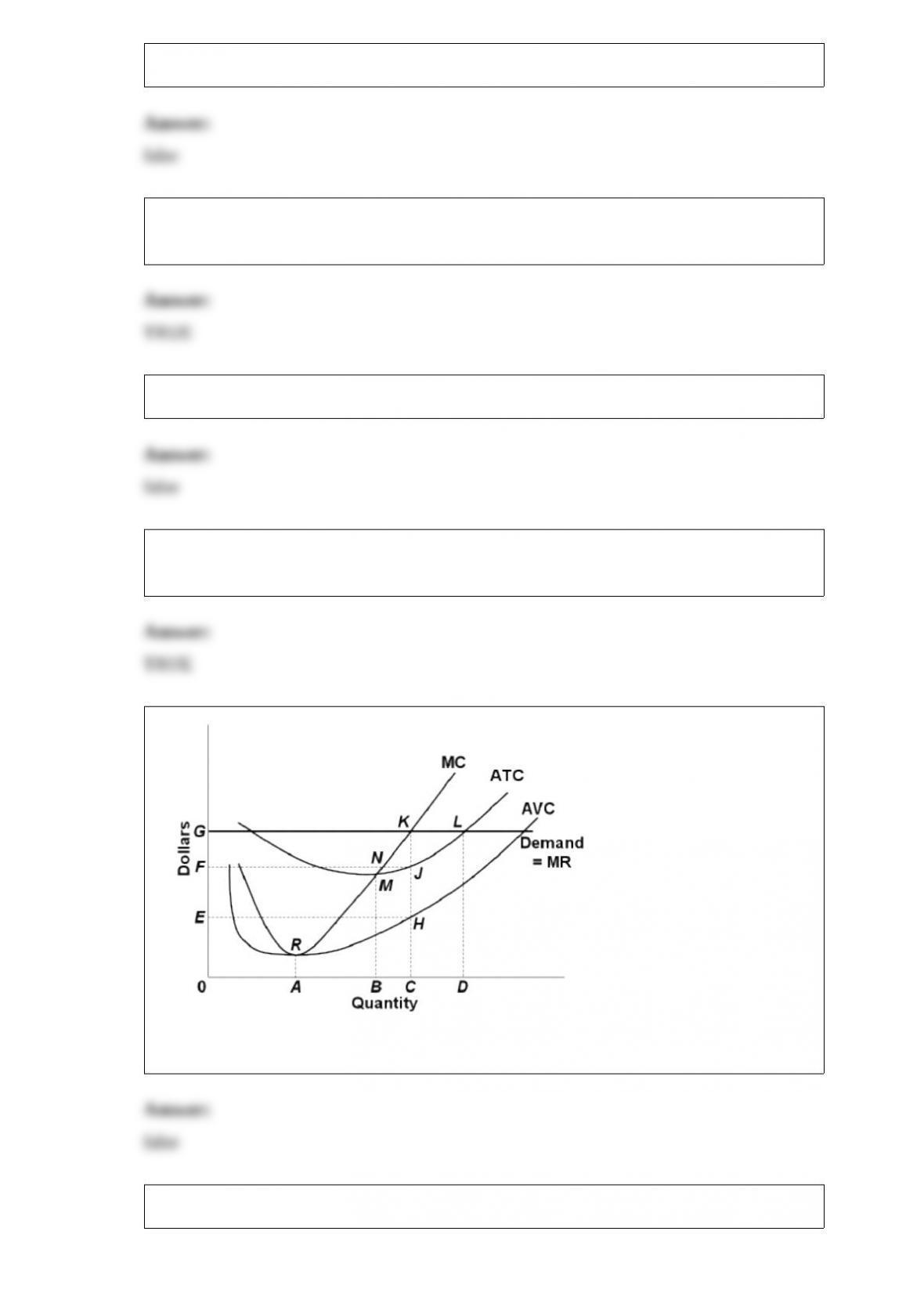
refer to the above diagram. if demand fell to the level of fnj, there would be no output at
which the firm could realize an economic profit.
6) Monopolization is illegal under Section 1 of the Sherman Act.

7) an increase in total spending generates economic growth by shifting the production
possibilities curve farther from the origin.
8) Cost-push inflation is depicted as a rightward shift of the aggregate demand curve
along an upsloping aggregate supply curve.
9) Which of the following statements is most consistent with the benefits-received
principle of taxation?
A.A childless couple should not be required to pay taxes for the support of public
schools.
B.Prosperous corporations should pay substantial taxes even if they use few
government goods and services.
C.The best tax is the income tax.
D.People with high incomes should pay more taxes than people with low incomes.
10) A breakdown of the shares of economic production for two different countries is
listed below, along with per capita income and growth rate. Use this information to
calculate the growth rates per sector and answer the following questions.
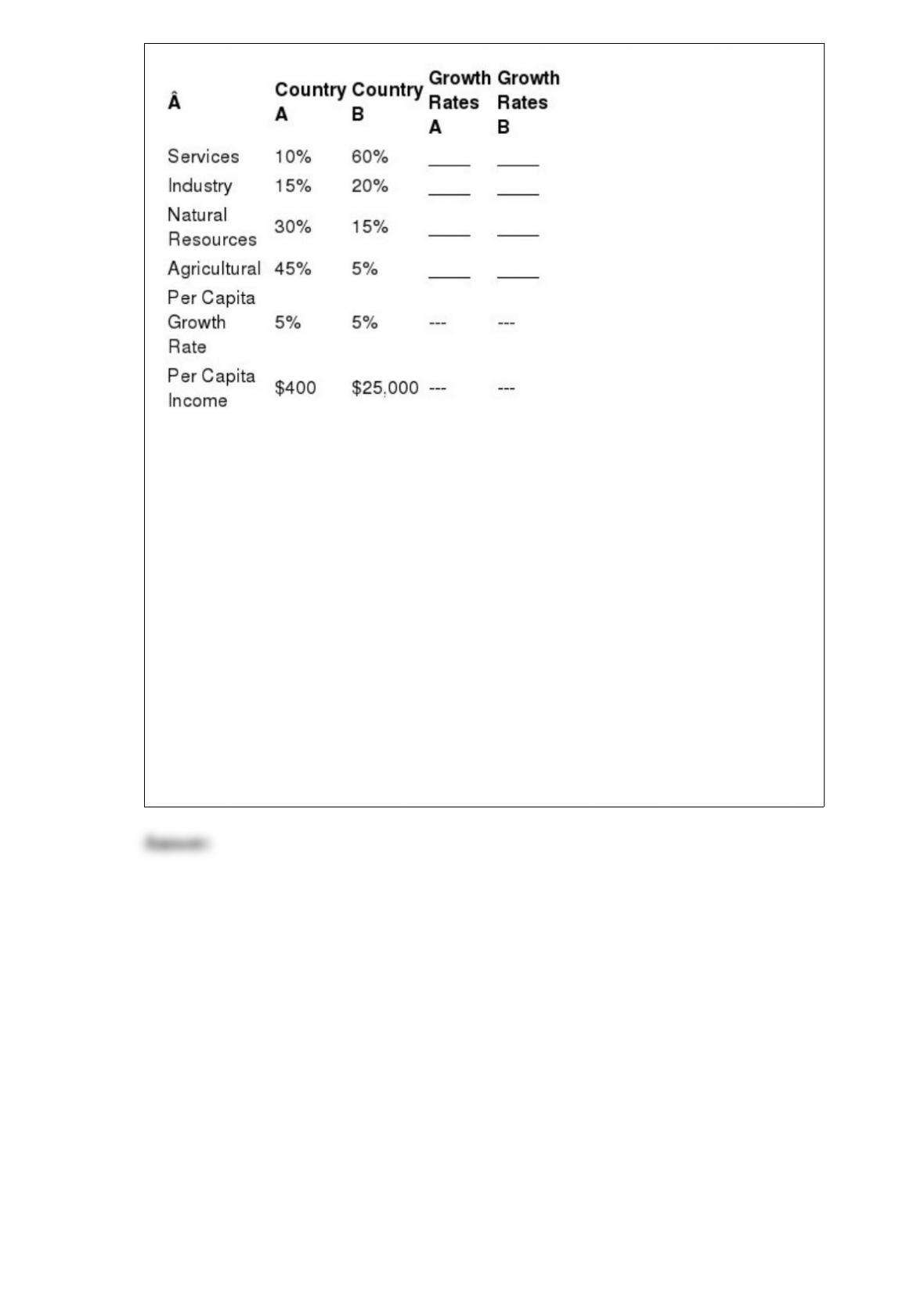
(a)What is the amount of per capita growth in countries A and B? Will the growth
increase, decrease or maintain the income gap?
(b)Suppose country As economy becomes more industrialized, increasing the
productive share of services and industry. What likely effect will this having on country
As growth rate? Suppose as a result of this change the growth rate of services and
industry is now 3.5% and 2.5% respectively, while the rates for natural resources and
agriculture remain the same. What is the new total growth rate? What is the new
distribution of the economy? What is the effect of the new growth on the income gap?
(c)What growth rate would country A have to maintain to reduce the income gap with
country B by 10%, assuming country B grew by 5%? If country B grew by 2%? If
country B experienced no growth?
(d)What growth rate would country A have to maintain to reduce the income gap with
country B completely if country B experienced 3% growth?
(e)What do your answers in (a) through (d) tell you about the situation facing
developing countries? How does the element of time (growth over several years)
change your answer?
11) (Consider This) According to the Consider This box on catfish and art, which of the
following firms were recently convicted of price fixing?
A.Dell and Gateway (personal computer makers)
B.Boeing and Airbus (aircraft manufacturers)
C.Heinz and Del Monte (food product firms)
D.Sotheby’s and Christy’s (art auction houses)
12) Capital and labor:
A.are always complementary.
B.are always substitutable.
C.may be either complementary or substitutable.
D.are both normal inputs.
13) If the United States wants to increase its net exports, it might take steps to:
A.increase its GDP.
B.reduce existing tariffs and import quotas.
C.decrease the dollar price of foreign currencies.
D.increase the dollar price of foreign currencies.
14)
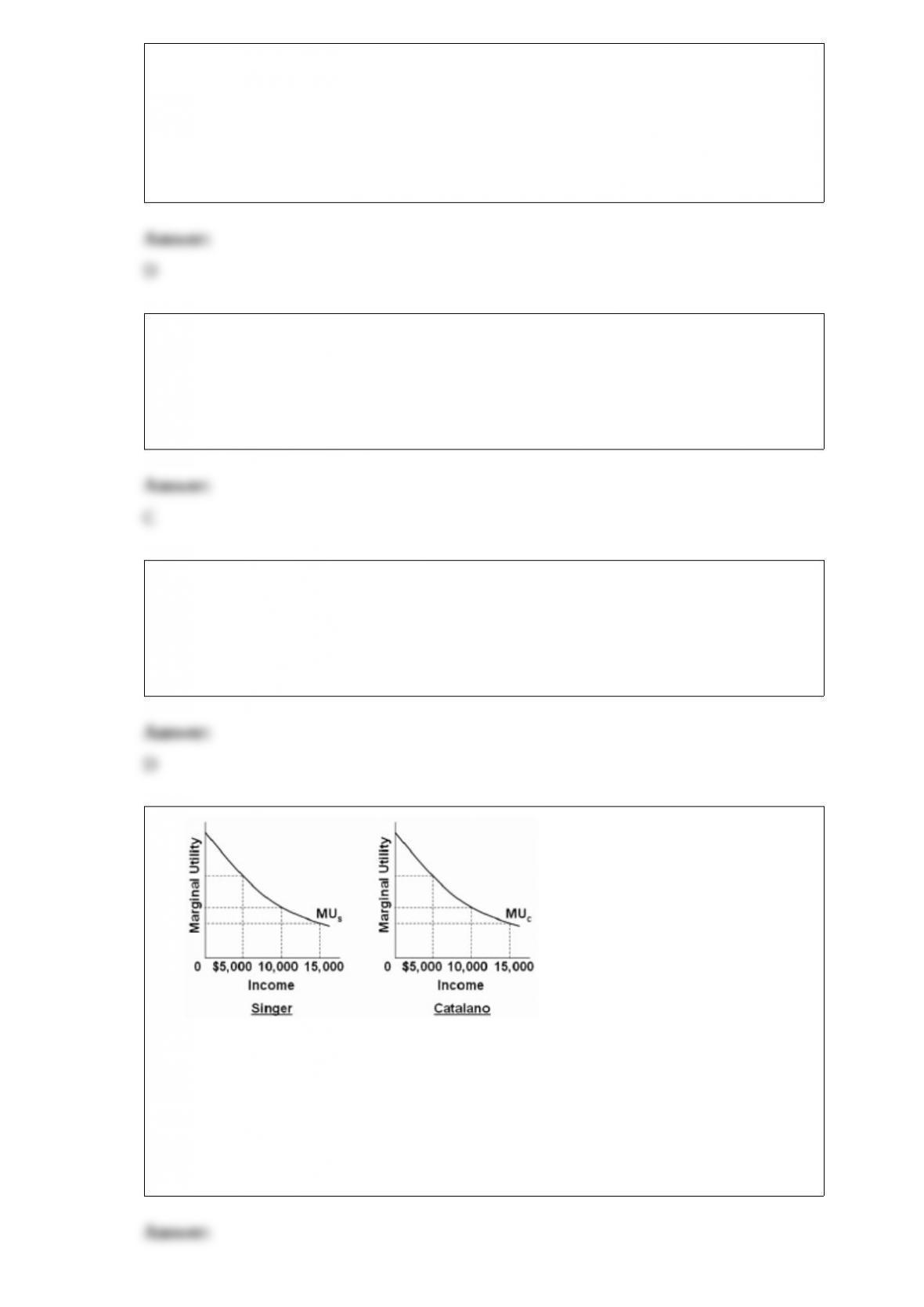
Refer to the above diagrams that show identical marginal utility from income curves for
Singer and Catalano. The marginal utility from income curves are drawn on the
assumption that:
A.Singer buys more inferior goods than does Catalano.
B.Singer and Catalano have identical capacities to enjoy income.
C.Catalano has a greater capacity to enjoy income than does Singer.
D.Singer has a greater capacity to enjoy income than does Catalano.
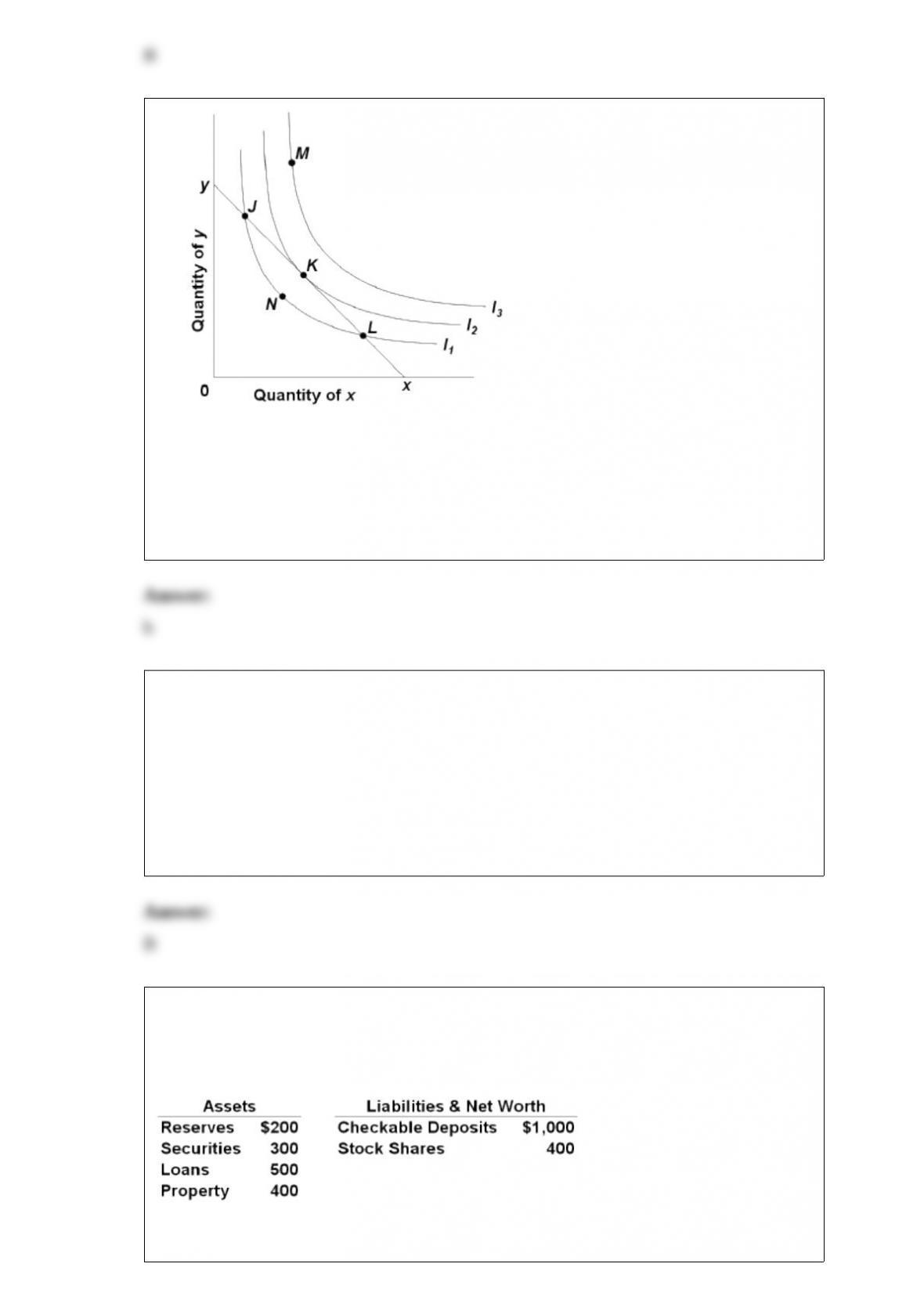
15)
refer to the above diagram where xy is the relevant budget line and i1, i2, and i3 are
indifference curves. at point k:
a.mux = muy.
b.mrs = px/py.
c.mrs = py/px.
d.px exceeds py.
16) Which of the following statements is correct?
A.The supply of money decreases when the Federal Reserve Banks buy government
securities from households or businesses.
B.Excess reserves are the amount by which actual reserves exceed required reserves.
C.Commercial banks decrease the supply of money when they purchase government
bonds from households or businesses.
D.Commercial bank reserves are a liability to commercial banks but an asset to the
Federal Reserve Banks.
17) The following consolidated balance sheet of the commercial banking system.
Assume that the reserve requirement is 20 percent. All figures are in billions and each
question should be answered independently of changes specified in all preceding ones.
Refer to the above data. The commercial banking system has excess reserves of:
A.zero.

B.$2 billion.
C.$5 billion.
D.$10 billion.
18) Henry George advocated a single tax on:
A.real capital.
B.entrepreneurial profits.
C.land.
D.labor income.
19) if actual gdp is less than potential gdp:
a.potential gdp will fall.
b.the price level will rise.
c.investment spending will fall.
d.the actual unemployment rate will be higher than the natural unemployment rate.
20) From 2004 to 2006 the Fed raised the Federal funds rate gradually in a series of
steps. The Fed’s purpose was to raise the prime interest rate so that:
A.high inflation rates would fall.
B.aggregate demand would continue to grow consistently and with low inflation.
C.aggregate supply would grow, increasing output and lowering the price level.
D.banks would reduce lending that was building up unmanageable consumer debt.
21) What is the difference in the explanation of the shape of the aggregate demand
curve and a single product demand curve? After all, both demand curves show an
inverse relationship between price and quantity.
22) What factors have contributed to growing inequality in incomes in the United
States?
23) Explain how the money market responds to a shortage of money or to a surplus of
money.

24) Describe the graph for a long-run supply curve in an increasing-cost industry. Why
does it have this slope?
25) The Federal Reserve Banks are bankers banks. Explain.
26) A state decides to pass a new law raising the excise tax on cigarettes. What would
be the probable incidence of this new tax?
27) Which is more effective in blocking imports, a tariff or a quota?
28) The price level in the United States is more flexible downward than upward.
FALSE