
If the CPI equaled 1.43 in 2008and 1.56 in 2009, then between 2008 and 2009 there
was:
A. inflation.
B. deflation
C. a recession
D. an expansion
Last year Christine worked as a consultant. She hired an administrative assistant for
$15,000 per year and rented office space (utilities included) for $3,000 per month. Her
total revenue for the year was $100,000. If Christine hadn’t worked as a consultant, she
would have worked at a real estate firm earning $40,000 a year.
Last year, Christine’s accounting profit was ______ and her economic profit was
______.
A. $100,000; $64,000
B. $64,000; $49,000
C. $49,000; $9,000
D. $9,000; 0

Public saving is positive when:
A. there is a government budget surplus.
B. after-tax income of households and businesses is less than consumption
expenditures.
C. the government’s budget is balanced.
D. after-tax income of households and businesses is greater than consumption
expenditures.
Changes in planned spending not caused by changes in output or the inflation rate will
shift the:
A. aggregate supply curve.
B. Keynesian cross.
C. potential output line.
D. aggregate demand curve.

Pat has just graduated from college and has two job offers. One pays $45,000 and
requires that Pat supervise employees doing construction work on a busy highway. The
other is an office job that pays $40,000. Chris has received the same offers from the
same firms. Pat values the added safety of the office job at $6,000 per year, and Chris
values the added safety of the office job at $3,000 per year. Suppose that the agency that
regulates highway safety requires that the highway construction firm provide additional
safety precautions. After the changes, Chris places no additional value on working at
the office, and Pat values the added safety of the office job by $2,000 per year. If the
safety precautions cost the firm $3,000 per year and the highway construction firm
reduces salaries by $3,000 to $42,000, then:
A. Pat will prefer the office job, and Chris will be indifferent between the two jobs.
B. both will prefer the highway job.
C. both will prefer the office job.
D. Chris will prefer the highway job, and Pat will be indifferent between the two jobs.
The value of intermediate goods is excluded from the measurement of GDP in order to:
A. adjust for inflation.
B. avoid double counting.
C. index economic activity.
D. measure GDP in constant prices.
You are trying to decide whether to purchase the latest Harry Potter book online or
borrow it from the library. There is no charge for borrowing a book from the library, but
going to the library takes more time than ordering a book online. Regardless of how
you get the book, its benefit to you is the same. If the cost of buying the book online is
$13, then you should:
A. borrow the book from the library because you can get it from the library for free.
B. borrow the book from the library if the cost of doing so (in terms of the extra time it
takes) is less than $13.
C. borrow the book from the library if the cost of doing so (in terms of the extra time it
takes) is greater than $13.
D. buy the book online because it takes less time.
The figure below shows the marginal benefit of having a security camera at the library
(MBL), the supermarket (MBS), and the museum (MBM). The marginal cost of hiring a
security guard is the same at all three places and is given by MC.
The optimal number of security cameras is ______ at the library, ______ at the super
market, and ______ at the museum.
A. 2; 5; 8
B. 4; 4; 4
C. 8; 5; 2
D. 5; 8; 11

Who from among the following would be classified as employed?
A. Brenda Smith, an 18 year old full-time college student.
B. Mario Faubert, a NHL hockey player at home sick with the flu.
C. Jack Little, a 21 year old new college graduate actively looking for his first job.
D. Sarah Lopez, a retired public school teacher.
The tendency for marginal utility to decline as consumption increases beyond some
point is called:
A. the law of demand
B. the law of diminishing marginal utility
C. the rational spending rule
D. utility maximization

If the Central Bank of Macroland puts an additional 1,000 dollars of currency into the
economy, the public deposits all currency into the banking system, and banks have a
desired reserve/deposit ratio of 0.10, then the banks will eventually make new loans
totaling ______ and the money supply will increase by _______.
A. $1,000; $1,000
B. $9,000; $9,000
C. $9,000; $10,000
D. $1,000; $9,000
In the short run, with predetermined prices, when output is less than planned aggregate
expenditure:
A. potential output is greater than short-run equilibrium output.
B. potential output is less than short-run equilibrium output.
C. planned investment is less than actual investment.
D. planned investment is greater than actual investment.

Dave’s Mirror Company expects to sell $1,000,000 worth of mirrors and to produce
$1,250,000 worth of mirrors in the coming year. The company purchases $300,000
worth of new equipment during the year. Sales for the year turn out to be $900,000.
Actual investment by Dave’s Mirror Company equals ______ and planned investment
equals _______.
A. $250,000; $150,000
B. $300,000; $200,000
C. $550,000; $450,000
D. $650,000; $550,000
When the price of insulin is $10, consumers demand 100 units; when the price is $15,
consumers demand 100 units; and when the price is $20, consumers demand 100 units.
Based on this information, the demand for insulin is:
A. unit elastic
B. perfectly elastic
C. perfectly inelastic
D. elastic
Imagine that you are an entrepreneur, making designer t-shirts in your garage. Your
total cost (in dollars) is given by the equation TC = 300 + 10Q, where Q represents the
number of t-shirts you make. If you make 100 t-shirts, your average total cost is
______.
A. $3
B. $10
C. $3.10
D. $13
Advances in information and communication technology are the principal factors cited
for the:
A. slowdown in productivity growth between 1973 and 1995.
B. speedup in productivity growth between 1973 and 1995.
C. slowdown in productivity growth since 1995.
D. speedup in productivity growth since 1995.

In Macroland, potential output equals $100 trillion and the natural rate of
unemployment is 4 percent. If the actual unemployment rate is 5 percent, then real GDP
must be:
A. $98 trillion.
B. $96 trillion.
C. $102 trillion.
D. $104 trillion.
If you have a comparative advantage in a particular task, then:
A. you are better at it than other people.
B. you give up more to accomplish that task than do others.
C. you give up less to accomplish that task than do others.
D. you have specialized in that task, while others have not.

The application of new technologies to the production process will increase:
A. average labor productivity.
B. the share of the population employed.
C. the unemployment rate.
D. the quantity of human capital.
Increasing wage inequality results when international trade leads to ______ wages for
workers in exporting industries and ______ wages for workers in importing industries.
A. higher; higher
B. higher; lower
C. lower; no change in
D. lower; higher
Refer to the figure below. What is the price elasticity of supply at point B and point C?
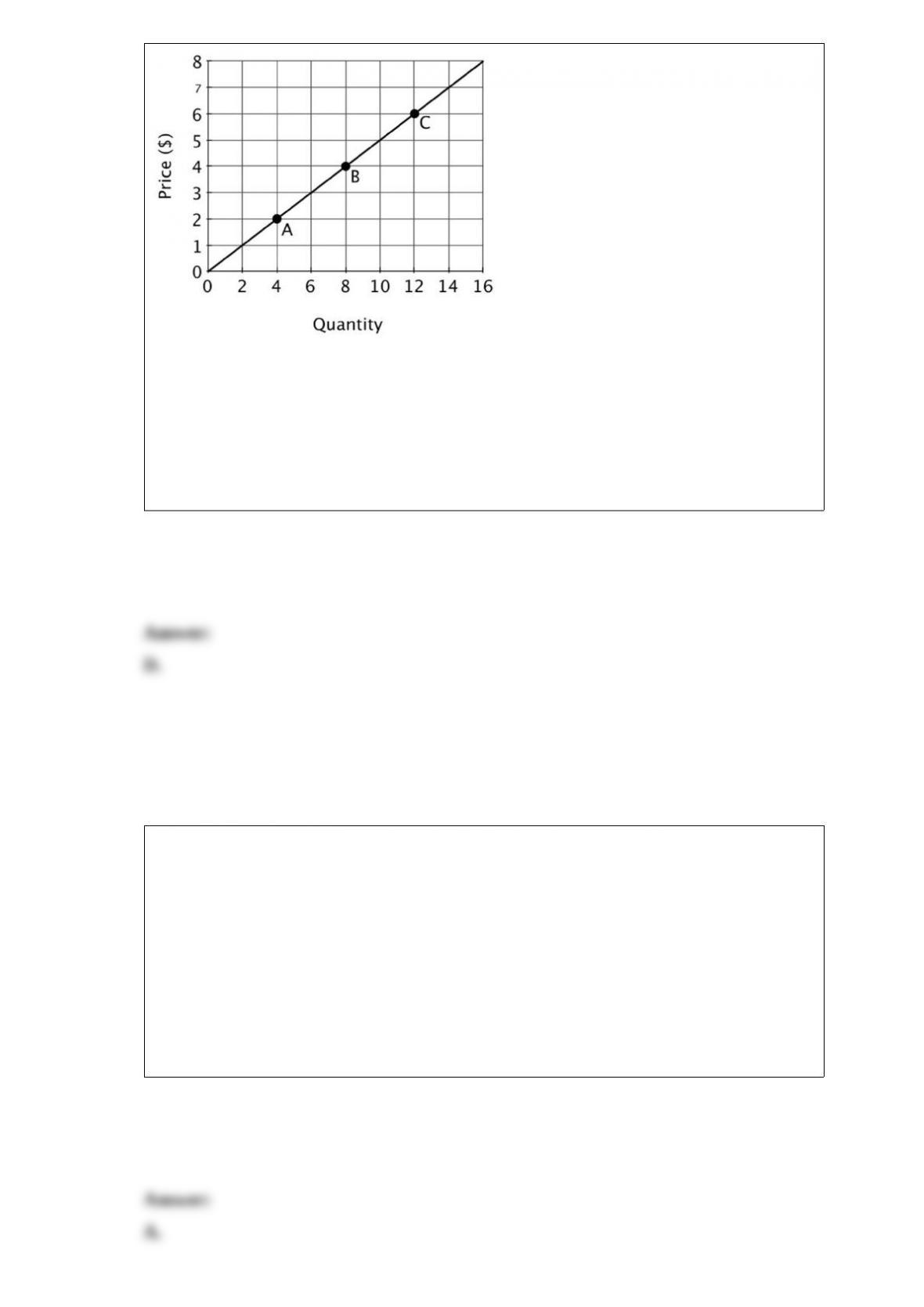
A. 1/2; 3/4
B. 3/4; 1/2
C. 3; 2
D. 1; 1
All of the following are examples of U.S. Federal Reserve System independence except
that:
A. the Federal Reserve Act does not explicitly prohibit legislative interference in
monetary policy.
B. Federal Reserve Governors are appointed for 14-year terms.
C. the Federal Reserve controls its own budget.
D. the Federal Reserve is under no obligation to finance the national deficit.
The figure below shows the supply and demand curves for jeans in Smallville.
At the price of $60 per pair, sellers offer _____ pairs of jeans per day, and buyers wish
to purchase ______ pairs of jeans a day.
A. 60; 20
B. 8; 24
C. 16; 16
D. 24; 8
According to the textbook, NAFTA was expected to help which country exploit its
comparative advantage in the production of goods made by unskilled labor?
A. Canada
B. Cuba
C. Mexico
D. The U.S.A.
Unlike economic profit, economic rent:
A. can be less than zero.
B. may not be driven to zero by competition.
C. doesn’t involve opportunity costs.
D. only applies to land.
Which of the following activities is most likely to be counted in GDP?
A. Fran volunteers at the local veteran’s hospital twice a month.
B. Stu gave $5 to a homeless man he met in the park.
C. Gail buys paper and crayons to donate to poor children in need of school supplies.
D. Bud works hard five hours each week to make sure that his lawn always looks nice.
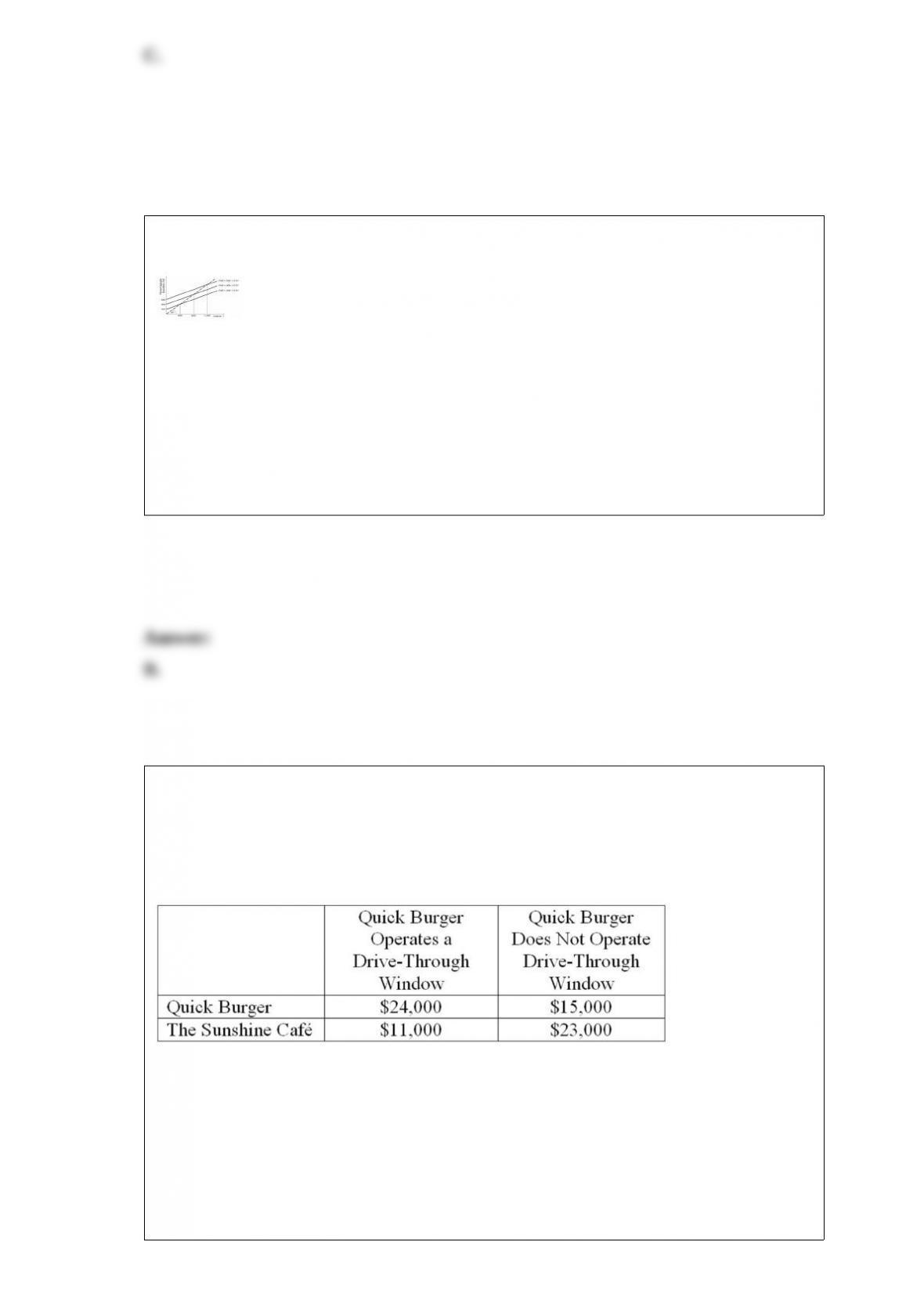
Refer to the figure below.]
Based on the figure, when PAE = 200 + 0.5Y, short-run equilibrium output equals:
A. 1,200.
B. 400.
C. 600.
D. 800.
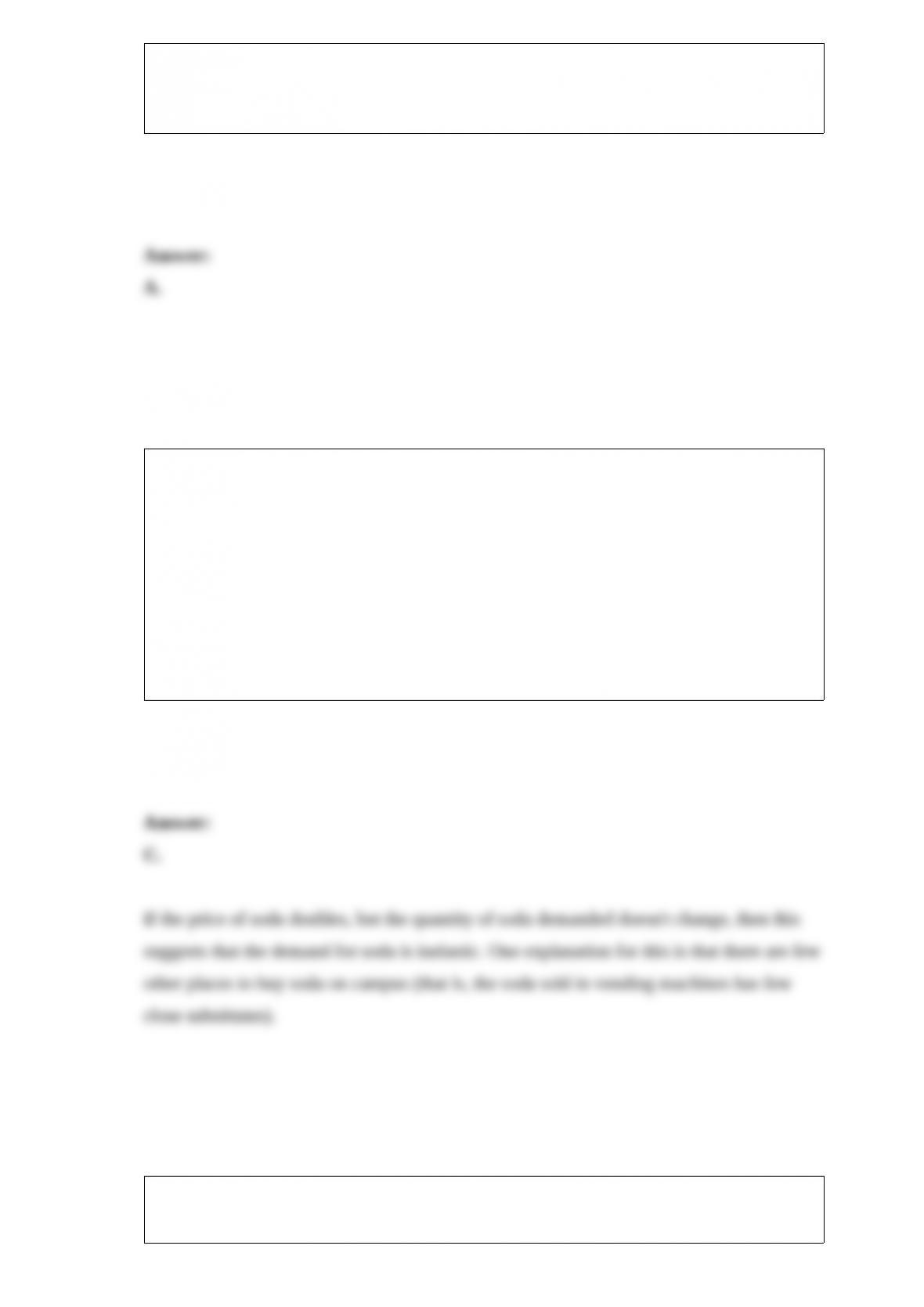
Consider two restaurants located next door to each other: Quick Burger and The
Sunshine Café. If Quick Burger opens a drive-through window, the increased traffic and
noise will bother customers seated outside at The Sunshine Café. The table below
shows the monthly payoffs to Quick Burger and The Sunshine Café when Quick Burger
does and does not operate a drive-through window.
If Quick Burger has the legal right to operate a drive-through, and Quick Burger and
The Sunshine Café can negotiate with each other at no cost, then will Quick Burger
operate a drive-though window?
A. No, because it is not socially efficient to operate a drive-through.
B. Yes, because Quick Burger’s payoff is higher when it operates a drive-through.
C. No, because it would lower the payoff for The Sunshine Café.
D. It cannot be determined.
Suppose the company that owns the vending machines on your campus has doubled the
price of a can of soda. If they then still sell almost the same number of sodas per day,
this suggests:
A. students do not have good nutritional information.
B. soda purchases represent a large fraction of students’ budgets.
C. there are few other places to purchase soda on campus.
D. the price elasticity of demand for soda is equal to 1.
Holding other factors constant, if growing concerns about job security raise
precautionary saving, then the real interest rate will ______ and the equilibrium

quantity of national saving and investment will ____.
A. increase; increase
B. increase; decrease
C. decrease; decrease
D. decrease; increase
Holding other factors constant, a decline in the price of new capital goods will:
A. increase national saving.
B. decrease national saving.
C. increase investment.
D. decrease investment.
When the Chinese government buys U.S. government bonds, from the perspective of
the United States, this is a(n):
A. import.
B. export.

C. capital outflow.
D. capital inflow.
The table below shows the relationship between the number of times you get your car
washed each month and your total monthly benefit from car washes. Each car wash
costs $15.
What’s the average benefit of 4 car washes per month?
A. $14
B. $12
C. $8
D. $4
A perfectly price discriminating monopolist’s profit is ______ the profit of a monopolist
who charges the same price to all of its customers.
A. the same as
B. less than
C. higher than

D. sometimes less than and sometimes greater than