Saving is often discouraged by usury laws during inflationary periods because
a. nominal rates of interest are kept above real rates of interest.
b. nominal rates of interest are kept below inflation rates.
c. nominal rates of interest are kept above inflation rates.
d. real rates of interest are kept above inflation rates.
Gwen’s decision to buy a new television instead of a bicycle for the same price
a. means that opportunity cost is zero since both cost the same amount.
b. would not have involved trade-off and opportunity cost if Gwen had decided to put
the money in a bank CD instead.
c. would not imply a trade-off because of scarcity if Gwen were a multimillionaire.
d. means that the opportunity cost to Gwen is the bicycle that she has given up.
There is only one efficient allocation of resources in an economy at one point in time.
a. True
b. False

A 10 percent increase in the cost of restaurant meals, which are a luxury, will most
likely
a. increase the purchase of meals by 10 percent.
b. increase the purchase of meals by less than 10 percent.
c. decrease the purchase of meals by more than 10 percent.
d. decrease the purchase of meals by less than 10 percent.
During 2008-2010, the U.S. economy showed signs of a(n)
a. mild recession.
b. recessionary gap.
c. inflationary gap.
d. deflationary gap.
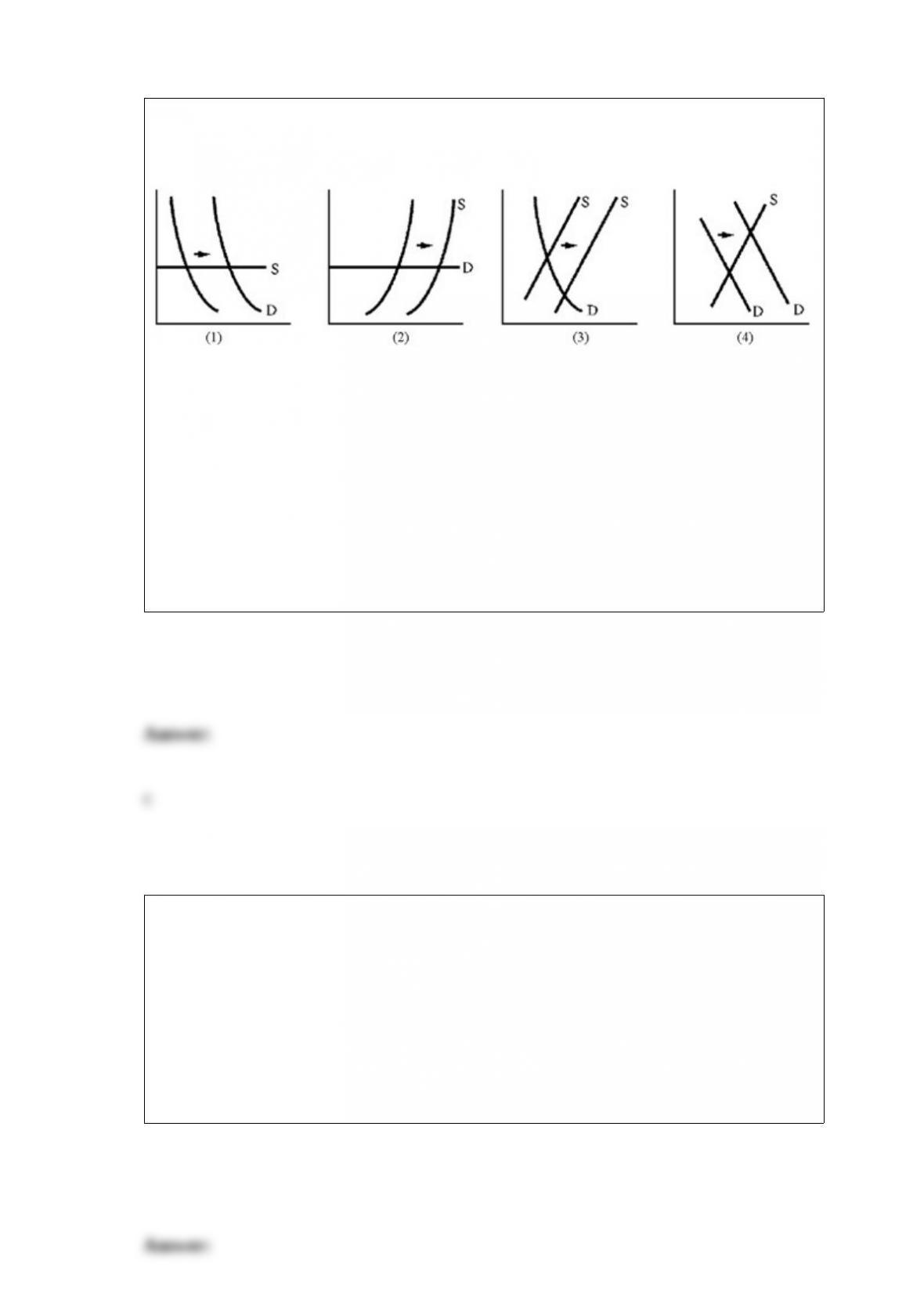
Figure 6-8
Libya sold more crude oil in 1985 than it sold five years earlier, but revenues were 17
percent less. Which graph in Figure 6-8 is consistent with this set of facts?
a. 1
b. 2
c. 3
d. 4
Inputs, or factors of production, include
a. labor.
b. machinery.
c. natural resources.
d. all of the above.
The extent of discrimination is
a. measured by the differences in incomes.
b. the reason for two-thirds of the income differential between black male workers and
white male workers.
c. difficult to quantify and controversial.
d. easily measured for each category of workers.
What is the leverage implied by the bank balance sheet listed below?
a. 2-to-1
b. 7-to-1
c. 8-to-1
d. 10-to-1
Stabilization policy may be necessary to slow down the speed of the adjustment
process.
a. True
b. False
Pork can be used to produce bacon or sausage, but not both. If the price of bacon rises
for some reason, then, everything else equal,
a. the price of sausage will rise.
b. the price of sausage will fall.
c. the resources used in raising Pork will become more expensive.
d. the resources used in raising Pork will become less expensive.
In John Rawls’ A Theory of Justice, people choose the rules for distributing income
from behind a veil of ignorance. People understand that ability determines income, but
they do not know their abilities or the abilities of others. Rawls argues that people are
risk averse and will choose the distribution rule that maximizes their income in the
worst case scenario (they have relatively little ability). An economist would call this
strategy
a. minimax.
b. maximin.
c. irrational.
d. tacit collusion.
A profit-maximizing monopolist will stop production while MR is still greater than MC.
a. True
b. False
In an efficient market, a scarce good generally has a ____ than a less-scarce good.
a. higher price
b. higher total utility to consumers
c. more even distribution across income classes
d. lower price in off-peak periods

Which of the following is one of the main features of our modern economy that helps
ensure against a repeat performance of the Great Depression?
a. transfer payments
b. outsourcing
c. multiplier
d. personal income tax
The demand for capital is
a. directly related to the interest rate.
b. inversely related to the interest rate.
c. unrelated to the interest rate.
d. first falls, and then rises, in relation to the interest rate.
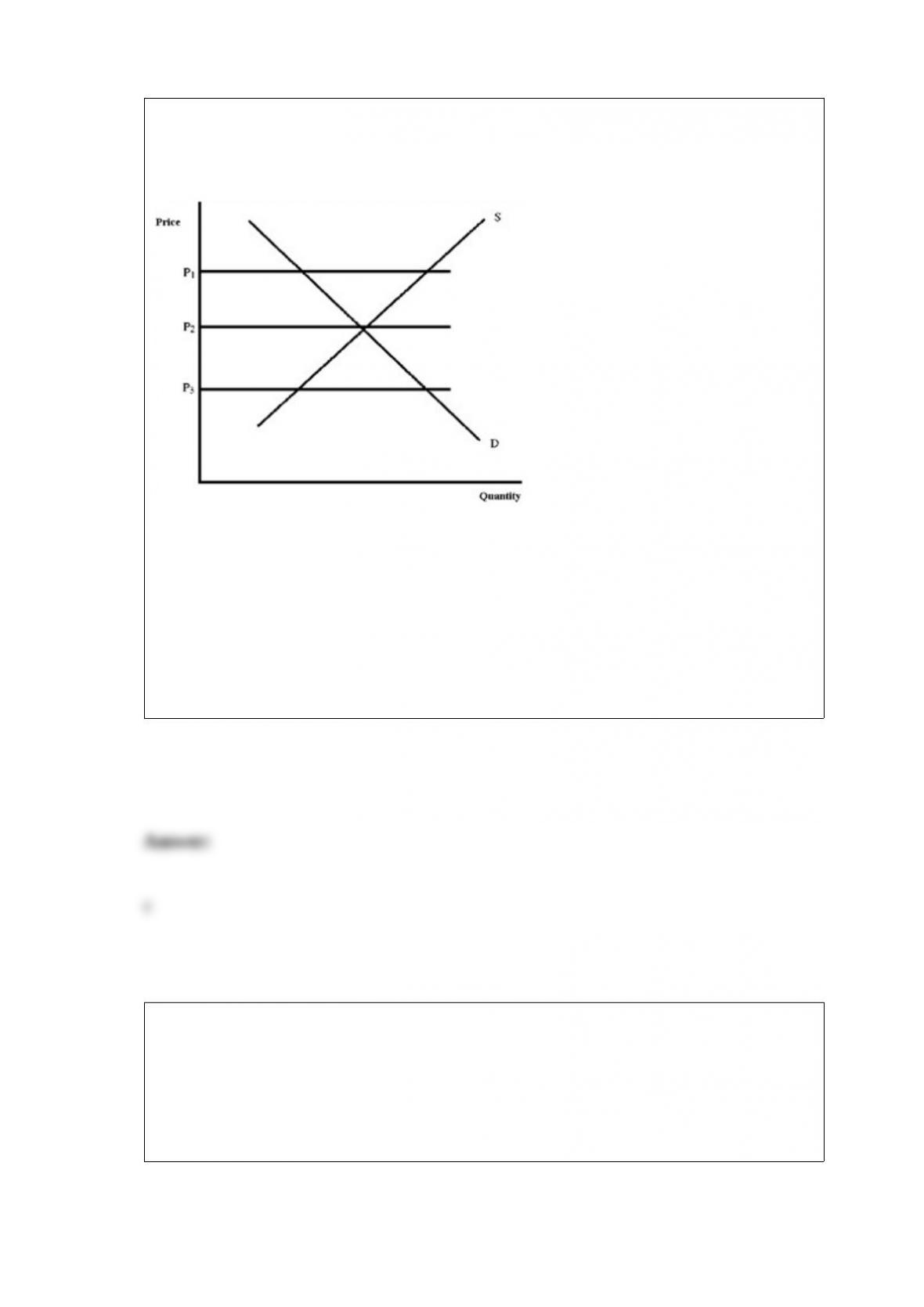
Figure 4-21
A shortage will tend to occur at which price in Figure 4-21?
a. P1
b. P2
c. P3
A minority candidate may not have the same chances as a white candidate for a job
simply based on an employer’s misconceptions about minorities.
a. True
b. False
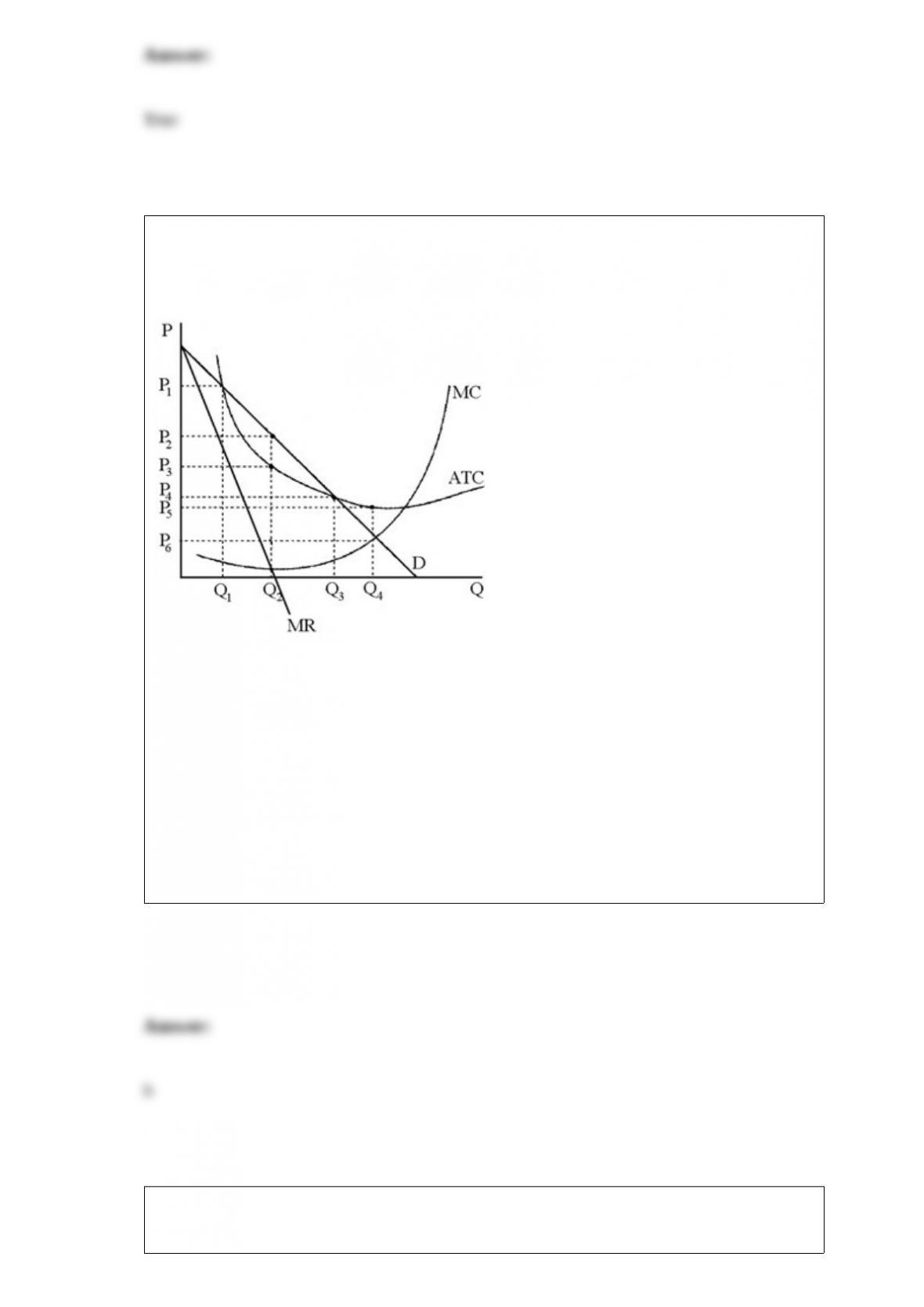
Figure 11-6
The profit-maximizing monopolist in Figure 11-6 will produce ____ units of output.
a. Q1
b. Q2
c. Q3
d. Q4
An expenditure schedule that lies below the full employment level of GDP will cause
a. rising prices.
b. increasing output.
c. falling inventories.
d. falling prices.
The demand curve for a monopolistic competitor has a negative slope.
a. True
b. False
The reason that inflation rarely harms workers is that
a. wages rise at the same time prices rise.
b. wages fall when prices rise.
c. nominal income falls as prices rise.
d. the minimum wage rate automatically rises when the price level rises.
The “law” of diminishing returns asserts that marginal returns will ultimately diminish
when the quantity of one input is increased.
a. True
b. False
Goods are distributed among people by means of:
a. a central authority
b. prices
c. markets
d. all of these
A monopolist’s cost curves may shift up because of
a. advertising expenditure.
b. bureaucratic inefficiencies.
c. coordination problems.
d. All of the above are correct.
The key element in preserving a monopoly is keeping rivals out of the market.
a. True
b. False
The numerical value of the MPC is typically
a. less than 1.
b. equal to 1.
c. greater than 1.
d. unpredictable.

If the government ran a major deficit, and there was no noticeable effect on the level of
GDP, this could be taken as evidence of
a. crowding-in.
b. structural deficit.
c. crowding-out.
d. monetary policy ineffectiveness.
About what percentage of the poor are children?
a. 13
b. 24
c. 36
d. 60
The cost disease of the service sector in recent years is the result of
a. market failure.
b. government intervention.
c. collective bargaining by unions.
d. uneven productivity growth.
When interest rates in the economy fall, the prices of previously issued bonds
a. must fall.
b. must change, but may either rise or fall.
c. must rise.
d. may remain unchanged.
In a mixed economy
a. all economies choose the same mix of private and public involvement in the
economy.
b. the government is more important than the private sector in generating output.
c. there is some government influence over the workings of the free market.
d. all of the above.
Both tariffs and quotas will restrict supplies coming into the country from abroad.
a. True
b. False
Most economists agree that the economy will adjust to a recessionary gap, but the
adjustment process
a. is rapid and destabilizing.
b. is moderately quick, but not as rapid as necessary.
c. takes place solely on the supply side.
d. is very slow.