
Profit-maximizing cartels choose price equal to:
a. marginal cost.
b. average total cost of the last unit.
c. marginal revenue.
d. the monopolistically competitive price.
e. the monopoly price.
Wagner Machine Tool produces output according to Q = 4(KL)1/2, where K is the
amount of capital used and L is the amount of labor employed. Capital costs $2 per unit,
and Wagner is constrained in the short run to use 16 units of capital. If labor costs $8
per unit, Wagner’s minimized short-run marginal cost at an output of 48 is:
a. $3.00.
b. $3.50.
c. $4.00.
d. $4.50.
e. $5.00.

Sarah Jones believes that Coke and Pepsi are perfect substitutes. That is, she is equally
happy with a Coke or a Pepsi and cannot tell the difference between them. Her
indifference curves:
a. are linear, with slope equal to “1.
b. are upward-sloping.
c. are linear, with slope equal to 1.
d. cross where she consumes equal amounts of Coke and Pepsi.
e. cannot be defined, since she likes both equally well.
The first derivative of total profit with respect to quantity is:
a. average revenue.
b. marginal revenue.
c. marginal profit.
d. average profit.
e. total profit.
The OPEC oil cartel lost its market power and world oil prices fell in the 1980s

because:
a. OPEC expanded its membership to include all international producers of oil.
b. world consumers boycotted OPEC oil.
c. a limit pricing strategy was pursued by some members of the cartel.
d. members began to cheat on cartel agreements.
e. the United States refused to buy oil from OPEC.
Oligopoly is the only market structure in which one finds:
a. barriers to entry.
b. competing brand names.
c. minimum average total cost pricing.
d. advertising.
e. firm interdependence.
The cost of pollution originating in the chemical industry is Cp = 4P + 2P2, where P is
the quantity of pollutants emitted. The cost of pollution control for this industry is Cc =

120 ” 12P. What is the optimal effluent fee?
a. $4.
b. $8.
c. $12.
d. $16.
e. $24.
In the following table, the marginal product of labor at L = 6 is:
a. 3
b. 2
c. 5
d. 4
e. 1

If output is produced according to Q = (KL)3/4, then this production process exhibits:
a. increasing returns to scale.
b. decreasing returns to scale.
c. first increasing and then decreasing returns to scale.
d. constant returns to scale.
e. first decreasing and then increasing returns to scale.
Eddie is auctioning a Willie Mays baseball card. If the expected profit from the auction
is $10,000 and the probability of a win is 10%, the surplus to be split between buyer
and seller is:
a. $0.
b. $1,000.
c. $10,000.
d. $100,000.
e. none of the above.

Many economists believe that competition is preferable to monopoly:
a. because competition allocates resources more efficiently than monopoly does.
b. because diffuse economic power leads to more diffuse political power.
c. because competition yields a greater variety of goods and services.
d. regardless of the costs of de-concentrating a concentrated industry.
e. because monopolies tend to pay too little in taxes.
The present value of expected future profits will if the discount rate increases
and will if expected future profits increase.
a. increase; not change
b. increase; increase
c. not change; decrease
d. decrease; increase
e. decrease; decrease
A producer of two fixed proportion outputs A and B, producing QA = QB with marginal

revenues MRA and MRB, should equate marginal cost to:
a. the maximum (MRA, MRB).
b. the minimum (MRA, MRB).
c. MRA, which should equal MRB.
d. the horizontal sum of MRA and MRB.
e. the vertical sum of MRA and MRB.
A representative firm with short-run total cost given by TC = 50 + 2q + 2q2 operates in
a competitive industry where the short-run market demand and supply curves are given
by QD = 1,410 ” 40P and QS = “390 + 20P. Its short-run profit-maximizing level of
output is:
a. 0 units.
b. 1 unit.
c. 2 units.
d. 5 units.
e. 7 units.

In Russia, as per capita income rises from $1,980 to $2,020, everything else remaining
constant, annual per capita consumption of vodka falls from 525 to 475 liters; this
implies an income elasticity of demand for vodka of:
a. “0.50.
b. “5.0.
c. 2.0.
d. 5.0.
e. 0.50.
Output is produced according to Q = 4LK, where L is the quantity of labor input and K
is the quantity of capital input. If the price of K is $10 and the price of L is $5, then the
cost-minimizing combination of K and L capable of producing 32 units of output is:
a. L = 8 and K = 1.
b. L = 4 and K = 2.
c. L = 2 and K = 2.
d. L = 2 and K = 4.
e. L = 1 and K = 8.

Diminishing marginal returns:
a. imply decreasing returns to scale.
b. occur at all combinations of input usage.
c. occur only for labor.
d. are consistent with increasing returns to scale.
e. are inconsistent with increasing returns to scale.
When the coefficient of determination is near 1 but the t-statistics are all insignificant,
the regression likely suffers from:
a. nonconstant variance of the error terms.
b. multicollinearity.
c. serial correlation.
d. randomness.
e. nonidentifiability.
The total variation in the dependent variable Y is:

a. S (Yi ” Ymean)2.
b. S (Yi ” Yestimated)2.
c. S (Yi ” Ymean)2/ S (Yi ” Yestimated)2.
d. S (Yi ” Yestimated)2/ S (Yi ” Ymean)2.
e. 1 ” S (Yi ” Yestimated)2/ S (Yi ” Ymean)2.
The law of diminishing marginal returns is obvious because, if it didn’t hold, it would
be possible to:
a. feed everyone in the world by intensively cultivating one acre of land.
b. manufacture all of the cars in the world using just one of the world’s existing
factories.
c. increase total output of a product without employing additional inputs.
d. All of the above.
e. a and b.
Glyde Air Fresheners is the dominant firm in the solid room aromatizer industry, which

has a total market demand given by Q = 80 ” 2P. Glyde has competition from a fringe
of four small firms that produce where their individual marginal costs equal the market
price. The fringe firms each have total costs given by TCi = 10Qi + 2Q2
i. If Glyde’s total
costs are given by TCG = 100 + 6QG, what price should Glyde establish for air
fresheners?
a. $10.
b. $12.
c. $14.
d. $16.
e. $18.
Fox’s Fine Furs (FFF) estimates that its total cost of production is TC = 125 + 100Q +
25Q2. Furs sell for $1,100 each. To maximize profits, FFF should sell:
a. 8 furs.
b. no furs.
c. 20 furs.
d. 38 furs.
e. 22 furs.

J. D. Power, the big management consulting firm, extols the reliability of Dell
computers; this causes the:
a. demand for Dell computers to increase.
b. supply of Dell computers to increase.
c. quantity supplied of Dell computers to increase.
d. quantity supplied of Dell computers to decrease.
e. demand and supply of Dell computers to remain unchanged.
Fred loves tomatoes. He makes soups, sauces, and stews with them; stuffs them; roasts
them; and grills them. Fred has discovered a farmer’s market where the price of a bushel
of tomatoes depends on how many bushels are purchased. The first bushel is $15; the
second, $12; the third, $10; and four or more, $9 each. Fred has $82 to spend on
tomatoes and on “all other things” during the coming week. All other things sell for $1
per unit. Assume that all other things are measured on the vertical axis. What is Fred’s
marginal rate of substitution if he chooses to buy 5 bushels of tomatoes?
a. “9
b. 0.10
c. 12
d. 1/15
e. 1/9

Whenever marginal product is increasing with increasing use of an input:
a. total product is increasing at a decreasing rate.
b. total product is increasing at an increasing rate.
c. marginal product is less than average product.
d. average product is decreasing.
e. total product is declining as input use increases.
Suppose that Wilma’s utility function is given by
U(E) = 100 ” 2E2,
where E = Wilma’s work effort in producing homemade dinners, measured in hours per
day. The marginal utility of effort for Wilma is:
a. 2E2.
b. “2E.
c. 100.
d. “4E.
e. none of the above.

A dominant strategy is one that:
a. beats all others, regardless of the opponent’s choice.
b. beats all others, given the opponent’s choice.
c. is beaten by all others, regardless of the opponent’s choice.
d. is beaten by all others, given the opponent’s choice.
e. beats at least one other, given the opponent’s choice.
The demand for fax machines in thousands of units has been estimated to be Q = 1,000
” 1.5P + 5L, where P is the price of the machines and L is the average cost of a
10-minute midday call from Los Angeles to New York. At a fax machine price of $400
and a phone call cost of $10, the price elasticity of demand for fax machines is:
a. “4.0.
b. “2.50.
c. “0.61.
d. “0.25.
e. “1.33.

The long-run average cost curve slopes upward if there are:
a. some factors without diminishing marginal returns.
b. diseconomies of scope in the management of multiplant operations.
c. economies of scale.
d. diseconomies of scale.
e. no factors without diminishing marginal returns.
If price is $12 when the price elasticity of demand is “1, then marginal revenue must be:
a. $24.
b. $18.
c. $12.
d. $6.
e. $0.
If a representative firm with long-run total cost given by TC = 50 + 2q + 2q2 operates in
a competitive industry where the short-run market demand and supply curves are given
by QD = 1,410 ” 40P and QS = “390 + 20P, its long-run profit-maximizing level of
output is:
a. 0 units.
b. 1 unit.
c. 2 units.
d. 5 units.
e. 7 units.
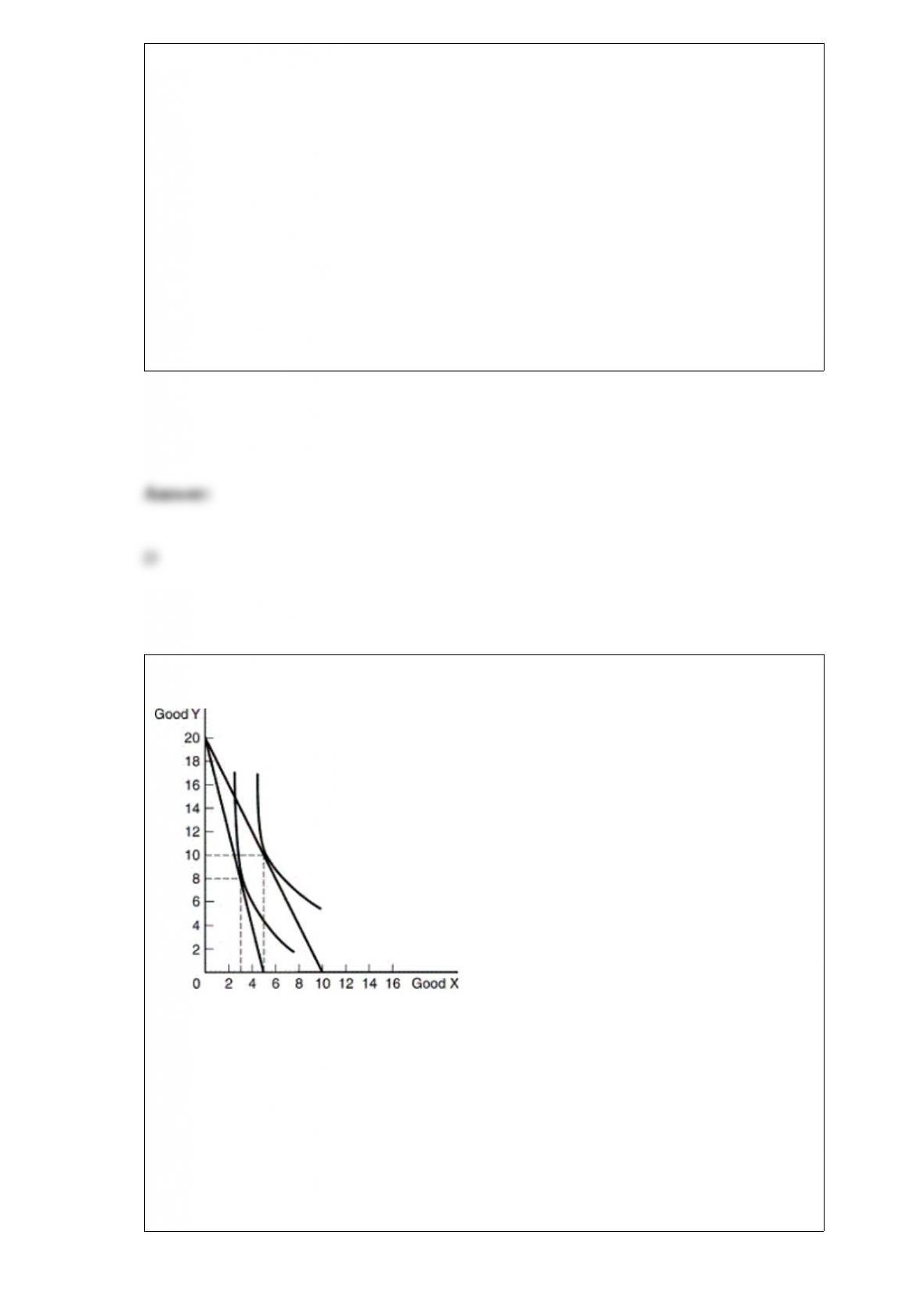
Using the indifference map below, two points on a demand curve for good Y are:
a. (8, $5) and (10, $5).
b. (3, $10) and (5, $20).
c. (3, $20) and (8, $5).
d. (3, $20) and (5, $10).
e. The answer cannot be determined from the information given.

You buy your child a $100 savings bond that matures in 10 years and pays an annual
interest rate of 10%. At maturity the bond will be worth:
a. $228.17.
b. $200.
c. $259.37.
d. $271.17.
e. $217.71.
The estimated mathematical relationship between dependent and independent variables
derived using ordinary least squares is called the:
a. covariance.
b. sample regression line.
c. residual demand curve.
d. goodness of fit.
e. coefficient of determination.