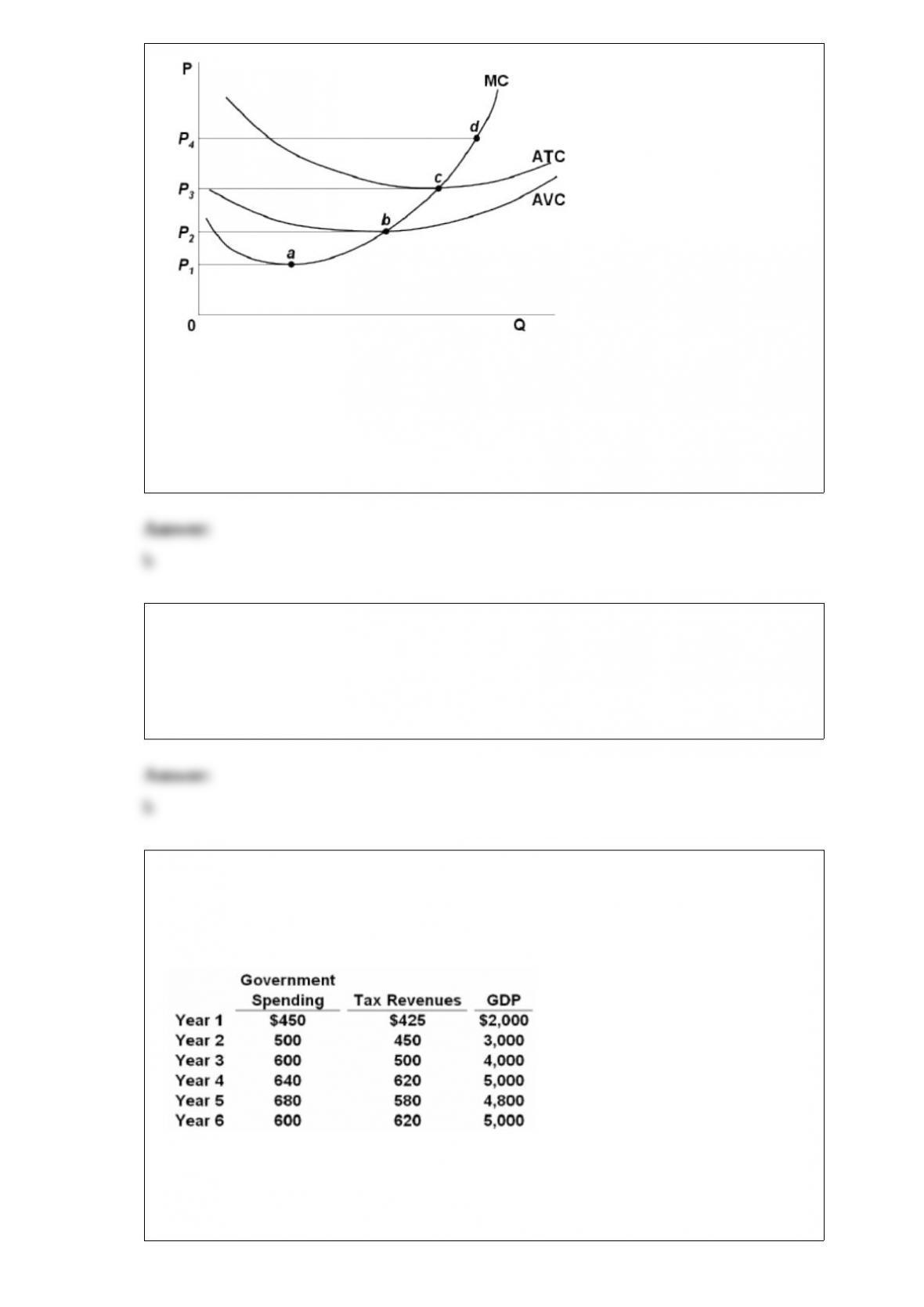
1)
refer to the above diagram for a purely competitive producer. the lowest price at which
the firm should produce (as opposed to shutting down) is:
a.p1.
b.p2.
c.p3.
d.p4.
2) which of the following is a characteristic of pure monopoly?
a.close substitute products
b.barriers to entry
c.the absence of market power
d.”price taking”
3) Answer the next question(s) using the following budget information for a
hypothetical economy. Assume that all budget surpluses are use to pay down the public
debt.
Refer to the above data. If year 1 is the first year of this nation’s existence and year 4 is
the present year, the public debt as a percentage of GDP in year 4 is:
A.7.5 percent.
B.1.39 percent.

C.2.5 percent.
D.3.9 percent.
4) a recession is a period in which:
a.cost-push inflation is present.
b.nominal domestic output falls.
c.demand-pull inflation is present.
d.real domestic output falls.
5) a firm that produces a single product but owns plants in many different stages of the
production process – for example, a steel producer that owns iron ore mines and rolling
mills – best illustrates a:
a.vertically integrated firm.
b.multinational corporation.
c.virtual corporation.
d.conglomerate.
6) Other things equal, the prospect of imitation by others:
A.decreases the expected rate of return on R&D expenditures.
B.increases the expected rate of return on R&D expenditures.
C.increases the interest-rate cost of funds used to finance R&D expenditures.
D.decreases the interest-rate cost of funds used to finance R&D expenditures.
7) answer the next question(s) on the basis of the following data. all figures are in
billions of dollars.
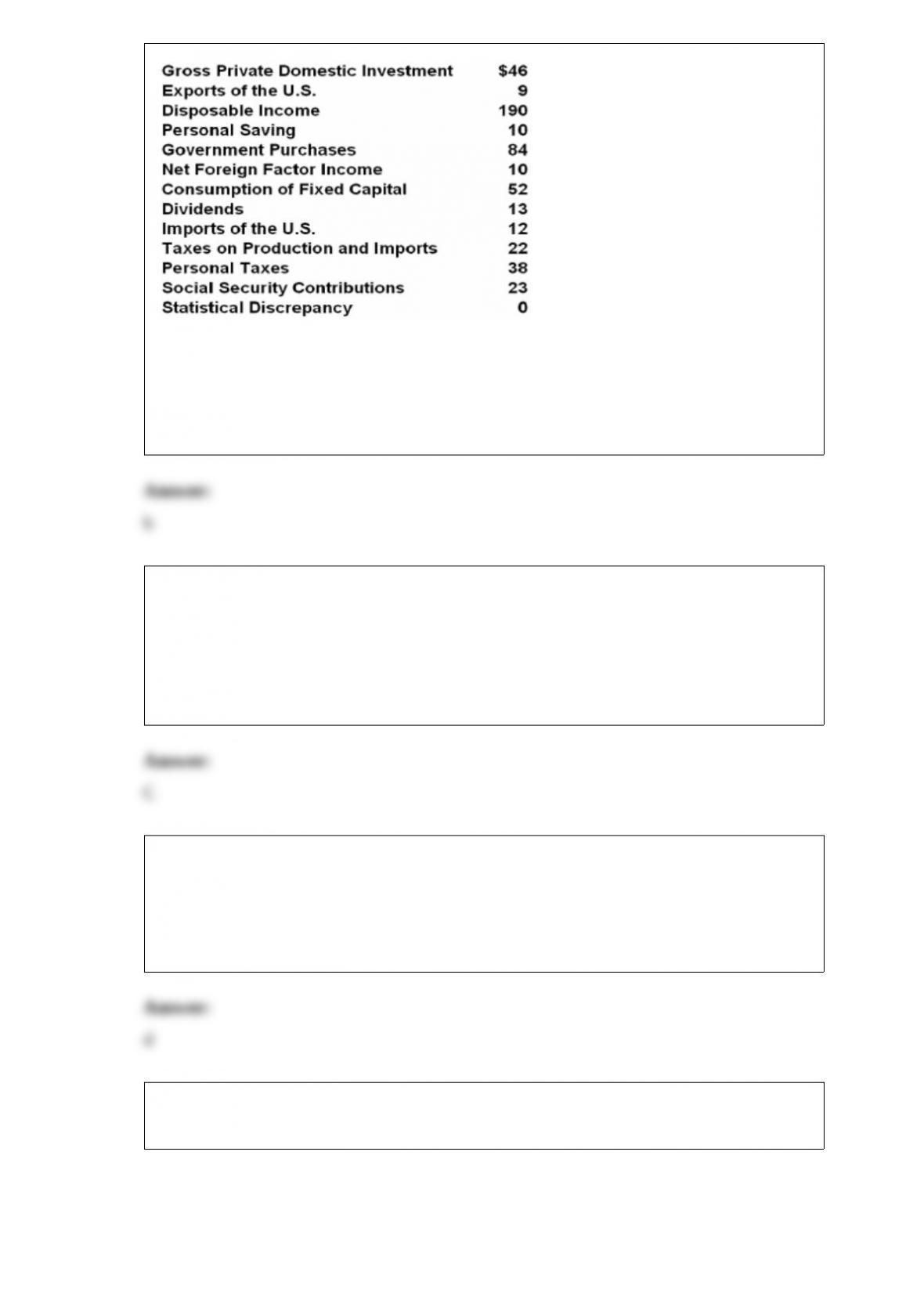
refer to the above data. the net domestic product is:
a.$233.
b.$255.
c.$230.
d.$348.
8) The financial account balance is a nation’s:
A.net investment income minus its net transfers.
B.exports of goods and services minus its imports of goods and services.
C.sale of real and financial assets to people living abroad minus its purchases of real
and financial assets from foreigners.
D.domestic investment spending minus domestic saving.
9) well-defined property rights:
a.discourage investment and growth.
b.discourage hard work.
c.impede exchange.
d.encourage owners to maintain or improve their property.
10) the following cost data for a firm that is selling in a purely competitive market.
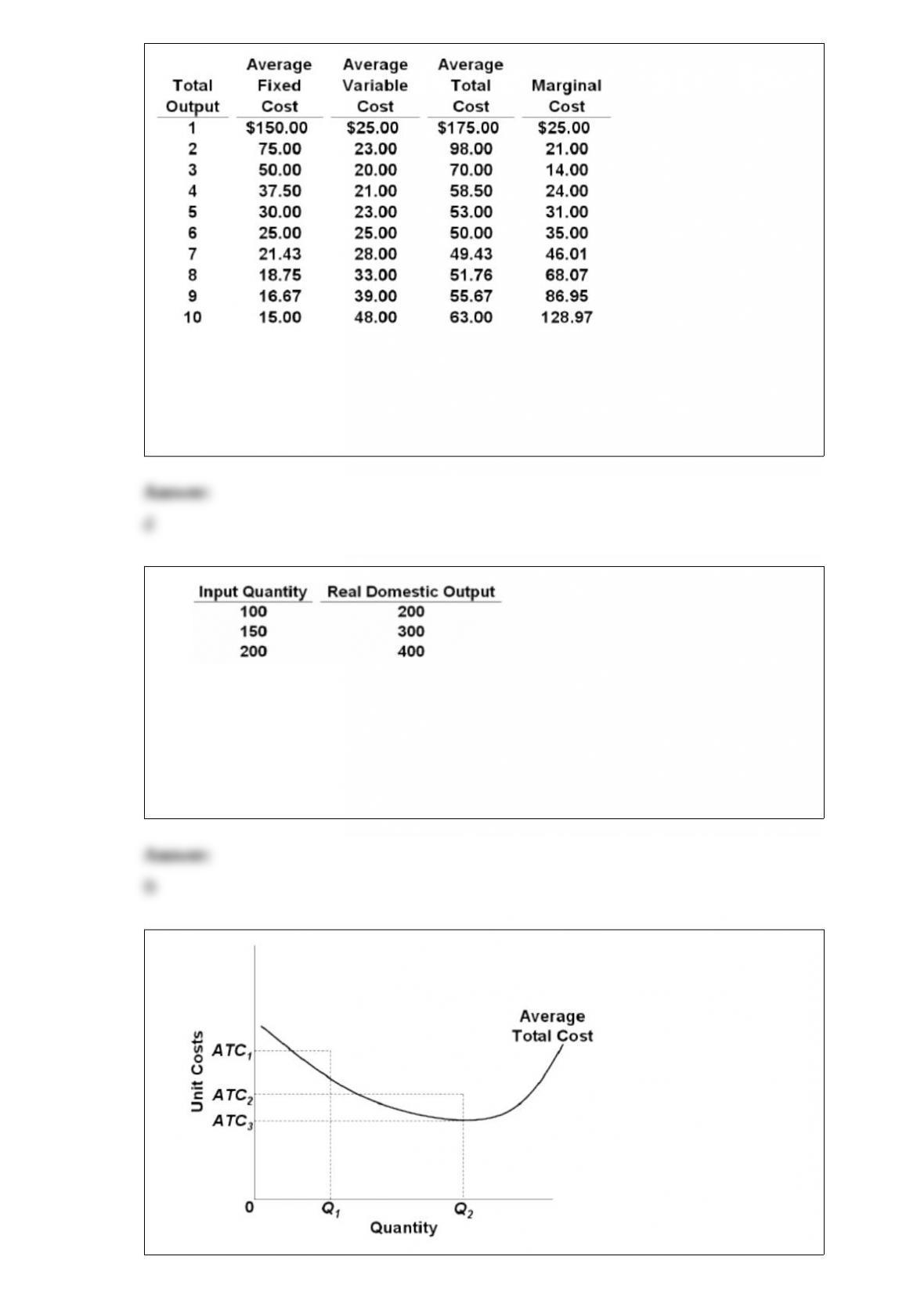
refer to the above data. if the market price for this firm’s product is $24, it will produce:
a.4 units at a loss of $150.
b.6 units at a loss of $90.
c.3 units at an economic profit of zero.
d.4 units at a loss of $138.
11)
Suppose that the price of each input increased from $5 to $8. The per-unit cost of
production in the above economy would:
A.rise by $1.50 and the aggregate supply curve would shift to the right.
B.rise by 60 percent and the aggregate supply curve would shift to the left.
C.rise by 60 percent and the aggregate demand curve would shift to the left.
D.fall by $1.50 and the aggregate demand curve would shift to the right.
12)

refer to the above long-run cost diagram for a firm. if the firm produces output q2 at an
average cost of atc2, then the firm is:
a.producing the profit-maximizing output, but is failing to minimize production costs.
b.incurring x-inefficiency, but is producing that output at which all existing economies
of scale might be realized.
c.incurring x-inefficiency and is failing to produce the output at which all economies of
scale might be realized.
d.producing that output with the most efficient combination of inputs and is realizing all
existing economies of scale.
13) strong economic growth since 1960 has allowed nations like singapore and ireland
to surpass nations such as the united kingdom and france in real gdp per capita.
14) If the amount of money demanded exceeds the amount supplied, the:
A.demand-for-money curve will shift to the left.
B.money supply curve will shift to the right.
C.interest rate will rise.
D.interest rate will fall.
15) if actual gdp is less than potential gdp:
a.potential gdp will fall.
b.the price level will rise.
c.investment spending will fall.
d.the actual unemployment rate will be higher than the natural unemployment rate.
16) health care expenditures coming directly out of consumers’ pockets, primarily in the
form of deductibles and copayments, account for what percent of u.s. health care
spending?
a.19 percent.
b.34 percent.
c.47 percent.
d.81 percent.

17) According to the Taylor rule, when real GDP is at its potential and inflation is at its
target rate of 2 percent, the Fed should:
A.carefully lower the Federal funds rate in an attempt to stimulate non-inflationary real
GDP growth.
B.raise the Federal funds rate in an attempt to eliminate the remaining inflation.
C.lower the Federal funds rate to lower borrowing costs for the Federal government.
D.keep the Federal funds rate at 4 percent.