1) which of the following nations is not a member of the european union?
a.switzerland
b.france
c.germany
d.italy
2) Price fixing is considered to be a per se violation of the antitrust laws because:
A.a guilty verdict requires proof of injury to consumers.
B.a guilty verdict requires proof of injury to other competitors.
C.the rule of reason is applicable.
D.a guilty verdict requires proof that the activity was attempted, not that it unreasonably
restrained trade.
3) as defined in national income accounting, investment includes:
a.business expenditures on machinery and equipment.
b.all consumption.
c.imports, but not exports.
d.all nonfood items.
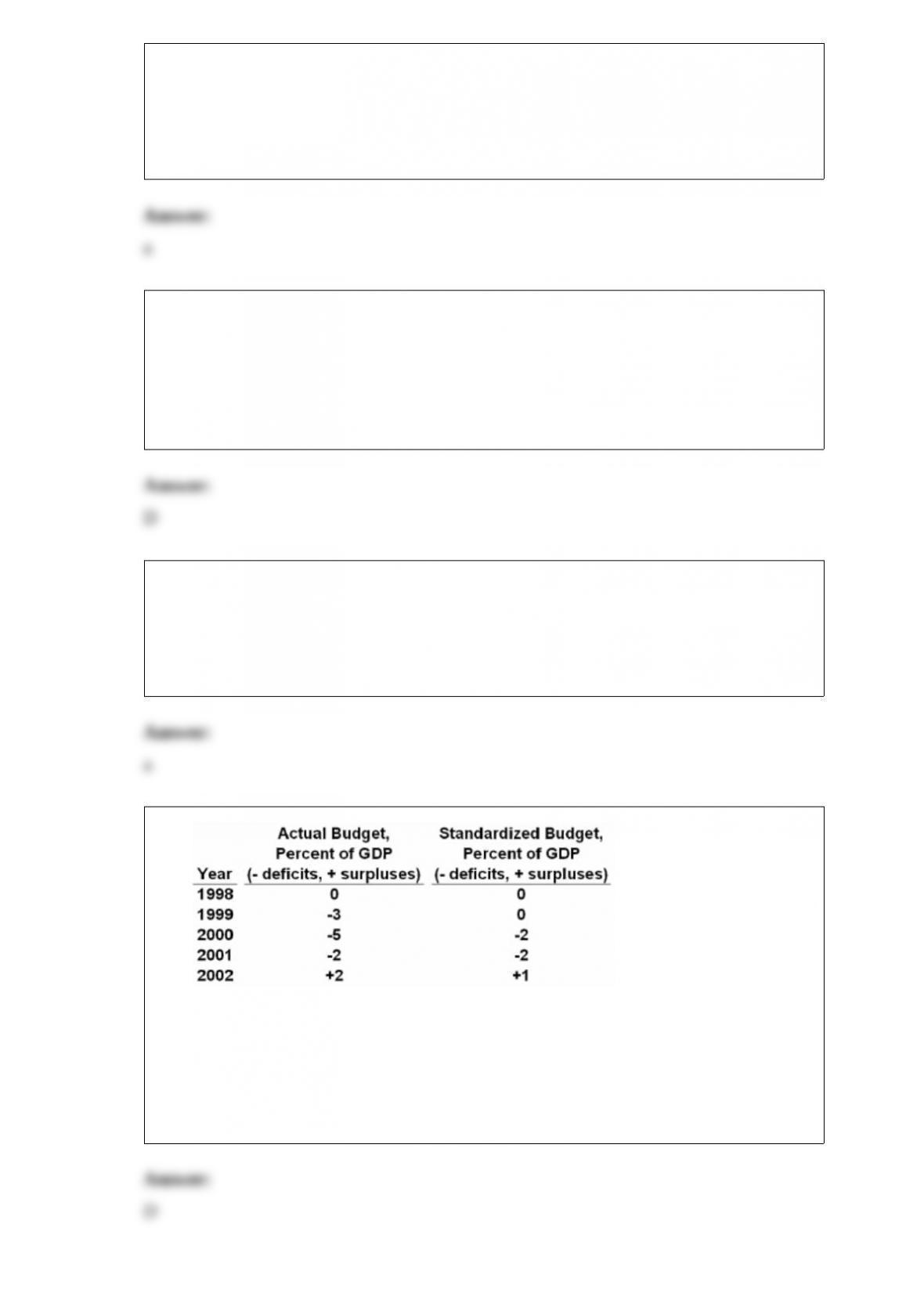
4)
Refer to the above table for a fictional economy. The changes in the budget conditions
between 2001 and 2002 best reflect a(n):
A.recession.
B.expansionary fiscal policy.
C.tax increase.
D.contractionary fiscal policy.
5) Which of the following would contribute to a United States balance of payments
surplus?
A.the United States makes a unilateral tariff reduction on imported goods
B.General Motors pays a dividend to a Swiss stockholder
C.the United States cuts back on U.S. military personnel stationed in Germany
D.Russian vodka becomes increasingly popular in the United States
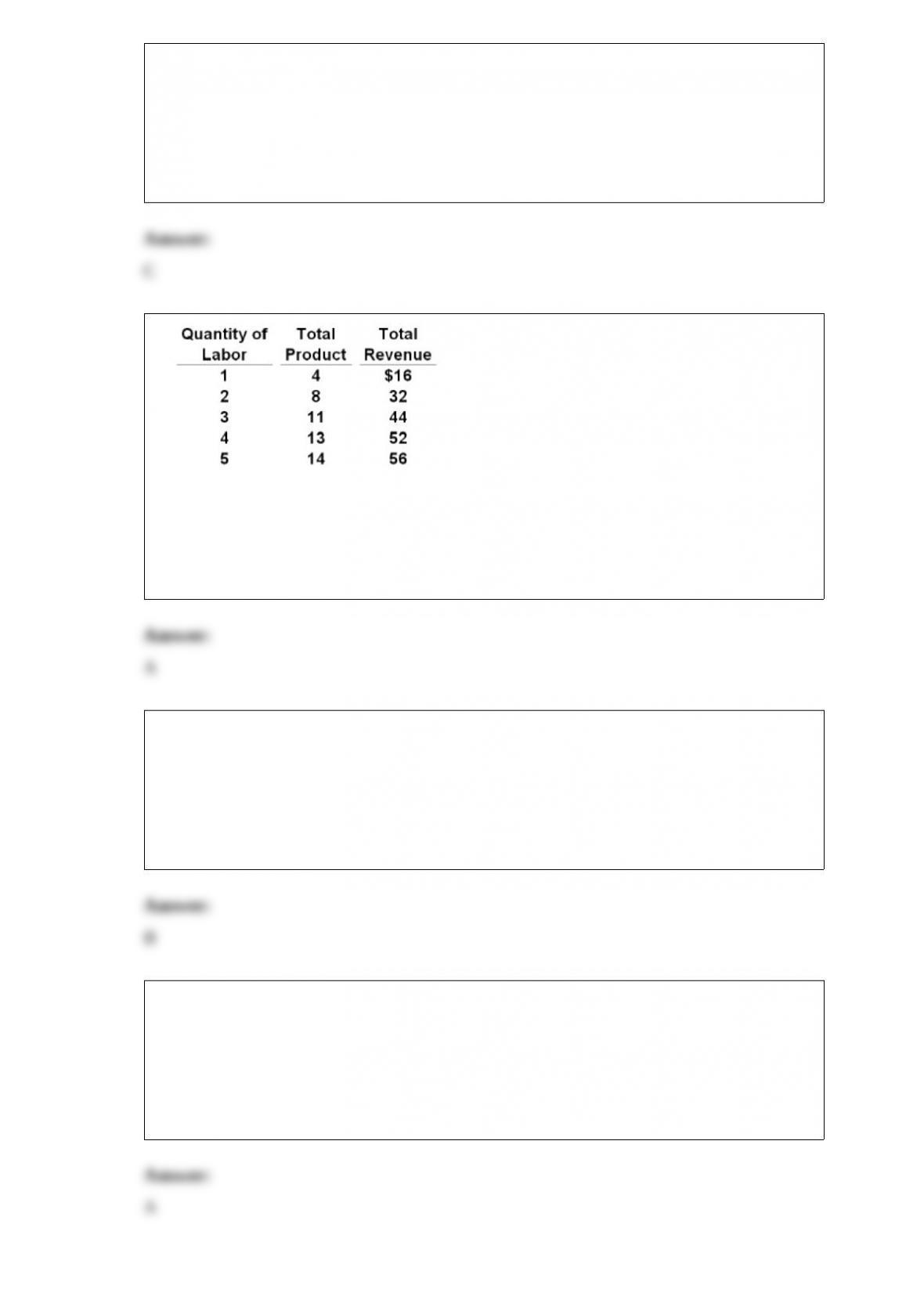
6)
Refer to the above data. The marginal revenue product of the second worker is:
A.$16.
B.$32.
C.$8.
D.$4.
7) Which of the following provides public assistance to those who are blind and
otherwise disabled?
A.Medicare
B.Supplemental Security Income (SSI)
C.Medicaid
D.TANF
8) Exclusive unionism attempts to increase wage rates by:
A.decreasing the supply of labor.
B.setting a minimum or standard wage above the competitive level.
C.increasing the supply of labor.
D.increasing the demand for labor through lobbying for more government projects
employ union workers.

9) real income is found by:
a.dividing nominal income by 70.
b.multiplying nominal income by 1.03.
c.dividing the price index (in hundredths) by nominal income.
d.dividing nominal income by the price index (in hundredths).
10) Occupational licensing can best be understood in terms of:
A.the inclusive unionism model.
B.the exclusive unionism model.
C.the bilateral monopoly model.
D.the monopsony model.
11) If the wage rate increases:
A.a purely competitive producer will hire less labor, but an imperfectly competitive
producer will not.
B.an imperfectly competitive producer will hire less labor, but a purely competitive
producer will not.
C.a purely competitive and an imperfectly competitive producer will both hire less
labor.
D.an imperfectly competitive producer may find it profitable to hire either more or less
labor.
12) the marginal cost curve is:
a.upsloping because of increasing marginal opportunity costs.
b.upsloping because successive units of a specific product yield less and less extra
utility.
c.downsloping because of increasing marginal opportunity costs.
d.downsloping because successive units of a specific product yield less and less extra
utility.
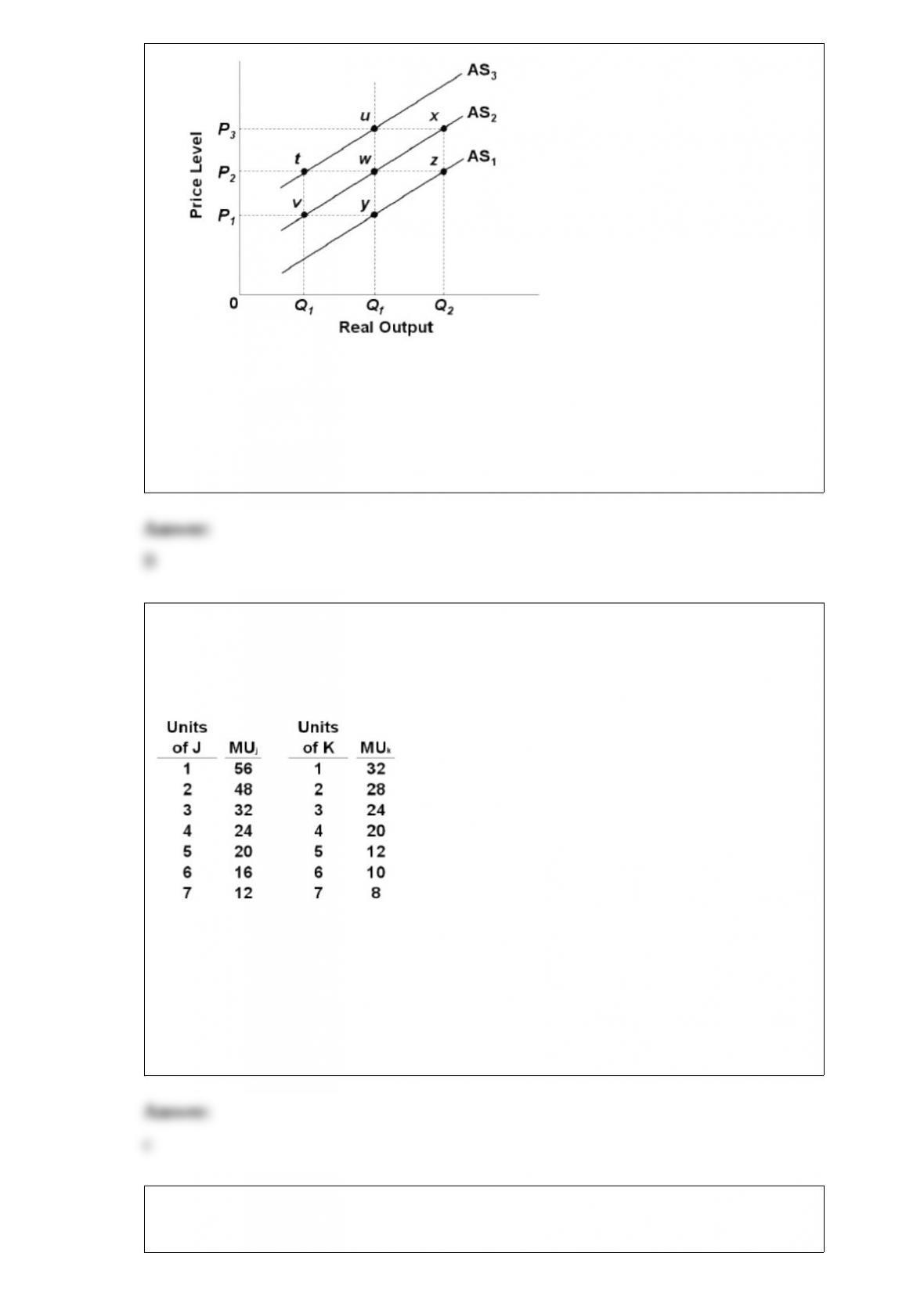
13)
Refer to the above diagram. If drawn, the long-run aggregate supply curve would
include points:
A.v, w, and u
B.y, w, and u
C.t, w, and z
D.y, w, and x
14) the following two schedules which show the amounts of additional satisfaction
(marginal utility) which a consumer would get from successive quantities of products j
and k.
refer to the above data. what level of total utility is realized from the equilibrium
combination of j and k, if the consumer has a money income of $52 and the prices of j
and k are $8 and $4 respectively?
a.156 utils
b.124 utils
c.276 utils
d.36 utils
15) The public debt is held as:
A.U.S. securities, corporate bonds, and common stock.

B.Federal Reserve Notes.
C.U.S. gold certificates.
D.Treasury bills, Treasury notes, Treasury bonds, and U.S. savings bonds.
16) If an employer is a monopsonist:
A.its MRC curve will lie below its labor demand curve.
B.its labor supply and MRC curves will coincide and be perfectly elastic.
C.it must also be a monopolist in the product market.
D.its labor supply curve will be upsloping and the MRC curve will lie above it.