
The machines workers have to work with are considered
A) human capital.
B) physical capital.
C) entrepreneurship.
D) financial capital.
To evaluate the size of the federal budget deficit or surplus over time, it would be best
to look at the
A) absolute size of the budget deficit or surplus.
B) budget deficit or surplus as a percentage of GDP.
C) budget deficit or surplus as a percentage of tax revenues.
D) budget deficit or surplus as a percentage of government spending.
The Difference between the lowest price a firm would have been willing to accept and
the price it actually receives from the sale of a product is called
A) producer surplus.
B) profit.
C) marginal revenue.

D) price Differential.
Which of the following groups had the highest poverty rate in 2011 in the United
States?
A) Asians
B) blacks
C) Hispanics
D) female heads of families
For allocative efficiency to hold,
A) price must equal marginal revenue of the last unit sold.
B) price must equal the marginal cost of the last unit produced.
C) average variable cost is minimized in production.
D) average total cost is minimized in production.
Holding everything else constant, an increase in the price of raisins will result in
A) a decrease in the quantity of raisins demanded.
B) an increase in the demand for raisins.
C) a decrease in the supply of raisins.
D) an increase in the quantity of raisins demanded.
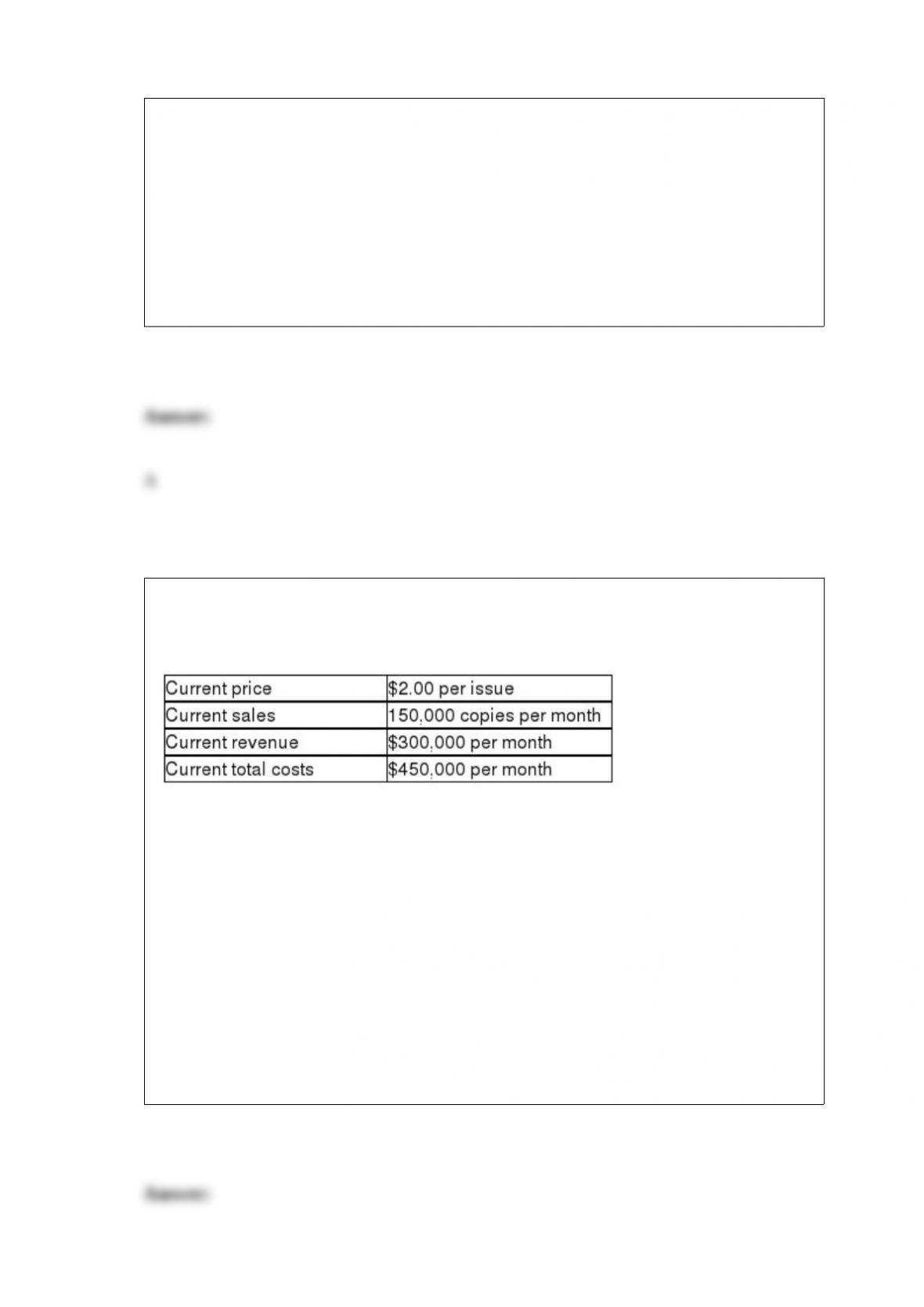
Table 6-4
The publisher of a magazine gives his staff the following information:
He tells the staff, “Our costs are currently $150,000 more than our revenues each
month. I propose to eliminate this problem by raising the price of the magazine to $3.00
per issue. This will result in our revenue being exactly equal to our cost.”
Which of the following statements is correct?
A) The publisher’s analysis is correct only if the demand is perfectly elastic.
B) The publisher’s analysis is correct only if the demand is elastic.
C) The publisher’s analysis is correct only if the demand is perfectly inelastic.
D) The publisher’s analysis is correct only if the demand is unit-elastic.

Which of the following is motivated by an equity concern?
A) Some U.S. colleges have cut back on merit scholarships since these programs siphon
money from need-based programs, thus harming lower-income students with greater
financial need.
B) Following the removal of subsidies in urban water use, household demand for water
decreased quite significantly in Bogor, Indonesia.
C) In November 2003, the Federal Communications Commission implemented the
“local number portability” rule which gives cell phone customers the option of keeping
their number when they switch carriers within the same geographic region.
D) The United States protects intellectual property rights, allowing inventors to prevent
others from using their inventions without payment.
Article Summary. In an August 2013 speech from the Lincoln Memorial, President
Obama was expected to emphasize that increased economic equality is needed to
improve racial equality. Economic gaps based on race have endured for 50 years,
with the differences in unemployment rates between blacks and whites remaining
virtually unchanged and the gap in wealth actually increasing. “If you look at 50
years after the 1960s civil rights movement, the most stubborn and persistent
challenge when it comes to the nation’s racial challenge remains in the areas of
economics and wealth,” said Marc Morial, president of the National Urban
League.
Source: Zachary A. Goldfarb, “For Obama, 50 years after historic march,
economic equality the path to racial justice,” Washington Post, August 17, 2013.
The article mentions increased economic equality is needed in terms of wealth, and for
some people this means a more equitable distribution of wealth. Would an equitable
distribution of wealth necessarily be the most efficient distribution of wealth?
A) Yes, equitable and efficient are two different words which have the same definition.
B) Yes, in order for the distribution to be equitable, it must also be efficient.
C) No, it is impossible to have an economically efficient distribution which is also an
equitable distribution.
D) No, an economically efficient distribution of wealth would not necessarily be
equitable.
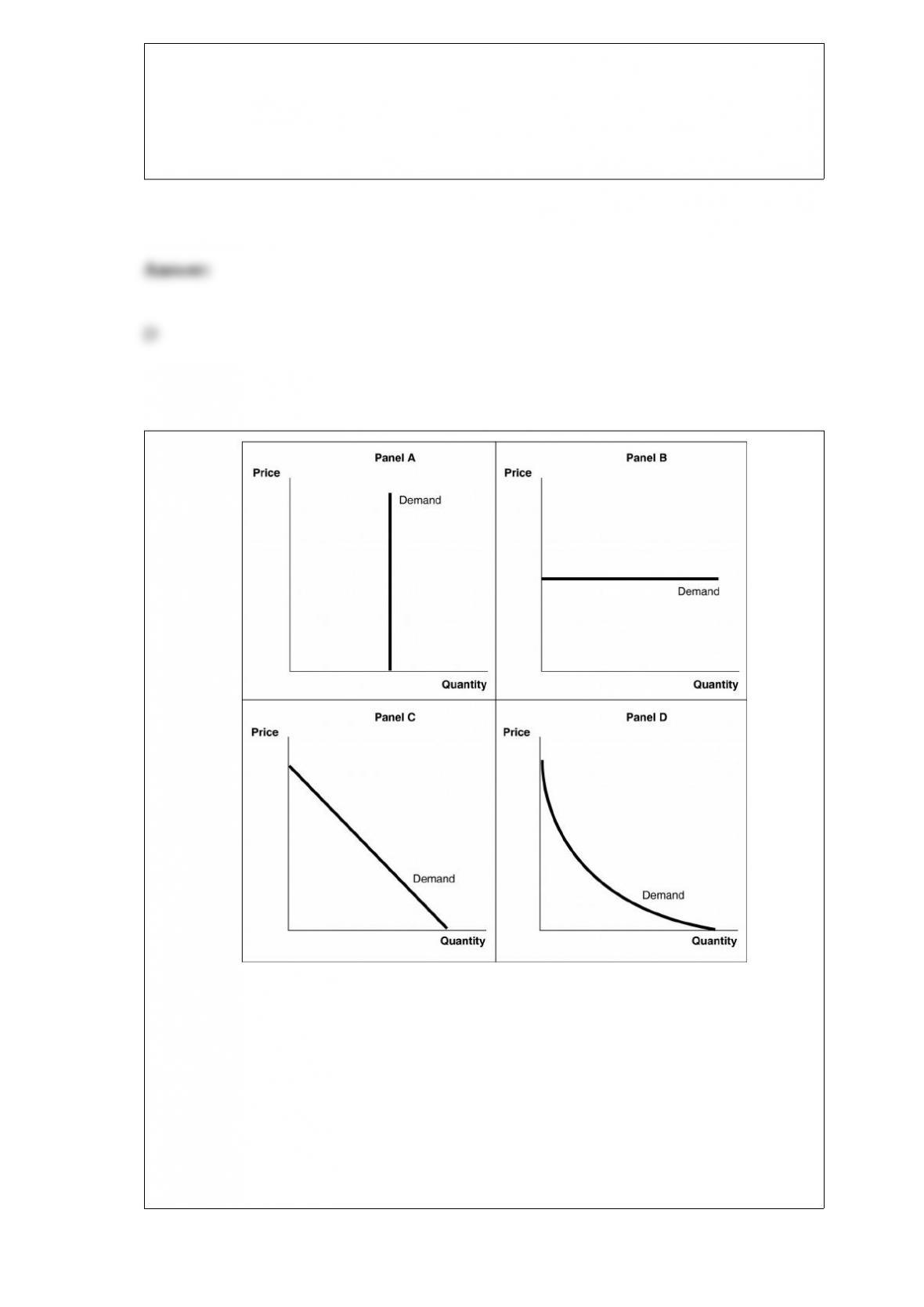
Figure 6-1
The demand curve on which elasticity changes at every point is given in
A) Panel A.
B) Panel B.
C) Panel C.
D) none of the above graphs.
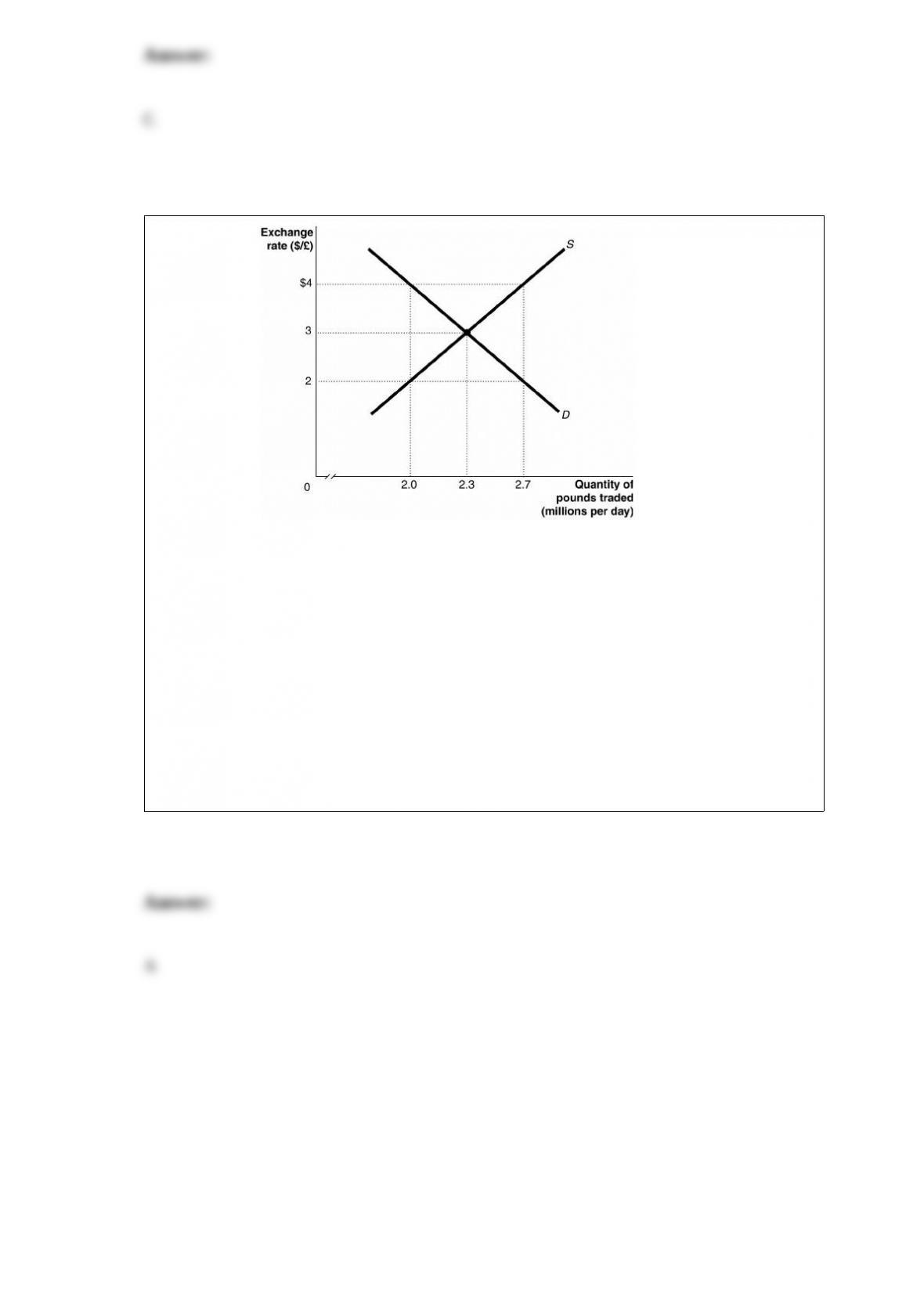
Figure 19-10
Under the Bretton Woods System of exchange rates, if the par exchange rate was $2 per
pound in the figure above, and equilibrium persisted at $3, then this was evidence of
________ and the IMF would allow a ________ in the exchange rate.
A) fundamental disequilibrium; revaluation
B) fundamental disequilibrium; devaluation
C) fundamental overvaluation; devaluation
D) fundamental overvaluation; revaluation